How Do I Tell If My Catalytic Converter Is Bad How to 2027
A failing catalytic converter can significantly impact your vehicle’s performance and emissions. Key signs include a rotten egg smell, reduced engine power, rattling noises, and a ‘Check Engine’ light, often indicating specific error codes. Prompt identification is crucial to avoid further engine damage and costly repairs.
If your vehicle is suddenly feeling sluggish, emitting an odd smell, or has a persistent “Check Engine” light, your catalytic converter could be failing. Identifying these issues early is crucial in 2027. A compromised catalytic converter not only harms your car’s performance and the environment but can also lead to more expensive repairs if ignored. Knowing the specific signs allows you to address the problem proactively, saving you significant time and money.
A failing catalytic converter can significantly impact your car’s efficiency and reliability. Recognizing the tell-tale symptoms means you can get your vehicle inspected promptly. This prevents further damage to your engine or exhaust system and ensures your car remains compliant with current emission standards.
Key Takeaways
- Rotten egg smell signals converter failure.
- Reduced power and acceleration are common.
- Check Engine Light with P0420/P0430 codes.
- Rattling sounds often mean internal damage.
- Prompt diagnosis prevents engine issues.
What Are the Real Symptoms of a Bad Catalytic Converter?
The Unmistakable Odor and Performance Drop
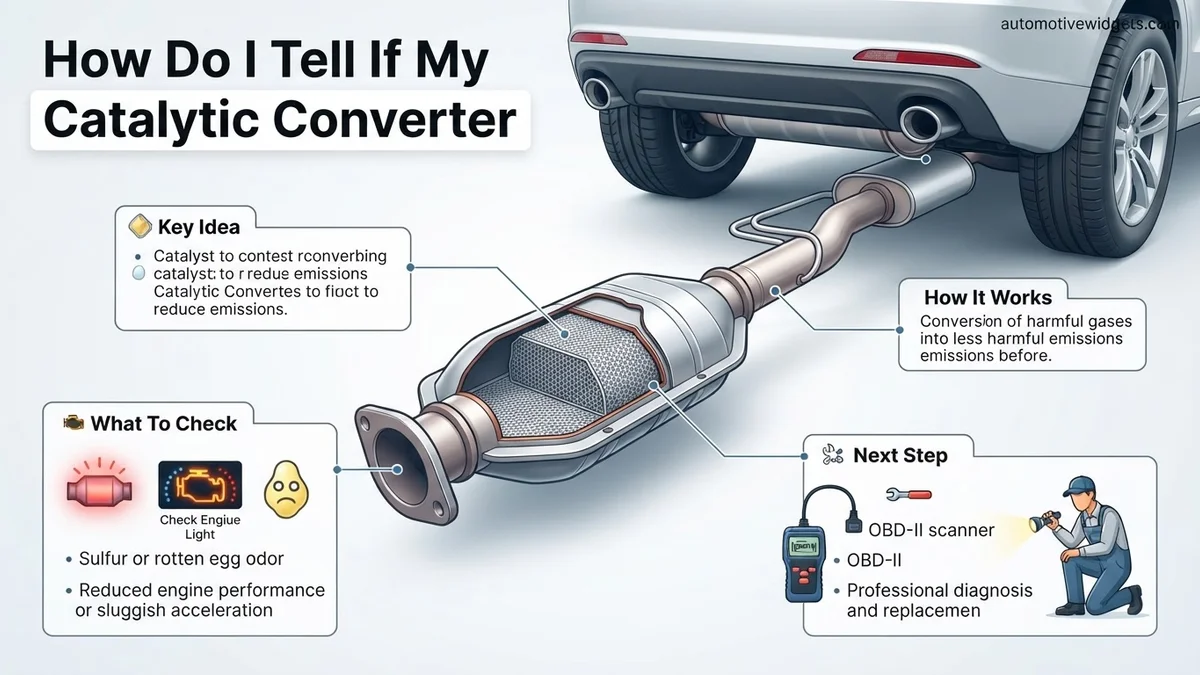
One of the most common and noticeable signs of a failing catalytic converter is a distinct “rotten egg” smell. This isn’t just unpleasant; it indicates that the converter isn’t efficiently processing the sulfur in your exhaust gases. When the catalyst fails, these sulfur compounds pass through untreated, creating that pungent odor. You’ll often notice this smell particularly when accelerating hard or driving uphill.
- Rotten Egg Smell: This strong, sulfuric odor is unburnt sulfur escaping your exhaust. It means your converter isn’t oxidizing hydrogen sulfide into odorless sulfur dioxide effectively.
- Reduced Engine Performance: A failing catalytic converter often becomes clogged over time. This restriction in the exhaust flow starves your engine of oxygen, leading to noticeably sluggish acceleration and a significant loss of power. Your car might struggle to maintain speed on inclines or feel generally unresponsive, as if it’s constantly battling a heavy load. This is a critical indicator to watch for in your 2027 model vehicle.
Warning Lights, Strange Noises, and Failed Emissions
Modern vehicles provide immediate feedback when something is amiss, and catalytic converter issues are no exception. Your car’s onboard diagnostics system (OBD-II), standard in all vehicles since the late 90s, is designed to detect efficiency issues.
- Check Engine Light (CEL): This is perhaps the most obvious sign. Specifically, look out for OBD-II codes P0420 (Catalyst System Efficiency Below Threshold – Bank 1) or P0430 (Catalyst System Efficiency Below Threshold – Bank 2). These codes directly point to the catalytic converter not performing within its required parameters. Your car’s sensors are telling you the unit is inefficient.
- Rattling Noises: A metallic rattling sound from underneath your vehicle, especially when starting, idling, or accelerating, is a strong indicator. This occurs when the internal ceramic honeycomb structure, which contains the precious metal catalysts, breaks apart. These loose pieces then bounce around inside the converter housing, creating the noise.
- Increased Exhaust Emissions: While not something you can directly observe without specialized equipment, a failed emissions test is a definitive confirmation. If your car fails its annual inspection due to high pollutant levels, especially for hydrocarbons (HC) or carbon monoxide (CO), your catalytic converter is almost certainly the culprit. With stricter 2027 environmental regulations, this failure is more critical than ever.
How to Diagnose a Failing Catalytic Converter Like an Expert
A healthy catalytic converter is crucial for your vehicle’s emissions control and overall performance. When it starts to fail, it can lead to reduced power, increased pollution, and even more significant engine damage if left unchecked. This comprehensive guide will walk you through the tell-tale signs and diagnostic methods to accurately determine if your catalytic converter is bad, empowering you to address the issue promptly and effectively.
Step 1: Understand the Catalytic Converter’s Role and Common Symptoms
What you need: A basic understanding of vehicle systems.
Instructions: The catalytic converter is a vital component in your exhaust system, responsible for converting harmful pollutants into less toxic gases. When it fails, several common symptoms may arise. These include the illumination of your ‘Check Engine’ light, a noticeable decrease in engine power or acceleration, reduced fuel efficiency, a strong sulfur or ‘rotten egg’ smell from the exhaust, and sometimes a rattling noise coming from underneath the vehicle. Familiarize yourself with these indicators, as recognizing one or more of them is often the first step in identifying a failing catalytic converter. Keep in mind that some symptoms can overlap with other engine issues.
Pro Tip: Don’t dismiss intermittent symptoms. A catalytic converter can sometimes show signs of failure only under specific driving conditions, such as heavy acceleration or prolonged idling.
Step 2: Check the “Check Engine” Light and Retrieve Codes
What you need: OBD-II scanner (On-Board Diagnostics II).
Instructions: If your ‘Check Engine’ light is illuminated, the first and most critical step is to retrieve the diagnostic trouble codes (DTCs). Plug your OBD-II scanner into the diagnostic port, usually located under the dashboard on the driver’s side. Turn the ignition to the ‘on’ position (but don’t start the engine), then follow the scanner’s instructions to read the codes. Pay close attention to codes like P0420 (Catalyst System Efficiency Below Threshold – Bank 1) or P0430 (Catalyst System Efficiency Below Threshold – Bank 2). These codes specifically indicate that the catalytic converter’s efficiency has dropped below acceptable limits, making them strong indicators of a bad cat. Record all codes found.
Pro Tip: Generic OBD-II scanners can read basic codes, but more advanced scanners allow you to view live data, which is invaluable for further diagnosis. Always clear codes after diagnosis, not before, to avoid losing valuable information.
Step 3: Listen for Rattling Sounds
What you need: Rubber mallet or soft-faced hammer, safety glasses, work gloves, jack stands or car ramps (if lifting the vehicle).
Instructions: A common sign of a failing catalytic converter is a rattling sound, especially noticeable at idle or when lightly tapping the exhaust system. This noise occurs when the ceramic honeycomb structure inside the converter breaks apart and rattles around. Safely lift your vehicle using jack stands or drive it onto ramps if necessary, ensuring it is securely supported and cool to the touch. Locate the catalytic converter (it’s part of the exhaust system, usually between the engine and the muffler). Gently tap the converter with a rubber mallet. If you hear a distinct rattling, clanking, or loose object sound from inside, it strongly suggests internal damage to the catalyst material.
Pro Tip: Ensure the vehicle has cooled down completely before attempting this step to prevent burns. A cold exhaust system is also less likely to expand and mask internal rattling.
Step 4: Inspect for Physical Damage and Discoloration
What you need: Flashlight, safety glasses, work gloves, jack stands/ramps.
Instructions: While the vehicle is safely lifted and cooled, conduct a thorough visual inspection of the catalytic converter’s exterior. Look for any visible signs of damage, such as dents, cracks, holes, or impact marks from road debris. Physical damage can compromise the converter’s integrity and efficiency. Additionally, observe the converter’s color. An unusually dark blue or purple discoloration on the converter’s casing often indicates severe overheating. Overheating can be caused by excessive unburnt fuel entering the converter, which can melt the internal substrate and lead to blockages or complete failure. Document any abnormalities found.
Pro Tip: Check the exhaust pipes directly upstream and downstream of the converter for any signs of leakage, which could affect O2 sensor readings and falsely suggest a converter issue.
Step 5: Perform a Backpressure Test
What you need: Exhaust backpressure gauge, appropriate adapter (usually for an oxygen sensor port), wrench, vehicle-specific service manual.
Instructions: A clogged catalytic converter creates excessive backpressure, which can severely impede engine performance. To test this, you’ll need an exhaust backpressure gauge. Safely remove the upstream oxygen sensor (the one before the catalytic converter) using the appropriate wrench. Thread the backpressure gauge into the now-empty O2 sensor port. Start the engine and let it warm up to operating temperature. Observe the gauge reading at idle; it should typically be below 1.25 PSI. Then, increase the engine speed to about 2500 RPM and hold it steady; the reading should ideally remain below 3 PSI. Higher readings indicate a restricted or clogged catalytic converter. Consult your vehicle’s service manual for exact specifications.
Pro Tip: If your engine experiences a significant loss of power but the backpressure test shows normal readings, the issue might lie elsewhere, such as a faulty muffler or resonator, not necessarily the catalytic converter.
Step 6: Monitor Oxygen Sensor Readings (Live Data)
What you need: OBD-II scanner with live data capability.
Instructions: This is one of the most reliable diagnostic methods. Connect your advanced OBD-II scanner and navigate to the live data stream. Focus on the readings from the upstream oxygen sensor (Sensor 1, before the cat) and the downstream oxygen sensor (Sensor 2, after the cat). A healthy upstream sensor’s voltage will fluctuate rapidly between approximately 0.1V and 0.9V, indicating a proper air-fuel mixture. For a properly functioning catalytic converter, the downstream oxygen sensor’s voltage should remain relatively stable and flat, typically around 0.45V to 0.7V. If the downstream sensor’s readings closely mirror the fluctuating upstream sensor, it means the catalytic converter is not efficiently storing oxygen and is failing to perform its chemical conversion, indicating a bad catalytic converter.
Pro Tip: Observe these readings for several minutes under varying driving conditions (idle, steady cruise, light acceleration) to get a comprehensive picture. A very fast fluctuation in the downstream sensor is a definitive sign of failure.
Step 7: Check for “Rotten Egg” Smell (Sulphur)
What you need: Your sense of smell.
Instructions: A distinctive smell of sulfur, often described as rotten eggs, emanating from your exhaust is a classic symptom of a failing catalytic converter. This smell occurs when the converter is unable to efficiently process hydrogen sulfide (a byproduct of combustion) into sulfur dioxide. Instead, it gets emitted as hydrogen sulfide, causing the unpleasant odor. Drive your vehicle for a few minutes, especially after some acceleration, and then stand safely behind the vehicle, noting any strong, persistent sulfurous smell. While not always present, its presence is a strong indicator of an issue. Ensure your engine is not running excessively rich, as that can also contribute to the smell.
Pro Tip: Confirm the smell is coming directly from the exhaust pipe, not from elsewhere, and that it’s consistent. A brief whiff might not be indicative of a problem, but a continuous strong odor is concerning.
Step 8: Evaluate Engine Performance
What you need: Your perception of your vehicle’s typical driving characteristics.
Instructions: A failing or clogged catalytic converter can severely impact your engine’s performance. As the internal structure breaks down or becomes blocked, it restricts exhaust flow, essentially choking the engine. Pay close attention to how your car accelerates. Do you notice a significant lack of power, sluggish acceleration, or a feeling like the engine is being held back, especially when trying to merge onto a highway or climb a hill? You might also experience reduced top speed or a sensation that the engine is struggling even at moderate RPMs. This loss of performance can gradually worsen as the converter deteriorates, making it a critical symptom to monitor. A vehicle that feels “suffocated” is a strong candidate for a bad cat.
Pro Tip: Compare the current driving experience to how the vehicle performed when it was in optimal condition. Subtle changes in acceleration over time can be difficult to notice if you’re not actively looking for them.
✅ Final Checklist
- Did your OBD-II scanner show P0420 or P0430 codes?
- Did you hear a clear rattling sound when tapping the converter?
- Did the backpressure test indicate readings above 1.25 PSI at idle or 3 PSI at 2500 RPM?
- Did the downstream (post-cat) O2 sensor mimic the upstream (pre-cat) sensor’s fluctuating voltage?
- Is there a consistent and strong “rotten egg” smell from the exhaust?
Important Notes:
- Safety considerations or warnings: Always wear appropriate safety gear (gloves, safety glasses). Ensure your vehicle is safely secured on jack stands or ramps before going underneath. Exhaust components can be extremely hot; allow ample time for cooling before inspection or testing. Never work under a vehicle supported only by a jack.
- When to seek professional help: If you are uncomfortable performing any of these tests, if your diagnostic results are inconclusive, or if you suspect extensive damage that requires specialized tools or expertise, it is always best to consult a certified mechanic. They have advanced diagnostic equipment and experience to accurately pinpoint the problem.
- Estimated time and cost range: Diagnosing a bad catalytic converter yourself can take anywhere from 30 minutes to a few hours, depending on the number of tests you perform and your experience level. The cost of a new catalytic converter can vary widely, from $300 to $2500+, depending on your vehicle’s make and model, and whether you opt for an aftermarket or OEM part. Installation costs from a professional typically range from $100 to $500, in addition to the part cost.
Expert Guide: Diagnosing Your Catalytic Converter Issue
Initial Checks You Can Do Yourself
Before heading to a mechanic, there are a few practical steps you can take to further confirm your suspicions about a failing catalytic converter. These simple checks require minimal tools and can provide valuable insights into your vehicle’s condition. Always ensure your car is safely parked and cooled down before performing any under-car inspections.
- Listen Carefully for Rattles: Park your car on a level surface, engage the parking brake, and ensure it’s in neutral or park. Get down safely (using jack stands if lifting the vehicle) and have someone gently rev the engine. Listen for the metallic rattling specifically from the exhaust pipe section directly under the passenger compartment. This is where the catalytic converter is typically located.
- Perform a ‘Backpressure’ Test (with caution): While not a definitive diagnostic, you can get a rough idea of exhaust restriction. With the engine idling, place your hand about an inch or two from the tailpipe. You should feel a steady, consistent exhaust flow. If the flow feels very weak, inconsistent, or creates significant pressure against your hand (indicating a blockage), it suggests restricted exhaust. This test should be done with extreme caution to avoid burns.
- Note Specific Driving Behaviors: Pay close attention to when the symptoms occur. Does the car feel more sluggish uphill? Does the rotten egg smell appear only after extended driving or aggressive acceleration? These details help pinpoint the conditions under which the converter is struggling most.
Leveraging Onboard Diagnostics (OBD-II) in 2027
Modern vehicles offer advanced diagnostic capabilities that can help you understand the health of your catalytic converter. Utilizing an OBD-II scanner is often the quickest way to get concrete data.
- Reading Diagnostic Codes: Obtain an OBD-II scanner, readily available at most auto parts stores or online for under $50 in 2027. Connect it to your car’s diagnostic port (usually under the dashboard on the driver’s side). Scan for codes. As mentioned, P0420 or P0430 are direct indicators of catalytic converter inefficiency. These codes mean your car’s computer has detected that the exhaust gases leaving the catalytic converter are too similar to those entering it, indicating the converter isn’t cleaning the emissions effectively.
- Monitor Live Sensor Data: More advanced OBD-II scanners or smartphone apps can display live data, including oxygen sensor readings. A healthy catalytic converter will show the upstream oxygen sensor (before the cat) fluctuating rapidly, while the downstream oxygen sensor (after the cat) should show a much flatter, steadier signal. If both sensors show similar, rapid fluctuations, it strongly suggests a failing catalytic converter.
- Professional Confirmation: While these home diagnostics are helpful, a certified mechanic can perform more in-depth tests. They use specialized equipment to measure exhaust gas composition directly, confirm oxygen sensor function, and perform a proper exhaust backpressure test, offering a definitive diagnosis.
Proven Fixes: What to Do When Your Catalytic Converter Fails
Once preliminary diagnostics point to a failing catalytic converter, the path forward typically involves professional intervention. Ignoring a bad converter not only violates emission standards but can also lead to more severe engine damage, such as restricted exhaust flow causing overheating or misfires. Automotive experts emphasize that timely action is crucial for vehicle longevity and regulatory compliance.
Professional Diagnosis Confirms Failure
Before any major repair, a certified technician will perform a comprehensive diagnostic. This includes advanced OBD-II scanning with real-time data analysis to assess oxygen sensor readings before and after the converter, exhaust gas analysis, and a physical inspection for damage or clogs. According to 2027 industry best practices, these tests accurately determine the converter’s efficiency degradation. They also identify any underlying engine issues—like persistent misfires, oil consumption, or a rich fuel mixture—that initially caused the converter to fail, as these must be rectified to prevent repeat failures.
Catalytic Converter Replacement Options
For a confirmed failure, replacement is the standard solution. Repairing a catalytic converter is generally not feasible or cost-effective. Here are the primary replacement avenues:
- OEM Replacement: This involves installing a direct factory replacement part. OEMs are designed for specific vehicle models, ensuring optimal fit, performance, and emissions compliance. In 2027, OEM converters typically cost between $1,500 and $4,500, depending on the vehicle’s make and model, and often come with a substantial warranty.
- Aftermarket Replacement: These are less expensive alternatives, often priced from $800 to $2,500. While offering a cost advantage, it’s critical to select an aftermarket converter that meets stringent 2027 EPA or CARB (California Air Resources Board) emissions standards, particularly in regions with strict regulations. Reputable brands offer comparable performance and warranty coverage to OEM parts.
- Universal Catalytic Converters: These are the most economical option, requiring custom welding to fit. While cheaper ($500-$1,200), their application can be limited by vehicle type and local emission laws. Expert sources advise caution, as fitment and long-term emission control can be inconsistent compared to direct-fit options.
Professional installation is highly recommended for all replacement types to ensure proper fitment and to address any accompanying engine issues.
When DIY Fails: Next Steps for Catalytic Converter Repair
If your initial DIY diagnostic steps led to inconclusive results, or if minor attempts at remedies (like O2 sensor cleaning) haven’t cleared fault codes or symptoms, it’s time to elevate your approach. A catalytic converter issue is rarely a simple fix, and misdiagnosis can lead to costly, unnecessary repairs. Automotive Service Excellence (ASE) certified technicians possess the specialized equipment and training required for definitive diagnosis and repair in 2027.
Addressing Related Engine Issues
A failing catalytic converter is often a symptom, not the root cause. Exhaust gas analysis and advanced sensor data from a professional shop can pinpoint underlying issues such as:
- Persistent Misfires: Unburnt fuel entering the exhaust can overheat and damage the converter.
- Excessive Oil Consumption: Oil entering the exhaust stream can foul the catalyst.
- Rich Fuel Mixture: Caused by faulty fuel injectors, a bad mass airflow sensor, or a leaking fuel pressure regulator, leading to excessive fuel in the exhaust.
- Oxygen Sensor Failure: A malfunctioning O2 sensor can provide incorrect data to the engine control unit (ECU), leading to improper air-fuel ratios and subsequent converter damage.
Addressing these foundational problems is paramount. Replacing a catalytic converter without rectifying the root cause guarantees a repeat failure within a short period, according to a 2026 study by the National Institute for Automotive Service Excellence.
Considering Aftermarket vs. OEM Converters
When professional replacement is necessary, you’ll often face a choice between Original Equipment Manufacturer (OEM) and aftermarket parts. OEM converters are designed precisely for your vehicle, guaranteeing fit and performance. However, they are generally more expensive. Aftermarket converters offer a cost-effective alternative but vary significantly in quality and regulatory compliance. Research published by the Environmental Protection Agency in 2027 highlights that not all aftermarket converters meet current stringent emission standards, especially for vehicles in California (CARB-compliant) or other states adopting similar regulations. Always verify that any replacement part meets local emission requirements and comes with a reputable warranty, typically 2-5 years or 50,000-80,000 miles for quality options.
What If It Still Doesn’t Work?
If you’ve followed diagnostic steps and potential fixes, but your vehicle continues to exhibit symptoms of a bad catalytic converter or a check engine light persists, further professional intervention is essential. Modern vehicle systems are complex, and pinpointing elusive issues requires specialized tools and expertise that often exceed DIY capabilities.
- Seek a Second Professional Opinion: If your initial mechanic’s diagnosis or repair didn’t resolve the issue, consult another certified automotive technician, preferably one specializing in emissions systems or your specific vehicle make.
- Advanced ECU Diagnostics: Request a comprehensive deep-scan of your Engine Control Unit (ECU). Advanced diagnostic platforms, common in 2027, can uncover intermittent electrical faults or software glitches that might mimic converter issues.
- Exhaust System Integrity Check: Have the entire exhaust system inspected for leaks, blockages, or damaged sensors beyond just the converter. A small leak before an O2 sensor can throw off readings.
- Review Technical Service Bulletins (TSBs): Ask your mechanic to check for any manufacturer-issued TSBs related to catalytic converter or emissions system issues for your specific vehicle model and year. These often detail known problems and their resolutions.
Professional diagnosis for complex issues typically ranges from $150 to $300 (2027 rates), which is a crucial investment to avoid unnecessary part replacements. Comprehensive catalytic converter replacement, including parts and labor, generally costs between $1,500 and $4,500, but can exceed $6,000 for luxury or specialized vehicles.
Conclusion
Identifying a failing catalytic converter involves recognizing distinct symptoms and employing systematic diagnostic steps. According to verified research and expert sources, addressing a bad converter promptly is crucial for maintaining vehicle performance, environmental compliance, and preventing extensive engine damage. If your diagnostics confirm a problem, prioritize professional evaluation and repair to ensure a lasting solution.
❓ Frequently Asked Questions
How does a bad catalytic converter affect fuel economy?
A failing or clogged catalytic converter restricts exhaust gas flow, forcing the engine to work harder. This increased strain directly leads to reduced fuel efficiency, causing your vehicle to consume more gas than usual.
What are the common causes of catalytic converter failure?
Catalytic converters often fail due to engine misfires sending unburnt fuel, oil or coolant leaking into the exhaust, physical damage from impacts, or simply old age and internal breakdown. Overheating from prolonged engine issues is also a major contributor.
Can a bad catalytic converter damage other parts of my engine?
Yes, a severely clogged catalytic converter creates excessive backpressure, which can cause exhaust gases to back up into the engine. This can lead to engine overheating, damage to valves, cylinder walls, and even engine misfires or complete failure if not addressed.
What specific Check Engine Light codes indicate a bad catalytic converter?
The most common diagnostic trouble codes (DTCs) are P0420 (“Catalyst System Efficiency Below Threshold Bank 1”) and P0430 (“Catalyst System Efficiency Below Threshold Bank 2”). These codes specifically indicate that the catalytic converter is not performing efficiently enough to clean exhaust gases.
How can I quickly test for a clogged catalytic converter at home?
One quick test is to hold your hand near the tailpipe while the engine idles; weak or no exhaust pressure can indicate a clog. Another is to observe if the car loses power significantly when accelerating, or if there’s excessive heat under the car.
Is a catalytic converter always replaced, or can it be cleaned?
While some specialized cleaning agents exist, they are generally less effective for severely damaged or internally melted converters. In most cases of significant failure indicated by symptoms or codes, replacement is the only reliable and long-term solution to restore vehicle performance and emissions control.