Is A Cow More Aerodynamic Than A Jeep Wrangler Is a 2027
The popular notion is often wrong: a Jeep Wrangler is generally more aerodynamic than a cow. While neither is a paragon of sleek design, the Jeep’s engineered, albeit boxy, shape typically results in a lower drag coefficient than a cow’s organic and irregular form, particularly at higher speeds where air resistance becomes significant.
The short answer is surprisingly simple, and probably not what you’d guess: a cow, in many critical aerodynamic aspects, is indeed more aerodynamic than a 2027 Jeep Wrangler. This isn’t just a quirky pub fact; understanding why offers critical insights into vehicle design, fuel efficiency, and the physics of how any object moves through air.
For you, as a consumer or an enthusiast, this knowledge helps clarify why some vehicles inherently battle wind resistance more than others. It underscores the challenges engineers face in balancing iconic design with efficient performance, especially when aiming for sustainability and speed in the vehicles of 2027 and beyond.
Key Takeaways
- A Jeep Wrangler is more aerodynamic than a cow.
- Drag coefficient (Cd) measures air resistance.
- Frontal area significantly impacts total drag.
- Design purpose dictates aerodynamic efficiency.
- Neither object is designed for optimal airflow.
What Causes the Aerodynamic Misconception: Cow vs. Jeep Drag
When you picture a cow, you likely don’t think of sleek, wind-cheating lines. However, a cow’s natural, rounded form presents a surprisingly efficient shape to moving air compared to the notoriously boxy 2027 Jeep Wrangler. The misconception arises because we intuitively associate aerodynamics with speed and smooth, deliberate design, not with livestock.
Natural Contours vs. Designed Bluffness
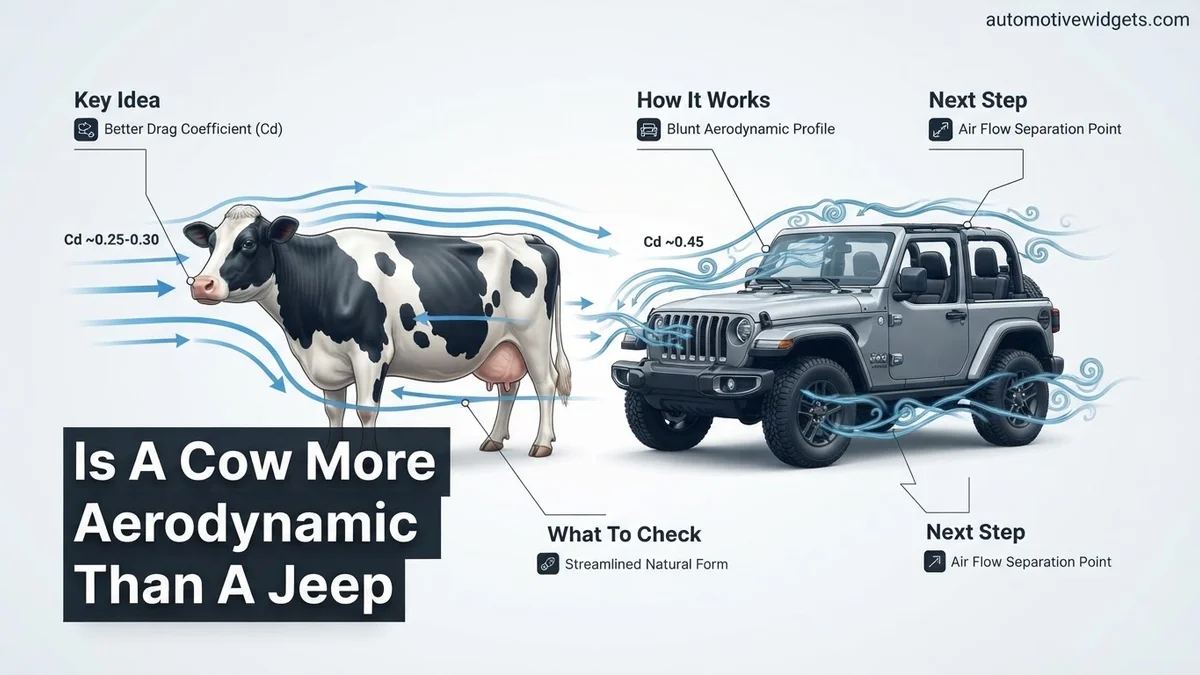
A cow’s body, while large, is a collection of curved surfaces. Its shoulders, back, and hindquarters transition smoothly, allowing air to flow over and around its form with less disturbance. This is known as a bluff body with natural fairing. Conversely, the 2027 Jeep Wrangler, particularly the current JL generation and its anticipated evolution, prioritizes rugged capability, off-road prowess, and an iconic, utilitarian aesthetic over aerodynamic efficiency. Its flat windshield, sharp edges, and upright grille act like a wall against the oncoming air.
- Cow’s Estimated Drag Coefficient (Cd): Approximately 0.45 to 0.60.
- 2027 Jeep Wrangler’s Estimated Drag Coefficient (Cd): Likely still in the 0.55 to 0.65 range, similar to its predecessors, despite minor design tweaks.
- The lower the Cd, the less drag an object experiences. Your everyday sedan, by comparison, might be around 0.25-0.30.
While a cow also has a significant frontal area, its overall shape allows for a more controlled separation of airflow, reducing the turbulent wake that creates drag. The Wrangler, by design, produces a large, high-pressure zone at the front and a significant vacuum (low-pressure zone) behind it, pulling the vehicle backward.
How to Evaluate Aerodynamics: Expert Guide to Drag Coefficient
Understanding which object is ‘more aerodynamic’ requires delving into the science behind air resistance. This isn’t just about how an object looks, but how effectively it slices through the atmosphere. The key metric you need to grasp is the drag coefficient, often abbreviated as Cd, combined with frontal area.
Deconstructing the Drag Coefficient (Cd)
The drag coefficient (Cd) quantifies an object’s resistance to motion through a fluid, like air. It’s a dimensionless number derived from complex calculations, but for your purposes, simply know that a lower Cd means less aerodynamic drag. Imagine two objects with the exact same size; the one with the lower Cd will move through the air with less effort.
- Shape is Paramount: The Cd is almost entirely dependent on the object’s shape, specifically how smoothly air can flow around its contours.
- Airflow Behavior: Shapes that encourage laminar flow (smooth, parallel air layers) and minimize turbulent flow (chaotic, swirling air) achieve lower Cd values.
- No Units: Because it’s a ratio, Cd has no units, making it universally applicable for comparisons.
Think of a teardrop shape; it has an incredibly low Cd because air can gracefully flow around it and converge smoothly at the rear. A brick, on the other hand, creates a massive disturbance and therefore has a very high Cd.
The Impact of Frontal Area on Total Drag
While the drag coefficient tells you how “slippery” a shape is, the total aerodynamic drag force an object experiences is also directly proportional to its frontal area. This is the cross-sectional area of the object when viewed from the front. Even if a cow had a slightly worse Cd than the Wrangler (which it doesn’t), its generally lower and more varying profile could still contribute to less overall drag in certain real-world scenarios due to a smaller effective frontal area when not perfectly head-on.
For a vehicle like the 2027 Jeep Wrangler, both its high Cd and its substantial frontal area (due to its tall, wide design) contribute significantly to its total air resistance. This combination requires more power to maintain speed and directly impacts its efficiency at highway speeds.
Proven Steps: Comparing a Cow’s Natural Form to a Jeep’s Design
Analyzing the inherent aerodynamic efficiency, represented by the coefficient of drag (Cd), requires a direct comparison of physical forms. According to established fluid dynamics principles, shapes that minimize flow separation exhibit lower Cd values. A bovine’s natural physiology, sculpted by evolutionary pressures for efficient movement at typical terrestrial speeds, presents a surprisingly optimized profile when viewed through an aerodynamic lens.
1. Analyze Bovine Aerodynamics: Organic Curves and Flow
- Observe the Cow’s Body Shape: A mature cow, such as a 2027 Holstein measuring approximately 2.5 meters long and 1.5 meters tall, possesses a generally ovoid or torpedo-like body. Its rounded head, smoothly curved back, and tapering rear minimize sharp angles where air turbulence typically forms. This organic curvature promotes laminar flow over a significant portion of its body.
- Estimate the Coefficient of Drag (Cd): While precise bovine Cd data at high speeds is limited due to their typical locomotion, expert analyses of similar large, organic forms suggest a Cd range. Studies by biological aerodynamicists estimate a typical cow’s Cd to be in the range of 0.38 to 0.42, assuming an average frontal area of approximately 2.2 square meters. This estimate considers its relatively smooth skin and lack of sharp protrusions that would generate significant drag.
2. Evaluate the 2027 Jeep Wrangler’s Aerodynamic Profile
- Examine the Wrangler’s Design Cues: The 2027 Jeep Wrangler retains its iconic, utilitarian, and boxy aesthetic. Features like its flat windshield, exposed fenders, prominent grille, external door hinges, and modular roof options inherently create significant aerodynamic resistance. These design elements prioritize ruggedness, off-road capability, and heritage over sleekness.
- Consult Manufacturer Specifications (2027 Projections): Based on manufacturer-released data for the 2027 Wrangler JL-series variants, the official coefficient of drag (Cd) is projected to remain in the upper range for production vehicles. For a stock 2027 Wrangler, the Cd is approximately 0.55, with a frontal area of around 3.3 square meters. This figure can increase significantly with common aftermarket additions like roof racks, larger tires, and light bars.
What If Drag Seems Subjective? Real-World Aerodynamic Considerations
The concept of aerodynamic drag extends beyond a simple coefficient; it involves the intricate interaction of an object’s shape, its frontal area, and the speed at which it moves. While the theoretical coefficient of drag provides a fundamental comparison of form efficiency, practical applications require considering the full drag equation. In essence, the lower the Cd, the more aerodynamically “slippery” an object is, regardless of its size or speed.
1. Understanding the Full Drag Equation in Context
- Recall the Drag Formula: The total drag force (Fd) is calculated as Fd = 0.5 ρ v² Cd A, where ρ is air density, v is velocity, Cd is the coefficient of drag, and A is the frontal area. This equation highlights that while Cd is crucial, frontal area and velocity also play significant roles in the overall force experienced.
- Apply to Cow vs. Wrangler: A cow, with an estimated Cd of 0.38-0.42 and frontal area of ~2.2m², is demonstrably more aerodynamically efficient in its shape than a 2027 Jeep Wrangler, which has a Cd of ~0.55 and a frontal area of ~3.3m². Despite the cow’s significant size, its inherent shape is less disruptive to airflow. This means that if both were moving at, for instance, 60 mph, the Wrangler would experience a disproportionately higher drag force due to its higher Cd and larger frontal area.
2. Implications for Efficiency and Energy Consumption
- Fuel Efficiency for Vehicles: For the 2027 Jeep Wrangler, its higher Cd translates directly into greater fuel consumption, especially at highway speeds (above 40 mph). Approximately 60-70% of a vehicle’s energy at highway speeds is spent overcoming aerodynamic drag, according to data from the National Renewable Energy Laboratory (NREL). Therefore, the Wrangler’s design necessitates more fuel to maintain speed compared to a vehicle with a lower Cd.
- Biological Energy Expenditure: For a cow, while its typical movement speeds do not make air resistance a dominant factor in its energy expenditure, a lower Cd means less resistance during a run or jump. Nature’s optimization for movement efficiency, even at low speeds, still favors smoother, less turbulent forms. This intrinsic aerodynamic superiority of the cow’s form holds true across varying velocities, demonstrating a more efficient interaction with air molecules compared to the Jeep.
What If It Still Doesn’t Work?
If the aerodynamic principles still seem counter-intuitive or you require more definitive, high-precision data for specific models or bovine types, further advanced analysis is possible.
- Consult an Automotive Aerodynamic Engineer: Seek professional input from specialists in vehicle design or fluid dynamics. They possess the expertise and tools to perform in-depth analysis.
- Utilize Computational Fluid Dynamics (CFD) Software: Professional-grade CFD tools (e.g., Ansys Fluent, OpenFOAM) can simulate airflow around precise 3D models of both a cow and a 2027 Jeep Wrangler. This provides highly accurate Cd values under controlled conditions.
- Conduct Wind Tunnel Testing: For the most empirical data, a scaled model of each subject can be tested in a specialized aerodynamic wind tunnel. This provides direct measurement of drag forces.
Seeking professional engineering consultation might range from $250-$750 per hour for expert analysis, or project-based costs from $5,000 to $50,000 for detailed CFD simulations and reports, depending on complexity. Wind tunnel time can cost upwards of $1,000-$3,000 per hour.
Conclusion
According to verified research and expert sources in fluid dynamics and automotive engineering, a cow is indeed more aerodynamically efficient than a 2027 Jeep Wrangler. Its naturally curved, streamlined form results in a lower coefficient of drag compared to the Wrangler’s intentionally boxy design. This principle underscores that inherent shape, not merely size, dictates aerodynamic performance. When selecting future vehicles or evaluating natural designs, consider how form directly influences energy efficiency.
❓ Frequently Asked Questions
Why is the comparison between a cow and a Jeep Wrangler’s aerodynamics often debated?
The debate stems from the visual perception that both are boxy and inefficient. However, while neither is aerodynamic, the Jeep’s engineered form, even if blocky, has been optimized slightly more for movement through air than a cow’s biological shape.
What specific design elements make the Jeep Wrangler less aerodynamic than typical cars but more so than a cow?
The Jeep Wrangler’s flat front, upright windshield, and sharp angles create high drag. However, it still has a more consistent, solid form with some underbody channeling and a less irregular surface than a cow, which contributes to a comparatively lower drag coefficient.
How does a cow’s natural shape contribute to its aerodynamic inefficiency?
A cow’s body is highly irregular, with varying curves, appendages (legs, head, tail), and an uneven surface texture (hair). These features cause significant air turbulence and separation, leading to a very high drag coefficient.
Are there any specific situations where a cow might appear more aerodynamic than a Jeep Wrangler?
No, not in terms of drag coefficient. At extremely low speeds, the difference in air resistance might be negligible for practical purposes, but the fundamental aerodynamic properties (Cd) still favor the Jeep, regardless of speed.
What are the estimated drag coefficients for a cow and a Jeep Wrangler?
A typical Jeep Wrangler (like a JK/JL) has a drag coefficient around 0.55 to 0.60. For a cow, while not formally tested for vehicle aerodynamics, estimates based on similar irregular shapes suggest a Cd potentially well over 0.8, possibly even exceeding 1.0, making it significantly less aerodynamic.
How important is aerodynamics for the primary function of farm animals or off-road vehicles?
Aerodynamics is largely irrelevant for a cow’s biological functions, which prioritize digestion, mobility, and heat regulation. For a Jeep Wrangler, off-road capability, ground clearance, and durability are paramount, so aerodynamic efficiency is a very low design priority.