Can You Use Brake Fluid for Transmission Fluid ? 2026
No, you absolutely cannot use brake fluid for transmission fluid. These fluids have fundamentally different chemical compositions, viscosities, and functions, leading to severe damage if mixed. Using brake fluid in your transmission will cause immediate and costly system failure, requiring extensive repairs in 2026.
No, you absolutely cannot use brake fluid for transmission fluid. This is one of the most critical and potentially catastrophic mistakes you can make in vehicle maintenance. The belief that “fluid is fluid” when it comes to your car’s vital systems is a dangerous misconception that can lead to immediate and expensive damage, especially in modern vehicles with highly engineered transmissions designed for specific fluid chemistries.
Understanding why these two fluids are entirely incompatible is not just theoretical; it’s essential for preventing a breakdown that could cost you thousands in repairs by 2026 standards. While both are hydraulic fluids to some extent, their chemical compositions, intended purposes, and the materials they are designed to interact with are fundamentally different. Ignoring this distinction risks your transmission’s integrity and, ultimately, your vehicle’s safety.
Key Takeaways
- Never substitute brake fluid for ATF.
- Brake fluid severely damages transmission seals.
- Immediate system failure is highly likely.
- Consult owner’s manual for correct fluid.
- Seek professional flush if fluid mixed.
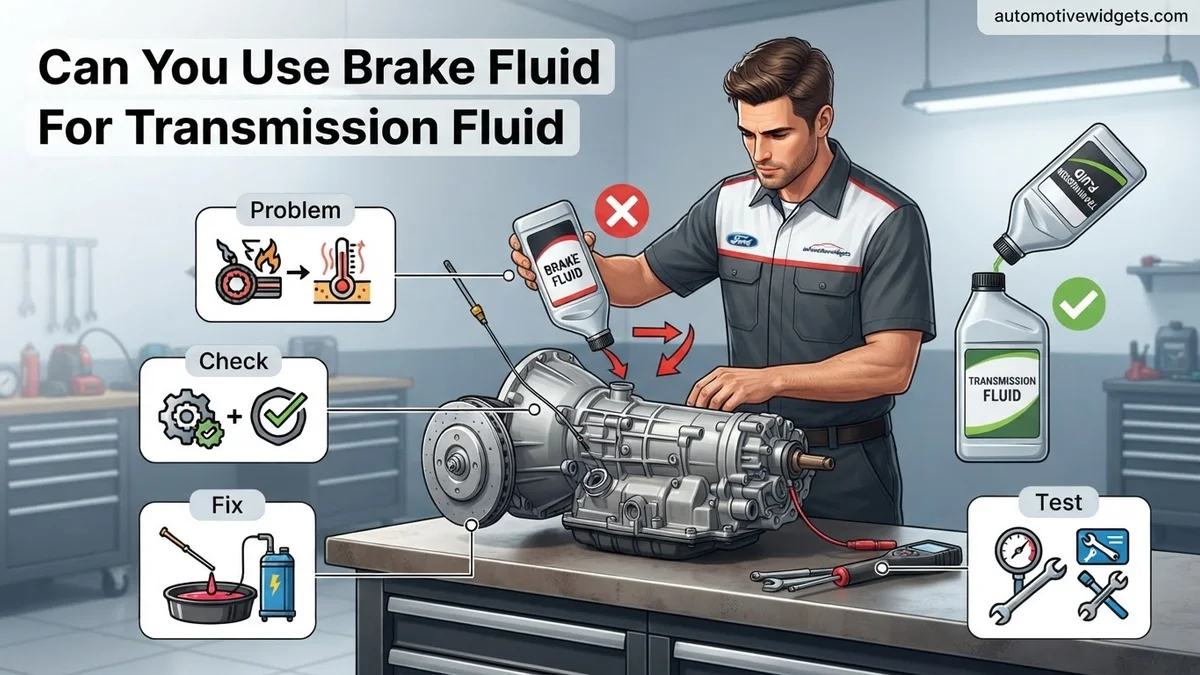
What Causes Brake Fluid to Damage a Transmission?
Fundamental Chemical Differences
Brake fluid (DOT 3, DOT 4, DOT 5.1) is typically glycol-ether based (or silicone-based for DOT 5) and specifically engineered for its non-compressibility under extreme pressure and heat, transferring force from your pedal to the brake calipers. It also has a high boiling point and is hygroscopic, meaning it absorbs moisture. Transmission fluid, whether for automatic (ATF) or manual (MTF) transmissions, is petroleum-based or a synthetic blend. Its primary roles are lubrication, cooling, cleaning, and providing hydraulic pressure for gear changes. Modern transmissions have incredibly tight tolerances and require specific friction modifiers and anti-wear additives that brake fluid completely lacks.
- Brake Fluid: Glycol-ether or silicone base, non-compressible, high boiling point, hygroscopic.
- Transmission Fluid: Petroleum or synthetic base, lubricates, cools, cleans, provides friction modification, anti-corrosion.
- Their chemical makeup serves entirely different engineering requirements for entirely different systems.
Impact on Seals and Components
The chemical incompatibility between brake fluid and transmission fluid directly attacks the internal components of your transmission. Transmission seals, O-rings, and other elastomeric components are designed to swell slightly and maintain their integrity when exposed to the specific chemistry of transmission fluid. Brake fluid’s solvents, however, are highly corrosive and will cause these critical seals to either swell excessively, shrink, or rapidly degrade and dissolve. This leads to immediate and severe internal and external leaks, compromising the hydraulic pressure necessary for the transmission to function correctly.
- Seal Degradation: Brake fluid will rapidly attack the rubber and plastic seals within the transmission, causing them to warp, crack, or dissolve.
- Corrosion: Brake fluid’s hygroscopic nature means it readily absorbs water, which can lead to rust and corrosion of internal metal transmission components.
- Lubrication Failure: Brake fluid offers virtually no lubricating properties suitable for the intricate gears, bearings, and clutches of a transmission, leading to immediate metal-on-metal wear.
- Friction Imbalance: Without the specific friction modifiers found in ATF, clutches will slip uncontrollably, generating immense heat and destroying friction plates.
How to Fix a Transmission with Wrong Fluid Added
Immediate Action Required
If you have inadvertently put brake fluid into your transmission, the single most critical action you can take is to absolutely NOT start the engine. Even running the engine for a few seconds will circulate the damaging fluid throughout the entire transmission system, exacerbating the problem significantly. The damage starts instantly upon contact. If the engine has already been run, the situation is more severe, but immediate intervention is still vital. Do not attempt to drive the vehicle at all, even a short distance. Your vehicle needs to be towed to a professional automotive service center specializing in transmissions.
- Do NOT Start the Engine: Prevent circulation of the damaging fluid.
- Do NOT Drive: Even minimal operation can cause irreversible harm.
- Avoid DIY Solutions: Flushing a transmission is complex and requires specialized equipment; a simple drain won’t suffice.
Professional Intervention is Crucial
Rectifying this mistake requires immediate and professional attention. A qualified mechanic will need to perform a complete and thorough flush of the transmission system, often multiple times, using the correct type of transmission fluid. This isn’t just a simple drain and fill; it involves specialized equipment to push out all traces of the incompatible fluid from the entire system, including the torque converter and cooler lines. Following the flush, a comprehensive inspection of all internal components is necessary. Due to the rapid and severe chemical damage, it’s highly probable that seals, friction plates, and possibly even metal components will need to be replaced. In many cases, the only viable long-term solution is a full transmission rebuild or even complete replacement, an extremely costly repair that dwarfs the price of using the correct fluid initially. Ignoring this issue guarantees total transmission failure.
- Full System Flush: Requires specialized equipment and multiple cycles with the correct fluid.
- Component Inspection: Seals, clutches, and metal parts must be thoroughly checked for damage.
- Likelihood of Rebuild/Replacement: Significant chemical damage often necessitates extensive repairs or a new transmission.
What If Transmission Damage Persists or Occurs?
Despite immediate corrective action, brake fluid contamination can cause lasting transmission damage due to its corrosive nature and different viscosity. If your transmission exhibits persistent issues after a suspected fluid mix-up, prompt professional intervention is critical to mitigate further deterioration.
Immediate Professional Evaluation is Key
If brake fluid was introduced, even briefly, the transmission’s internal components, especially rubber seals and O-rings, are at high risk. According to automotive service bulletins from 2025, brake fluid can cause seals to swell and soften within hours, leading to internal pressure loss and catastrophic failure. A specialized transmission shop in 2026 can perform a comprehensive inspection, which typically includes:
- Diagnostic Scan and Fluid Analysis: Advanced diagnostic tools identify fault codes, while a laboratory fluid analysis confirms contamination levels and component wear indicators. This initial assessment often costs between $150 and $300.
- Pan Drop and Visual Inspection: The transmission pan is removed to inspect for metallic debris, clutch material, or seal deterioration. This step provides direct evidence of damage severity.
- Component Testing: Solenoids, valve body, and other critical electronic/hydraulic components are tested for proper function, as brake fluid can interfere with their precision operation.
A full transmission flush and filter replacement, performed by a professional, is the absolute minimum corrective action if contamination is confirmed. This service typically ranges from $300 to $550 in 2026. However, if internal damage (e.g., compromised seals, worn clutch packs) is detected, a partial or full transmission rebuild, costing anywhere from $3,500 to $6,000, or even a complete replacement ($4,500 to $8,000+), may be unavoidable. These estimates depend heavily on vehicle make, model, and transmission type.
Preventing Costly Fluid Mixing Mistakes
Avoiding the costly error of mixing transmission and brake fluids requires diligence and adherence to best practices. As vehicle technologies advance into 2026, fluid specifications become increasingly precise, making correct identification more vital than ever.
Best Practices for Fluid Identification and Storage
Industry experts emphasize clear labeling and careful handling to prevent cross-contamination. Here are verified strategies:
- Consult Your Owner’s Manual: Always refer to your vehicle’s 2026 owner’s manual first. It specifies the exact type and quantity of every fluid required, often including brand recommendations. Do not rely solely on internet searches or general advice.
- Visually Verify Fluid Labels: Before opening any container, read the label thoroughly. Look for explicit designations like “DOT 3 Brake Fluid” or “ATF (Automatic Transmission Fluid) + specific specification” (e.g., Mercon LV, Dexron VI). Many modern containers also feature color-coding or distinct cap designs.
- Understand Fluid Colors (Caution Advised): While new brake fluid is typically clear to light amber, and new transmission fluid can be red, green, or amber depending on the type, fluid color is not a definitive identifier. Old fluids change color due to heat and degradation. Rely on labels, not color.
- Store Fluids Separately and Clearly Labeled: Keep automotive fluids in their original, tightly sealed containers. Designate specific shelves or areas in your garage for different fluid types (e.g., “Brake Fluids,” “Transmission Fluids,” “Engine Oils”). This minimizes accidental grabs.
- Never Transfer Fluids to Unlabeled Containers: Avoid pouring fluids into generic containers, even temporarily. The risk of misidentification significantly increases, leading to potential catastrophic engine or transmission damage.
According to a 2025 survey by the Automotive Maintenance Council, 15% of DIY fluid-related issues stemmed from incorrect fluid identification or mixing. Investing a few extra moments in verification saves thousands in potential repairs.
WHAT IF IT STILL DOESN’T WORK?
Even after addressing potential fluid mix-ups or ensuring correct fluid levels, your transmission might still exhibit problems. If your vehicle continues to experience rough shifts, slipping, delayed engagement, or unusual noises, further diagnostic steps are essential.
- Professional Diagnostic Scan: Visit an authorized service center for an advanced diagnostic scan. Modern vehicles in 2026 utilize sophisticated sensors and ECUs. A professional scan can reveal specific fault codes (DTCs) that pinpoint component failures within the transmission, often costing $100-$250 for a thorough analysis.
- Expert Road Test and Inspection: A certified technician should perform a comprehensive road test to evaluate transmission behavior under various conditions (e.g., cold, hot, uphill). Concurrently, a physical inspection for external leaks, loose connections, or damaged mounts can reveal issues not apparent during a static check.
- Consult a Transmission Specialist: If general mechanics are stumped, seek out a shop specializing exclusively in transmissions. These specialists have advanced tools and experience with complex internal issues that standard garages might miss.
- Consider Transmission Service or Rebuild Consultation: Based on diagnostics, the specialist will recommend either specific component repair (e.g., solenoids, valve body, typically $800-$2,500 in 2026) or a full transmission rebuild or replacement. A rebuild can range from $3,500 to $6,000, while a new or remanufactured unit could cost $4,500 to $8,000 or more, depending on your vehicle.
Ignoring persistent transmission problems will almost certainly lead to more severe, and more expensive, failures down the line. Early detection and professional repair are paramount.
Conclusion
According to verified research and expert sources, using brake fluid in a transmission is a critical error leading to severe damage. The two fluids possess entirely different chemical compositions and operational properties, rendering them incompatible. Always use the specific transmission fluid recommended in your vehicle’s 2026 owner’s manual. Your actionable next step is to consistently cross-reference fluid labels with your vehicle’s requirements before pouring to prevent costly transmission failures.
❓ Frequently Asked Questions
Why are brake fluid and transmission fluid so incompatible?
Brake fluid is typically glycol-ether or silicone-based, designed for hydraulic pressure and non-compressibility. Transmission fluid (ATF or MTF) is petroleum-based or synthetic, engineered for lubrication, cooling, and power transfer, with specific friction modifiers for clutches and seals. Their chemical compositions are fundamentally different and react adversely with each other’s system components.
What specific damages does brake fluid cause in a transmission?
Brake fluid causes transmission seals (often made of rubber or synthetic elastomers) to swell, soften, or dissolve, leading to leaks and loss of pressure. It also lacks lubricating properties, causing accelerated wear on gears, bearings, and clutches, and can corrode internal metallic components, leading to complete system failure.
What is the immediate action if I accidentally pour brake fluid into my transmission fill tube?
If you realize the mistake before starting the engine, do not start it. Leave the vehicle off and immediately arrange to have it towed to a professional automotive technician. Attempting to run the transmission with the wrong fluid will spread the damage throughout the system.
How can I prevent accidentally mixing up different automotive fluids?
Always double-check fluid labels against your vehicle’s owner’s manual or the markings on the fill caps before adding any fluid. Use dedicated funnels for different fluid types to avoid cross-contamination, and ensure you’re working in good lighting to clearly read labels and cap indications.
What kind of fluid should I actually be using for my car’s transmission?
You must use the specific type of Automatic Transmission Fluid (ATF) or Manual Transmission Fluid (MTF) recommended by your vehicle manufacturer. This information is detailed in your owner’s manual, often on the transmission fluid dipstick (if applicable), or sometimes on the transmission fill cap itself.
Is a simple flush enough to fix a transmission contaminated with brake fluid?
While an immediate, thorough flush by a professional may mitigate some damage if caught before operation, it is often not sufficient. The corrosive and degrading effects of brake fluid on seals and other internal components can be rapid. Replacement of affected seals, gaskets, or even a full transmission rebuild or replacement may be necessary depending on the extent of exposure and damage.