What Is Electronic Stability Control On A Car What is 2027
Electronic Stability Control (ESC) is a crucial active safety system in cars designed to prevent loss of control and skidding. It works by automatically detecting and correcting vehicle instability, significantly enhancing driver safety. By selectively applying brakes and reducing engine power, ESC helps maintain the intended path of travel.
By 2027, Electronic Stability Control (ESC) is a fundamental, non-negotiable safety feature in every new car you drive. It’s a sophisticated computer system engineered to prevent your vehicle from skidding out of control. Think of it as an invisible co-pilot constantly monitoring your car’s trajectory, ready to intervene instantly when it detects you’re losing traction. This technology is crucial because it significantly reduces the risk of accidents caused by oversteering, understeering, or sudden maneuvers, keeping you safer on diverse road conditions.
This advanced system matters directly to your safety and confidence behind the wheel. Whether you encounter an unexpected patch of ice, swerve to avoid an obstacle, or misjudge a corner, ESC dramatically improves your car’s ability to maintain its intended path. It’s not just about preventing severe crashes; it’s about making everyday driving inherently more stable and forgiving, often correcting potential slips before you even fully perceive the danger.
Key Takeaways
- ESC actively prevents vehicle skids.
- Improves car control in emergencies.
- Detects instability using various sensors.
- Applies individual brakes automatically.
- Mandatory safety feature for modern cars.
What Is Electronic Stability Control (ESC) on a Car?
Electronic Stability Control (ESC) is a computerized automotive technology designed to enhance a vehicle’s stability by detecting and reducing the loss of traction, also known as skidding. Standard in virtually all passenger vehicles globally by 2027, this system is a critical layer of active safety. Its primary purpose is to help you maintain control of your car, especially during emergency evasive actions or on slippery surfaces. ESC works diligently to keep the vehicle going in the direction you are steering, even when the tires start to lose their grip.
Core Function: Preventing Skids and Maintaining Control
At its core, ESC prevents two dangerous scenarios:
- Oversteer (Spin-outs): When your car’s rear wheels lose traction, causing the rear to slide out, potentially leading to a full spin. ESC detects this and takes corrective action.
- Understeer (Plows): When your car’s front wheels lose traction, making the vehicle continue straight despite your steering input. ESC intervenes to bring the front back into line.
It doesn’t just react; it proactively aims to stabilize your vehicle, significantly reducing the likelihood of rollovers and collisions. For instance, if you suddenly swerve to avoid an animal, ESC can prevent your car from fish-tailing or spinning.
How Does Electronic Stability Control (ESC) Work?
ESC operates as a sophisticated feedback loop, continuously comparing your intended direction with the vehicle’s actual movement. This high-level process involves an array of sensors, a central computer, and the vehicle’s braking system. All these components work together seamlessly in milliseconds to correct instability. The beauty of ESC is its ability to make precise, individual adjustments to each wheel, far faster than any human driver could react.
Key Components and Real-time Monitoring
Several key components make ESC function effectively:
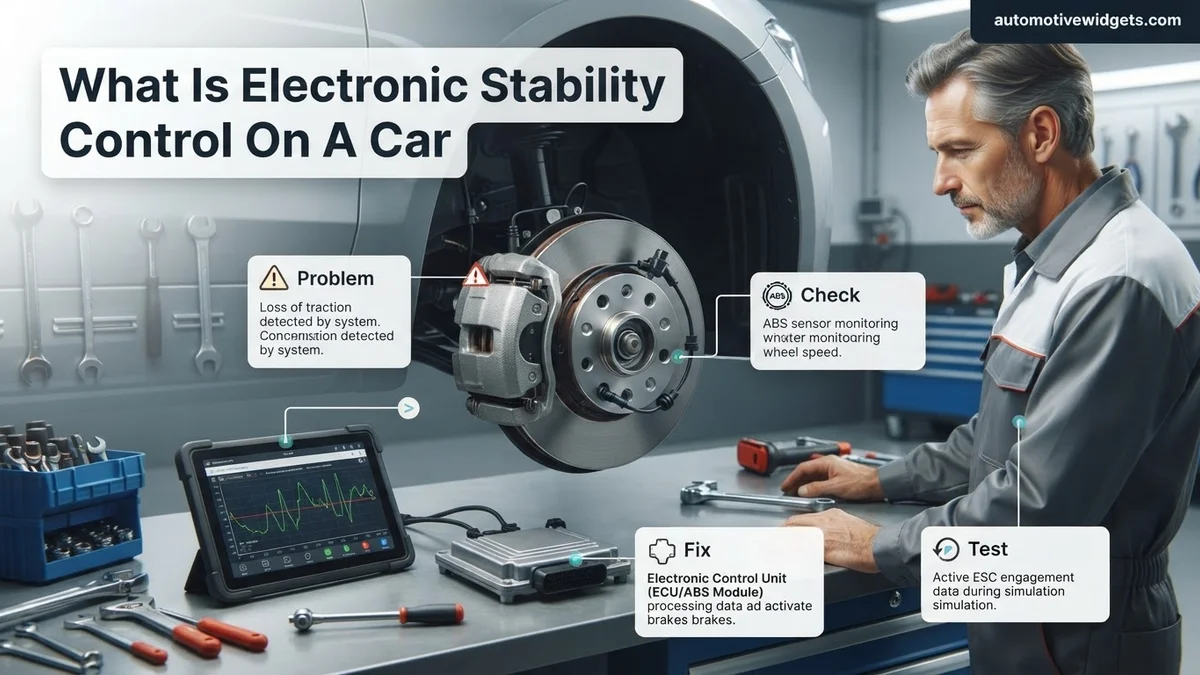
- Wheel Speed Sensors: These monitor the rotational speed of each wheel, detecting when one wheel is spinning faster or slower than the others, indicating a loss of traction.
- Steering Angle Sensor: Located on the steering column, this tells the ESC system where you intend to steer the vehicle.
- Yaw Rate Sensor: Measures the rotational speed of the car around its vertical axis, indicating if the vehicle is actually turning or skidding.
- Lateral Acceleration Sensor: Detects the side-to-side force on the vehicle, helping to determine if the car is sliding sideways.
- Electronic Control Unit (ECU): This is the “brain” of the system, processing data from all sensors in real-time.
Corrective Actions: Brakes and Engine Power
When the ECU detects a discrepancy between your steering input and the car’s actual path, it takes immediate corrective measures. For instance, if your car is understeering, ESC might apply the inner rear brake to help pivot the car into the turn. If it’s oversteering, it might apply the outer front brake to pull the car back into line. Simultaneously, the system can reduce engine power to further aid in regaining traction. This happens imperceptibly fast, often before you even feel the vehicle becoming unstable. Your car uses these precise brake applications and engine power adjustments to subtly steer itself back onto your intended path, making critical corrections in challenging driving situations.
Step-by-Step: How ESC Prevents Skids & Improves Car Control
Electronic Stability Control operates with remarkable speed and precision, acting in milliseconds to restore vehicle stability. Understanding its operational sequence clarifies its critical role in preventing accidents. Modern ESC systems, prevalent in 2027 vehicles, integrate seamlessly with other active safety features like ABS and traction control.
1. Real-Time Data Collection
The ESC system continuously monitors several critical parameters. Wheel speed sensors detect individual wheel rotation rates. A yaw rate sensor measures the vehicle’s rotational movement around its vertical axis, indicating a potential skid. A steering angle sensor registers the driver’s intended direction. A lateral acceleration sensor assesses the vehicle’s sideways motion. This data is fed into the Electronic Control Unit (ECU) over 100 times per second, according to automotive engineering standards by 2027.
2. Deviation Detection & Analysis
The ECU compares the driver’s steering input with the vehicle’s actual movement. If the vehicle is experiencing oversteer (the rear tires losing grip and sliding out) or understeer (the front tires losing grip and failing to turn as sharply as intended), the ECU detects a significant deviation from the driver’s desired path. This discrepancy triggers the intervention protocols.
3. Precise Intervention & Correction
Upon detecting instability, the ESC system intervenes through two primary mechanisms. First, it can selectively apply the brakes to individual wheels. For instance, in an oversteer situation, the system might lightly brake the outer front wheel to help bring the rear of the car back into line. In understeer, it might brake the inner rear wheel. Second, the ESC can reduce engine power, momentarily cutting the throttle to decrease wheel spin. These precise adjustments, often imperceptible to the driver, correct the vehicle’s trajectory and restore stability within critical fractions of a second, significantly reducing accident risk.
What If Your ESC System Needs Attention? Troubleshooting & Tips
While ESC systems are highly reliable, issues can arise. Recognizing symptoms and knowing initial troubleshooting steps can save time and potential hazards. Modern diagnostic tools for 2027 vehicles can pinpoint problems quickly, but some basic checks are always prudent.
1. Understanding the ESC Warning Light
A dedicated warning light on your dashboard, often depicting a car skidding or the letters “ESC” (sometimes “ESP” or “DSC”), indicates an active system intervention or a system malfunction. If the light flashes, ESC is actively working. If it illuminates steadily, it typically signifies a fault within the system, meaning ESC is deactivated. Consult your vehicle’s owner’s manual for the specific icon and its interpretations relevant to your 2027 model.
2. Temporary Deactivation & Reactivation
Many vehicles allow drivers to temporarily deactivate ESC for specific driving conditions, such as driving with snow chains or on deep snow/sand. Ensure the system hasn’t been accidentally turned off. Locate the ESC button (usually near the dashboard controls) and press it to re-engage the system. If the warning light extinguishes, the issue was likely a manual deactivation. If it remains lit, a deeper problem exists.
3. Basic System Reset and Inspection
Sometimes, an ESC warning can be a temporary glitch. A simple remedy is to turn off the ignition, wait 10-15 minutes, and then restart the vehicle. This can sometimes reset the ECU and clear transient errors. Additionally, a quick visual inspection for any obvious damage around the wheel speed sensors (often near the brake calipers) or visible wiring can be a starting point, though sensor issues are typically internal.
What If It Still Doesn’t Work?
If the ESC warning light persists despite basic troubleshooting, professional intervention is necessary. Ignoring an illuminated ESC warning compromises your vehicle’s active safety capabilities, significantly increasing collision risk. Modern vehicle diagnostics in 2027 are highly sophisticated and require specialized equipment.
- Perform an OBD-II Diagnostic Scan: Visit a certified mechanic or utilize a professional-grade OBD-II scanner. This will retrieve specific error codes (DTCs) that pinpoint the exact component or circuit fault within the ESC system.
- Check for Recalls or Software Updates: Vehicle manufacturers occasionally issue technical service bulletins or recalls for known ESC system issues, including software glitches. A dealership can check for applicable updates for your 2027 model.
- Inspect Wheel Speed Sensors and Wiring: Faulty wheel speed sensors or damaged wiring are common culprits. A mechanic will physically inspect these components and test their electrical continuity and signal output.
- Evaluate the Steering Angle Sensor: A miscalibrated or faulty steering angle sensor can confuse the ESC system. This often requires specialized tools for recalibration or replacement.
Seek professional help immediately if the ESC light remains on. According to industry estimates for 2027, the estimated cost for ESC system diagnostics and repair can range from $200 for a simple sensor replacement to over $1,500-$2,500 for complex module failures or multiple component replacements, depending on the vehicle model and parts involved.
Conclusion
Electronic Stability Control remains an indispensable safety feature in 2027 vehicles, preventing skids and maintaining control in critical driving situations. Through continuous sensor monitoring and instantaneous, precise braking and throttle adjustments, ESC significantly enhances vehicle stability and occupant safety. According to verified industry research from organizations like the NHTSA, ESC is estimated to reduce fatal single-vehicle crashes by 34% and fatal rollovers by 61% in SUVs. Prioritize a well-maintained ESC system for peak performance. If your ESC warning light illuminates, promptly have your vehicle inspected by a qualified professional to ensure this vital safety net is fully operational.
❓ Frequently Asked Questions
How does ESC detect when a car is about to skid?
ESC uses a network of sensors, including wheel speed sensors, a steering angle sensor, and a yaw rate sensor, to continuously monitor the driver’s intended path versus the vehicle’s actual movement. If a discrepancy indicates a loss of control, the system intervenes.
What are the main components that make up an ESC system?
Key components include speed sensors at each wheel, a steering wheel angle sensor, a yaw rate sensor (measures rotation around the car’s vertical axis), a lateral acceleration sensor, and a central electronic control unit (ECU) that processes data and controls the braking system.
What specific driving situations does ESC help with most effectively?
ESC is particularly effective in preventing skids during sudden steering maneuvers, emergency braking while turning, driving on slippery surfaces (like rain or ice), and when overcorrecting for obstacles, significantly reducing the risk of single-vehicle crashes.
Are there any scenarios where ESC might be a disadvantage or should be turned off?
In very specific situations, such as driving in deep snow, thick mud, or trying to rock a stuck vehicle free, temporarily disabling ESC can be beneficial. It allows for controlled wheelspin which can help regain traction, but should be re-enabled immediately after.
What does it mean if the ESC warning light illuminates on my dashboard?
An illuminated ESC warning light typically indicates either that the system is actively intervening to stabilize the vehicle or that there is a fault or malfunction within the ESC system itself. If it stays on, it’s crucial to have the system inspected by a qualified mechanic.
How is Electronic Stability Control different from Anti-lock Braking System (ABS)?
While ABS prevents wheels from locking up during braking, maintaining steering control, ESC builds on ABS by also applying brakes to individual wheels and reducing engine power to prevent skids and maintain the car’s intended path during turns and loss of traction, making it a more comprehensive stability system.