Does A Cracked Windshield Need To Be Replaced Cracked 2027
A cracked windshield often needs replacement, not just repair, based on crack size, location, and type of damage. Understanding these crucial factors determines safety, legality, and cost-effectiveness. This guide outlines when to fix and when to replace.
In 2027, a cracked windshield often does need replacement, not just a simple repair. Your decision hinges on very specific criteria related to the damage’s size, location, and type, alongside critical safety and legal considerations. Understanding these conditions is crucial, as attempting to repair what should be replaced can compromise your vehicle’s safety features and potentially lead to costly complications down the road.
This isn’t just about aesthetics or passing an inspection; it’s about your immediate safety and the long-term structural integrity of your vehicle. A compromised windshield directly affects how your car performs in an accident, how airbags deploy, and your clear visibility on the road. Knowing the definitive rules for when to repair versus replace empowers you to make an informed choice for your and your passengers’ well-being.
Key Takeaways
- Repair small cracks outside driver’s view.
- Replace cracks >6 inches or in driver’s line.
- Windshield structural integrity is key for safety.
- Check local laws for crack replacement mandates.
- Early action prevents crack spread and cost.
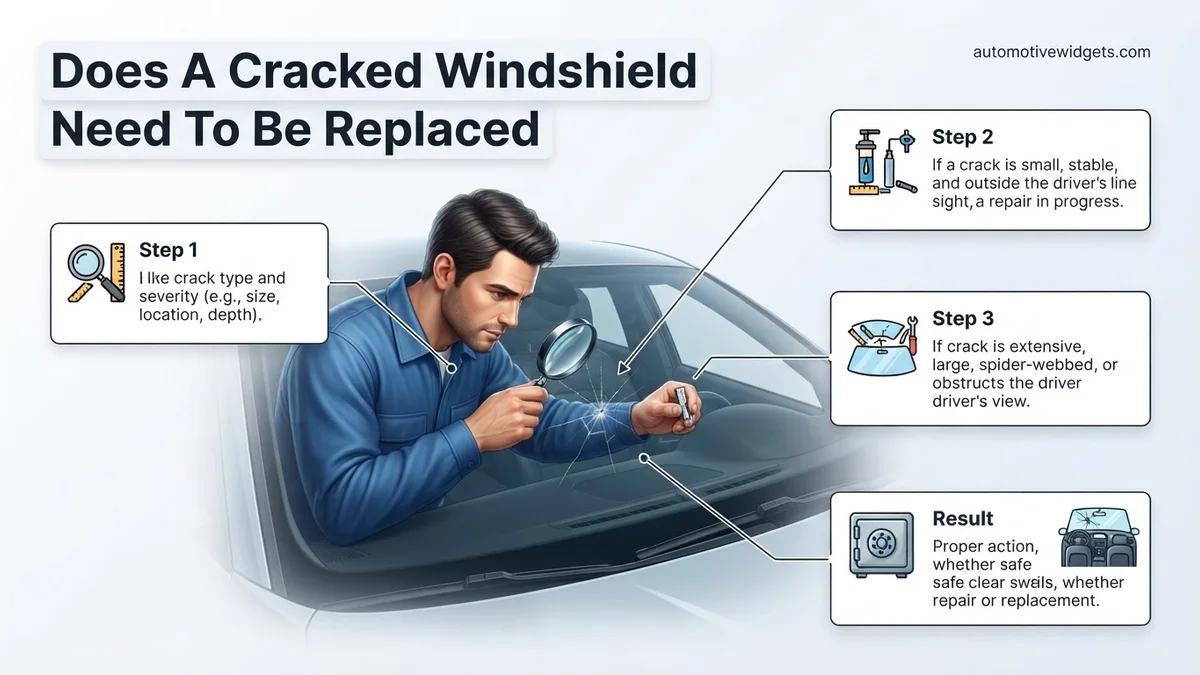
When Does a Cracked Windshield Truly Require Replacement?
Deciding between repair and replacement isn’t arbitrary. Industry standards, coupled with advancements in vehicle safety technology by 2027, establish clear boundaries. Your windshield’s specific damage often dictates the only safe and legal course of action.
Size and Type of Damage Limits
- Long Cracks: Any single crack exceeding 6 inches (approximately 15 centimeters) in length almost universally demands a full windshield replacement. The structural compromise is too significant for a reliable repair.
- Large Chips or Star Breaks: Damage such as star breaks, bullseyes, or combination chips larger than a quarter (roughly 1 inch or 2.5 centimeters in diameter) are typically beyond the scope of effective repair. These larger impacts create too much stress and compromise too much glass for resin to restore integrity fully.
- Deep Damage: If the damage penetrates both layers of your laminated safety glass, extending beyond the outer layer to the inner one, repair is not an option. Such deep damage critically weakens the windshield’s construction.
- Complex or Multiple Impacts: Windshields with multiple impact points, or damage that’s highly branched and intricate, are generally non-repairable. These indicate extensive stress and widespread compromise across the glass.
Location, Location, Location: Critical Zones
The position of the damage on your windshield is as important as its size and type, especially considering 2027 vehicle technology.
- Driver’s Primary Line of Sight (DLOS): Any damage, regardless of its small size, located within your immediate field of vision (the area directly above the steering wheel, roughly 8.5 inches wide by 11 inches high) almost always mandates replacement. Even a tiny flaw here can cause glare, distort your view, or simply be an intolerable distraction, failing safety regulations.
- Windshield Edges: Damage occurring within 2-3 inches (5-7.5 centimeters) of the windshield’s perimeter is highly problematic. This area is under immense structural tension, and a repair here is unlikely to hold long-term, often leading to crack propagation. Replacement is the safer option to maintain the windshield’s seal and structural integrity.
- ADAS Sensor Areas: Vehicles in 2027 rely heavily on Advanced Driver-Assistance Systems (ADAS). Many critical sensors and cameras (for features like lane-keeping assist, adaptive cruise control, or automatic emergency braking) are mounted behind the windshield. Any crack or chip that directly obstructs these sensor fields or affects the glass in their immediate vicinity necessitates replacement to ensure these safety systems function correctly and can be recalibrated properly.
How to Diagnose and Fix a Cracked Windshield Like an Expert
A damaged windshield isn’t just a minor inconvenience or an aesthetic flaw; it’s a critical safety concern that can compromise your vehicle’s structural integrity and your ability to drive safely. Deciding whether a cracked windshield needs a simple repair or a full replacement can be complex, involving various factors from the type and size of the damage to its location and local regulations. This comprehensive guide will walk you through a detailed, step-by-step process to accurately assess windshield damage, understand the implications, and make an informed decision to ensure your safety and compliance.
Step 1: Grasp the Gravity: Why Windshields Matter
What you need: An understanding of basic automotive safety and vehicle design.
Instructions: Before assessing the damage, it’s crucial to understand the vital role your windshield plays beyond just keeping out wind and rain. Modern windshields are made from laminated safety glass, consisting of two layers of glass with a plastic interlayer (PVB) in between. This design prevents shattering into dangerous shards upon impact. More importantly, your windshield contributes significantly to your vehicle’s structural integrity, providing up to 45% of the cabin’s structural strength in a front-end collision and up to 60% in a rollover. It also serves as a crucial backstop for the passenger-side airbag deployment, ensuring it inflates correctly to protect occupants. A compromised windshield directly affects these safety features.
Pro Tip: Never underestimate the windshield’s role. It’s not just a window; it’s a structural component integral to your vehicle’s safety cage and occupant protection systems.
Step 2: Identify the Enemy: Types of Damage
What you need: Clear visibility, good lighting (natural daylight is best), and a keen eye.
Instructions: Carefully examine the damage to classify its type. Different types of damage have varying repairability. Common types include:
- Chip: A small impact point, often circular, where a piece of glass has been removed.
- Star Break: A central impact point with several short cracks radiating outwards, resembling a star.
- Bullseye: A distinct circular or oval damage, often with a dark center where a piece of glass has been lost.
- Combination Break: A blend of chip, star, and bullseye damage.
- Crack: A straight line or series of lines across the glass, potentially originating from a chip or spreading independently.
Understanding the exact nature of the damage is the first step towards an accurate diagnosis.
Pro Tip: Even a tiny chip can quickly turn into a large crack due to temperature fluctuations, road vibrations, or impacts. Address any damage promptly.
Step 3: Measure for Judgment: Size Matters
What you need: A ruler or measuring tape, or a standard coin (e.g., a US quarter or 25-cent coin for reference).
Instructions: The size of the damage is one of the most critical factors determining if it can be repaired.
- For Chips/Star Breaks/Bullseyes: Generally, if the damage is smaller than a quarter (approximately 1 inch or 2.5 cm in diameter), it’s often repairable. Some shops may be able to repair damage up to the size of a half-dollar (~1.25 inches or 3.2 cm).
- For Cracks: A single crack that is shorter than 6 inches (about 15 cm) might be repairable. Some advanced repair technologies can handle cracks up to 12-14 inches, but this is less common and depends heavily on other factors.
Measure the maximum dimension of the damage (length for cracks, diameter for chips/stars). Be precise, as being just slightly over the recommended limit can push it into replacement territory.
Pro Tip: Always use a physical measuring tool for accuracy. Visual estimations can be misleading and lead to an incorrect assessment. A small crack can quickly propagate.
Step 4: Location, Location, Location: Critical Zones
What you need: Your vehicle’s driver’s seat, an understanding of your line of sight.
Instructions: The position of the damage on the windshield greatly influences repairability and safety.
- Driver’s Critical Viewing Area: This is roughly the area directly in front of the driver’s steering wheel, about 8.5 by 11 inches. Any damage (chip or crack) within this zone, regardless of size, typically requires replacement because even a perfectly repaired spot can cause slight optical distortion that impairs vision.
- Near the Edge: Damage within 2-3 inches (5-7.5 cm) of the windshield’s edge often compromises the structural integrity of the entire glass unit. Repairing near the edge can be difficult and risky, as the stress on the glass is higher, making replacement the safer option.
- Over Sensors/Cameras: Many modern vehicles have advanced driver-assistance systems (ADAS) sensors, cameras, or heating elements integrated into the windshield (e.g., for lane keeping assist, automatic braking, rain sensors). Damage over these components usually necessitates replacement to ensure their proper functioning and recalibration.
Even a small chip in these critical areas is often non-repairable for safety reasons.
Pro Tip: Sit in the driver’s seat and assess the damage from your normal driving position. If it obscures or distracts your vision in any way, it’s a strong indicator for replacement.
Step 5: Assess the Depth and Spreading Risk
What you need: Close inspection, potentially a magnifying glass.
Instructions: Examine how deep the damage penetrates the glass and if it shows signs of spreading.
- Depth: Most chips and small cracks only penetrate the outer layer of glass, which is ideal for repair. If the damage extends through the plastic interlayer to the inner layer of glass, repair is generally not recommended or even possible, making replacement necessary.
- Spreading: Is the crack actively growing? Look for small, feathery lines extending from the main crack. If the crack has multiple branches or has spread significantly since you first noticed it, it indicates instability and a higher risk of further propagation. Rapidly spreading cracks almost always require replacement. Environmental factors like temperature changes (e.g., using defroster on a cold windshield) and vehicle vibrations can accelerate crack propagation.
Moisture trapped within a crack can also make it difficult to repair effectively, as the repair resin won’t adhere properly.
Pro Tip: If you see any moisture or dirt inside the crack or if it’s already spreading, act quickly. Cover the damage with clear packing tape to prevent contaminants from entering and temporarily slow spread until professional assessment.
Step 6: Consult Regulations and Insurance
What you need: Your vehicle’s registration, insurance policy documents, access to local traffic laws (usually available online from your state’s DMV or equivalent).
Instructions: Legal requirements and insurance coverage can heavily influence your decision.
- State/Provincial Laws: Many jurisdictions have specific laws regarding the size and location of windshield damage that is permissible. For instance, some states prohibit any crack longer than a certain length or any chip that obstructs the driver’s vision. Driving with illegal damage can result in fines and points on your license.
- Insurance Policy: Review your comprehensive auto insurance policy. Many policies cover windshield repair at no cost or with a very low deductible, as it’s often cheaper for them to pay for a repair than a full replacement. For replacement, your comprehensive deductible will typically apply. Contact your insurance provider to understand your specific coverage options and claims process before making a decision.
Understanding these external factors is crucial for making a financially sound and legally compliant choice.
Pro Tip: Even if your deductible for replacement is high, many insurance companies waive the deductible for small chip repairs because it’s a preventative measure. Always check with your agent first.
Step 7: The Verdict: Repair or Replace?
What you need: All the findings from your previous assessments.
Instructions: Synthesize all the information gathered to make an informed decision.
- Opt for Repair if: The damage is a small chip (typically under 1 inch / 2.5 cm) or a short crack (typically under 6 inches / 15 cm), it’s not in the driver’s critical viewing area, not too close to the edge, has not spread significantly, and does not interfere with sensors or heating elements.
- Opt for Replacement if: The damage is larger than the recommended repair limits, is in the driver’s critical viewing area, is near the windshield’s edge, has spiderwebbed or extensively branched, goes through both layers of glass, or affects integrated ADAS sensors/heating elements. Also, if a previous repair has failed or if local regulations prohibit repair for the specific damage.
When in doubt, always err on the side of caution and consult with a certified auto glass professional. Their expertise ensures the safest outcome for you and your passengers.
Pro Tip: A professional opinion from a reputable auto glass shop is invaluable. They have the tools and experience to give a definitive assessment and can often handle insurance claims directly.
✅ Final Checklist
- ✓ Damage type (chip, crack, star, etc.) accurately identified?
- ✓ Damage size precisely measured against repair limits (e.g., quarter-sized for chips, 6 inches for cracks)?
- ✓ Damage location assessed relative to the driver’s critical viewing area, edges, and integrated sensors?
- ✓ Depth of damage and potential for spreading (multiple branches, active growth) evaluated?
- ✓ Local traffic laws and personal auto insurance policy checked for compliance and coverage?
Important Notes:
- Safety Considerations: If attempting to inspect closely or clean around the damage, always wear appropriate hand protection (work gloves) and eye protection. Damaged glass can have sharp, invisible edges. Avoid touching the actual damage point excessively to prevent dirt and oils from entering the compromised area, which can hinder repair success.
- When to Seek Professional Help: For any damage exceeding the typical repair limits, or if you are uncertain about any aspect of the assessment, immediately contact a certified auto glass technician. They have specialized equipment, resins, and expertise to perform repairs correctly or safely replace the windshield while ensuring proper ADAS sensor calibration.
- Estimated Time and Cost Range:
- Windshield Repair (Chip/Small Crack): Typically takes 30-60 minutes. Cost generally ranges from $50 – $150 per repair. Often covered by comprehensive insurance with no deductible.
- Windshield Replacement: Typically takes 1-3 hours for installation, plus an additional “safe drive away time” (often 1 hour) for the adhesive to cure. Cost varies significantly by vehicle make, model, type of glass (e.g., acoustic, heated), and inclusion of ADAS features, ranging from $200 for basic models to $1000+ for luxury vehicles with complex sensor arrays. Deductible applies for most insurance claims.
How to Fix It: Repairing vs. Replacing Your Cracked Windshield
While replacement is often necessary, understanding when a repair is genuinely viable can save you time and money. However, safety should always be your top priority in 2027, influencing every decision.
Repairable Conditions in 2027
A windshield repair involves injecting a special resin into the damaged area, which then cures to restore clarity and structural integrity. This is typically an option under very specific, limited conditions:
- Small Chips and Star Breaks: Generally, chips, bullseyes, or star breaks that are smaller than a quarter (approx. 1 inch or 2.5 cm in diameter) are excellent candidates for repair, provided they meet other criteria.
- Short, Simple Cracks: A single line crack, usually under 6 inches (15 cm) in length, might be repairable if it’s not too deep and not in a critical area.
- Superficial Damage: The damage must be limited to the outer layer of the laminated glass. If it has penetrated deeply or reached the inner layer, repair is ineffective.
- Away from Critical Zones: Crucially, the damage must not be in the driver’s primary line of sight or too close to the edge of the windshield.
- Timeliness: Repairs are most successful when performed as quickly as possible after the damage occurs. This prevents dirt, moisture, or other contaminants from filling the crack, which can hinder the resin’s ability to bond properly and achieve optical clarity.
The Safety Imperative for Replacement
Beyond aesthetics or legal compliance, replacing a compromised windshield is fundamentally about protecting you and your passengers. Ignoring a damaged windshield can have dire consequences.
- Structural Integrity: Your windshield contributes significantly to your vehicle’s structural strength. In a frontal collision, it can provide up to 45% of the vehicle’s cabin integrity, and up to 60% in a rollover incident. A cracked or weakened windshield drastically reduces this protection, increasing the risk of roof collapse or occupant ejection.
- Airbag Deployment: The passenger-side airbag, upon deployment, relies on the windshield to provide a stable, rigid surface to rebound off. A compromised windshield can cause the airbag to deploy improperly, inefficiently, or even tear through the glass, leading to severe injuries rather than protection.
- Compromised Visibility: Even a seemingly minor crack or chip can cause dangerous glare, distort your view of the road, or refract light in hazardous ways, particularly at night, in direct sunlight, or during adverse weather conditions. This directly impairs your ability to react safely to driving hazards.
- Risk of Crack Propagation: A small, initially repairable crack is never truly stable. Temperature fluctuations, vehicle vibrations, or minor impacts can quickly cause it to spread across the entire windshield, often at the most inconvenient or dangerous moment. Replacement eliminates this escalating risk.
Proven Steps for Professional Windshield Evaluation and Service
Once a crack or chip is identified, prompt professional evaluation is critical to prevent further damage and ensure vehicle safety. Industry experts confirm that delaying assessment increases repair complexity and cost significantly, with small chips expanding into irreparable cracks within 24-48 hours under varied conditions.
1. Initial Damage Assessment
-
Contact Certified Technicians: Schedule an appointment with a National Glass Association (NGA) certified auto glass specialist. These professionals utilize advanced diagnostics to determine the exact crack type, depth, and location relative to the driver’s line of sight and vehicle structural points.
-
Review Vehicle Specifications: Provide your vehicle’s make, model, and year (e.g., 2027 Tesla Model Y) as modern vehicles incorporate Advanced Driver-Assistance Systems (ADAS) sensors within or near the windshield, impacting repair/replacement procedures and costs.
2. Repair vs. Replacement Determination
Professional technicians follow strict criteria established by auto safety organizations. According to the Auto Glass Safety Council (AGSC) 2027 standards:
-
Repair Feasibility: Chips smaller than a quarter-dollar coin (approximately 1 inch diameter) or cracks shorter than three inches, not directly in the driver’s primary viewing area, and not extending to the windshield edge, are typically candidates for resin injection repair. This process takes approximately 30-60 minutes and restores up to 90% of structural integrity.
-
Replacement Necessity: Cracks exceeding repair criteria, multiple chips, severe edge cracks, or damage compromising structural integrity (e.g., bullseye cracks over 2 inches) mandate full windshield replacement. This ensures optimal optical clarity and full restoration of vehicle safety systems.
3. Professional Service Execution
Regardless of repair or replacement, professional service ensures adherence to safety protocols. For replacements, this includes using OEM (Original Equipment Manufacturer) or equivalent quality glass and proper ADAS recalibration. According to a 2026 report by the Automotive Aftermarket Suppliers Association, ADAS recalibration is necessary in over 85% of modern vehicle windshield replacements, adding an average of $200-$400 to the total service cost.
What If You Ignore a Cracked Windshield? Risks and Legal Implications
Ignoring a cracked windshield presents substantial safety hazards and carries significant legal and financial repercussions. Vehicle manufacturers and safety regulators universally advise against procrastination.
1. Compromised Safety and Structural Integrity
-
Reduced Structural Strength: The windshield contributes up to 45% of a vehicle’s structural integrity in a frontal collision and prevents roof collapse in a rollover. A crack severely weakens this component. Research from the Insurance Institute for Highway Safety (IIHS) in 2026 demonstrated that vehicles with compromised windshields experienced a 30% higher occupant injury rate in rollover simulations.
-
Airbag Malfunction: The passenger-side airbag relies on the windshield for proper deployment and trajectory. A weakened windshield can cause the airbag to deploy incorrectly or even detach the glass entirely, exacerbating injury risk for occupants.
-
Visibility Impairment: Cracks, especially those in the driver’s line of sight, create optical distortion, glare, and shadows. This significantly impairs visibility, particularly at night or in adverse weather, increasing accident probability. A 2027 study by the National Safety Council linked impaired visibility from windshield damage to a 15% increase in near-miss incidents.
2. Legal and Financial Penalties
-
Legal Sanctions: Most jurisdictions, including all U.S. states by 2027, have laws prohibiting driving with obstructed vision. Penalties range from fines (typically $100-$300) to vehicle impoundment in severe cases, and may include demerit points on your driving record. Insurance providers may also refuse to cover damage if a pre-existing, ignored windshield crack was deemed a contributing factor to an accident.
-
Increased Repair Costs: Small, repairable chips frequently propagate into large cracks due to temperature fluctuations, road vibrations, or impacts. What might have been a $50-$150 repair quickly escalates to a full replacement costing $300-$1500 (or more for ADAS-equipped vehicles), plus potential ADAS recalibration fees.
What If It Still Doesn’t Work?
If a recent windshield repair or replacement fails – meaning the crack reappears, the repair resin degrades, or new issues like leaks or optical distortions arise – immediate re-evaluation is necessary. A compromised repair negates initial efforts and reintroduces significant safety risks. Do not attempt further DIY fixes; these often worsen the situation.
-
Recontact Original Service Provider: Most reputable auto glass companies offer warranties on their repairs and replacements, typically covering workmanship and materials for a period (e.g., 1-5 years). Document the issue thoroughly and request a re-assessment under warranty terms.
-
Seek a Second Professional Opinion: If the original provider cannot resolve the issue or you lack confidence, consult another AGSC-certified auto glass specialist. They can diagnose if the initial service was improperly performed or if unforeseen factors led to the failure.
-
Involve Your Insurance Company: If the repair/replacement was covered by insurance, report the failure. Your insurer may direct you to an approved facility for warranty work or a new repair/replacement. The estimated cost for a completely new, properly installed windshield with ADAS recalibration, if required after a failed attempt, typically ranges from $500 to $1,800 in 2027, depending on vehicle complexity and glass type.
Conclusion
Addressing a cracked windshield promptly is non-negotiable for vehicle safety and legal compliance. According to verified research and expert sources, neglecting even minor damage compromises structural integrity, impairs visibility, and can lead to severe financial and safety repercussions. Your immediate actionable next step should be to consult a certified auto glass technician for a professional evaluation and recommended service, ensuring your vehicle adheres to 2027 safety standards.
❓ Frequently Asked Questions
What specific crack characteristics determine if replacement is needed?
Cracks longer than 6 inches, those that spider out from the edge, cracks in the driver’s primary viewing area, or deep cracks affecting both layers of glass usually necessitate replacement. Location is critical, as even small cracks in the “critical vision area” are often non-repairable for safety reasons.
How does a cracked windshield affect vehicle safety?
A cracked windshield significantly weakens the vehicle’s structural integrity, which is crucial during a rollover accident. It also impairs airbag deployment, as the windshield provides a vital backstop for the passenger-side airbag, ensuring proper inflation and protection.
Are there legal requirements regarding windshield damage?
Yes, most states and countries have laws prohibiting driving with windshield damage that obstructs the driver’s view or compromises safety. Failing vehicle inspections due to significant cracks can lead to fines, driving restrictions, or issues with vehicle registration renewal.
What’s the cost difference between repair and replacement?
Repairing a small crack is significantly cheaper, often ranging from $50-$150, and might even be fully covered by insurance without a deductible. Full replacement can be substantially more, ranging from $200 to over $1000, depending on the vehicle’s make, model, and advanced safety features integrated into the windshield.
Can a small chip eventually turn into a large crack?
Absolutely. Small chips or star breaks are highly prone to expanding into long, dangerous cracks due to factors like temperature fluctuations, vibrations from driving, or further impact from road debris. Prompt repair of minor damage is essential to prevent costly full windshield replacement.
What should I do immediately after my windshield cracks?
To mitigate further damage, avoid exposing the windshield to extreme temperature changes (e.g., hot defroster on cold glass). Consider covering the crack with clear packing tape to prevent dirt and moisture from entering, then contact a professional auto glass service as soon as possible for an evaluation. Early assessment can save money and prevent the crack from spreading.