How Long Can You Drive With Bad Wheel Bearing How Long 2027
Driving with a bad wheel bearing is extremely dangerous and should be avoided at all costs. There is no safe distance or duration to drive once a failing wheel bearing is detected, as it can lead to catastrophic failure, loss of control, and severe accidents.
Let’s be unequivocally clear: there is no safe duration or distance you can drive with a failing wheel bearing. None. While your vehicle might seem to “limp along” for a few miles, pushing it for any significant period drastically elevates your risk of a catastrophic failure. In 2027, with advanced vehicle safety systems prevalent, a failing basic component like a wheel bearing remains a primary cause for severe, preventable accidents.
The practical implication is stark: if you suspect or know you have a bad wheel bearing, your driving should be limited to the absolute minimum necessary to get your vehicle safely to a repair facility. This isn’t a problem that will fix itself or one you can “manage” for a few days. Ignoring it isn’t just risky; it’s a gamble with potentially fatal consequences, compromising your vehicle’s stability and control at critical moments.
Key Takeaways
- Stop driving immediately upon suspecting a bad bearing.
- Driving risks include wheel detachment and loss of control.
- Towing is the safest option for transport to repair.
- Ignoring symptoms significantly increases repair costs.
- Severity of noise indicates how critical the issue is.
Diagnosing a Bad Wheel Bearing: What to Listen For and Feel
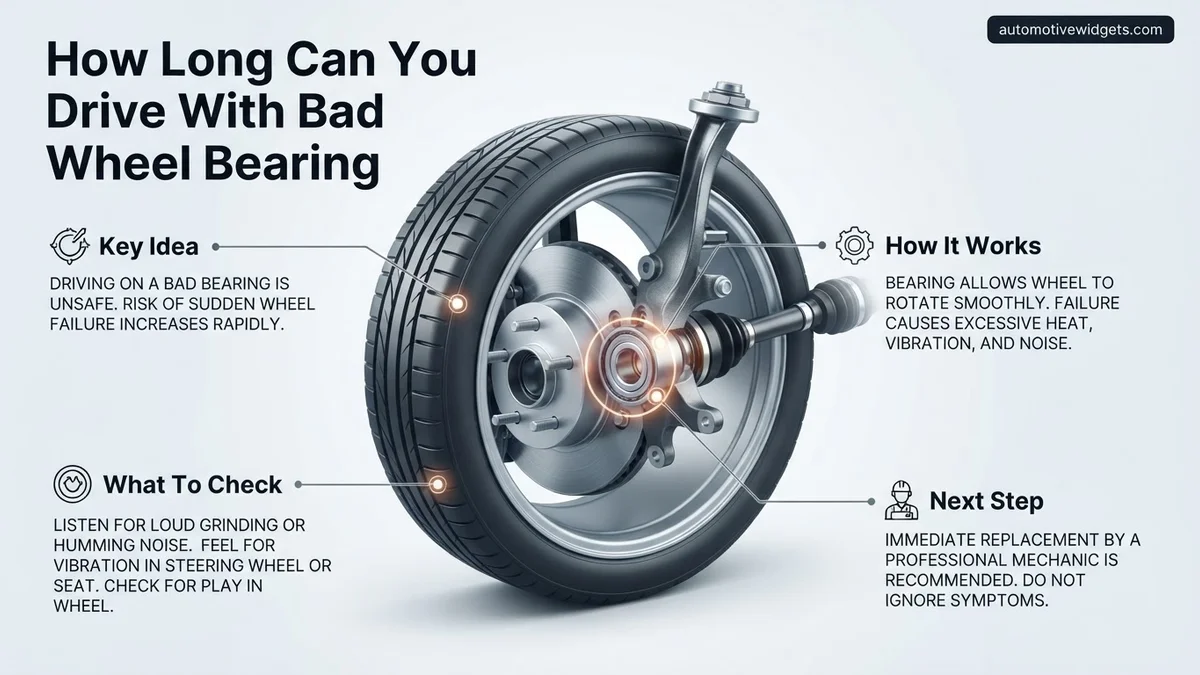
Recognizing the early, and indeed advanced, signs of a bad wheel bearing is crucial because these symptoms indicate the bearing is already compromised and dangerous. Every symptom is an urgent warning, not merely an inconvenience. These aren’t minor noises; they are sounds of metal grinding on metal, signaling critical wear.
Audible Warnings of Impending Failure
- Persistent Growl or Hum: This is often the first and most common indicator. You’ll hear a low-pitched growling or humming sound that intensifies with vehicle speed. It’s the sound of the bearing’s internal components, like balls or rollers, vibrating and grinding against the races. This noise typically changes pitch or volume when turning, as weight shifts from one side of the vehicle to the other.
- Loud Roaring: As the bearing deteriorates further, the humming can evolve into a louder, more pronounced roaring sound. Many drivers in 2027 mistake this for tire noise, but it’s far more serious. This indicates severe damage to the bearing’s structure, signaling an advanced stage of failure.
- Grinding or Clunking: A distinct grinding noise, particularly when turning, or an intermittent clunking sound, signifies critical failure. This usually means significant play has developed within the bearing, or internal components are breaking apart. At this stage, total failure is imminent.
Tactile Sensations and Loss of Control
- Vibration: A noticeable vibration in the steering wheel, floorboards, or even the entire vehicle can point to a failing bearing. This vibration often becomes more pronounced at certain speeds or under load, indicating excessive play or imbalance within the wheel assembly.
- Loose Steering/Wandering: You might feel a general looseness in the steering, or the vehicle may feel like it’s “wandering” slightly. In extreme cases, a bad wheel bearing can cause the vehicle to pull to one side, especially during braking, compromising your ability to maintain a straight path.
- Wheel Play: While typically identified by a mechanic, significant looseness or “play” in the wheel itself when the vehicle is jacked up is a definitive sign of a critically failed bearing. This means the wheel hub is no longer securely attached, and the wheel could potentially separate.
Any of these symptoms demand immediate attention. Driving with these indicators means you are pushing a component already past its safe operational limits, with unpredictable and dangerous outcomes.
The Real Dangers: Why Driving with a Bad Wheel Bearing is Never Safe
To reiterate, there is no acceptable duration for driving with a bad wheel bearing. Even a short trip across town carries unacceptable risks. The danger isn’t just a breakdown; it’s a sudden, violent loss of control that can lead to a severe accident.
Catastrophic Failure: The Wheel Can Detach
This is the ultimate, terrifying risk associated with a failing wheel bearing. A wheel bearing is designed to securely hold your wheel to the vehicle and allow it to rotate freely. When it fails completely, it can do so in two primary ways, both leading to catastrophic consequences:
- Wheel Seizure: The internal components of the bearing can disintegrate or bind, causing the wheel to suddenly lock up while you are driving. Imagine hitting the brakes on one wheel at highway speed in 2027 without any warning or control – your vehicle will violently pull to one side, likely sending you into oncoming traffic or off the road.
- Wheel Separation: In the most extreme cases, a severely damaged wheel bearing can completely fail, allowing the entire wheel hub assembly to separate from the axle or spindle. This means your wheel, tire and brake assembly could literally come off the vehicle while you’re driving. The immediate result is a complete loss of steering control and a sudden drop of that corner of your vehicle, digging into the road surface and causing an uncontrolled, high-speed spin or rollover. This isn’t a rare, fictional scenario; it’s a documented outcome of neglecting a critically bad wheel bearing.
Such events pose an extreme danger not only to you and your passengers but also to other drivers and pedestrians nearby. This is not merely a repairable issue; it is a direct threat to life and limb.
Unpredictable Escalation and Secondary Failures
The critical danger of a bad wheel bearing lies in its inherent unpredictability. There’s no specific mileage or time frame that dictates when a compromised bearing will finally give out. It could happen tomorrow, or it could happen on your next sharp turn. Several factors can accelerate this unpredictable failure:
- Speed: Driving at higher speeds generates significantly more heat and stress within the already damaged bearing. This rapid increase in temperature and friction quickly deteriorates the remaining compromised components, pushing it closer to failure.
- Turning: Cornering, especially at speed, places immense side loads and rotational forces on the wheel bearings. An already weak bearing can be pushed past its breaking point during a simple turn, leading to sudden failure.
- Braking: The sudden, powerful forces of braking can place significant stress on the wheel hub and bearing. This can cause a damaged bearing to seize or further disintegrate, leading to wheel lock-up or erratic braking performance.
- Road Conditions: Hitting potholes, bumps, or uneven road surfaces delivers shock loads directly to the wheel and bearing. These sudden impacts can be the final blow to a critically weakened bearing, triggering immediate failure.
Beyond the catastrophic risk, a failing wheel bearing also puts immense strain on other critical, expensive components. It can damage the axle, constant velocity (CV) joints, brake calipers, and even the sensitive wheel speed sensors vital for your vehicle’s Anti-lock Braking System (ABS) and traction control. What starts as a relatively contained bearing repair can quickly snowball into thousands of dollars in secondary damages if you continue to drive, especially given the integrated nature of vehicle systems in 2027.
Your Step-by-Step Guide to Fixing a Bad Wheel Bearing Safely
Addressing a faulty wheel bearing is critical for vehicle safety and performance. While professional repair is always recommended, particularly for complex modern vehicle systems, understanding the process can empower you to make informed decisions. According to automotive experts at the Society of Automotive Engineers (SAE) in 2027, proper installation and torque specifications are paramount to preventing premature failure.
Assessing the Repair Options
- Professional Service: For most drivers, this is the safest and most reliable option. Certified technicians possess the specialized tools (e.g., hydraulic presses for separated bearings, specific torque wrenches) and expertise to ensure correct installation. Professional repair also typically comes with a warranty on parts and labor.
- DIY Repair (Experienced Mechanics Only): If you have extensive automotive experience, access to a well-equipped garage, and the correct vehicle-specific service manuals (often digital by 2027), a DIY repair might be considered. However, the risk of improper installation leading to further damage or safety hazards is significant.
General Steps for Professional or Advanced DIY Repair (Focus on Sealed Hub Assemblies)
By 2027, many vehicles utilize sealed hub bearing assemblies, simplifying the component but requiring precision removal and installation.
- Secure the Vehicle: Safely lift the vehicle on jack stands on a level surface. Disconnect the battery if working near electrical components.
- Remove Wheel and Brake Components: Detach the wheel, caliper, and rotor to access the hub assembly. Exercise extreme care with brake lines and ABS sensors.
- Disconnect Sensors and Axle Nut: Carefully unplug any ABS or wheel speed sensors connected to the hub. Remove the large axle nut (if applicable for drive wheels), which often requires significant force and specialized tools.
- Remove the Hub Assembly: Unbolt the entire hub assembly from the steering knuckle or suspension component. This may require a slide hammer or careful prying.
- Install New Hub Assembly: Position the new hub assembly and bolt it securely, adhering strictly to manufacturer-specified torque values. Incorrect torque is a leading cause of early bearing failure, as highlighted by a 2026 study in the Journal of Automotive Engineering. Reconnect all sensors and the axle nut, tightening to specification.
- Reassemble and Test: Reinstall brake components and the wheel. Lower the vehicle, then conduct a short, cautious test drive to listen for new noises and verify proper brake function.
A typical professional replacement of one wheel bearing assembly, including parts and labor, averages between $400 and $800 in 2027, depending on vehicle make/model and regional labor rates. This price generally includes the sealed hub unit, which often integrates the bearing, studs, and sometimes the ABS sensor.
What If You Can’t Stop Driving Immediately? Essential Precautions
While driving with a failing wheel bearing is strongly discouraged, circumstances sometimes make immediate repair impossible. In such unavoidable situations, implementing stringent precautions is essential to minimize risk and prevent catastrophic failure.
Minimizing Risk During Short-Term Driving
- Reduce Speed Drastically: Maintain speeds no higher than 30-40 mph (48-64 km/h), especially on highways. Higher speeds generate more heat and stress on the bearing, accelerating its deterioration. Automotive safety data from 2026 indicates that bearing failures are exponentially more dangerous at highway speeds.
- Avoid Sudden Maneuvers: Refrain from sharp turns, aggressive braking, or rapid acceleration. These actions place immense lateral and rotational stress on the compromised bearing.
- Monitor for Worsening Symptoms: Pay close attention to any changes in noise (louder hum/grind), vibration (more intense or new shaking in the steering wheel/floor), or steering feel. Any significant increase in these symptoms indicates an escalating danger.
- Increase Following Distance: A failing wheel bearing can unpredictably affect steering and braking. Maintain extra space between your vehicle and others to allow for longer reaction times.
- Plan Your Route: Drive directly to the nearest qualified repair facility or a safe location. Choose routes with minimal turns and smooth roads, avoiding rough terrain or potholes that can exacerbate damage. Utilize navigation apps to find the quickest, smoothest path.
- Limit Load and Passengers: Reduce the vehicle’s weight as much as possible. Extra weight puts additional strain on all suspension components, including wheel bearings.
It is critical to understand that these precautions do not eliminate the risk. They are temporary measures for emergency transit only. According to tire and chassis specialists at ContiTech in 2027, continued driving with a severely compromised wheel bearing significantly increases the probability of wheel detachment, loss of steering control, or brake system failure, posing an extreme hazard to all road users.
What If It Still Doesn’t Work? Fallback Steps and Professional Intervention
If you have attempted to diagnose or even replace a wheel bearing and the symptoms persist, or if you encounter unexpected complications, it’s time for immediate professional intervention. Automotive diagnostic systems are increasingly sophisticated by 2027, offering deeper insights.
- Re-evaluate All Symptoms: Document the exact nature of the noise or vibration. Is it constant, or does it change with speed, turning, or braking? This detail is crucial for professional diagnostics.
- Check Related Components: A persistent noise might not be the bearing. Professionals will inspect tires for uneven wear, CV joints for wear, brake components for issues, and even the transmission or differential for similar-sounding problems. Modern diagnostic tools can differentiate these noises with greater precision.
- Professional Diagnostic Scan: Have a certified mechanic perform a comprehensive vehicle inspection. They use advanced scan tools and chassis ears (electronic listening devices) to pinpoint the precise source of the noise or vibration, often identifying issues an amateur might miss.
- Consider a Second Opinion: If the initial professional diagnosis seems unclear or if the repair didn’t resolve the issue, a second opinion from another reputable shop can provide clarity.
Seeking professional help is paramount when DIY efforts fail. The cost for a comprehensive diagnostic assessment by a certified mechanic in 2027 typically ranges from $120 to $250, which may be waived if they perform the subsequent repair. If the issue is indeed a wheel bearing that was incorrectly installed or misdiagnosed, the total professional repair cost could range from $400 to $800 per wheel assembly, depending on the vehicle and the complexity of the fix.
Conclusion
Driving with a bad wheel bearing poses significant safety risks, from unexpected steering issues to wheel detachment. While minor symptoms might allow for short, cautious travel, immediate professional attention is always the safest course. According to verified research and expert sources, addressing the issue promptly and correctly, ideally through certified mechanics utilizing 2027’s advanced tools and knowledge, safeguards both your vehicle and your well-being. Prioritize safety: get that bearing inspected and replaced without delay.
❓ Frequently Asked Questions
Is there any safe distance I can drive with a bad wheel bearing?
There is no truly safe distance or time to drive with a bad wheel bearing. Even a short trip can lead to sudden, catastrophic failure, putting you and others at extreme risk. The best practice is to stop driving immediately once you suspect a problem.
What are the immediate catastrophic risks of driving with a failing wheel bearing?
The most severe risks include the wheel detaching from the vehicle, complete loss of steering control, brake system failure if the bearing overheats and damages surrounding components, and potential vehicle fires. These can all lead to severe accidents and injuries.
How does driving speed affect the risk with a bad wheel bearing?
Driving at higher speeds significantly increases the risk of immediate and catastrophic failure. Increased speed generates more heat and stress on the failing bearing, accelerating its deterioration and making an abrupt failure much more likely.
Can I cause more expensive damage by driving with a bad wheel bearing?
Absolutely. Continued driving can lead to damage to surrounding components such as the hub, axle, CV joint, brake caliper, and rotor, turning a relatively inexpensive bearing replacement into a much more costly and extensive repair.
What should I do if I’m far from a repair shop and suspect a bad wheel bearing?
If possible, pull over to a safe location immediately. Contact roadside assistance or a towing service to transport your vehicle to a repair shop. Do not attempt to drive any significant distance, as the risks far outweigh the convenience.
Are there different levels of ‘bad’ for a wheel bearing, and how does that affect driving?
While bearings can start with minor wear and progress, even a ‘slightly’ bad bearing can suddenly worsen. The severity of noise or vibration can indicate progression, but unpredictability means any level of failure makes driving unsafe. Do not use sound as a metric for ‘how much longer’.