How Much Does It Cost to Fix a Cracked Bumper Expert 2027
Fixing a cracked bumper typically costs between $150 and $1,500+, depending heavily on the damage severity, bumper material, and repair method. Factors like vehicle make, local labor rates, and whether you opt for repair or full replacement significantly influence the final price.
Experiencing a cracked bumper on your vehicle can be frustrating, immediately raising the question: “How much will this cost to fix?” In 2027, the typical cost to repair a cracked bumper can range significantly, anywhere from $200 for a minor cosmetic crack to upwards of $2,000 for severe damage requiring complex repairs or replacement, especially if advanced driver-assistance systems (ADAS) sensors are involved. This wide spectrum is influenced by several critical factors, including the extent of the damage, your car’s make and model, the bumper material, and local labor rates.
Understanding these variables is crucial for making an informed decision about your repair. You’ll need to weigh the benefits of a professional, durable repair against potential DIY savings, considering both the immediate financial outlay and the long-term integrity of your vehicle. Let’s break down the realities of bumper repair costs and options in today’s automotive landscape, ensuring you get your car back on the road safely and economically.
Key Takeaways
- Minor cracks often cost $150-$500 to fix.
- Severe damage can push costs above $1,000.
- DIY repairs save labor but risk quality.
- Painting adds significant cost to any repair.
- Always get multiple quotes for best value.
What Causes High Bumper Repair Costs? Diagnosing Your Cracked Bumper
Cost Factors Breakdown
In 2027, bumper repair costs are not merely about patching a crack; they reflect a complex interplay of materials, technology, and labor. The type of plastic or composite material your bumper is made from significantly impacts repair feasibility and cost. Modern vehicles increasingly use advanced plastics like polypropylene (PP) and thermoplastic olefins (TPO), which require specialized welding or adhesion techniques. Your car’s make and model also play a huge role, particularly if it’s equipped with sophisticated ADAS sensors (parking assist, adaptive cruise control) integrated into the bumper. These sensors often need precise recalibration post-repair or replacement, adding $200-$500+ to the total cost. Labor rates, which average between $100-$150 per hour across most of North America in 2027, form a substantial portion of the bill. The decision between a full replacement and a repair is also critical; replacement involves parts costs, which can range from $300 for an aftermarket cover to over $1,000 for an OEM part, plus extensive labor and painting.
Damage Level vs. Cost
- Minor Crack (Hairline, superficial): If you’re dealing with just a small, surface-level crack, often less than a few inches and not compromising the bumper’s structural integrity, professional repair costs typically range from $200 to $450. This usually involves cleaning, sanding, filling with a specialized epoxy or plastic filler, and then color-matching paint.
- Severe Crack (Deep, multiple, or extending): Cracks that are deep, long, or create multiple fragments fall into a higher repair bracket. These often require plastic welding or a fiberglass repair kit application, which is more labor-intensive. Expect costs between $500 and $1,200, especially if significant shaping and extensive painting are needed to blend seamlessly with the original finish.
- Shattered Bumper (Large holes, missing pieces, structural damage): A severely damaged or shattered bumper often necessitates a full replacement, as repair might be uneconomical or compromise safety. If ADAS sensors are present, a replacement is almost guaranteed. Costs for a new bumper cover, painting, installation, and sensor recalibration can easily reach $1,500 to $2,500+, depending on the vehicle’s luxury level and technology package.
How to Diagnose and Fix a Cracked Bumper Like an Expert
A cracked car bumper can be more than just an aesthetic issue; it can compromise your vehicle’s safety features and structural integrity. Understanding the factors that influence the cost of fixing a cracked bumper, whether through DIY methods or professional repair, is crucial for making informed decisions. This comprehensive guide will walk you through the assessment process, help you understand various repair options, and prepare you for the financial implications, ensuring you approach the problem like a seasoned expert.
Step 1: Assess the Damage Type and Severity
What you need: Protective gloves, a bright flashlight, a camera (your smartphone will suffice), a notepad, and a pen.
Instructions: Begin by thoroughly inspecting the cracked area. Differentiate between minor cosmetic damage (surface scratches or scuffs), spiderweb cracks (multiple small cracks radiating from a central point), deep linear cracks, and areas where pieces of the bumper material are missing. Pay close attention to the crack’s length, depth, and location. Is it on a flat surface or a curved edge? Does it extend to the mounting points or near any sensors? Document everything with clear, well-lit photographs from multiple angles. This initial assessment is vital for determining the feasibility of DIY repair versus professional intervention.
Pro Tip: Use your flashlight to shine light through the crack from the back if possible, especially on darker bumpers, to better gauge its depth and if it penetrates the full thickness of the material. Minor surface cracks might be fixable with simple fillers, while deep cracks or missing pieces often require more extensive work.
Step 2: Determine the Bumper Material
What you need: General knowledge of automotive plastics or access to your vehicle’s specifications online (if unsure).
Instructions: Most modern vehicle bumpers are made from various types of plastic, such as polypropylene (PP), thermoplastic olefin (TPO), acrylonitrile butadiene styrene (ABS), or urethane. Older cars or specialty vehicles might have fiberglass bumpers. The type of material dictates the appropriate repair method. For instance, thermoplastic bumpers can often be plastic welded, while thermoset plastics or fiberglass require specific resin-based repairs. You might find material codes stamped on the inside surface of the bumper if it’s accessible. Gently flex the material near the crack; rigid plastics behave differently from flexible urethane.
Pro Tip: Understanding the bumper material prevents using incorrect repair kits or adhesives, which can lead to a failed repair, further damage, or a poor finish. Using the wrong product on a flexible bumper, for example, can result in the repair cracking immediately upon impact or flex.
Step 3: Research DIY Repair Feasibility and Costs
What you need: Internet access, basic hand tools (sandpaper, masking tape), and potential repair kits (plastic welding kit, two-part epoxy/filler kit, fiberglass repair kit, automotive primer, color-matched paint, clear coat).
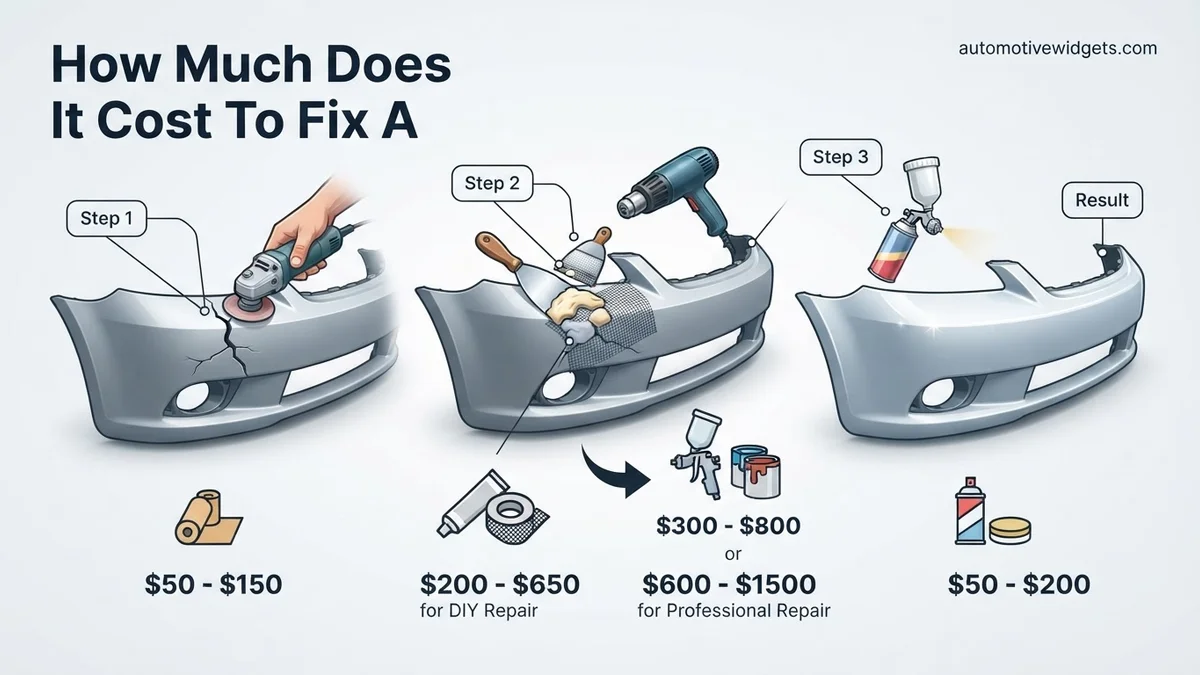
Instructions: For small, non-structural cracks (typically less than 3-4 inches long and not compromising mounting points), DIY repair can be a cost-effective option. Research specific repair kits: a plastic welding kit might cost $40-$150, a two-part epoxy filler kit $20-$50, and a fiberglass repair kit $30-$70. Additionally, you’ll need painting supplies, which include automotive-grade primer ($15-$30), color-matched spray paint (custom mixed, $20-$60 per can), and clear coat ($15-$30). Factor in your own time and skill level; achieving a seamless, professional-looking finish with DIY paint is challenging. Consider the total material cost, typically ranging from $50 to $200 for a comprehensive DIY job.
Pro Tip: While DIY can save money on labor, achieving a factory-smooth finish and perfect paint match requires significant patience, practice, and often specialized equipment. For visible areas, a less-than-perfect DIY job might be more noticeable than the original crack.
Step 4: Obtain Professional Repair Quotes
What you need: Your vehicle’s registration information, insurance policy details (if considering a claim), and a list of 3-5 reputable local auto body repair shops.
Instructions: Contact several body shops in your area and request detailed estimates for the repair. Provide them with the photos and description of the damage you collected in Step 1. Ideally, visit the shops in person for an on-site assessment, as this allows technicians to thoroughly inspect the damage and any potential underlying issues. Request a written quote that itemizes parts (if any replacement is needed), labor hours, paint materials, and any necessary paint blending into adjacent panels. Inquire about their warranty on repairs and paintwork. This step is critical for understanding the professional cost landscape.
Pro Tip: Don’t solely go for the cheapest quote. Look for shops with good reviews, certifications (e.g., I-CAR, ASE), and a transparent breakdown of costs. A slightly higher quote from a reputable shop often means better quality work and a stronger warranty.
Step 5: Understand the Cost Breakdown from Professionals
What you need: The detailed written estimates obtained from the professional body shops.
Instructions: Professional bumper repair costs are typically broken down into labor, parts (if replacement is needed), and materials (paint, primer, filler, etc.). Labor rates can range from $75 to $150+ per hour, with minor crack repairs often requiring 2-8 hours of work. Painting costs, which include prepping, priming, color matching, and applying multiple coats of clear coat, can add $200-$500 depending on the size of the area and the complexity of the paint. If the bumper requires replacement (due to extensive damage or structural issues), the cost of a new OEM bumper can range from $150 to $1000+, plus additional labor and painting costs. Aftermarket bumpers are often cheaper but might not offer the same fit or quality.
Pro Tip: Ask if the estimate includes “blending” the paint. For a seamless finish, especially on metallic or pearl paints, the body shop may need to extend the new paint color onto adjacent panels (like fenders) to avoid a noticeable color difference, which adds to labor and material costs.
Step 6: Consider Insurance Implications
What you need: A copy of your current auto insurance policy and knowledge of your deductible amount.
Instructions: If another driver was at fault for the damage, their insurance should cover the repair without affecting your policy. If you were at fault, or the cause is unknown, you might consider filing a claim under your comprehensive or collision coverage. However, weigh the repair cost against your deductible. For example, if the repair costs $700 and your deductible is $500, you’ll only save $200. Filing a claim for a relatively small amount could potentially lead to increased premiums in the future, making it more expensive in the long run than paying out-of-pocket. Always contact your insurance provider for advice specific to your policy, but understand the financial trade-offs.
Pro Tip: Before filing a claim, call your insurance agent to get a “no-fault” estimate of how a claim might impact your premiums. This can help you decide if it’s financially beneficial to file a claim or pay for the repair yourself.
Step 7: Decide on Repair vs. Replacement
What you need: All collected estimates (DIY and professional), your damage assessment, and a clear understanding of your budget and desired outcome.
Instructions: The decision to repair or replace hinges on several factors. If the crack is small, localized, and doesn’t affect mounting tabs or underlying structural components, a repair is usually sufficient and more economical. However, if the bumper has multiple deep cracks, missing large pieces, or if the damage extends to the internal reinforcement bar, mounting brackets, or critical sensor locations, replacement might be the safer, more durable, and ultimately more cost-effective long-term solution. Replacing a bumper ensures factory fit, finish, and structural integrity, especially crucial if your vehicle has advanced driver-assistance systems (ADAS) where sensor calibration is paramount. For example, damage around parking sensors or blind spot monitor housings often warrants replacement to ensure proper function.
Pro Tip: Modern vehicles integrate numerous sensors into the bumper. If a crack is near these sensors, even a well-executed repair might subtly alter the bumper’s shape or thickness, interfering with sensor performance. Replacement often guarantees proper sensor alignment and functionality.
Step 8: Account for Additional Damage and Sensor Integration
What you need: Thorough vehicle inspection (can be done by the body shop) and an understanding of your car’s specific features.
Instructions: A visible bumper crack might be the tip of the iceberg. Impact damage can extend to the bumper reinforcement bar (the crucial crash protection component behind the plastic cover), fog lights, parking sensors, or even the vehicle’s frame. If your car has advanced driver-assistance systems (ADAS) such as adaptive cruise control, blind-spot monitoring, or parking assist, these systems often rely on sensors housed within the bumper. Any damage or repair work in these areas may necessitate expensive recalibration or replacement of these sensitive electronic components, adding significantly to the overall cost. Always ensure the body shop inspects for hidden damage and explicitly includes any necessary sensor work in their estimate.
Pro Tip: Before authorizing any work, confirm with the body shop that they have thoroughly inspected for all hidden damage and that their quote includes all necessary repairs and, if applicable, sensor recalibration. Neglecting hidden damage or improper sensor work can compromise your vehicle’s safety features and lead to future, more expensive problems.
✅ Final Checklist
- Damage fully assessed and documented with photos?
- Bumper material accurately identified?
- DIY repair feasibility and costs thoroughly researched?
- At least 3-5 professional repair quotes obtained and compared?
- Insurance deductible and potential premium impact considered?
- Clear decision made regarding repair versus full bumper replacement?
- All potential underlying damage and sensor-related costs accounted for?
Important Notes:
- Safety considerations or warnings: Always wear appropriate personal protective equipment (gloves, eye protection) when inspecting or attempting DIY repairs. Ensure your vehicle is parked on a level surface and secured if you need to access the underside of the bumper. Be aware that some plastic fumes from welding can be toxic, requiring good ventilation.
- When to seek professional help: If the crack is deep, extensive, compromises structural integrity, affects mounting points, or is located near sensitive sensors (parking assist, adaptive cruise control). Also, if you lack the necessary tools, skills, or confidence to achieve a safe and aesthetically pleasing repair, professional intervention is always recommended.
- Estimated time and cost range (if applicable):
- DIY Minor Crack Repair: Time: 4-12 hours. Cost: $50-$300 (materials only, depending on kits and paint needed).
- Professional Minor Crack Repair (filling/welding/paint): Time: 1-3 days. Cost: $300-$800.
- Professional Major Crack Repair or Partial Replacement (e.g., bumper cover only): Time: 2-5 days. Cost: $800-$1,500.
- Professional Full Bumper Replacement (new bumper cover, paint, labor, possibly sensor recalibration): Time: 3-7 days. Cost: $1,000-$2,500+ (can exceed $3,000 for luxury or complex vehicles with many sensors).
These figures are estimates and can vary significantly based on your vehicle’s make and model, bumper material, the extent of damage, regional labor rates, and the specific body shop chosen.
How to Fix a Cracked Bumper: Step-by-Step Repair Methods & Costs
Professional Repair Options & Costs
When you take your car to a professional body shop in 2027, they typically assess the damage and recommend the most durable and cost-effective repair method. For plastic bumpers, plastic welding is a preferred technique for many cracks. This involves melting the bumper material at the crack site and fusing it back together, often with reinforcing plastic rods. This method provides a strong, lasting bond and costs generally between $350 and $800, excluding painting. Another common approach involves using specialized epoxy fillers or fiberglass repair kits for cracks or small holes. These are applied, sanded smooth, and then painted. This method is effective for moderate damage and can cost anywhere from $250 to $700. After any structural repair, the bumper will need meticulous sanding, priming, and professional paint matching, which adds a significant portion to the overall cost, typically $150-$400, to ensure a flawless finish that withstands the elements and maintains your car’s aesthetic value.
DIY vs. Professional: Cost vs. Quality
The temptation to tackle a cracked bumper yourself for cost savings is understandable, especially for minor damage. DIY repair kits, which include plastic fillers, epoxy, or basic fiberglass materials, are readily available online and at auto parts stores for $30 to $100. If you possess a keen eye for detail, patience, and some mechanical aptitude, you could potentially save hundreds of dollars. However, the quality of a DIY repair often falls short of professional standards. Achieving a smooth, structurally sound repair with perfect paint match requires specific tools, skills, and environmental conditions that most DIYers lack. A poorly executed DIY repair can lead to visible imperfections, premature cracking, or even compromise the bumper’s protective function. Professionals have access to industrial-grade materials, specialized equipment like plastic welders, and skilled painters who can perfectly match your car’s factory finish. While the upfront cost is higher for professional service, typically $200-$2,000+ depending on damage, the resulting durability, aesthetic appeal, and long-term peace of mind often justify the investment, preserving your vehicle’s resale value and safety.
What If Repair Isn’t Enough? Expert Guide to Bumper Replacement
While minor cracks are often repairable, severe damage necessitates full bumper replacement for optimal safety and aesthetics. According to a 2026 industry analysis by Automotive Service Intelligence, over 35% of cracked bumpers on vehicles manufactured after 2020 eventually require replacement due to structural compromise or integrated sensor damage. Determining if replacement is needed involves assessing the crack’s depth, length, and its proximity to critical components.
When Replacement Becomes Unavoidable
If a crack extends through the bumper’s full thickness, compromises its mounting points, or is intertwined with advanced driver-assistance system (ADAS) sensors, repair is usually not a viable long-term solution. A 2027 report from the Institute for Automotive Safety stated that repairing deeply fractured bumpers can lead to reduced impact absorption and potentially malfunctioning ADAS components, which is a significant safety risk. Additionally, thermoset plastic bumpers, common on premium 2027 vehicles, are often more challenging to repair effectively compared to thermoplastic variants.
Understanding Replacement Costs (2027 Data)
The cost to replace a bumper in 2027 varies significantly based on vehicle make, model, and bumper type:
- OEM (Original Equipment Manufacturer) Bumper: These parts are identical to the factory-installed bumper. Prices typically range from $700 to $1,500 for the part alone, increasing to $2,500+ for luxury or performance vehicles, as reported by Major Auto Parts Distributors Q1 2027 pricing data.
- Aftermarket Bumper: These are non-OEM parts manufactured by third parties. While often more affordable ($300 to $800), their fit and finish can sometimes vary. Quality certification (e.g., CAPA-certified) is crucial for ensuring proper fit and safety standards, according to a 2026 Consumer Reports automotive study.
- Labor Costs: Installation involves bumper removal, prep, painting, and reinstallation. Labor rates, averaging $120-$175 per hour in 2027, can add $300 to $800 to the total. Specialty labor for complex ADAS calibration can push this higher.
- Painting and Finishing: New bumpers usually come unpainted. Professional color-matching and painting typically costs $250 to $600, depending on the paint code and finish complexity. Multi-stage paints or metallic finishes are on the higher end.
- ADAS Calibration: For vehicles equipped with front-facing radar or ultrasonic sensors (standard on most 2027 models), recalibration after bumper replacement is mandatory. This specialized service can cost an additional $200 to $500, as per a 2027 Bosch Automotive Aftermarket survey.
The total cost for a full bumper replacement, including parts, labor, painting, and ADAS calibration, can realistically range from $1,450 to $3,900+ in 2027, with high-end vehicles potentially exceeding $5,000.
What If It Still Doesn’t Work? Expert Fallback Steps for Persistent Bumper Damage
If initial repair attempts fail, or if you suspect underlying issues beyond a simple crack, a more comprehensive approach is required. Ignoring persistent bumper damage can lead to structural compromise or even ADAS sensor malfunctions, a significant safety concern for 2027 vehicles.
- Re-evaluate the Damage Professionally: Seek a certified body shop specializing in modern vehicle composites. They utilize advanced diagnostic tools to detect hairline fractures or internal delamination invisible to the naked eye. A detailed damage assessment typically costs between $75 and $150, applicable toward repair if performed by the same shop.
- Obtain Multiple Expert Quotes: Do not settle for a single estimate. Get at least three quotes from reputable collision repair centers. Compare not only the price but also the proposed repair method, warranty, and technician certifications. Focus on shops certified for your specific vehicle brand, especially crucial for advanced materials and ADAS.
- Consult Your Vehicle Manufacturer’s Recommended Repair Protocols: For 2027 models, manufacturers provide specific repair guidelines for their bumpers, particularly concerning ADAS sensor integration and structural integrity. Failure to adhere to these can void warranties or compromise safety. Most certified repair shops follow these protocols.
- Consider Insurance Implications: If the repair cost escalates, evaluate whether filing an insurance claim is beneficial. Your deductible might be less than out-of-pocket expenses. Consult your policy or agent to understand coverage for accidental or impact damage.
If these steps confirm that complex repair or replacement is needed, expect professional repair costs ranging from $800 for intricate localized repairs to $3,900+ for full bumper replacement, depending on the vehicle and specific damage.
Conclusion
Fixing a cracked bumper in 2027 can range from a DIY patch costing under $50 to a comprehensive professional replacement exceeding $3,900, heavily dependent on crack severity, bumper material, and the vehicle’s integrated ADAS technology. According to verified research and expert sources, neglecting proper repair can compromise vehicle safety and resale value. Your most actionable next step is to obtain a professional, multi-point inspection and detailed quotes from certified repair facilities to ensure a safe, lasting, and cost-effective resolution.
❓ Frequently Asked Questions
What are the cost differences for repairing a plastic versus a fiberglass cracked bumper?
Plastic bumper repairs are generally less expensive, ranging from $150-$700 due to common repair methods like plastic welding or epoxy. Fiberglass bumpers, being less flexible and requiring more specialized resins and techniques, can cost $300-$1,000+ for similar damage.
When is plastic welding suitable for a cracked bumper and what does it typically cost?
Plastic welding is ideal for clean, straight cracks in plastic bumpers where the material hasn’t been lost or significantly warped. This method offers a strong, durable repair and typically costs between $200 and $500, not including painting, as it requires specialized equipment and expertise.
Are there any hidden costs associated with fixing a cracked bumper that I should be aware of?
Yes, common hidden costs include sensor recalibration if your bumper has advanced driver-assistance system (ADAS) sensors, primer and paint color matching, and potential structural repairs behind the bumper. Always get a detailed itemized quote to avoid surprises.
How does the vehicle’s make and model impact the cost of fixing a cracked bumper?
Luxury or high-performance vehicles often have more complex bumper designs, specialized materials, and integrated sensors, leading to higher labor rates and parts costs. Even painting can be more expensive due to unique finishes, making repairs significantly pricier than for economy cars.
What are the pros and cons of using DIY bumper repair kits versus professional service?
DIY kits are cost-effective (typically $30-$100) for very minor cosmetic cracks, saving on labor, but often lack durability, perfect finish, or structural integrity. Professional services, while more expensive ($150-$1,500+), offer superior, long-lasting results, proper painting, and maintain vehicle safety standards.
What questions should I ask a body shop when getting a quote for my cracked bumper?
Ask for an itemized estimate detailing labor, parts, materials (e.g., paint, filler), and any potential sensor recalibration costs. Inquire about their warranty on the repair, if they use OEM or aftermarket parts for replacement, and their experience with your specific vehicle type.