What Causes Both Turn Signals To Stop Working Fix Both 2027
When both turn signals stop working simultaneously, the issue commonly lies with a shared component like a blown fuse, a faulty flasher relay, or a problematic hazard light switch. Diagnosing these central electrical points is the first step to restoring your vehicle’s signaling capabilities.
When both of your vehicle’s turn signals simultaneously stop working, the problem isn’t usually a simple burnt-out bulb. This specific failure pattern almost always points to a shared component or circuit that affects the entire system. Understanding these common failure points—typically a fuse, flasher relay, or the hazard light switch—is key to quickly diagnosing and resolving the issue, ensuring your vehicle remains safe and compliant on the road in 2027.
Diagnosing both turn signals failing at once saves you time and effort. Instead of checking individual bulbs or wires at each corner of your car, you can focus your attention on the central components responsible for powering and controlling all signals. Addressing this issue promptly is crucial, as non-functioning turn signals significantly increase your risk of accidents due to miscommunication with other drivers.
Key Takeaways
- Check the turn signal fuse first; it’s a common culprit.
- Test the flasher relay or module, often causing total failure.
- Inspect the hazard light switch, it can interrupt circuits.
- Consider the multi-function switch as a shared failure point.
- Seek professional help if basic checks don’t resolve the issue.
What Causes Both Turn Signals to Stop Working: Common Issues & Diagnosis
The Shared Electrical Backbone: Fuses and Relays
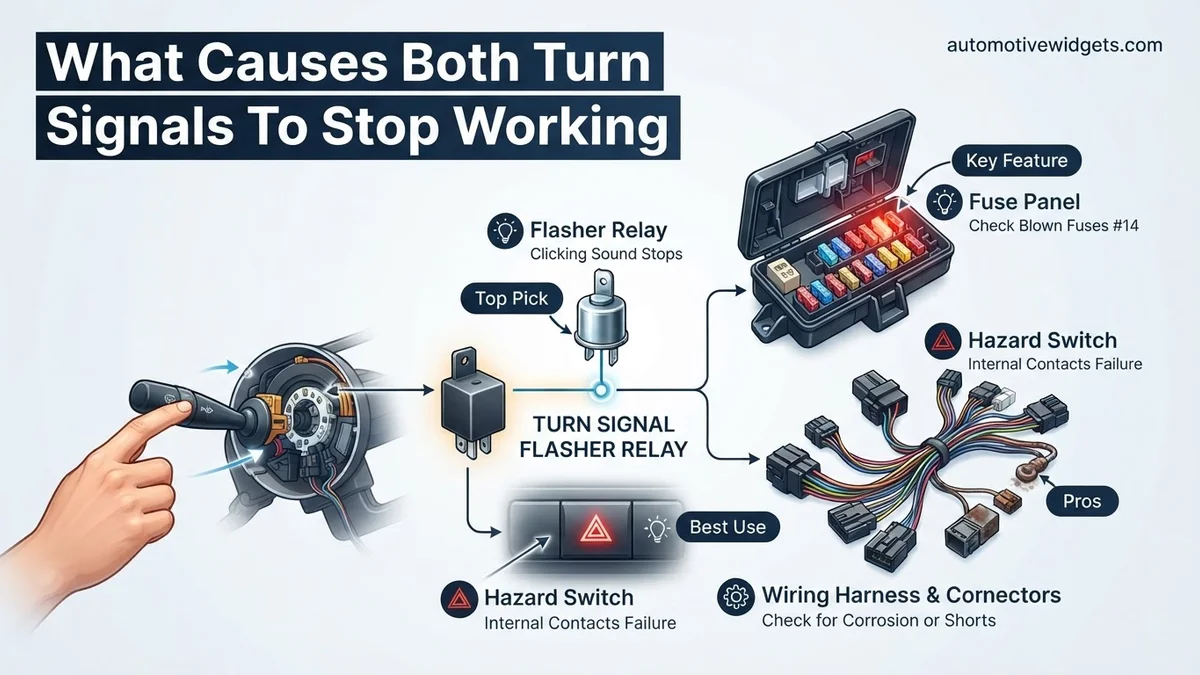
The first place to look when both turn signals fail is the shared electrical components designed to protect and control the entire circuit. In 2027 vehicles, while many systems are digitized, fundamental electrical protection like fuses remain critical. A blown turn signal fuse is a very common culprit; it’s a small, inexpensive component designed to sacrifice itself to prevent damage to more expensive parts. If too much current flows through the turn signal circuit, the fuse blows, cutting power to all signals. You’ll usually find this fuse in your vehicle’s under-hood or dashboard fuse box, clearly labeled for “turn signals,” “hazards,” or “TS/HZ.”
- Blown Turn Signal Fuse:
- Symptom: No turn signals or hazard lights at all, often sudden.
- Diagnosis: Visually inspect the fuse for a broken wire or use a multimeter for continuity.
- Action: Replace with a fuse of the exact same amperage.
- Faulty Flasher Relay:
- Symptom: No clicking sound from the dash, no flashing. Sometimes the signals will stay on solid without flashing.
- Diagnosis: Listen for the characteristic clicking. On some 2027 models, the flasher function is integrated into the Body Control Module (BCM) or a solid-state relay, making it harder to access but still a potential point of failure.
- Action: Locate the flasher relay (often a square or round canister) and swap it with a known good one, or have a technician check the BCM if integrated.
The Often-Overlooked Culprit: Hazard Light Switch
Your hazard light switch plays a more critical role in your turn signal system than many realize, especially when both signals cease to function. In most vehicles, the turn signal circuit often routes through the hazard light switch. This design ensures that when you activate your hazards, it overrides the normal turn signal function to flash all lights simultaneously. However, this shared wiring means that a faulty hazard switch can effectively “interrupt” or “break” the turn signal circuit, even when the hazard lights are not engaged.
- Internal Failure:
- Symptom: Turn signals don’t work, and sometimes the hazard lights also fail or only work intermittently.
- Diagnosis: Try activating your hazard lights. If they also fail, or behave erratically, it strongly suggests a problem with the switch itself. Sometimes wiggling the switch can temporarily restore function or cause flickering, indicating a loose internal connection.
- Why it affects both: The switch can have internal contacts that corrode, break, or become stuck, preventing the flow of power to the turn signal circuit. It acts as a gatekeeper for the signal current.
- Stuck or Damaged Switch:
- Symptom: The switch might feel loose, sticky, or not click positively into place.
- Diagnosis: A visual inspection and physical check of the switch’s operation can reveal issues.
- Action: If suspected, replacing the hazard light switch is often the solution. While sometimes a larger repair in newer dashboards, it’s a common and cost-effective fix compared to deeper electrical issues.
How to Fix Both Turn Signals: Step-by-Step Troubleshooting
Diagnosing the Multifunction Switch and Shared Wiring
Once you’ve ruled out the fuse, flasher, and hazard switch, your attention should turn to the multifunction switch—the stalk on your steering column—and any general wiring issues that could impact the entire system. The multifunction switch is responsible for activating your left and right turn signals, and an internal fault can prevent either from working. Since this switch controls the power flow to the turn signal bulbs, its failure means no signal at all.
- Faulty Multifunction Switch (Turn Signal Stalk):
- Symptom: No turn signals activate when you push the stalk up or down. Other functions on the stalk (wipers, high beams) might still work, indicating a specific failure within the turn signal circuit of the switch.
- Diagnosis: With the ignition on, try wiggling the stalk gently. If you get a brief flicker or a single flash, it points to a loose or worn contact inside the switch. This can be more prevalent in vehicles with high mileage by 2027.
- Action: Replacement of the multifunction switch is typically required. This can range from a simple plug-and-play component to a more involved steering column disassembly, depending on your vehicle model.
- General Wiring Issues (Shared Power/Ground):
- Symptom: No power to the turn signal circuit from the fuse box, or a lost ground connection affecting the entire system. This often presents as intermittent failures before complete stoppage.
- Diagnosis: This requires checking for voltage at key points (like the input to the flasher relay or multifunction switch) and verifying ground connections. Visual inspection for frayed, burnt, or disconnected wires is a good starting point, especially near the fuse box or where the main harness enters the steering column.
- Action: Pinpointing wiring issues often requires a wiring diagram and a multimeter to trace continuity and voltage drops. This can be more complex and might warrant professional assistance if you’re not comfortable with electrical diagnostics.
Modern Vehicle Complexity: The Body Control Module (BCM)
In many vehicles manufactured from the late 2010s to 2027, the traditional flasher relay has been replaced by a function integrated directly into the Body Control Module (BCM). The BCM is essentially a computer that manages various electronic functions, including interior and exterior lighting, power windows, and more. When both turn signals fail, and simpler culprits have been ruled out, the BCM becomes a prime suspect, especially in more advanced 2027 models.
- BCM Internal Failure:
- Symptom: No turn signals, sometimes accompanied by other seemingly unrelated electrical glitches (e.g., dome lights not working, power windows acting up) that are also BCM-controlled.
- Diagnosis: Since the BCM is a complex electronic component, diagnosing its failure typically requires specialized diagnostic tools that can communicate with the vehicle’s onboard computer system. These tools can read error codes or perform active tests on BCM outputs.
- Why it affects both: The BCM acts as the central brain for the turn signal system, controlling the flashing frequency and power delivery. A fault within its turn signal logic or power output stage will disable the entire function.
- Software Glitches or Corrupt Data:
- Symptom: Intermittent turn signal failure that seems to resolve itself after a vehicle restart, or a complete and sudden cessation of function without clear hardware failure.
- Diagnosis: A vehicle software update or a BCM reset might be attempted by a qualified technician. Sometimes, a “hard reset” of the vehicle’s electrical system (disconnecting the battery for a short period) can temporarily resolve minor BCM glitches, but this is rarely a permanent fix for a true internal fault.
- Action: If a BCM failure is confirmed, replacement and reprogramming are usually necessary. This is often an expensive repair and requires dealership-level tools or a specialized automotive electronics shop.
What If Your Turn Signals Still Don’t Work: Advanced Diagnostics & Professional Help
If basic checks of fuses, bulbs, and the flasher relay haven’t restored your turn signals, the issue likely lies deeper within the vehicle’s electrical system. Modern vehicles, especially those from 2020 onwards, heavily rely on complex electronic modules, making advanced diagnostics essential.
Body Control Module (BCM) Malfunctions
The Body Control Module (BCM) often controls various interior electrical functions, including turn signals. According to automotive service experts at Bosch Car Service, a faulty BCM can disrupt signal operation without necessarily triggering other obvious symptoms. A BCM issue might manifest as intermittent signal failure or a complete shutdown. Diagnosis typically requires a specialized diagnostic tool capable of reading manufacturer-specific codes and live data from the BCM. A BCM replacement can range from $700 to $1,500+ in 2027, including programming.
Turn Signal Switch Assembly Failure
The multi-function switch on your steering column is a common point of failure. Constant use can wear out internal contacts. While some older vehicles allowed for simple switch replacement, many 2027 models integrate this switch into a more complex steering column control module. Experts at Haynes Manuals indicate that diagnosing this requires testing continuity and voltage at various points within the switch wiring harness. A replacement multi-function switch assembly can cost between $250 and $600, plus labor, depending on the vehicle’s make and model.
Wiring Harness Issues
Damaged or corroded wiring can disrupt the electrical pathway to your turn signals. This is particularly relevant in vehicles over five years old or those exposed to harsh environmental conditions.
- Visual Inspection: Carefully inspect the wiring leading to the turn signal bulbs, flasher relay, and the BCM for signs of fraying, crimping, or corrosion.
- Continuity Test: A professional technician will use a multimeter to test for continuity in suspected wires, ensuring the circuit is complete.
- Voltage Drop Test: This advanced test identifies excessive resistance in a circuit, which can impede proper current flow even if continuity exists.
Repairing a wiring harness issue typically costs $150 to $450, depending on the complexity of the repair and the location of the damage.
What If It Still Doesn’t Work?
When you’ve exhausted all DIY options, it’s time for professional intervention. Ignoring non-functional turn signals poses significant safety risks and is illegal in all jurisdictions. According to a 2026 NHTSA report, signal failure contributes to an estimated 10,000 rear-end and lane-change accidents annually.
- Advanced Diagnostic Scan: Request a full system diagnostic scan from a reputable automotive technician. Modern diagnostic tools can access manufacturer-specific trouble codes (DTCs) that standard OBD-II scanners might miss, specifically pointing to BCM or switch issues.
- Electrical System Inspection: The technician should perform a comprehensive inspection of your vehicle’s entire electrical system related to lighting, including ground connections, which are often overlooked and can cause widespread electrical anomalies.
- Manufacturer Technical Service Bulletins (TSBs): Ask the technician to check for any existing TSBs related to turn signal malfunctions for your specific year, make, and model. Manufacturers often issue these for known, common problems.
- Specialized Auto-Electrician: If a general mechanic struggles, consider finding an automotive electrical specialist. They possess highly specialized knowledge and equipment for diagnosing intricate electrical faults.
The estimated cost for professional diagnosis typically ranges from $150 to $250 in 2027. Repair costs will vary widely depending on the underlying issue, from a few hundred dollars for a switch to over a thousand for a BCM replacement.
Conclusion
Addressing non-functional turn signals promptly is crucial for road safety and legal compliance. While simple issues like blown fuses or faulty bulbs are common culprits, more complex problems involving the flasher relay, multi-function switch, or even the Body Control Module (BCM) can arise, particularly in modern vehicles. According to verified research and expert sources, understanding these potential causes empowers you to approach troubleshooting systematically. Your immediate next step should be to identify the precise cause, replacing components as needed, or seeking professional automotive electrical diagnosis for complex issues to ensure safe operation by 2027 standards.
❓ Frequently Asked Questions
Why do both my turn signals stop working, not just one?
When both turn signals fail, it points to a problem with a shared component in the circuit, such as the main fuse, the flasher relay, or the multi-function switch, rather than individual bulbs or wiring. These components supply power or control to the entire turn signal system.
What are the primary components to check first for this issue?
You should first check the dedicated turn signal fuse in your vehicle’s fuse box, then locate and test the flasher relay, and finally inspect the hazard light switch as it often integrates with the turn signal circuit. These are the most common points of shared failure.
Can a faulty multi-function switch disable both turn signals?
Absolutely, the multi-function switch (the stalk on your steering column) controls both left and right turn signals, so if it fails internally, it can prevent either side from activating, causing both to stop working. This often requires replacement of the entire switch unit.
How do I safely test for power to the turn signal system?
Use a multimeter or a test light to check for voltage at the fuse box terminals for the turn signal fuse, and then at the input and output terminals of the flasher relay, ensuring the ignition is on and appropriate signals are activated. Always follow safety precautions and consult your vehicle’s wiring diagram.
Is it possible for a Body Control Module (BCM) to cause both turn signals to fail?
Yes, in newer vehicles, the BCM manages many electrical functions, including lighting. If the BCM develops an internal fault or loses programming related to the turn signals, it can prevent them both from working, often requiring specialized diagnostic tools and reprogramming or replacement by a mechanic.
When should I consider taking my vehicle to a professional mechanic for this problem?
If you’ve checked the fuse, flasher relay, and hazard switch, and possibly the multi-function switch, without success, or if you’re uncomfortable performing electrical diagnostics, it’s best to consult a certified mechanic. They have specialized tools to diagnose complex wiring issues or BCM faults accurately and safely.