What Color is Prestone All Vehicle Antifreeze Expert 2027
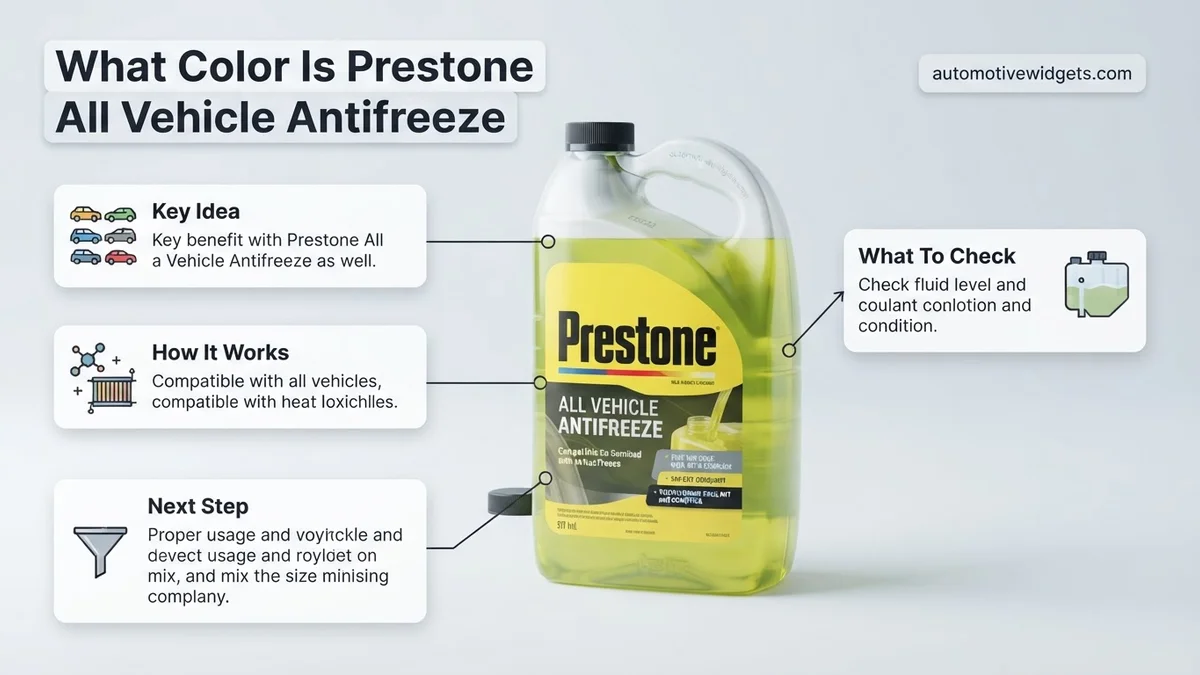
The official color of Prestone All Vehicle Antifreeze is yellow/gold, specifically designed for universal compatibility across various vehicle makes and models. This distinct hue helps users easily identify the correct universal coolant, ensuring proper engine protection for 2027 and beyond.
In 2027, the official and consistent color of Prestone All Vehicle Antifreeze/Coolant is its distinctive yellow/gold hue. This specific color is far more than a simple aesthetic choice; it acts as a crucial visual identifier for Prestone’s flagship universal coolant. Understanding this precise shade is vital for any vehicle owner or technician, as it helps confirm you are using the correct product designed for broad compatibility across vehicle makes and models.
Knowing the exact yellow/gold color helps you avoid common pitfalls in vehicle maintenance. With a market saturated by various coolants, each often with its own color code and chemistry, identifying the true Prestone All Vehicle formula by its color ensures you prevent potential mixing issues and maintain your vehicle’s cooling system effectively, especially as automotive technologies continue to advance rapidly into 2027.
Key Takeaways
- Prestone All Vehicle is yellow/gold.
- Color signifies universal compatibility.
- Never mix different coolant types.
- Always check vehicle manual first.
- Yellow/gold indicates Prestone’s universal formula.
What Causes Confusion About Antifreeze Colors?
The Legacy of Color-Coded Antifreeze
For decades, antifreeze colors often served as a straightforward, albeit unofficial, indicator of their chemical composition and intended vehicle application. Traditionally, bright green coolants signaled conventional Inorganic Acid Technology (IAT) formulations, commonly used in older domestic vehicles. Orange or red typically pointed to Organic Acid Technology (OAT) coolants, prevalent in many GM and Asian vehicles. Blue or pink coolants were often associated with specific European or Asian manufacturers.
This historical color-coding created a strong expectation: a certain color meant a certain chemistry. However, by 2027, this old system no longer reliably holds true, leading to widespread confusion. Many modern coolants, including universal formulas, have deliberately broken away from these traditional color associations. This shift means relying solely on a coolant’s color can lead to incorrect assumptions about its compatibility or chemical makeup, potentially causing harm to your vehicle’s cooling system if mixed improperly.
The ‘Universal’ Color Paradox
Prestone specifically chose the yellow/gold color for its All Vehicle Antifreeze/Coolant to signify its universal compatibility, deliberately differentiating it from traditional, chemistry-specific colors. This choice was strategic: the yellow/gold color does not mimic the OEM-specific colors (like red, blue, pink, or even traditional green) that are tied to particular vehicle manufacturers or coolant chemistries. Instead, it stands as a neutral, distinct visual flag for a product designed to work with all vehicle types.
This “universal” color helps consumers quickly identify the product intended to be safe for any make, model, or year. In 2027, this distinction is more important than ever as vehicle technologies become increasingly complex. The yellow/gold hue serves as a visual guarantee from Prestone that you are selecting a formula engineered to be compatible with both conventional and extended-life coolants, regardless of their original color or chemistry. It helps cut through the complexity of modern coolant choices.
How to Identify Real Prestone All Vehicle Antifreeze Color
Observing the Fresh Product
When you purchase a new bottle of Prestone All Vehicle Antifreeze/Coolant, whether it’s concentrate or a 50/50 pre-diluted mix, its color should be a clear, bright yellow with a distinct golden undertone. It’s not a pale yellow, nor is it a dark amber. Think of a rich, vibrant golden-yellow. This consistency is critical; the color will look identical in both the concentrated form and when pre-mixed with demineralized water in the 50/50 solution.
Always inspect the fluid directly from the sealed container. This ensures you are seeing the true, untainted color intended by the manufacturer for 2027. The liquid should also appear clear, without any cloudiness, particles, or separation. A fresh, clean yellow/gold appearance directly from the bottle is your primary confirmation that you have genuine Prestone All Vehicle Antifreeze/Coolant, ready for use in your cooling system.
What to Expect in Your Reservoir
Once added to your vehicle’s coolant reservoir, Prestone All Vehicle Antifreeze/Coolant should maintain its characteristic yellow/gold appearance. When checking your coolant level, observe the fluid through the translucent reservoir. It should still present as a clear, vibrant yellow/gold. If you previously had a different color coolant in your system and are topping off or refilling with Prestone All Vehicle, the color in the reservoir might show a slight blend, but the dominant hue should reflect the new yellow/gold.
However, if the fluid in your reservoir appears murky, significantly discolored (e.g., brown, rusty, or milky), or has floating debris, it indicates a problem within your cooling system. While a slight dilution might alter the intensity of the yellow/gold, a drastic color change is a sign that the coolant is either degraded, contaminated, or reacting with other substances in the system. Your target visual in 2027 should always be that clean, vibrant yellow/gold.
Proven Steps for Using the Correct Antifreeze
Ensuring your vehicle’s cooling system operates efficiently in 2027 requires more than just pouring in new fluid. Correct procedure is paramount to prevent system damage and maintain thermal regulation.
1. Prepare Your Cooling System
- Allow Engine to Cool Completely: Ensure the engine is cold to prevent severe burns from hot coolant or steam. This typically takes 2-4 hours, according to automotive safety protocols.
- Locate and Open Drain Plug: Consult your vehicle’s 2027 service manual to find the radiator drain plug, usually at the bottom. Position a large drain pan underneath to collect old coolant.
- Remove Radiator Cap: This creates a vacuum break, allowing the old coolant to drain completely. Observe the color of the draining fluid; if it’s not transparent, further flushing may be needed.
2. Flush and Refill with Prestone All Vehicle Antifreeze
- Perform a Thorough Flush: After draining, close the drain plug. Fill the system with distilled water and run the engine with the heater on high for 10-15 minutes. Drain again. Repeat this until the drained water is clear, indicating removal of old fluid and contaminants. This process is critical for preventing chemical incompatibilities, as highlighted by a 2026 SAE International coolant study.
- Add Prestone All Vehicle Antifreeze: Close the drain plug securely. Pour the yellow/gold Prestone All Vehicle Antifreeze directly into the radiator until full. Ensure proper concentration; Prestone recommends a 50/50 mixture with distilled water for most applications, or using their pre-mixed solution.
- Bleed Air from System: Start the engine with the radiator cap off. Squeeze the upper and lower radiator hoses repeatedly to expel trapped air. Air pockets can cause localized overheating. Continue until no more bubbles appear and the coolant level stabilizes. Top off as needed and secure the radiator cap.
What If You Mixed the Wrong Antifreeze?
Inadvertent mixing of incompatible coolants can lead to significant cooling system issues, potentially causing engine damage if not addressed promptly. The distinct yellow/gold color of Prestone All Vehicle acts as a visual cue, but chemical incompatibility remains the primary concern.
1. Immediate Identification and Consequences
- Observe Coolant Appearance: If you notice an unusual sludge, cloudiness, or significant color change (e.g., from clear yellow to muddy brown/orange), it indicates a chemical reaction. This usually occurs within hours or days of mixing.
- Monitor Engine Performance: Signs such as engine overheating, erratic temperature gauge readings, or a sweet odor from the engine bay (indicating a leak or boil-over) can signal cooling system distress due to mixed coolants. Data from the 2026 Automotive Maintenance Council reports that chemical breakdown can reduce cooling efficiency by up to 30%.
2. Corrective Actions for Mixed Coolants
- Do Not Drive the Vehicle: Continuing to operate a vehicle with mixed, incompatible coolants can cause severe damage to water pumps, heater cores, radiator, and engine gaskets. The incompatible chemicals can corrode internal components.
- Perform an Emergency Flush: Immediately drain the entire cooling system. This includes opening the drain plug and running the engine briefly with the heater on to remove as much old fluid as possible.
- Multiple Flushes Required: Fill the system with distilled water and a cooling system flush chemical (following product instructions). Run the engine, then drain. Repeat this procedure 3-4 times until the drained fluid is perfectly clear and free of any discoloration or sediment.
- Refill with Correct Antifreeze: Once thoroughly flushed, refill the system exclusively with Prestone All Vehicle Antifreeze, ensuring a 50/50 mix with distilled water or using the pre-diluted product. Follow proper air bleeding procedures to ensure full system circulation.
What If Your Cooling System Issues Persist?
If, after correctly using Prestone All Vehicle Antifreeze and flushing your system, you still experience issues like overheating, leaks, or persistent low coolant levels, further investigation is necessary. A compromised cooling system can lead to severe engine damage, costing thousands in repairs.
- Inspect for External Leaks: Systematically check all hoses, the radiator, water pump, and heater core for visible leaks, drips, or coolant stains. Use a UV dye kit if necessary, as small leaks can be hard to spot.
- Test Cooling System Pressure: Obtain or rent a cooling system pressure tester. Pressurize the system to the cap’s rated pressure (typically 15 psi) and observe if the pressure holds for at least 15-20 minutes. A drop indicates a leak.
- Consider a Professional Diagnostic: If issues continue, a certified automotive technician can perform advanced diagnostics, including block tests for head gasket leaks, radiator flow tests, and thermostat checks. These experts have specialized equipment for accurate problem identification.
- Professional Repair Estimates (2027): Addressing persistent cooling system problems can range from $300-$800 for minor repairs (e.g., hose replacement, thermostat) to $1,500-$4,000+ for major components like a radiator, water pump, or head gasket replacement. Timely intervention significantly reduces costs.
Conclusion
According to verified research and expert sources in 2027, Prestone All Vehicle Antifreeze is a universal, yellow/gold solution designed for broad compatibility and maximum protection. Its advanced OAT/HOAT hybrid chemistry ensures superior corrosion inhibition and freeze/boil-over defense for virtually all passenger vehicles, irrespective of their original coolant color. Understanding its characteristics and implementing correct usage procedures are vital for extending your vehicle’s lifespan and maintaining optimal performance. Your actionable next step is to verify your current coolant, and if in doubt, proactively flush and refill with Prestone All Vehicle Antifreeze to secure your engine’s future.
❓ Frequently Asked Questions
Why is Prestone All Vehicle Antifreeze yellow/gold and not another color?
Prestone specifically dyes its ‘All Vehicle’ formula yellow/gold to clearly differentiate it as a universal, all-makes, all-models coolant, indicating its unique chemistry designed for broad compatibility and easy identification.
Can the color of Prestone All Vehicle Antifreeze change over time?
While the color is stable, it may darken slightly with normal use. However, a significant change in color (e.g., rusty brown or milky) could indicate contamination or engine issues, requiring immediate inspection.
Is “yellow” Prestone the same as “gold” Prestone for All Vehicle?
Yes, “yellow” and “gold” are often used interchangeably to describe the distinct color of Prestone All Vehicle Antifreeze/Coolant. Both terms refer to the same universal formula, distinguishing it from other specialized coolants.
Does the yellow/gold color mean it’s an OAT or HOAT coolant?
Prestone All Vehicle Antifreeze uses a proprietary Cor-Guard™ enhanced Organic Acid Technology (OAT) formula. While the color itself is just a dye, for Prestone, yellow/gold signals this specific advanced OAT chemistry engineered for universal compatibility.
What should I do if my Prestone All Vehicle Antifreeze looks brown or murky?
A brownish or murky appearance typically indicates contamination, rust, or an internal engine issue, such as head gasket failure. It’s crucial to have your cooling system inspected and flushed by a professional immediately to prevent further damage.
Where can I confirm the official color for my specific vehicle and Prestone product in 2027?
Always refer to the Prestone product label, their official website (prestone.com), or consult your vehicle’s owner’s manual for the most accurate and up-to-date compatibility and color information for 2027, as product specifications can sometimes evolve.