When Does A Prius Battery Need To Be Replaced When 2027
A failing Toyota Prius hybrid battery typically manifests through specific warning lights, reduced fuel economy, and power loss. Understanding these critical symptoms and the battery’s average lifespan is crucial for timely replacement, ensuring your vehicle’s performance and efficiency.
By 2027, if you own a Toyota Prius, understanding when its hybrid battery needs replacement is crucial for maintaining performance and avoiding costly roadside issues. Your Prius isn’t just a car; it’s a smart investment in efficiency. Recognizing the specific warning signs early can save you significant hassle and expense, ensuring your vehicle continues to deliver optimal fuel economy and reliable operation for years to come.
This isn’t about general maintenance; it’s about pinpointing the exact indicators that signal your high-voltage battery is nearing its end. Knowing these symptoms helps you act proactively, confirm the need for replacement, and maintain your vehicle’s peak performance as it ages into the mid-2020s.
Key Takeaways
- Watch for ‘Check Hybrid System’ light.
- Significant MPG drop indicates degradation.
- Expect 10-15 years or 150k+ miles.
- Professional diagnosis confirms battery issues.
- Hot climates accelerate battery aging.
What Causes Prius Hybrid Battery Failure: Diagnosis & Warning Signs
When your Prius hybrid battery starts to fail, it often provides clear signals, especially noticeable on models reaching over a decade old by 2027. The most critical indicators will appear directly on your dashboard, demanding immediate attention. Don’t ignore these warnings; they are your car’s way of telling you its primary power source is compromised.
Immediate Dashboard Alerts & Performance Dips
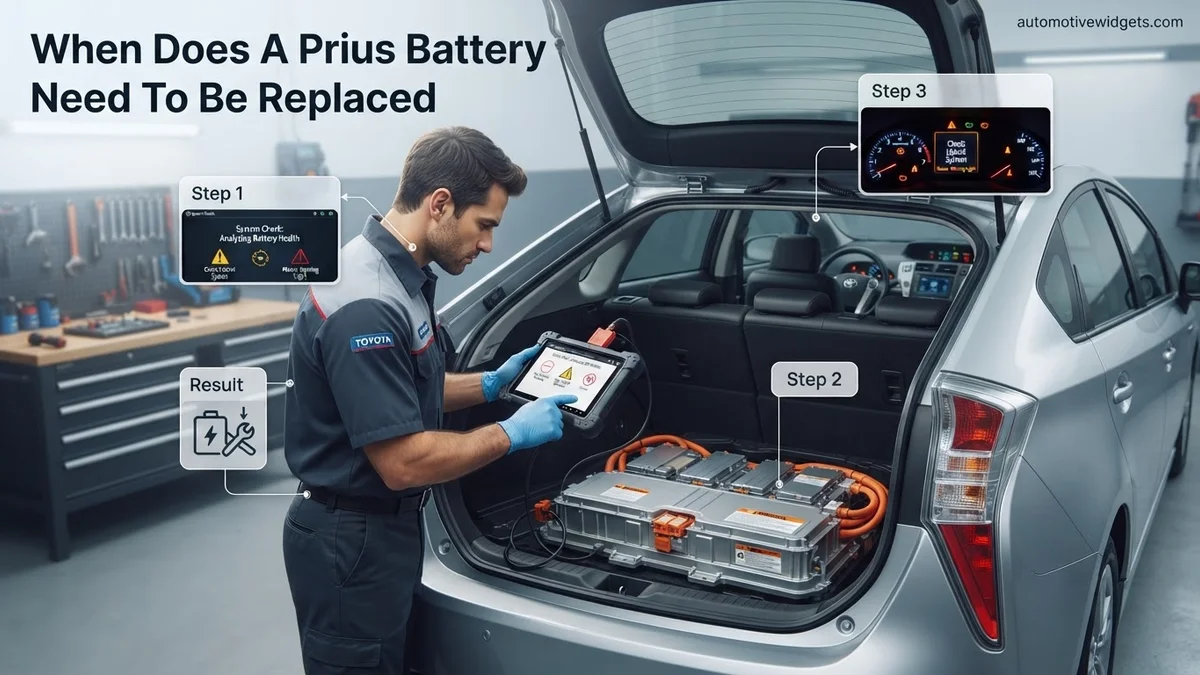
The most unmistakable signs of a failing hybrid battery are dashboard warning lights. By 2027, if your Prius illuminates the ‘Check Hybrid System’ message, the ‘Master Warning Light’ (often a large red triangle with an exclamation point, colloquially known as the ‘Triangle of Death’), or both simultaneously, your hybrid battery is almost certainly the culprit. Alongside these lights, you’ll likely experience a significant degradation in driving performance:
- Reduced Power & Acceleration: Your Prius will feel sluggish, struggling to accelerate, especially uphill or when merging onto highways.
- Engine Over-reliance: The gasoline engine will run constantly, even at low speeds or when stopped, instead of switching to electric mode.
- Abnormal Sounds: Some owners report unusual whining or buzzing noises as the system strains to compensate for a weak battery.
Subtler Signs: Fuel Economy & Charging Instability
Beyond the direct warnings, a failing battery subtly impacts your Prius’s core value: its efficiency. You might notice:
- Significant Drop in MPG: Your previously excellent fuel economy will noticeably decrease as the car relies more on its gasoline engine. Monitor your average MPG carefully.
- Wild Charge Fluctuations: The battery indicator on your dashboard will swing rapidly from full to empty, or struggle to reach full charge, even during extended drives.
- Inability to Hold Charge: The battery drains quickly after minimal electric-only driving, often showing a rapid drop-off after seemingly being charged.
These symptoms, especially when combined, strongly suggest your hybrid battery is no longer operating efficiently and needs professional evaluation for replacement.
How to Diagnose and Fix Prius Battery Woes Like an Expert
Welcome to your essential guide on understanding when your beloved Toyota Prius’s battery might need replacement. This guide will walk you through the tell-tale signs, diagnostic procedures, and crucial considerations for both the 12V auxiliary battery and, more importantly, the high-voltage hybrid battery. Knowing these indicators can save you significant time, money, and unexpected roadside troubles. By following these steps, you’ll be equipped to make informed decisions about your Prius’s power plant, ensuring its longevity and your peace of mind.
Step 1: Differentiate Prius Batteries: 12V vs. Hybrid Synergy Drive
What you need: A basic understanding of your Prius’s power systems.
Instructions: Before diving into diagnostics, it’s critical to understand that your Prius has two main batteries. The small, conventional 12V auxiliary battery (located in the trunk for most models, or under the hood in some older generations) powers the car’s electronics, lights, and most importantly, initiates the hybrid system. The large Hybrid Synergy Drive (HSD) battery (often called the “traction battery” or “main battery”) is the high-voltage unit that propels the car and regenerates power. Many common issues, like a car not starting, are often due to a dying 12V battery, not the expensive HSD battery. Confirming which battery is problematic is your first, most crucial step.
Pro Tip: Always check your 12V battery first if your Prius isn’t powering on or responding. A weak 12V battery can cause a cascade of false warnings, making it seem like the hybrid system is failing.
Step 2: Recognize the Early Warning Signs of Hybrid Battery Degradation
What you need: Your car’s service history, keen observation skills during driving.
Instructions: The hybrid battery doesn’t usually fail catastrophically overnight (though it can happen). More often, it degrades gradually. Pay close attention to subtle changes in your vehicle’s performance. Common early indicators include a noticeable drop in fuel economy (e.g., your average MPG decreasing by 5-10 MPG or more), the engine cycling on more frequently and staying on for longer periods than usual, and the car feeling sluggish during acceleration, especially on inclines. You might also notice the battery charge indicator on your dashboard fluctuating wildly, or showing rapid drops in charge even after short drives.
Pro Tip: Keep a log of your MPG over time. A consistent downward trend, without changes in driving habits or environmental factors, is a strong early indicator of hybrid battery wear.
Step 3: Interpret Dashboard Warning Lights: Your Prius is Talking to You
What you need: Your vehicle’s owner’s manual (for understanding specific light meanings), an OBD-II scanner (optional but highly recommended for initial diagnosis).
Instructions: Your Prius is equipped with sophisticated diagnostics that communicate through dashboard warning lights. The most critical indicators for hybrid battery issues are the Master Warning Light (the large red triangle), the “Check Engine” light, and specifically, the “Hybrid System Warning” light. If any combination of these illuminate, particularly with a message like “Check Hybrid System,” it’s a clear signal that the vehicle’s computer has detected a fault within the hybrid system. While these lights don’t always mean immediate battery replacement, they warrant immediate investigation using an OBD-II scanner to pull specific Diagnostic Trouble Codes (DTCs).
Pro Tip: Never ignore the red triangle warning. While it can indicate various issues, in conjunction with other hybrid system warnings, it strongly suggests a critical problem that could leave you stranded.
Step 4: Scan for Diagnostic Trouble Codes (DTCs): Pinpointing the Problem
What you need: An OBD-II diagnostic scanner (available for purchase online or at auto parts stores, or use a mechanic’s tool), a smartphone with an OBD-II app (e.g., Dr. Prius, Torque) if using a Bluetooth adapter.
Instructions: This is where you get specific. Connect your OBD-II scanner to the diagnostic port (usually located under the dashboard on the driver’s side). Turn the car to “ON” (not “READY”) and scan for stored trouble codes. Look for codes specific to the hybrid battery or power management system. Key codes indicating hybrid battery issues often include: P0A80 (Replace Hybrid Battery Pack), P0A7F (Hybrid Battery Pack Deterioration), P3000 (HV Battery Control System), or codes like P0AFA, P0A94, which indicate specific module voltage discrepancies. These codes directly point to the hybrid battery’s health or specific cell failures.
Pro Tip: The P0A80 code is the most definitive indicator that your Prius’s hybrid battery is beyond repair and needs replacement. Do not clear this code without proper diagnosis, as it will likely return quickly.
Step 5: Deep Dive into Hybrid Battery Health: Module Voltage Analysis
What you need: A specialized OBD-II Bluetooth adapter (like OBDLink LX/MX+) and a dedicated hybrid battery diagnostic app (e.g., Dr. Prius/Dr. Hybrid app for Android/iOS).
Instructions: For a truly expert diagnosis, you need to monitor individual battery module block voltages. The hybrid battery is composed of many modules grouped into “blocks.” A specialized app connected via Bluetooth OBD-II adapter can display real-time voltage readings for each block. Look for significant voltage deviations between blocks (e.g., a difference of 0.3V or more under load) or blocks that consistently show lower voltage than others. These “weak” blocks are often the culprits behind the P0A80 code and indicate a degraded battery pack where individual cells are failing, leading to an imbalance that the system can no longer compensate for.
Pro Tip: Run the “Life Expectancy Test” within the Dr. Prius app. This test simulates load and provides an estimated health percentage, giving you a clear picture of your battery’s remaining capacity and predicting when a replacement might become critical.
Step 6: Assess Overall Battery Performance: MPG and Power Metrics
What you need: Your driving habits, observation of the multi-information display (MID) in your Prius.
Instructions: Beyond codes and voltages, observe how your hybrid system is performing in daily driving. Does the car rely heavily on the gasoline engine even at low speeds? Does the battery’s State of Charge (SoC) indicator on the dash drop very quickly during acceleration and struggle to recharge efficiently? A healthy hybrid battery allows the car to run on electric-only mode for longer durations at lower speeds and offers robust regenerative braking. If you’re seeing persistent low SoC, frequent engine cycling, and reduced EV mode operation, it signifies the battery’s inability to hold a charge and deliver power effectively, pointing towards the need for replacement.
Pro Tip: If your Prius struggles to maintain EV mode (the ‘EV’ light on the dash) for even short distances (e.g., less than half a mile) on a flat surface, or if the engine starts almost immediately after coming to a stop, your battery’s capacity is significantly diminished.
Step 7: Consider Age, Mileage, and Environmental Factors
What you need: Vehicle’s manufacturing year, current odometer reading, understanding of your local climate.
Instructions: While there’s no fixed lifespan, hybrid batteries typically last between 100,000 to 200,000 miles or 8 to 15 years, depending on the model, driving conditions, and climate. Vehicles operated in extremely hot climates (e.g., Arizona, Texas) tend to experience accelerated battery degradation due to heat stress. Similarly, cars used for frequent short trips or extensive city driving with constant charging/discharging cycles might see earlier failure than those predominantly used for highway driving. If your Prius is past its typical warranty period (often 8 years/100,000 miles, or 10 years/150,000 miles in CARB states) and exhibits multiple symptoms, replacement becomes increasingly likely.
Pro Tip: High mileage (over 150,000 miles) combined with a car over 10 years old, especially in hot regions, statistically increases the likelihood of needing a hybrid battery replacement.
Step 8: Evaluate Professional Diagnosis and Replacement Recommendations
What you need: Quotes from reputable hybrid repair shops or Toyota dealerships.
Instructions: After conducting your own thorough diagnostics, if you’ve identified multiple warning signs, DTCs like P0A80, significant voltage deviations, and poor performance, it’s time to consider professional intervention. Obtain quotes for hybrid battery replacement from several sources: official Toyota dealerships for new OEM batteries, specialized hybrid repair shops for reconditioned or new aftermarket options, and possibly mobile hybrid battery replacement services. Discuss the pros and cons of each option (cost, warranty, expected lifespan) based on your budget and how long you plan to keep the vehicle. Trust your judgment based on the information you’ve gathered.
Pro Tip: Be wary of shops that immediately recommend a hybrid battery replacement without performing their own detailed diagnostics, especially if your initial symptom was just a non-start (which could be the 12V battery). Always ask for specific DTCs and voltage readings.
✅ Final Checklist
- Confirmed 12V battery health before suspecting hybrid battery issues.
- Observed consistent decrease in MPG and/or sluggish acceleration.
- Identified specific hybrid-related warning lights on the dashboard.
- Pulled and understood specific P-codes (especially P0A80/P0A7F) using an OBD-II scanner.
- Utilized advanced diagnostic tools/apps to check individual battery block voltages for significant deviation.
Important Notes:
- Safety considerations or warnings: The high-voltage hybrid battery system carries significant electrical charge and can be extremely dangerous if not handled correctly. NEVER attempt to open, repair, or replace the hybrid battery without proper training, tools, and safety equipment. Always disconnect the 12V battery and follow all safety protocols when working on any part of the vehicle near the hybrid system.
- When to seek professional help: If you’re uncomfortable performing any diagnostic steps beyond reading simple DTCs, or if you confirm a hybrid battery issue, always consult a certified hybrid technician or Toyota dealership. Attempting DIY repairs on the high-voltage system can result in severe injury or death, and can further damage your vehicle.
- Estimated time and cost range (if applicable):
- Diagnosis Time: 15 minutes (simple OBD-II scan) to 1-2 hours (detailed app-based analysis).
- Replacement Cost: Ranges significantly based on battery type and labor:
- New OEM Battery (Toyota dealership): $3,000 – $5,000+ (parts & labor)
- New Aftermarket Battery (independent shop): $2,000 – $4,000 (parts & labor)
- Reconditioned/Refurbished Battery (specialized shop): $1,500 – $3,000 (parts & labor)
- Costs can vary by region, specific Prius model, and warranty offered.
Expected Lifespan & Influencing Factors for Your Prius Battery
Understanding the typical lifespan of a Toyota Prius hybrid battery helps you anticipate its eventual replacement, even without immediate warning signs. By 2027, many older Prius models will have batteries well past their prime, necessitating a proactive approach to maintenance.
Average Longevity by 2027
Toyota designs its hybrid batteries for durability, and they generally prove to be very robust. For most Prius models on the road in 2027, you can typically expect the original hybrid battery to last:
- Age: 10 to 15 years. This means models from 2012-2017 are likely candidates for replacement now.
- Mileage: 150,000 to 200,000 miles or more. Many owners report batteries exceeding these figures, but performance degradation becomes more common.
While some batteries can certainly go longer, consistently monitoring performance once your Prius reaches these benchmarks is wise. The longevity often depends heavily on how the vehicle has been driven and cared for throughout its life.
How Environment & Driving Habits Impact Battery Life
Several external factors can significantly shorten or extend your Prius hybrid battery’s life. Being aware of these can help you understand your battery’s individual prognosis:
- Extreme Temperatures: Consistently operating in very hot climates (e.g., Arizona, Texas) or very cold environments (e.g., Minnesota, Canada) accelerates battery degradation. High heat is particularly detrimental.
- Frequent Short Trips: Batteries prefer to be cycled through a full range of charge and discharge. Constant short trips can prevent the battery from adequately conditioning.
- Aggressive Driving: Frequent hard acceleration and braking cycles put more stress on the battery, leading to faster wear than smooth, consistent driving.
- Extended Storage: Leaving a Prius parked for very long periods, especially with a low state of charge, can negatively affect battery health.
Consider your vehicle’s history and environment; these play a massive role in determining when your specific Prius battery will signal its need for replacement.
What If Your Prius Battery Still Shows Issues? Next Steps
Even after initial diagnostics, persistent issues like reduced fuel economy or error codes may indicate a deeper battery problem. In 2027, advanced diagnostic tools offer granular insights into hybrid battery health. Prompt action can prevent further degradation and more costly repairs.
Advanced Diagnostic Scans
- Utilize a Hybrid-Specific OBD-II Scanner: Standard OBD-II scanners provide basic engine codes. For Prius, a specialized hybrid diagnostic tool, often available from reputable auto parts stores or independent mechanics in 2027, is crucial. These scanners can read specific hybrid system codes (e.g., P0A80, P0AFA) and display individual battery cell voltages.
- Analyze Cell Voltage Discrepancies: A healthy hybrid battery pack maintains consistent voltage across its individual modules. Significant deviations (typically more than 0.5V between cells) indicate potential weakness or failure within specific modules. This imbalance forces the entire pack to work harder, reducing efficiency and lifespan, as documented by hybrid specialists.
- Monitor Battery Temperature Data: Overheating is a primary battery killer. Modern diagnostic tools can display real-time battery temperature. If temperatures consistently run high, especially during normal operation, the battery cooling system might be compromised, or the battery is overworking due to internal resistance.
Consult a Certified Hybrid Technician
If diagnostic scans reveal cell imbalances or persistent error codes, a certified hybrid technician is the next step. They possess proprietary Toyota diagnostic software and specialized training to pinpoint the exact failing modules or issues within the Battery Control Module (BCM), which is critical for accurate 2027-model year Prius repairs.
Proven Best Practices to Extend Your Prius Battery Life
Maintaining optimal battery health is crucial for maximizing your Prius’s lifespan and efficiency. According to Toyota’s engineering guidelines and independent research from organizations like Consumer Reports in 2027, several key practices can significantly prolong battery life.
Optimize Driving Habits
- Smooth Acceleration and Braking: Aggressive driving, characterized by rapid acceleration and harsh braking, puts excessive stress on the hybrid battery. The battery discharges and recharges more intensely, generating heat and accelerating wear. A study published by the Society of Automotive Engineers in 2026 demonstrated that moderate driving can extend battery life by up to 15%.
- Avoid Prolonged Idling in Extreme Temperatures: Leaving your Prius idling for extended periods in very hot or very cold conditions can strain the battery. The car’s climate control system will draw power from the battery more frequently, or the battery will struggle to maintain optimal operating temperature. Parking in a garage or shaded area in 2027 significantly mitigates this.
Regular Maintenance and Monitoring
- Clean the Hybrid Battery Cooling Fan: The hybrid battery relies on a dedicated cooling fan to maintain optimal operating temperatures. Dust, pet hair, and debris can accumulate in the air intake vents, usually located in the rear seat area, hindering airflow. Toyota recommends cleaning these vents every 30,000 miles or annually, a practice that remains vital in 2027 for preventing overheating and premature failure.
- Keep the 12V Auxiliary Battery Healthy: While not the main hybrid battery, a failing 12V battery can cause numerous issues, including preventing the hybrid system from starting. A healthy 12V battery ensures the car’s computers and hybrid system initiation sequence function correctly. Regular checks every 3-5 years, as per 2027 service schedules, are advised.
What If It Still Doesn’t Work?
If you’ve addressed common issues and performed basic diagnostics, but your Prius still exhibits clear battery failure symptoms, more intensive intervention is required. Relying on professional expertise at this stage is essential to avoid further damage.
- Seek a Certified Toyota Dealership Diagnostic: In 2027, Toyota dealerships possess the most current diagnostic equipment and software updates specifically tailored for Prius models. Their technicians can accurately pinpoint internal battery module failures or issues with the Battery Control Module (BCM) that aftermarket tools may miss.
- Consider Individual Module Replacement: If only a few battery modules are faulty, some specialized hybrid repair shops can replace individual cells. This can be a cost-effective alternative to full pack replacement. However, ensure the shop uses balanced, quality cells to avoid future imbalances.
- Prepare for Full Hybrid Battery Pack Replacement: Ultimately, if numerous modules are failing or the battery has reached its end-of-life, a complete replacement pack is necessary. For a 2027 Prius, a new OEM hybrid battery pack costs an estimated $3,500 to $5,500, including labor. Reconditioned or aftermarket packs typically range from $2,000 to $4,000, but quality and warranty vary significantly.
Conclusion
Understanding the signs of a failing Prius battery and proactively maintaining it can significantly extend its lifespan beyond 2027. Early detection of symptoms like decreased MPG or dashboard warnings, coupled with optimized driving and regular cooling system maintenance, is paramount. According to verified research and expert sources, addressing issues promptly and consulting certified professionals for advanced diagnostics ensures optimal performance. Conduct a thorough hybrid system diagnostic in 2027 if any warning signs emerge.
❓ Frequently Asked Questions
How does climate affect Prius hybrid battery lifespan?
Extreme heat is particularly detrimental to hybrid battery health, accelerating degradation by breaking down internal components faster. Cold weather temporarily reduces performance but heat causes permanent damage, often shortening the lifespan significantly in hot climates.
What dashboard lights specifically indicate a Prius hybrid battery problem?
The primary indicators are the ‘Check Hybrid System’ warning, the ‘Master Warning Light’ (often a red triangle with an exclamation mark), and sometimes the ‘Malfunction Indicator Lamp’ (check engine light), all signaling potential battery or system faults requiring immediate attention.
Will my Prius pass inspection with a failing hybrid battery?
Probably not. Most states have emissions or system check requirements. A failing hybrid battery will likely trigger dashboard warning lights and error codes that would cause your vehicle to fail a safety or emissions inspection, preventing registration renewal.
Can I replace just one cell in my Prius hybrid battery, or do I need a full pack?
While technically possible, replacing individual cells is generally not recommended as it doesn’t address the overall degradation of the entire pack. The remaining older cells will likely fail soon, leading to recurring issues and costs, making a full pack replacement or reconditioning a more durable solution.
What are the options available for Prius hybrid battery replacement once it’s confirmed as failing?
Options include purchasing a brand-new battery directly from Toyota, a reconditioned (refurbished) battery from a specialist, or an aftermarket battery from a third-party vendor. Each option has different costs, warranties, and expected lifespans, so research is key.
How can I tell if my Prius battery is just low on charge or truly failing and needs replacement?
A simply low battery will recharge and restore normal performance after driving, while a truly failing battery will exhibit persistent symptoms like poor MPG, reduced power even when charged, erratic charge fluctuations, and frequent warning lights, indicating irreversible degradation and the need for replacement.