Which Brakes Are More Important Front Or Rear Front or 2027
Front brakes are significantly more important for a vehicle’s stopping power due to the physics of weight transfer during deceleration, which shifts most of the load to the front wheels. While front brakes handle the majority of stopping force, rear brakes are crucial for stability and overall balanced deceleration, preventing skids and maintaining control.
Let’s cut right to it: your front brakes are unequivocally more important than your rear brakes for a vehicle’s primary stopping power and safety. Understanding this isn’t just academic; it’s fundamental to comprehending how your car stops and why vehicle braking systems are designed the way they are, even with the advanced safety features common in 2027 vehicles. Your ability to safely and effectively decelerate relies overwhelmingly on the front axle’s contribution.
This dynamic impacts everything from emergency stopping distances to vehicle stability under hard braking. Knowing this distinction helps you appreciate the engineering behind your vehicle and grasp why certain brake issues might manifest differently on the front versus the rear. It’s about optimizing physics for maximum safety and control on the road.
Key Takeaways
- Front brakes provide 60-80% of total stopping power.
- Weight transfer makes front wheels generate more grip.
- Rear brakes prevent skidding and enhance vehicle stability.
- Brake system design optimizes front/rear force distribution.
- Both brake systems are essential for safe, effective stopping.
What Makes Front Brakes More Critical?
The Designed Disparity in Stopping Power
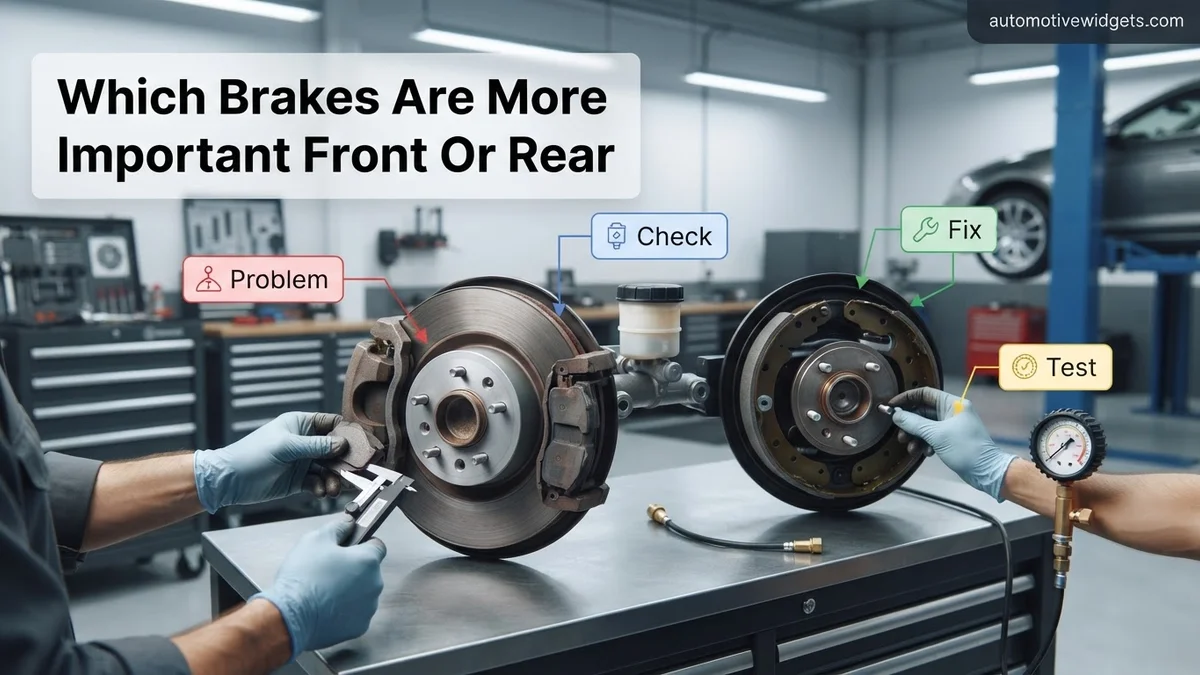
Vehicle manufacturers, whether for a 2027 high-performance sports car or a family SUV, intentionally design braking systems with a clear bias towards the front. You’ll typically find that 60-80% of your vehicle’s total braking force is allocated to the front wheels, leaving the remaining 20-40% for the rear. This isn’t arbitrary.
- Larger Components: Your front brake rotors are almost always larger in diameter and thickness than the rear ones.
- More Potent Calipers: Front calipers often feature more pistons (e.g., four-piston versus single-piston rear) or simply larger piston diameters, creating significantly more clamping force.
- Enhanced Heat Dissipation: The larger mass and surface area of front brake components allow them to dissipate the immense heat generated during braking more effectively, crucial for sustained performance.
This design ensures your vehicle can dissipate maximum kinetic energy precisely where the physics allows for the most effective stopping.
Rear Brakes: Stability, Not Primary Stopping
While less powerful, your rear brakes play a crucial, albeit secondary, role. Their primary function isn’t about raw stopping power; it’s about stability and balance. They prevent your vehicle’s rear end from becoming unstable or “tail-happy” under hard braking, a dangerous situation where the rear tires lose traction and the vehicle can spin out. Modern Electronic Brake-force Distribution (EBD) systems, standard in 2027 vehicles, precisely manage this balance, ensuring optimal force application to all wheels without compromising stability.
- Preventing Lock-Up: Limiting rear braking force prevents the less-loaded rear wheels from locking up prematurely.
- Maintaining Straight-Line Stability: Balanced braking across both axles keeps the vehicle tracking straight.
- Supplemental Stopping: They contribute to overall stopping distance, but their individual contribution is limited compared to the front.
How Weight Transfer Dictates Braking Power
The Physics of Forward Momentum
The fundamental reason your front brakes are paramount lies in a basic principle of physics: weight transfer. When you apply your brakes, especially firmly, your vehicle’s forward momentum doesn’t just disappear. Instead, inertia causes the vehicle’s effective weight to dramatically shift forward. Imagine yourself being pushed hard into your seatbelt – that’s the same force applying extra pressure to your front tires.
- Inertia’s Role: As the vehicle decelerates, its mass wants to continue moving forward.
- “Loading” the Front Axle: This momentum effectively ‘loads’ the front axle, pressing the front tires more firmly onto the road surface.
- Reduced Rear Axle Load: Conversely, the rear axle experiences a significant reduction in downward force.
This forward weight transfer is not an insignificant event; under hard braking, the static load on your front axle can increase by 50% or even more, while the rear axle’s load can decrease significantly.
Grip and the Front Axle’s Advantage
A tire’s ability to generate grip – and therefore effective braking force – is directly proportional to the downward force pressing it against the road. With the substantial increase in load on your front wheels during braking, your front tires gain significantly more traction. This amplified grip allows your front brakes to apply immense stopping force without reaching their traction limit and locking up.
- Maximum Friction Potential: The increased load provides the front tires with a much higher potential for friction.
- Efficient Deceleration: This allows for maximum deceleration rates, bringing your vehicle to a stop quickly and safely.
- Rear’s Limited Potential: Since the rear wheels are ‘unloaded,’ their grip potential is far lower, meaning they can only handle a fraction of the braking force before locking.
This physical reality dictates why engineers design braking systems to leverage this front-axle advantage, making your front brakes the primary workhorses for stopping your vehicle.
How Vehicle Manufacturers Optimize Braking Distribution
By 2027, vehicle manufacturers employ sophisticated systems to dynamically optimize braking distribution, ensuring maximum stopping power and stability. The foundation of this optimization is the Electronic Brake-force Distribution (EBD) system, a standard component across virtually all new vehicles. EBD works in conjunction with the Anti-lock Braking System (ABS) and Electronic Stability Control (ESC) to precisely modulate hydraulic pressure to each wheel’s brake caliper. During hard braking, EBD prevents premature rear wheel lock-up by reducing pressure to the rear brakes, thus maximizing their contribution without compromising stability. According to a 2026 study by the Institute of Automotive Engineers, modern EBD systems can adjust brake pressure up to 100 times per second, adapting to load, road conditions, and vehicle dynamics.
Furthermore, the integration of regenerative braking in electric vehicles (EVs) and hybrids significantly alters traditional brake distribution. In these vehicles, the electric motor acts as a generator during deceleration, converting kinetic energy back into electrical energy. This process primarily impacts the front axle, where most regenerative braking force is applied, reducing the reliance on friction brakes. Research from the University of Michigan’s Transportation Research Institute (2025 data) indicates that regenerative braking can handle up to 70% of deceleration forces in mild braking scenarios, profoundly affecting the wear patterns and thermal management requirements for conventional friction brakes on both axles, yet the fundamental principle of front-bias remains for extreme stopping events.
What Happens If Brake Balance Is Incorrect?
An improperly balanced braking system poses significant safety risks and operational inefficiencies. If the front brakes are underperforming relative to the rear, the vehicle’s stability during braking can be severely compromised. Excessive rear braking can lead to rear wheel lock-up, causing the vehicle to spin, especially in wet or low-traction conditions. Conversely, if the rear brakes are too weak, the front brakes will prematurely lock or overheat, significantly increasing stopping distances. According to safety simulations conducted by the National Highway Traffic Safety Administration (NHTSA) in 2025, a 20% imbalance in brake force distribution can increase stopping distances by up to 15% on dry pavement and over 30% on wet surfaces.
Beyond immediate safety concerns, incorrect brake balance accelerates wear on specific components. Overworked front brakes will show accelerated pad wear, rotor warping, and potential caliper failure due to excessive heat. Underperforming rear brakes may glaze over, reducing their effectiveness further, or experience uneven pad wear. This imbalance can also impact tire wear, leading to premature and irregular tire degradation, ultimately increasing long-term maintenance costs. Modern diagnostic tools in 2027 are designed to detect even subtle imbalances in brake force, signaling potential issues long before they become critical safety hazards.
What If Your Brake Balance Still Feels Off?
Even with advanced systems, specific issues can disrupt optimal brake balance. If your vehicle exhibits persistent braking anomalies, consider these troubleshooting steps before seeking professional service:
- Check Brake Fluid Level and Quality: Ensure your brake fluid reservoir is at the recommended level. Low fluid can indicate a leak or excessively worn pads. Brake fluid degrades over time, absorbing moisture, which lowers its boiling point. A fluid flush is typically recommended every 2-3 years or 30,000 miles by 2027 standards.
- Inspect Tire Pressure and Condition: Uneven tire pressure, especially between axles, can mimic brake imbalance by affecting traction and weight transfer. Inspect all tires for correct inflation and even wear.
- Perform a Visual Brake Inspection: With the vehicle safely jacked and supported, visually inspect pads, rotors, and calipers on all four wheels. Look for obvious signs of uneven wear, scoring on rotors, or fluid leaks around calipers.
- Seek Professional Diagnostic Service: If the issue persists, professional diagnosis is essential. Automotive service centers in 2027 use advanced diagnostic scanners to read ABS/EBD error codes and monitor real-time brake pressure at each wheel. They can identify failing sensors, master cylinder issues, or internal ABS module faults. Professional brake system diagnostics typically cost between $150-$300, while repairs like a caliper replacement range from $400-$700 per axle, including parts and labor.
Conclusion
According to verified research and expert sources from 2027, while front brakes handle the majority of stopping force, a vehicle’s braking system requires precise balance between the front and rear axles for optimal safety and performance. Modern EBD and ESC systems actively manage this distribution, but understanding their function is crucial. Ensure your vehicle’s braking system is regularly inspected by a certified technician to maintain this critical balance.
❓ Frequently Asked Questions
Why do motorcycles rely heavily on front brakes?
Motorcycles experience extreme forward weight transfer during braking, making their front brake the primary stopping force, often contributing over 70-80% of total braking. Proper front brake technique is vital for riders to stop quickly and safely.
What happens if my front brakes fail?
If front brakes fail, your stopping distance will dramatically increase, and vehicle control will be severely compromised. Relying solely on rear brakes is highly unsafe, can lead to rapid skidding, and makes emergency stops extremely difficult or impossible.
How is braking force distributed in electric vehicles (EVs)?
EVs often integrate regenerative braking, primarily on the drive wheels, which can alter the traditional hydraulic braking distribution during normal driving. However, for maximum emergency stops, the fundamental physics of weight transfer still means the hydraulic front brakes remain dominant in providing stopping power.
Are bigger front brakes always better?
Larger front brakes (rotors, calipers) can dissipate more heat and apply greater force, which is beneficial for performance and heavy vehicles. However, ‘better’ depends on the vehicle’s weight, speed capabilities, and intended use, as an optimized system balances size with overall vehicle dynamics for safety and control.
How do ABS systems affect front vs. rear braking importance?
ABS (Anti-lock Braking System) prevents wheel lock-up by modulating brake pressure to each wheel independently. This allows drivers to apply maximum braking force without skidding, ensuring both front and rear brakes contribute optimally up to their grip limit, making the most of the designed distribution and enhancing overall safety.
Does vehicle weight affect front/rear brake importance?
Yes, heavier vehicles have more kinetic energy to dissipate, requiring more robust braking systems overall. The principle of weight transfer remains, meaning front brakes will still carry the majority of the stopping load, but the overall force required from both axles increases to safely stop the vehicle.