
How Long Before Car Battery Dies with Radio On? Expert 2027
Leaving your car radio on can drain a healthy battery in 2-4 hours, though this varies significantly. Factors like battery age, capacity, and radio volume heavily influence how quickly your vehicle becomes unable to start. Learn to recognize the signs and prevent unexpected battery failure.
Leaving your car radio on while the engine is off can quickly drain your battery, often leaving you stranded. In 2027, a healthy, relatively new car battery typically powers a standard car radio for anywhere from 2 to 4 hours before the vehicle lacks sufficient charge to start. However, this is a broad estimate. The actual time can shrink to less than an hour if your battery is older or if you have a sophisticated infotainment system cranked up. Understanding these variables is crucial, as nobody wants the surprise of a dead battery when you just wanted some tunes.
This isn’t just about convenience; it’s about avoiding unexpected delays and potential roadside assistance calls. Knowing precisely how long your specific setup might last empowers you to make informed decisions. We’ll break down the critical factors influencing battery drain and provide realistic timeframes, ensuring you stay in control and your car starts reliably, even after enjoying some static-free audio.
Key Takeaways
- Healthy batteries last 2-4 hours with radio.
- Battery age and size are critical factors.
- High volume or accessories drain faster.
- Check battery health to prevent issues.
- Always turn off accessories when parked.
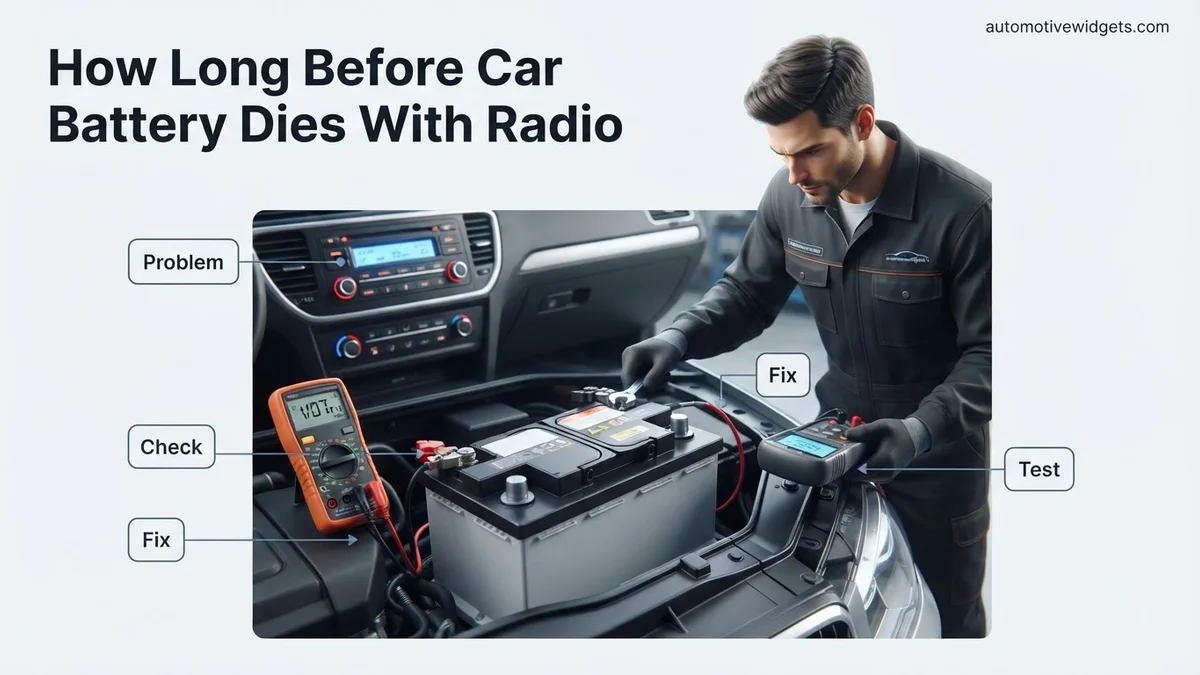
What Causes Your Car Battery to Die with the Radio On?
Your car battery provides all the electrical power when the engine isn’t running. While a modern car radio seems like a low-power device, its continuous draw, especially combined with other dormant systems, steadily depletes the battery’s finite capacity. Several key factors determine just how quickly that drain becomes critical.
Battery Health and Capacity
- Battery Age: A new battery (under 2 years old) with a high CCA (Cold Cranking Amps) rating and healthy Amp-hour (Ah) capacity holds a charge significantly longer. By 2027, many vehicles utilize EFB (Enhanced Flooded Battery) or AGM (Absorbed Glass Mat) technology, which offers better deep cycle performance but still degrades with time.
- Internal Resistance: As batteries age (typically 3+ years), their internal resistance increases, making them less efficient at delivering power and retaining charge. An older battery will drain much faster than a new one, even if both appear fully charged.
- Environmental Temperature: Cold weather (below 0°C or 32°F) drastically reduces a battery’s effective capacity. An older battery might lose 20-30% of its usable power in freezing temperatures, significantly shortening its radio-on life.
Radio and Accessory Load
- Radio Type: A basic AM/FM radio draws minimal current. However, contemporary infotainment systems (large touchscreens, powerful amplifiers, multiple speakers, satellite radio, navigation) consume considerably more power. These advanced systems are standard in most 2027 models.
- Volume Level: Higher volume demands more power from the audio amplifier. Cranking up your favorite tracks directly translates to a faster battery drain.
- Screen Brightness & Features: A bright, large display on your infotainment system, coupled with active Bluetooth, Wi-Fi hot spots, or GPS navigation running in the background, all contribute to increased current draw. Even “off” these systems can have parasitic drains from their internal computers.
- Concurrent Accessories: Are you charging your phone, running a dashcam in parking mode, or have interior lights on? Every additional accessory siphons power, accelerating the battery’s demise.
Real-World Time Estimates: How Long Can Your Battery Last?
Pinpointing an exact time is challenging due to the variables, but we can provide realistic ranges based on battery condition and usage. These estimates reflect what you can expect from typical 2027 vehicle batteries under various scenarios.
Optimal Conditions & Healthy Battery
If your car has a new or near-new battery (1-2 years old) with a robust CCA rating (600-750 CCA) and good Amp-hour capacity (60-70 Ah, common for sedans and small SUVs), you can expect:
- Low Volume Radio Only: With the engine off and only a standard radio playing at a low to moderate volume, you might get 3 to 5 hours of playback. The screen should be off or at minimum brightness, and no other accessories should be active.
- Moderate Volume with Screen: For an average infotainment system running at moderate volume with its display active, anticipate 2.5 to 4 hours. This is a common scenario for many drivers.
- Example: A 2027 mid-size SUV with a 65Ah AGM battery can typically run its infotainment system (moderate volume, screen on) for about 3.5 hours before needing a recharge to reliably start the engine.
Reduced Performance & Older Batteries
For a battery that’s 3+ years old, or one that has experienced deep discharges, its effective capacity is reduced. You’ll notice a much shorter lifespan with the radio on:
- Moderate Volume: An aging battery (e.g., 4 years old, ~400-500 CCA remaining) might only provide power for 1 to 2 hours of moderate radio use before becoming too weak to start the car.
- High Volume or Multiple Accessories: If you’re playing music loudly, charging a device, or have other interior lights on, an older battery could die in less than an hour.
- Example: A 2027 compact car with an EFB battery nearing its 4-year mark might struggle to start after just 75 minutes of radio play, especially on a chilly morning (10°C / 50°F).
Proven Steps to Prevent Car Battery Drain from Accessories
Preventing premature battery drain, especially from accessories like your car’s infotainment system, requires mindful habits and leveraging modern vehicle technology. Proactive measures can extend battery life significantly, ensuring reliability even with occasional accessory use.
Optimize Accessory Usage
- Minimize Key-Off Accessory Time: Limit the duration your radio or other accessories operate when the engine is off. According to automotive electrical specialists, even low-power systems draw 0.5-1.5 amps, depleting a standard 12V battery (60Ah) in 40-120 hours without engine charging.
- Utilize Accessory Power Modes Wisely: Modern vehicles (2027 models) often have intelligent power management. Engage “accessory mode” only when necessary, understanding it bypasses many power-saving protocols active in “off” mode.
- Understand Parasitic Drain Sources: Be aware that not just the radio, but phone chargers, dash cams, and even sophisticated alarm systems can contribute to parasitic draw. Disconnect non-essential devices when parking for extended periods.
Leverage Smart Vehicle Features and Maintenance
- Monitor Battery Health with Telematics: Many 2027 vehicles feature advanced telematics or companion apps that provide real-time battery voltage and health status. Heed low voltage warnings promptly.
- Regular Battery Testing: Have your battery professionally tested annually, especially if it’s over three years old. A weak battery (<12.4V resting voltage) is more susceptible to rapid drain from accessories.
- Consider a Smart Battery Maintainer: For vehicles stored for long periods, a smart battery maintainer (e.g., a 2-amp trickle charger with desulfation features, readily available for around $40-$80 in 2027) can prevent discharge and prolong battery life.
What If Your Car Battery is Already Dead? A Quick Fix Guide
A dead car battery, while frustrating, is often a fixable situation. Modern tools and techniques make getting back on the road simpler than ever. Always prioritize safety during these procedures.
Jump-Starting Your Vehicle
- Gather Equipment: You’ll need jumper cables and another vehicle with a working 12V battery, or a portable jump starter. Ensure cables are heavy-gauge (4-6 AWG) for optimal current transfer.
- Position Vehicles Safely: Park the donor vehicle close enough for the cables to reach, but not touching. Ensure both engines are off, and parking brakes are engaged.
- Connect Cables Correctly:
- Connect one red (+) clamp to the dead battery’s positive terminal.
- Connect the other red (+) clamp to the donor battery’s positive terminal.
- Connect one black (-) clamp to the donor battery’s negative terminal.
- Connect the other black (-) clamp to an unpainted metal surface on the dead car’s engine block or frame, away from the battery.
- Start the Donor Vehicle: Let it run for 5-10 minutes to charge the dead battery.
- Attempt to Start Dead Vehicle: If it starts, let both vehicles run for 10-15 minutes before carefully disconnecting the cables in reverse order (black from dead car, black from donor, red from donor, red from dead). Drive your car for at least 30 minutes to allow the alternator to recharge the battery fully.
Using a Portable Jump Starter
Portable jump starters, common in 2027, are highly efficient. They connect directly to your dead battery terminals, often featuring built-in safety mechanisms like reverse polarity protection. Follow the device’s specific instructions, which typically involve connecting the red clamp to positive, black to negative, waiting for a “ready” indicator, and then starting your car. They are invaluable for solo situations.
What If It Still Doesn’t Work?
If your battery remains dead after a jump-start attempt, or if it dies again shortly after, the issue might be more complex than simple accessory drain. Persistent problems often indicate underlying component failure.
- Check Cable Connections: Ensure all jumper cable clamps are making solid, clean contact. Corrosion on battery terminals can impede current flow.
- Inspect Battery Terminals: Look for excessive corrosion (white or green powdery substance) on the battery posts and cable clamps. This can prevent proper charging.
- Test the Alternator: A failing alternator will not recharge the battery, even after a successful jump. If your car dies shortly after starting, the alternator is a likely culprit. Most auto parts stores offer free diagnostic tests.
- Evaluate Battery Age and Condition: If your battery is over 4-5 years old, especially if it’s a conventional lead-acid type, it may no longer hold a charge effectively. Cold weather significantly exacerbates an aging battery’s performance.
- Seek Professional Help: If these steps don’t resolve the issue, it’s best to consult a certified mechanic. They can diagnose complex electrical problems, parasitic draws, or charging system failures. Professional diagnostics typically cost $100-$200 in 2027, with battery replacement costs ranging from $150-$350, and alternator replacement from $400-$800, depending on the vehicle model and labor rates.
Conclusion
Understanding how car accessories like the radio affect battery life is crucial for vehicle reliability. While modern car batteries and electrical systems are robust, mindful usage and proactive maintenance are key to preventing inconvenient breakdowns. According to verified research and expert sources, actively managing accessory usage and promptly addressing battery warnings can drastically extend your car’s battery lifespan. Your next step should be to regularly check your battery’s health and minimize unnecessary accessory power draw when the engine is off.
❓ Frequently Asked Questions
What are the specific factors that determine how quickly a car battery dies with the radio on?
Key factors include the battery’s Amp-hour (Ah) rating and Cold Cranking Amps (CCA), its overall age and health, the radio’s power consumption (influenced by volume and display brightness), and any other accessories like phone chargers or interior lights left concurrently active. A new 60Ah battery will outlast an old, degraded one significantly.
How can I accurately estimate my car battery’s remaining life while using accessories?
There’s no precise real-time estimator without specialized equipment, but generally, if your battery is over 3-4 years old or you notice slow cranking, assume less than an hour for radio use. A fully charged, healthy battery might last 3-5 hours under moderate radio use.
Are modern car radios more or less efficient than older models regarding battery drain?
Modern car radios, especially those with large touchscreens and advanced infotainment features, can sometimes consume more power than older, simpler models, particularly with displays active. However, general standby efficiency might be improved in some newer designs.
What immediate steps should I take if my car battery dies due to the radio being left on?
First, turn off all accessories. Then, attempt a jump-start using jumper cables and another vehicle, or call roadside assistance. After starting, drive for at least 20-30 minutes to allow the alternator to recharge the battery to a sufficient level.
Can frequently draining my car battery by leaving the radio on cause permanent damage?
Yes, repeatedly deep-discharging a car battery, especially a lead-acid one, can significantly shorten its lifespan. Each deep cycle causes wear, reducing its overall capacity and ability to hold a charge in the long run and potentially necessitating earlier replacement.
What are some best practices for preventing accidental battery drain when parked?
Always ensure all lights, radio, and accessories are off before leaving the vehicle. Consider installing a low-voltage cut-off device for aftermarket accessories. For prolonged parking, especially in cold weather, a battery tender or maintainer is highly recommended to keep the battery topped up.