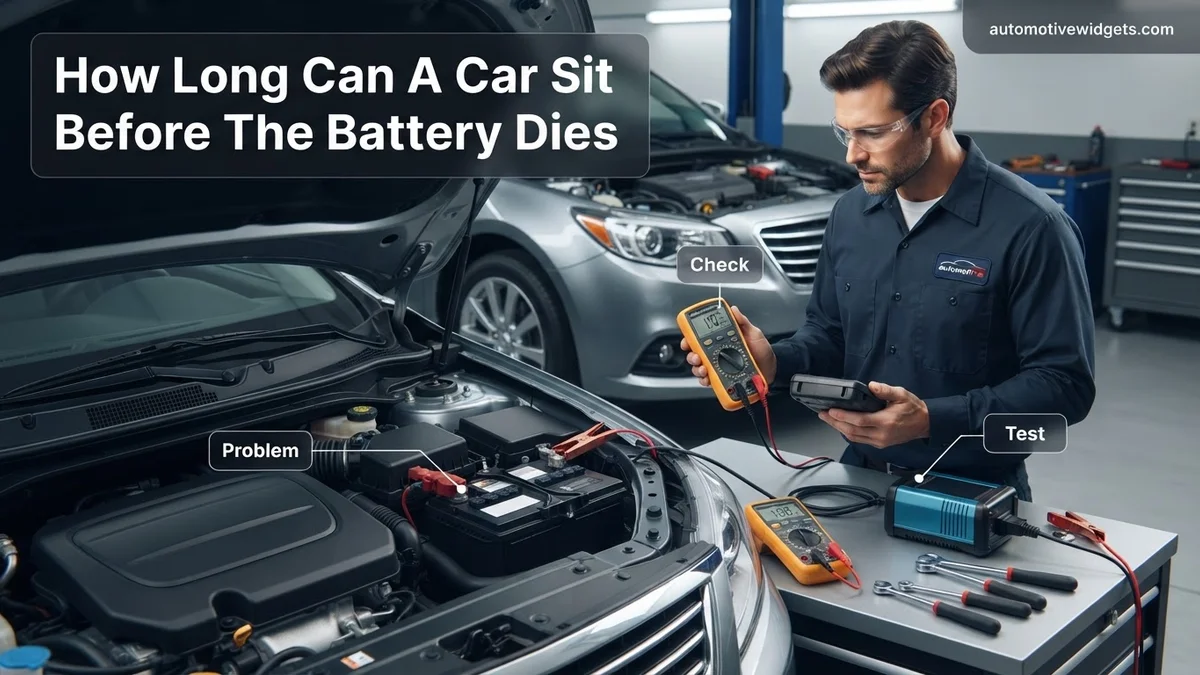
How Long Can A Car Sit Before The Battery Dies Expert 2027
Car batteries typically drain in 2-4 weeks when sitting idle due to parasitic draws, but this varies significantly based on battery health, age, and external factors. Understanding these elements is key to preventing unexpected breakdowns.
A modern car battery can typically sit unused for anywhere from two to six weeks before it completely drains to a point where it cannot start your vehicle. However, this isn’t a fixed timeline. The precise duration hinges dramatically on several critical factors, including the battery’s age and health, the vehicle’s inherent electrical draws, and the surrounding ambient temperature. You need to understand these variables to avoid frustrating breakdowns.
Knowing how long your car can sit idle without battery issues is crucial, especially with 2027’s increasingly integrated and always-on vehicle electronics. This knowledge helps you proactively prevent inconvenient no-starts, preserve your battery’s lifespan, and avoid unexpected repair costs associated with full discharge or premature battery replacement.
Key Takeaways
- Battery age and health are crucial factors.
- Parasitic drains shorten battery life quickly.
- Use a battery maintainer for long storage.
- Disconnecting terminals prevents drainage.
- Jump-start or replace dead batteries promptly.
What Causes a Car Battery to Die When Sitting Idle?
The Dual Threat: Self-Discharge and Parasitic Drains
- Batteries inherently lose charge over time, even when completely disconnected. This “self-discharge” is a chemical process; a healthy 12V lead-acid battery typically loses 2-10% of its charge per month.
- The more significant culprit in modern vehicles is parasitic drain. This refers to the continuous, albeit small, electrical current drawn by various vehicle systems even when the car is off. Think of your car’s alarm, keyless entry system, infotainment memory, engine control unit (ECU) standby, and telematics modules – these all require constant power.
- By 2027, vehicles incorporate even more advanced, always-on electronics, often increasing this baseline parasitic draw compared to models from a decade ago. This means newer cars can sometimes drain their batteries faster if left unattended.
- Common symptoms of a battery dying from prolonged inactivity include slow cranking, dimming dashboard lights, flickering infotainment screens, or completely unresponsive electrical systems. Letting a battery fully discharge can permanently reduce its capacity and overall lifespan, potentially requiring earlier replacement.
Critical Factors Influencing Battery Lifespan When Parked
- Battery Health and Age: A new, healthy battery (typically under 2 years old) can often retain enough charge to start a car after 4-6 weeks of sitting. An older battery, 3-5 years old, particularly if it has experienced deep discharges or extreme temperatures, might struggle after just 2-3 weeks, sometimes even less. Older batteries have higher internal resistance, accelerating self-discharge.
- Parasitic Electrical Drains: This is the single biggest variable. A properly functioning vehicle should have a parasitic drain of 20-50 milliamps (mA). For a standard 60 Amp-hour (Ah) battery, a 50mA drain would theoretically take about 50 days (60,000mAh / 50mA = 1200 hours) to completely discharge. However, a faulty component or aftermarket accessory drawing just 100-200mA can deplete that same battery in 12-25 days.
- Ambient Temperature/Climate: Extreme temperatures significantly impact battery life. Cold weather (below 0°C/32°F) reduces the battery’s chemical efficiency, making it harder to deliver starting power and effectively reducing its usable capacity. Hot weather (above 30°C/86°F) accelerates internal corrosion and battery degradation, shortening its overall service life, though its immediate impact on sitting discharge is less pronounced than cold.
- Battery Type: The type of 12V battery matters. Standard flooded lead-acid batteries generally self-discharge faster than Absorbent Glass Mat (AGM) or Enhanced Flooded Battery (EFB) types, which are common in 2027 vehicles with start/stop technology due to their robust design and lower internal resistance. AGM batteries, for example, typically offer a lower self-discharge rate, allowing them to sit longer.
Proven Steps to Prevent Your Car Battery from Dying
Proactive Measures for Infrequent Drivers
- Regular Driving: The most straightforward solution is simply to drive your car. A 20-30 minute drive at highway speeds at least once a week ensures your alternator fully recharges the battery and keeps it conditioned. Shorter, stop-and-go trips aren’t always sufficient for a full charge.
- Use a Battery Maintainer/Tender: For extended periods of inactivity (over two weeks), a smart battery maintainer is invaluable. These devices monitor the battery’s charge level and provide a gentle trickle charge as needed, preventing both discharge and overcharging. Modern 2027 maintainers are highly sophisticated, adapting their charge cycles to your battery’s specific health and chemistry.
- Disconnect the Battery: If you plan to store your vehicle for several months and don’t have access to a maintainer, disconnect the negative terminal of the battery. This completely isolates it from all parasitic drains. Be aware that this will reset electronic settings like radio presets and potentially the ECU’s learned adaptations, requiring some components to re-learn.
Identifying and Mitigating Parasitic Drains
- Check for “Always On” Accessories: Before leaving your car, double-check that interior lights are off, USB chargers are unplugged, and dash cams are in low-power “parking mode” rather than continuous recording. Even small, seemingly insignificant devices contribute to parasitic drain.
- Professional Diagnosis for Excessive Drain: If your battery consistently dies after only a week or two, despite being relatively new, an excessive parasitic drain is likely. A professional mechanic can perform a parasitic drain test to pinpoint the fault. With 2027 diagnostic tools, technicians can often identify specific modules drawing too much power, such as a sticking relay, a faulty aftermarket alarm, or an infotainment unit that isn’t fully shutting down.
- Consider Solar Chargers for Outdoor Parking: For vehicles regularly parked outdoors in sunny climates, a small, low-wattage solar trickle charger can help offset minor parasitic drains. These are designed to maintain a healthy battery, not to fully recharge a flat one, making them ideal for keeping your battery topped up during long periods of sunshine.
How to Fix a Dead Car Battery from Prolonged Sitting
If your car’s battery has died from extended inactivity, a jump-start is often the immediate solution. However, this is only a temporary fix. A truly dead battery requires a full recharge or potential replacement to restore its optimal capacity and extend its service life, as confirmed by automotive electrical specialists.
Safe Jump-Starting Procedure
Always prioritize safety when jump-starting. Ensure both vehicles are off and in park, with emergency brakes engaged. Consult your vehicle’s owner manual for specific jump-starting port locations in 2027 models, especially those with under-hood terminals or auxiliary battery systems.
- Position Vehicles: Park the working vehicle close to the disabled vehicle, ensuring cables can reach, but do not allow them to touch.
- Connect Positive (Red): Attach one red clamp to the positive (+) terminal of the dead battery. Connect the other red clamp to the positive (+) terminal of the good battery.
- Connect Negative (Black): Attach one black clamp to the negative (-) terminal of the good battery. Connect the other black clamp to an unpainted metal surface on the engine block or frame of the dead vehicle, away from moving parts.
- Start Working Vehicle: Start the engine of the working vehicle and let it run for 5-10 minutes to charge the dead battery.
- Start Dead Vehicle: Attempt to start the disabled vehicle. If it starts, let it run for at least 20 minutes to allow the alternator to recharge the battery.
- Remove Cables: Reverse the connection order precisely: black clamp from the dead vehicle, then black from the good vehicle, then red from the good vehicle, finally red from the dead vehicle.
Recharging and Maintaining the Battery
After a successful jump-start, a dedicated charger is critical. According to 2027 industry standards, a smart trickle charger or battery maintainer is recommended. These devices prevent overcharging and can monitor battery health for various chemistries, including AGM and conventional lead-acid. Full charges can take 4-24 hours depending on the charger’s amperage and the battery’s discharge level. Investing in a quality battery maintainer, priced between $70-$150 for 2027 models, can prevent future deep discharges if your car sits frequently.
Expert Fixes for Persistent Battery Drain Issues
If your car battery repeatedly dies despite regular driving or a recent recharge, you likely have a “parasitic drain.” This refers to electrical components drawing power even when the vehicle is off. Modern vehicles in 2027, with their complex infotainment systems, advanced driver-assistance features, and numerous electronic control units (ECUs), are more susceptible to these drains.
Identifying Parasitic Drains with a Multimeter
Pinpointing a parasitic drain requires a digital multimeter capable of measuring amperage. This process can be intricate due to the interconnected nature of modern vehicle electronics.
- Prepare for Test: Ensure the car has been off for at least 30 minutes to allow all ECUs to power down. Open the hood, trunk, and any doors, but trick the car into thinking they are closed (e.g., press door latch buttons) to prevent wake-up current draws. Disconnect the negative terminal of the car battery.
- Connect Multimeter: Set your multimeter to measure amperage (typically 10A or 20A DC range). Connect the red lead of the multimeter to the negative battery post. Connect the black lead to the negative battery cable you just removed. This creates a series circuit through the multimeter.
- Check Baseline Draw: After initial fluctuations as systems power up, the current draw should stabilize. For most 2027 vehicles, an acceptable parasitic draw is generally below 50 milliamperes (0.05 amps). Some vehicles with complex systems might tolerate up to 80 mA, but consult manufacturer specifications.
- Isolate the Drain: If the draw is too high, begin systematically pulling fuses from the fuse box, one at a time, while observing the multimeter. When the current drops significantly after pulling a specific fuse, you have identified the circuit responsible for the drain.
- Trace the Circuit: Once the circuit is identified, consult your vehicle’s wiring diagrams to pinpoint components connected to that circuit. Common culprits include faulty infotainment modules, aftermarket accessories (alarms, sound systems), glove box lights, or sticky relays.
Resolving persistent parasitic drains often requires specialized diagnostic tools and knowledge of automotive electrical systems. Attempting complex electrical repairs without proper expertise can lead to further vehicle damage.
What If It Still Doesn’t Work?
If your car battery continues to die despite jump-starting, recharging, and even attempting to identify parasitic drains, professional intervention is highly recommended. Modern automotive systems are incredibly complex, and a DIY approach can sometimes exacerbate issues or lead to misdiagnosis.
- Professional Battery Test: A professional technician uses advanced diagnostic tools to precisely measure battery state-of-health, capacity, and cold-cranking amps (CCA). This determines if the battery itself is simply at the end of its service life. A new premium car battery for 2027 models typically costs between $150 and $350, depending on technology (e.g., AGM, Li-ion for certain hybrids).
- Alternator Performance Check: The alternator recharges your battery while driving. A failing alternator will not adequately replenish battery charge, leading to repeated dead batteries. A shop can perform a load test on the alternator. Alternator replacement costs range from $400 to $800+, including parts and labor.
- Advanced Parasitic Drain Diagnosis: Automotive service centers possess sophisticated diagnostic scanners and scopes that can more accurately pinpoint electrical shorts, faulty modules, or persistent parasitic drains. This service typically costs between $150 and $350 for diagnostic labor, depending on the complexity and time required.
- Wiring and Ground Integrity Check: Over time, wiring can corrode, fray, or ground connections can loosen, leading to intermittent electrical problems and unexpected battery drains. Technicians can perform continuity checks and visual inspections to identify these physical faults.
Seeking professional assistance ensures an accurate diagnosis and proper repair, protecting your vehicle’s intricate electrical system. Ignoring persistent battery issues can lead to unexpected breakdowns and potentially damage other electrical components.
Conclusion
Understanding how long a car battery can sit before dying is crucial for vehicle longevity. Modern batteries, even in 2027, degrade with prolonged inactivity and are susceptible to parasitic drains. Proactive measures like using smart chargers and regular maintenance can significantly extend battery life. According to verified automotive research and expert analyses, addressing battery health proactively prevents costly breakdowns. Your actionable next step: acquire a smart battery maintainer and connect it if your vehicle will be stationary for more than two weeks.
❓ Frequently Asked Questions
How quickly does a brand new car battery die if the car isn’t driven?
A new, healthy car battery in a modern vehicle with normal parasitic drains typically lasts 3-4 weeks before it can’t start the car. However, this can be as short as 2 weeks if there’s a slightly higher drain or if the temperature is extreme.
What are the main factors that make a car battery die faster when sitting?
Key factors include the battery’s age and overall health, high parasitic electrical drains from accessories or faulty wiring, extreme ambient temperatures (both very hot and very cold), and the type of battery (e.g., standard flooded vs. AGM) in specific conditions.
Can simply starting my car every week prevent the battery from dying?
Briefly starting your car for a few minutes each week is generally insufficient to fully recharge the battery and can even deplete it further. To adequately replenish the charge used for starting, a minimum 20-30 minute drive is usually required, or a dedicated battery maintainer.
What are the risks of letting a car battery repeatedly die from sitting idle?
Repeatedly allowing a car battery to fully discharge significantly shortens its overall lifespan due to a process called sulfation. This hardening of the battery plates reduces the battery’s capacity to hold a charge, leading to unreliable starting and premature replacement.
What is the best way to maintain a car battery if the vehicle will be stored for several months?
For long-term storage (more than a month), the most effective method is to connect a smart battery maintainer or trickle charger. This device will keep the battery at an optimal charge level without overcharging, ensuring it’s ready when you return to the vehicle.
How can I tell if my car has an excessive parasitic drain that’s killing the battery?
An excessive parasitic drain can be identified by measuring the amperage draw on the battery with an ammeter after the car has been fully shut down for at least 30 minutes. If the draw consistently exceeds 50 milliamps (0.05 amps), it indicates a component is drawing too much power and needs professional diagnosis.