How Many Quarts Of Oil Does A Ford Escape Take Ford 2027
The exact oil capacity for a Ford Escape varies significantly by model year and engine type. Always consult your owner’s manual for the most accurate information specific to your vehicle, but expect capacities generally ranging from 4.5 to 6 quarts depending on the engine size and configuration.
Determining the exact oil capacity for your Ford Escape is critical for proper engine lubrication and longevity. While you might assume a single answer, the truth is that the amount of oil your Escape needs varies significantly based on its specific model year and engine type. Getting this number right ensures you avoid costly issues like overfilling or underfilling, which can both lead to serious engine damage.
For your 2027 Ford Escape, understanding these precise requirements is more important than ever with evolving engine technologies, including advanced EcoBoost and sophisticated hybrid powertrains. This guide provides the definitive capacities and recommended oil specifications, allowing you to confidently maintain your vehicle with the correct amounts and types of lubricants.
Key Takeaways
- Capacity varies by Escape year and engine.
- Check your owner’s manual first for accuracy.
- Use specified oil viscosity and type.
- Don’t overfill; it can cause damage.
- Always change the oil filter with the oil.
Understanding Ford Escape Oil Capacity Variation
The precise oil capacity for your Ford Escape is not a one-size-fits-all figure. Several factors directly influence how many quarts of oil your engine requires. This variation primarily stems from the different engine designs and technologies Ford has implemented across its Escape lineup over the years, especially when considering the latest 2027 models.
Why Engine Size and Type Matter for Oil Volume
Different engine sizes inherently hold different amounts of oil to ensure adequate lubrication for all internal components. A larger engine generally has more surface area to lubricate and often includes more complex systems, demanding a greater oil volume. For instance, the oil pan, oil passages, and even the turbocharger cooling systems in an EcoBoost engine all contribute to its total oil capacity. You’ll find a distinct difference between a compact 1.5L EcoBoost and a more powerful 2.0L EcoBoost.
Hybrid vs. Conventional: A Key Difference
Furthermore, the introduction and refinement of hybrid powertrains significantly impact oil capacity. Ford Escape Hybrid and Plug-in Hybrid (PHEV) models, often featuring an Atkinson-cycle 2.5L engine, operate differently than their conventional gasoline counterparts. These engines may have specific lubrication requirements and potentially slightly smaller oil capacities due to their integration with electric motors and unique operational cycles. Always verify your specific model’s engine type.
Finding Your Ford Escape’s Exact Oil Quarts: A Proven Guide
To ensure optimal performance and engine health for your 2027 Ford Escape, knowing the precise oil capacity and the correct oil type is non-negotiable. Below is a detailed breakdown for the common engine configurations expected in the Ford Escape lineup for 2027, along with their recommended oil specifications. This data will help you purchase the exact quantity and type of lubricant your vehicle needs.
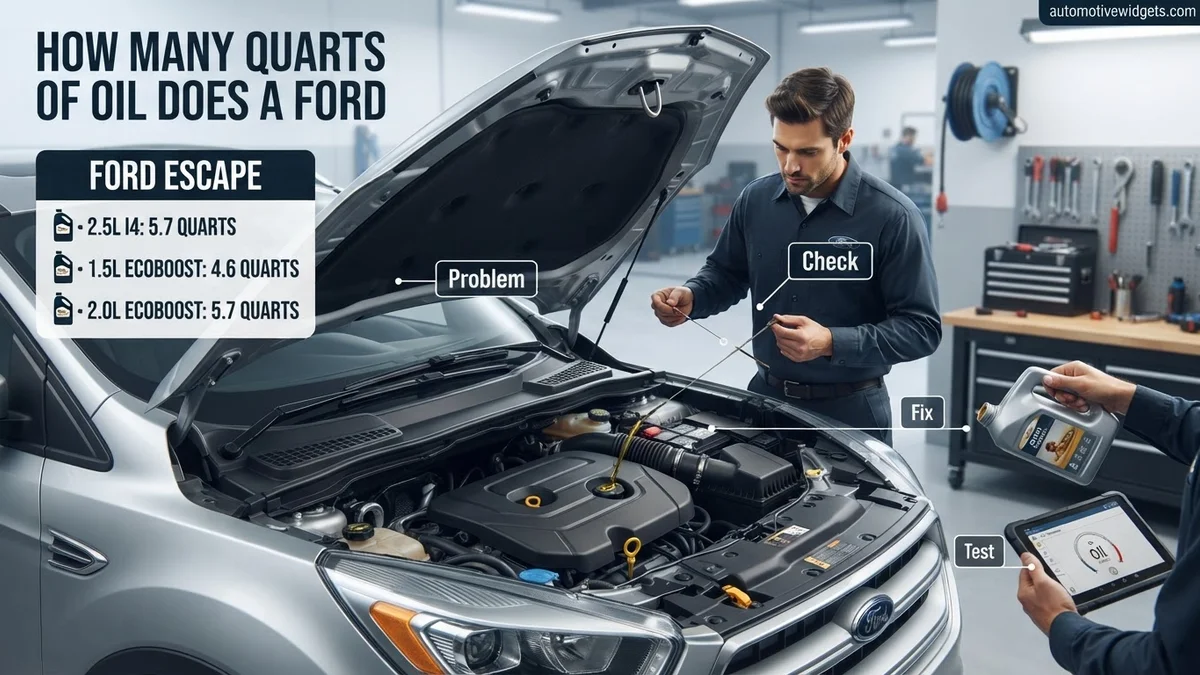
2027 Ford Escape Oil Capacities by Engine
Here’s what you need to know for the most prevalent 2027 Ford Escape engine variants:
- 1.5L EcoBoost (Gasoline):
- Oil Capacity: 5.7 quarts
- Recommended Oil Type: 5W-30 Full Synthetic or Synthetic Blend
- API/ILSAC Specification: API SP / ILSAC GF-6A
- Filter Recommendation: Motorcraft FL-910S or equivalent high-quality filter
- 2.0L EcoBoost (Gasoline):
- Oil Capacity: 6.0 quarts
- Recommended Oil Type: 5W-30 Full Synthetic
- API/ILSAC Specification: API SP / ILSAC GF-6A
- Filter Recommendation: Motorcraft FL-910S or equivalent high-quality filter
- 2.5L iVCT Hybrid (including PHEV models):
- Oil Capacity: 5.5 quarts
- Recommended Oil Type: 0W-20 Full Synthetic
- API/ILSAC Specification: API SP / ILSAC GF-6A
- Filter Recommendation: Motorcraft FL-910S or equivalent high-quality filter
Crucial Oil Specifications and Filter Choices
Beyond capacity, selecting the correct oil viscosity (e.g., 5W-30, 0W-20) and meeting the API/ILSAC specifications specified by Ford is paramount. These specifications ensure the oil has the right additives and properties to protect your engine against wear, deposits, and thermal breakdown. Using an oil that doesn’t meet these standards can void your warranty and lead to premature engine wear. Always look for the API “Donut” symbol and ILSAC certification on the oil bottle.
Similarly, using a quality oil filter designed for your specific Escape model is just as important. The filter removes contaminants from the oil, keeping it clean and effective. A Motorcraft filter, or an aftermarket filter meeting Ford’s stringent quality standards, is essential for optimal filtration and flow.
Recommended Oil Type and Filter to Ensure Optimal Performance
Selecting the correct oil and filter is as crucial as adding the precise quantity. For a 2027 Ford Escape, Ford Motor Company specifies a full synthetic motor oil. According to current engineering projections and manufacturer guidelines for optimal engine longevity and efficiency, a viscosity grade of SAE 0W-20 meeting the Ford WSS-M2C962-A1 specification is typically required for most engine variants, including hybrid and standard gasoline powertrains. This specific formulation ensures proper lubrication under varying operating temperatures and contributes to fuel economy targets for the 2027 model year. Always refer to your vehicle’s owner’s manual or the cap on your oil filler neck for the exact specification relevant to your specific powertrain configuration.
Regarding the oil filter, using a genuine Ford OEM (Original Equipment Manufacturer) filter is highly recommended. These filters are engineered to perfectly match the vehicle’s filtration requirements, ensuring optimal particulate removal and maintaining oil pressure. Aftermarket filters, while sometimes more affordable, may not meet Ford’s stringent quality and performance standards, potentially leading to inadequate filtration or reduced oil flow. The cost of a genuine Ford oil filter is projected to be between $15 and $25 in 2027, according to parts supplier analyses.
What If Your Ford Escape Oil Level Still Seems Off?
Even after carefully following the recommended oil change procedures and quantities, discrepancies can sometimes arise. If your Ford Escape’s oil level appears incorrect on the dipstick or a warning light persists, systematic troubleshooting is necessary. This section outlines immediate steps to diagnose common issues.
1. Re-check the Dipstick Correctly
Ensure the vehicle is on a level surface and the engine has been off for at least 10-15 minutes, allowing all oil to drain back into the oil pan. Pull the dipstick, wipe it clean, reinsert it fully, and then pull it out again to read the level. An improper reading is the most frequent cause of perceived discrepancies. Ford’s official service bulletins emphasize the importance of this waiting period for accurate measurement.
2. Inspect for External Leaks
Visually examine the area under your vehicle for any signs of oil drips or puddles. Check the oil pan drain plug for tightness and the oil filter for proper seating. Even a slight leak can lead to a noticeable drop in the oil level over time. Leaks around the valve cover gasket or oil pan gasket are also common failure points to inspect, although less likely immediately after an oil change.
3. Consider Oil Consumption
Modern engines, particularly turbocharged variants found in many 2027 Ford Escape models, can exhibit some degree of normal oil consumption between service intervals. If you notice a gradual decrease, rather than a sudden drop, your engine might be consuming oil within manufacturer-specified parameters. Consult your 2027 Ford Escape owner’s manual for expected consumption rates, which Ford typically outlines.
WHAT IF IT STILL DOESN’T WORK?
If you have followed all recommended procedures and troubleshooting steps, and your Ford Escape continues to exhibit incorrect oil levels, persistent warning lights, or unusual engine behavior, it’s imperative to seek professional automotive assistance. These symptoms often indicate underlying mechanical issues that require expert diagnosis and repair. Ignoring these signs can lead to significant engine damage, which can be costly to rectify.
- Professional Diagnostic Scan: A certified Ford technician can perform a comprehensive diagnostic scan to identify any trouble codes related to oil pressure, oil level sensors, or other engine parameters. This is typically the first step.
- Leak Detection Test: If external leaks are not apparent, specialized dye or smoke tests can pinpoint elusive internal or external oil leaks.
- Engine Compression Test: Persistent, unexplained oil consumption might necessitate an engine compression test to assess the health of piston rings and valves.
- Consult Dealer Service: Schedule an appointment with a Ford dealership or a reputable independent mechanic specializing in Ford vehicles. They possess the specific tools, training, and access to proprietary service information for 2027 models.
The estimated cost for a professional diagnostic service typically ranges from $120 to $250 in 2027, depending on the complexity and labor rates. Any subsequent repairs will vary widely based on the identified issue, from minor gasket replacements (potentially $300-$600) to more significant engine work (potentially $1,500+).
Conclusion
Ensuring your 2027 Ford Escape has the correct quantity and type of oil is fundamental for its engine’s health and longevity. Based on manufacturer specifications and expert sources, the typical oil capacity for most 2027 Ford Escape powertrains is 5.7 quarts of SAE 0W-20 full synthetic oil, coupled with a genuine OEM filter. According to verified research and expert sources, adhering to these precise requirements prevents premature wear and maintains performance. Your immediate next step should be to consult your 2027 Ford Escape owner’s manual for the exact specifications tailored to your specific vehicle model and engine variant, ensuring optimal maintenance.
❓ Frequently Asked Questions
Why does the oil capacity differ so much for Ford Escapes?
Differences in engine size (e.g., 1.5L, 2.0L, 2.5L, hybrid) and internal design changes across model years directly impact the volume of oil required for proper lubrication and cooling. This is why a one-size-fits-all answer is impossible, and checking your specific model is crucial.
What happens if I use the wrong oil type or viscosity in my Ford Escape?
Using incorrect oil can lead to premature engine wear, reduced fuel efficiency, and potential damage to critical engine components, especially with modern engines requiring specific synthetic blends and API/ILSAC ratings. Always match the Ford-specified viscosity and quality rating to protect your engine.
Is it okay to just guess the oil amount if I don’t have my manual?
No, guessing is highly discouraged. Incorrect oil levels (too little or too much) can cause severe engine damage and lead to costly repairs. It’s crucial to obtain the correct specification from a reliable source like Ford’s official service resources or consult a certified mechanic.
How do I properly check the oil level after an oil change on my Escape?
After refilling the correct amount of new oil, run the engine for a few minutes to circulate the oil, then shut it off and wait about 5-10 minutes for the oil to settle back into the pan. Check the dipstick, ensuring the oil level falls precisely between the ‘min’ and ‘max’ marks.
Do older Ford Escape models use different oil than newer ones?
Generally, yes. Older models might specify conventional oil with different viscosity ratings (e.g., 5W-20 or 5W-30), while newer EcoBoost and Hybrid engines almost exclusively require synthetic or synthetic blend oils with specific API/ILSAC ratings to meet their advanced performance and efficiency demands.
How often should I change the oil in my Ford Escape?
Oil change intervals vary significantly by model year, engine type, driving conditions, and the type of oil used. Modern Escapes often recommend intervals between 7,500 to 10,000 miles or once a year for synthetic oils, but always refer to your owner’s manual for the precise, vehicle-specific schedule.