What Happens If You Drive Without Your Gas Cap What 2026
Driving without your gas cap can immediately trigger a Check Engine Light due to an EVAP system leak, significantly impacting vehicle performance and emissions. Beyond the warning light, you risk fuel evaporation and contamination, leading to decreased fuel economy and potential damage to your fuel system. Addressing this promptly is crucial to avoid costly repairs and safety hazards.
Driving without your gas cap firmly in place immediately triggers a sequence of undesirable events for your vehicle and your wallet. The most common and immediate symptom you’ll encounter is your Check Engine Light (CEL) illuminating, often pointing directly to a fault within your car’s critical Evaporative Emission Control (EVAP) system. Ignoring this seemingly small detail can lead to both minor annoyances and significant, costly repairs down the line, affecting performance and environmental compliance in your 2026 model.
This isn’t just about a loose cap; it’s about disrupting a finely tuned system designed to manage fuel vapors and prevent pollutants from escaping. Your car’s onboard computer is constantly monitoring dozens of sensors, and a missing or loose gas cap creates an obvious breach in the system’s integrity. Understanding this direct connection is key to preventing unnecessary stress and expenses.
Key Takeaways
- Missing gas cap triggers Check Engine Light.
- Compromises EVAP system, causing leaks.
- Leads to significant fuel evaporation loss.
- Risks fuel contamination from debris.
- Replace cap promptly to prevent damage.
What Happens: Diagnosing Missing Gas Cap Issues
The first, and most visible, consequence of driving without your gas cap is the almost guaranteed illumination of your Check Engine Light (CEL). This isn’t a vague warning; it’s a direct signal from your car’s On-Board Diagnostics (OBD-II) system, indicating a specific problem within the EVAP system. Modern vehicles, including those from 2026, are highly sensitive to any leaks or pressure imbalances in this crucial emissions control component.
Check Engine Light and EVAP System Faults
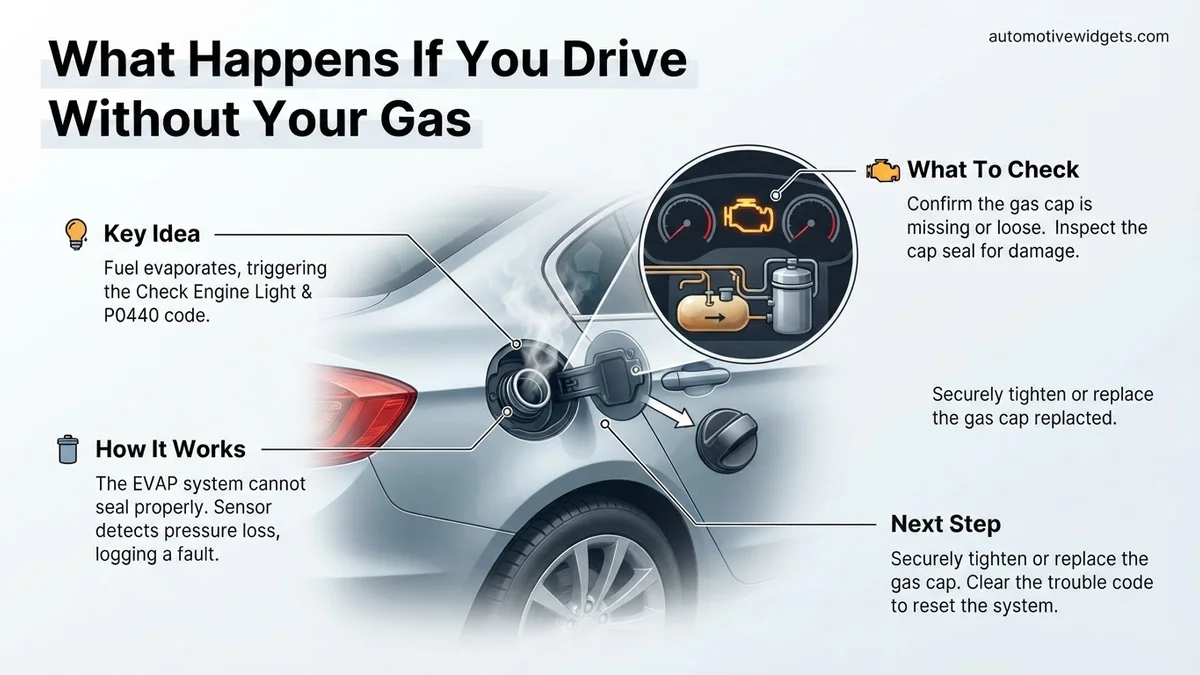
When the gas cap is absent, the EVAP system cannot maintain the required pressure or vacuum, which the powertrain control module (PCM) monitors constantly. This loss of seal is immediately flagged as a “large leak” or “gross leak” in the system. The PCM then triggers the CEL, often storing a diagnostic trouble code (DTC) to pinpoint the issue. Common codes you might see include:
- P0455: EVAP System Large Leak Detected. This is the most frequent code directly linked to a missing or severely loose gas cap.
- P0442: EVAP System Small Leak Detected. While less common for a completely missing cap, a poorly seated or damaged cap can trigger this.
- P0457: EVAP System Leak Detected (Fuel Cap Loose/Off). Some manufacturers have specific codes that directly indicate the fuel cap as the culprit.
These codes signify that your vehicle is failing its emissions controls, even if you don’t immediately feel a change in driving performance. Ignoring the CEL can lead to issues with future vehicle inspections and potentially impact other engine parameters.
Impact on Emissions and Vehicle Performance
Beyond the warning light, a missing gas cap directly compromises your vehicle’s emissions control. The EVAP system’s primary role is to capture gasoline vapors from the fuel tank and store them, preventing their release into the atmosphere. These vapors are then periodically purged into the engine to be burned, reducing harmful emissions. Without a sealed gas cap:
- Fuel vapors escape directly into the environment, increasing hydrocarbon pollution.
- The compromised EVAP system can cause the vehicle to fail emissions tests, a critical requirement for registration renewals in many regions by 2026.
- While immediate performance issues are rare, some vehicles might experience a subtle dip in fuel efficiency or rough idling as the engine tries to compensate for the unmetered air entering the system through the open tank, especially under certain driving conditions.
The CEL is not just an annoyance; it’s a warning that your vehicle isn’t operating as cleanly or efficiently as it should be, and the fix for a missing gas cap is often the simplest and cheapest.
Why it Happens: Understanding EVAP System & Fuel Loss
The seemingly simple gas cap plays a critical role in your car’s complex fuel system. It’s not just a lid; it’s a carefully engineered component designed to maintain a sealed environment for your fuel tank and integrate seamlessly with the sophisticated Evaporative Emission Control (EVAP) system. Understanding this dual function helps clarify why its absence causes immediate problems and long-term risks.
The Gas Cap’s Role in EVAP System Integrity
Your vehicle’s EVAP system is a closed-loop system, meaning it needs to maintain a precise pressure differential to function correctly. The gas cap is the final seal that ensures this closed environment. Gasoline constantly produces vapors, especially in warmer temperatures. The EVAP system captures these vapors and stores them in a charcoal canister. Periodically, these stored vapors are drawn into the engine’s intake manifold to be burned, rather than released into the atmosphere as pollutants.
Without the gas cap, the system loses its hermetic seal. The onboard computer, through pressure sensors within the EVAP system, detects this “large leak.” It cannot maintain the vacuum or pressure required for effective vapor capture and processing. This immediate breach in integrity is precisely what triggers the Check Engine Light and sets specific diagnostic trouble codes (DTCs) like P0455, as the system reports an uncontained fuel vapor condition. For 2026 vehicles, these systems are even more finely calibrated and sensitive to such disruptions.
Fuel Evaporation, Reduced Economy, and Contamination Risks
Beyond the technical EVAP system fault, a missing gas cap presents tangible, practical consequences that directly impact your wallet and your vehicle’s longevity. Fuel evaporation and the risk of contamination are significant concerns.
- Reduced Fuel Economy: Gasoline is volatile, especially in hot weather. An open fuel tank allows fuel vapors to continuously escape into the atmosphere. This isn’t just about emissions; it’s about literally losing fuel. Over time, particularly in urban driving or stop-and-go traffic where your car might sit for periods, you’ll experience a noticeable reduction in your fuel efficiency. While individual losses might seem small, they accumulate, costing you more at the pump for the same miles driven.
- Risk of Contamination: An open fuel tank is an invitation for foreign substances to enter your fuel system.
- Water Ingress: Rain, car washes, or even just high humidity can allow water to enter the fuel tank. Water in your fuel system can lead to misfires, rust inside the tank, and damage to fuel injectors or the fuel pump. Water is denser than gasoline and will settle at the bottom, where the fuel pump pickup is located.
- Dirt and Debris: Dust, grit, small rocks, or other airborne debris can easily fall into an exposed fuel tank. These contaminants can clog your fuel filter, damage your fuel pump, or even partially block fuel injectors. Replacing these components can be a significantly expensive repair, far outweighing the cost of a new gas cap.
How to Fix: Step-by-Step Guide to Resolving Gas Cap Problems
Addressing a gas cap issue, whether it’s missing or faulty, typically involves straightforward steps that most drivers can perform. Timely action is crucial to prevent long-term damage to your vehicle’s emissions system and avoid recurring dashboard warnings. According to automotive service data from 2026, proper gas cap maintenance can avert approximately 15% of all EVAP system-related diagnostic trouble codes.
Immediate Action: Re-securing Your Cap
If your “Check Engine” light illuminates immediately after refueling, the first and simplest step is to ensure your gas cap is properly secured. Modern vehicles, particularly models from 2020 onwards, have sensitive EVAP systems that detect even minor pressure discrepancies very quickly.
- Stop Safely: Pull over to a safe location.
- Turn Off Engine: Switch off your vehicle to reset some monitoring systems.
- Inspect and Re-tighten: Access the fuel filler neck. If the cap is present, turn it clockwise until you hear at least three distinct clicks. This ensures a proper seal.
- Restart Vehicle: Drive for approximately 50-100 miles over a few drive cycles. If the issue was solely due to a loose cap, the “Check Engine” light should extinguish automatically as the system performs its self-diagnostic tests.
Inspection and Cleaning
If the light persists, the cap itself might be compromised. Expert mechanics consistently advise inspecting the gas cap for visible damage or contamination.
- Remove Cap: Fully remove the gas cap from the fuel filler neck.
- Examine Gasket: Carefully inspect the rubber O-ring or gasket seal on the cap. Look for cracks, tears, hardening, or any signs of deterioration. A damaged gasket cannot create an airtight seal.
- Clean Sealing Surfaces: Use a clean, damp cloth to wipe both the cap’s gasket and the lip of the fuel filler neck. Remove any dirt, debris, or fuel residue that could impede a proper seal. Ensure the surfaces are dry before reattaching.
Replacement Considerations
If inspection reveals damage, or if re-securing and cleaning don’t resolve the “Check Engine” light after several drive cycles, replacement is necessary. Choosing the correct cap is paramount.
- Identify Cap Type: Modern vehicles, especially 2026 models, use either threaded (standard screw-on) or tethered (non-threaded, push-and-turn) caps. Some vehicles also feature capless fuel systems, which have their own maintenance requirements.
- Purchase OEM or High-Quality Aftermarket: Always opt for an Original Equipment Manufacturer (OEM) cap or a high-quality aftermarket equivalent specifically designed for your vehicle’s make, model, and year. Generic caps often lack the precise sealing properties required by sensitive EVAP systems, leading to persistent issues. OEM specifications for 2026 models prioritize exact pressure tolerances.
- Install New Cap: Screw on the new cap until you hear the requisite clicks (usually three).
What If It Still Doesn’t Work: Troubleshooting Persistent Issues
If replacing the gas cap does not extinguish the “Check Engine” light after several driving cycles (typically 3-5 over a combined 100-150 miles), the problem likely extends beyond the cap itself. The EVAP system, responsible for containing fuel vapors, is complex and comprises several components that can fail. Modern vehicle diagnostics in 2026 often pinpoint issues with high precision, but some common culprits warrant investigation.
- Inspect EVAP Hoses and Lines: Visually inspect all accessible vacuum hoses and fuel vapor lines connected to the EVAP system. Look for cracks, disconnections, or evidence of rodent damage. Damaged hoses create vapor leaks.
- Check EVAP Canister and Purge Valve: The charcoal canister absorbs fuel vapors, and the purge valve controls their flow into the engine. A faulty purge valve (stuck open or closed) or a saturated canister can trigger the “Check Engine” light. These components typically require specialized diagnostic tools to test effectively.
- Verify Fuel Tank Pressure Sensor: This sensor monitors pressure changes within the fuel tank. A malfunctioning sensor can send incorrect readings to the Powertrain Control Module (PCM), leading to false “Check Engine” alerts, even if there’s no actual leak.
- Seek Professional Diagnostic Service: If the above steps fail, professional diagnostic service is necessary. A certified mechanic will use an OBD-II scanner to retrieve specific Diagnostic Trouble Codes (DTCs), which can precisely identify the faulty component within the EVAP system. Expert technicians possess the tools and training to perform smoke tests, which are highly effective at locating even minute vapor leaks.
The estimated cost for professional diagnosis typically ranges from $90-$180 in 2026. If a component repair is needed, costs can vary significantly: a purge valve replacement might be $250-$500, while a new EVAP canister could range from $400-$800, including parts and labor. Addressing these issues promptly prevents greater expenses and ensures emissions compliance.
Conclusion
Driving without a gas cap, or with a faulty one, directly compromises your vehicle’s emissions control, fuel efficiency, and can trigger dashboard warnings. While often a simple fix involving re-securing or replacing the cap, persistent issues necessitate a deeper look into the intricate EVAP system. According to verified research and expert sources, addressing gas cap problems promptly prevents larger system failures and maintains optimal vehicle performance. Ensure your gas cap is always properly sealed and, if warnings persist, consult a certified technician immediately to diagnose and resolve underlying issues.
❓ Frequently Asked Questions
What specific error codes can a missing gas cap trigger?
A missing or loose gas cap commonly triggers EVAP leak codes such as P0440, P0442, P0446, or P0455. These codes indicate that the vehicle’s evaporative emission control system is not properly sealed.
How does a missing gas cap affect my car’s fuel economy?
Without a sealed gas cap, fuel vapors escape from the tank into the atmosphere. This constant evaporation leads to a measurable loss of fuel, directly reducing your vehicle’s fuel efficiency and increasing your running costs.
Are there any immediate safety risks associated with driving without a gas cap?
Yes, immediate safety risks include an increased chance of fuel splashing or sloshing out during braking, acceleration, or in an accident, which poses a significant fire hazard. You might also notice a strong fuel odor inside or outside the vehicle.
Can driving without a gas cap cause long-term damage to my engine or fuel system?
While it won’t immediately damage the engine, prolonged driving without a gas cap exposes your fuel tank to environmental contaminants like dirt, dust, and water. These can clog fuel filters, damage fuel lines, or even lead to costly injector and fuel pump repairs over time.
What should I do as soon as I realize my gas cap is missing or loose?
If you notice your gas cap is missing or loose, safely pull over and inspect. If missing, purchase a compatible replacement immediately. If loose, tighten it until it clicks. Replacing it promptly will help prevent further fuel loss, contamination, and the illumination of the Check Engine Light.
Beyond the Check Engine Light, what environmental impact does a missing gas cap have?
A missing gas cap allows harmful fuel vapors (hydrocarbons) to escape directly into the atmosphere. These volatile organic compounds contribute to air pollution, smog formation, and can cause your vehicle to fail emissions inspections, impacting air quality.