How Much Does It Cost To Change Engine Coolant in 2026
Changing engine coolant professionally typically costs between $100 and $250, but this can vary significantly based on several factors. Key influences include your vehicle’s make and model, the type of coolant required, local labor rates, and whether a full system flush is performed.
In 2026, the typical cost to have your engine coolant professionally changed ranges significantly, usually falling between $150 and $350. This essential service, often overlooked, is crucial for maintaining your vehicle’s health and preventing costly engine damage. Timely coolant replacement ensures your engine operates at its optimal temperature, preventing both overheating and freezing, which can lead to catastrophic failures like a cracked engine block or cylinder head.
Understanding these costs and what influences them empowers you to make informed decisions about your vehicle’s maintenance. Neglecting a coolant change can lead to corrosion, sludge buildup, and reduced cooling efficiency, ultimately shortening the life of your water pump, radiator, and indeed, your entire engine. Investing in this routine service protects your vehicle and your wallet in the long run.
Key Takeaways
- Professional coolant changes cost $100-$250.
- Full system flush adds to total cost.
- Vehicle type and coolant specification matter.
- Labor rates vary by region and shop.
- Regular changes prevent expensive damage.
What Causes High Engine Coolant Change Costs?
The Typical Price Tag in 2026
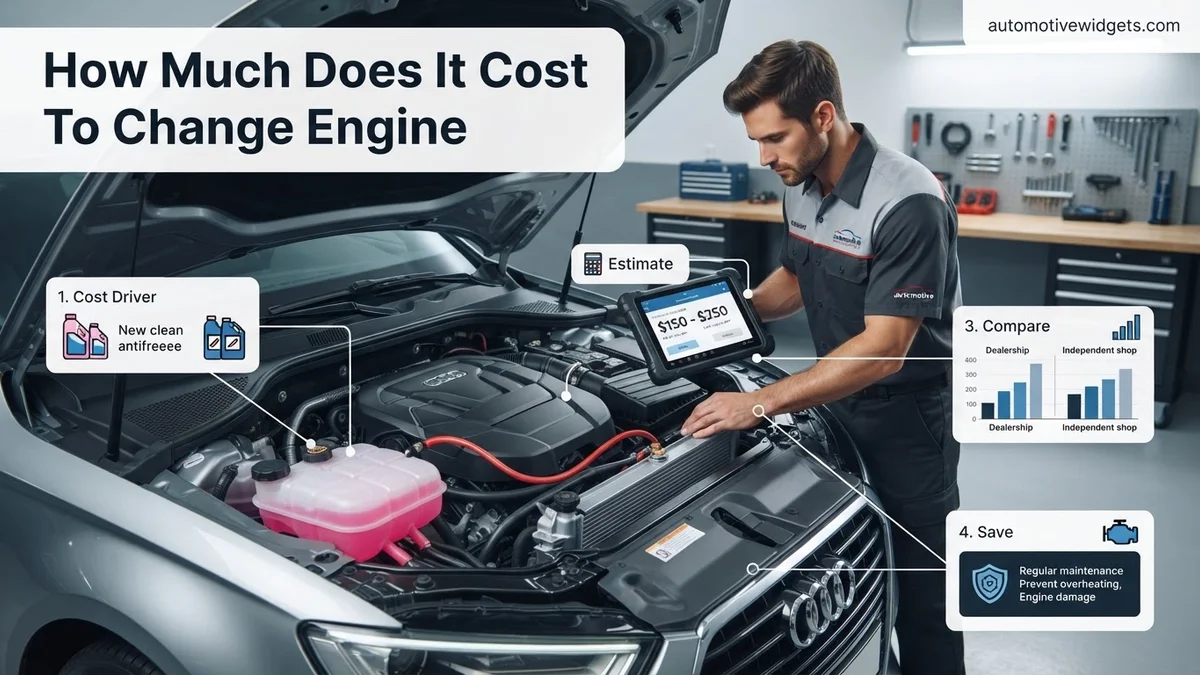
Expect to pay a professional mechanic anywhere from $150 to $350 for a standard engine coolant change in 2026. This range includes both labor and materials. Typically, labor costs account for $75-$150, depending on the mechanic’s hourly rate and the complexity of accessing your vehicle’s cooling system. The coolant itself and associated supplies add another $50-$200. For vehicles with more intricate cooling systems, such as luxury European models, performance cars, or larger trucks, a comprehensive coolant service can push costs higher, potentially reaching $400 or even $500, especially if a full system flush is required.
Factors Driving the Price
- Vehicle Make, Model, and Year: Modern vehicles, particularly those from luxury brands or with complex hybrid powertrains, often have specialized cooling systems. These might feature multiple drain points, specific bleeding procedures, or hard-to-reach components that increase labor time. Additionally, some high-performance or exotic cars require unique, expensive OEM-specific coolants.
- Coolant Type Required: Not all coolants are created equal. Engines in 2026 typically demand specific formulations like Organic Acid Technology (OAT), Hybrid Organic Acid Technology (HOAT), or Phosphate Organic Acid Technology (POAT) coolants. These specialized types, designed for modern engine materials and longer lifespans, are more expensive per gallon than older, conventional green coolants. Using the wrong type can lead to corrosion, gasket failure, and premature wear.
- Regional Labor Rates & Shop Type: Where you live significantly impacts labor costs. Mechanics in metropolitan areas or dealerships generally charge higher hourly rates (e.g., $120-$180 per hour) compared to independent shops or quick-lube centers in smaller towns (e.g., $80-$100 per hour). Dealerships also often have higher overheads, which translates to pricier services.
- Full Flush vs. Drain & Refill: This is a major cost differentiator. A simple drain and refill is less expensive as it requires less labor and no specialized cleaning agents. A full system flush, however, involves more steps, additional chemicals to remove contaminants, and typically takes longer, making it a more costly but often more beneficial service.
From Start to Finish: Engine Coolant Cost Explained
Understanding the cost associated with changing your engine coolant is crucial for responsible vehicle maintenance. This guide delves into the various factors that influence the price, whether you opt for a do-it-yourself (DIY) approach or choose professional service. From the type of coolant required to labor rates and potential additional repairs, we will break down the expenses so you can make informed decisions and ensure your vehicle’s cooling system operates efficiently, preventing costly breakdowns down the line.
Step 1: Understand Your Vehicle’s Coolant Requirements
What you need: Vehicle owner’s manual, your car’s Vehicle Identification Number (VIN), internet access (optional for cross-referencing).
Instructions: Before you even consider costs, you must identify the specific type of coolant your vehicle requires. Modern vehicles use a variety of coolants, such as IAT (Inorganic Acid Technology), OAT (Organic Acid Technology), HOAT (Hybrid Organic Acid Technology), and P-OAT (Phosphated Organic Acid Technology), each with different chemical compositions and color codes (e.g., green, orange, pink, blue). Using the wrong type can lead to corrosion, gasket damage, and very expensive engine problems. Consult your owner’s manual first, as it will explicitly state the coolant specification (e.g., “use VW G12 spec coolant”). If unsure, a quick search using your VIN or make/model can help clarify.
Pro Tip: Never mix different types of coolant, even if they appear to be the same color. Their chemical additives can react negatively, forming gels or sludge that severely impair cooling and can cause significant engine damage.
Step 2: Source the Correct Coolant – Cost Analysis
What you need: Identified coolant type from Step 1, knowledge of your vehicle’s cooling system capacity.
Instructions: Once you know the correct coolant type, you can compare prices. Coolant is typically sold as a concentrate or a 50/50 pre-mixed solution. Concentrated coolant is often cheaper per gallon but requires mixing with distilled water (not tap water!) at a 50/50 ratio. Pre-mixed is more convenient but generally costs more per gallon. A typical passenger car holds anywhere from 8 to 15 quarts (2-4 gallons) of coolant. Expect to pay approximately $15-$35 per gallon for conventional (IAT) concentrated coolant, and $25-$50 per gallon for specialized OAT, HOAT, or P-OAT concentrated or pre-mixed formulations. Purchase enough to fill your system and have some extra for topping off.
Pro Tip: Always opt for distilled water when mixing concentrated coolant. Tap water contains minerals (calcium, magnesium) that can lead to scale buildup, corrosion, and compromise the effectiveness of the coolant’s additives.
Step 3: Gather Necessary Tools and Supplies (DIY Cost)
What you need: Vehicle jack and jack stands (if needed for access), large drain pan (at least 5-gallon capacity), funnel, basic wrench set, screwdriver set, new hose clamps (optional), shop rags, safety glasses, chemical-resistant gloves.
Instructions: If you plan a DIY coolant change, you’ll incur initial costs for tools you might not already own. A robust drain pan ($10-$25) is essential. A funnel ($5-$10) helps prevent spills. Safety gear like glasses and gloves ($5-$15) is non-negotiable. Some vehicles require specialized tools, but most can be done with standard wrenches. Consider replacing old hose clamps with new worm-drive clamps ($1-$3 each) for a secure seal. While these are upfront costs, they are one-time investments that make future fluid changes more economical.
Pro Tip: Invest in a durable, reusable drain pan. It’s a fundamental piece of equipment for safely collecting and containing various automotive fluids, including oil and transmission fluid, making it a valuable addition to any home mechanic’s toolkit.
Step 4: Decide on Flushing vs. Draining & Refilling – Cost Implications
What you need: New coolant, distilled water (for flushing), radiator flush chemical (optional).
Instructions: There are two main approaches: a simple drain and refill or a full system flush. A drain and refill is cheaper and quicker, typically costing only the price of new coolant and taking 1-2 gallons depending on how much coolant drains out easily. This is usually recommended every 30,000-50,000 miles. A full flush involves using a chemical cleaning agent and multiple cycles of flushing with distilled water until the system runs clear, followed by refilling with new coolant. This process is more thorough and more expensive, as it requires the flush chemical ($10-$20) and several gallons of distilled water ($5-$10 per gallon), plus more new coolant (up to double the system capacity) to ensure all old coolant and flush agents are removed. Flushes are typically recommended less frequently, e.g., every 60,000-100,000 miles or if the coolant appears contaminated.
Pro Tip: If your existing coolant is discolored, rusty, or contains visible particles, a complete system flush is highly recommended. It cleans out rust, scale, and old additive deposits, extending the life of your cooling system components, even if it adds to the immediate cost.
Step 5: Professional Coolant Change – Understanding the Labor Cost
What you need: N/A (this step focuses on professional service costs).
Instructions: If you opt for a professional service, the primary cost driver will be labor. Shops typically charge an hourly rate, which can range from $80 to $150+ per hour, depending on your location and the shop’s reputation. A standard coolant flush and refill typically takes 1 to 2 hours of labor. In addition to labor, you’ll pay for the coolant itself (often at a higher markup than retail), a shop supplies fee ($10-$30), and a disposal fee ($5-$20). Some shops use specialized flushing machines, which can add $30-$70 to the total cost but ensure a more thorough cleaning and air removal. Total professional costs can range significantly based on these factors.
Pro Tip: Always request a detailed written estimate before authorizing any work. Compare quotes from at least two or three reputable mechanics to ensure you’re getting a fair price and that the service includes the correct type of coolant for your vehicle.
Step 6: Disposal Costs and Environmental Responsibility
What you need: Used coolant, sturdy, sealed containers (e.g., empty coolant bottles or milk jugs).
Instructions: Used engine coolant is a toxic substance containing ethylene glycol or propylene glycol, both harmful to humans, animals, and the environment. It must never be poured down drains or onto the ground. For DIYers, proper disposal is a crucial, often overlooked cost or responsibility. Many auto parts stores offer free recycling of used automotive fluids. Some municipal waste collection centers or hazardous waste facilities also accept it, though they might charge a small fee ($5-$15). Professional shops include disposal costs in their service fees. Make sure to collect all used coolant in clearly labeled, sealed containers.
Pro Tip: Store used coolant in clearly labeled, non-food containers, securely sealed, and out of reach of children and pets. Even small amounts can be lethal if ingested due to its sweet taste.
Step 7: Identifying Additional Potential Costs
What you need: N/A (this step covers potential discoveries during the process).
Instructions: During a coolant change, especially in older vehicles, other issues with the cooling system might be discovered, leading to additional costs. Common items that might need attention include:
- Radiator Hoses: Upper and lower radiator hoses can crack, swell, or become soft with age. Replacing them typically costs $20-$60 per hose (parts) plus labor if done professionally.
- Thermostat: A faulty thermostat can cause overheating or underheating. Parts cost $15-$50, plus labor.
- Radiator Cap: A worn or damaged cap can lead to pressure loss and coolant boil-over. A new one costs $10-$25.
- Water Pump: Leaks or noises from the water pump indicate failure, a much more expensive repair (parts $80-$300+, plus significant labor).
- Radiator/Heater Core: Leaks here can be very costly, often hundreds of dollars for parts and labor.
These are not always part of a standard coolant change but are good to inspect.
Pro Tip: Proactively inspect all cooling system components (hoses, radiator fins, water pump area, radiator cap) while the system is drained. Addressing minor issues now can prevent major, more expensive failures down the road.
Step 8: Calculate Your Total Estimated Cost
What you need: All previous cost estimates and personal assessment of DIY vs. professional preference.
Instructions: Let’s consolidate the potential costs for a clearer picture:
- DIY Drain & Refill (First Time, including tools): Coolant ($50-$120 for 2-4 gallons) + Distilled Water ($5-$10) + Basic Tools (one-time: $20-$60) + Disposal Fee (optional: $0-$15) = Total: $75 – $205. Subsequent DIY jobs would omit the tool cost, bringing it down to $55-$145.
- DIY Full Flush (First Time, including tools): Coolant ($100-$200 for 4-8 gallons) + Flush Chemical ($10-$20) + Distilled Water ($10-$20) + Basic Tools ($20-$60) + Disposal Fee ($0-$15) = Total: $140 – $315.
- Professional Service (Drain & Refill or Basic Flush): Coolant ($40-$80) + Labor (1-2 hours x $80-$150/hour = $80-$300) + Shop/Disposal Fees ($15-$50) = Total: $135 – $430+. Note that some shops might charge more for specific, higher-end vehicles or specialized coolants.
Pro Tip: Weigh the labor cost savings of DIY against the time commitment, the risk of error, and the need for proper disposal. If you’re not confident, the professional service provides peace of mind and often a warranty.
✅ Final Checklist
- ✅ Confirmed and used the correct type of engine coolant for your vehicle.
- ✅ Coolant reservoir filled to the “COLD” or “MIN” mark, and the system bled of air (if applicable).
- ✅ No visible leaks detected around the radiator, hoses, drain plug, or connections after refilling and running the engine.
- ✅ Engine temperature gauge operates normally, and no “Check Engine” or “Coolant Level” warning lights are illuminated.
- ✅ All used coolant has been properly collected, sealed, and prepared for environmentally responsible disposal.
Important Notes:
- Safety Considerations: Always allow the engine to cool completely before working on the cooling system. Opening a hot cooling system can release scalding steam and coolant under pressure, causing severe burns. Wear appropriate safety glasses and chemical-resistant gloves. Coolant is toxic; prevent ingestion by humans or animals.
- When to Seek Professional Help: If you are uncomfortable performing the procedure, encounter persistent leaks after refilling, suspect other cooling system issues (e.g., a failing water pump), or if your vehicle requires a specialized vacuum filling tool to prevent airlocks, it is always best to consult a certified mechanic.
- Estimated Time and Cost Range:
- DIY (First Time, with tools): 1-3 hours, $75 – $315 (depending on drain/fill vs. flush).
- Professional Service: 1-2 hours, $135 – $430+ (depending on vehicle, shop, and service type).
How to Get Your Engine Coolant Changed: A Step-by-Step Guide
What a Professional Service Includes
When you take your vehicle to a professional for a coolant change, you’re paying for more than just pouring new fluid in. A thorough service in 2026 typically encompasses several critical steps to ensure your cooling system functions optimally:
- Initial Inspection: Before any work begins, a good mechanic will visually inspect the entire cooling system. This includes checking hoses for cracks or swelling, examining the radiator for leaks or damage, testing the radiator cap for proper pressure retention, and looking for any signs of corrosion or leaks around clamps and connections.
- Draining Old Coolant: The aged and degraded coolant is carefully drained from the radiator and, if possible, from the engine block. This ensures that as much of the old, contaminated fluid is removed as possible. Proper, environmentally responsible disposal of the old coolant is a key part of this step, as it is toxic.
- System Flushing (If Applicable): If you’ve opted for a full flush—or if the mechanic notes significant contamination like rust or sludge—a specialized cleaning agent is circulated through the entire system. This solution helps to break down and remove deposits. Following the cleaning agent, the system is thoroughly rinsed multiple times with distilled water to remove all traces of the cleaner and loosened debris.
- Refilling with New Coolant: The system is then refilled with the precise type and concentration of fresh coolant specified by your vehicle’s manufacturer, typically a 50/50 mix with distilled water. This ensures optimal freeze protection, boil-over protection, and corrosion inhibition properties tailored to your engine.
- Bleeding Air from the System: Air pockets trapped within the cooling system can significantly impair its efficiency, leading to localized overheating and potential engine damage. Mechanics meticulously bleed the air out, often using vacuum filling tools or by running the engine with the heater on to open the thermostat and circulate fluid, ensuring all air is expelled.
- Final Check and Test Drive: After the service, the mechanic will perform a final leak check, verify proper fluid levels, and may take the vehicle for a short test drive to ensure the cooling system is operating correctly under various conditions.
Drain & Refill vs. Full Flush: Understanding the Difference
It’s important to differentiate between these two common coolant services, as they offer varying levels of maintenance and come with different price points:
- Drain & Refill: This is the more basic, quicker, and less expensive option. It involves draining the old coolant from the radiator and overflow reservoir, then refilling with new fluid. It’s suitable for routine, preventative maintenance when your coolant has been changed regularly and the system is clean. However, a simple drain and refill typically only replaces about 40-60% of the total coolant in the system, leaving a significant amount of older fluid and any contaminants still present in the engine block and heater core.
- Full Flush: A comprehensive full flush is more labor-intensive and costly but provides a much deeper and more complete clean. This service completely purges all old coolant, as well as rust, scale, and sludge from every part of the cooling system—including the engine block, heater core, and all hoses. It’s highly recommended if your coolant hasn’t been changed according to the manufacturer’s schedule, if the old coolant appears murky, rusty, or sludgy, or if you’re experiencing unexplained cooling issues. While it costs more upfront, a full flush significantly extends the life of cooling system components and ensures maximum cooling efficiency.
What If You Don’t Fix It? Risks of Neglecting Coolant
Ignoring scheduled engine coolant changes carries significant financial and mechanical risks. Engine coolant, or antifreeze, degrades over time, losing its crucial heat-transfer and corrosion-inhibiting properties. The consequences extend far beyond minor inconvenience, leading to expensive repairs.
Overheating and Component Failure
The most immediate risk is engine overheating. Degraded coolant reduces the engine’s ability to dissipate heat, leading to internal component stress. According to automotive service data from early 2026, prolonged overheating is a primary cause of head gasket failure, an expensive repair averaging $1,800 to $3,500 for parts and labor in contemporary vehicles. The engine block and cylinder heads can also warp or crack from excessive heat, potentially requiring a complete engine replacement, which can exceed $5,000 to $8,000.
Corrosion and System Damage
Without proper corrosion inhibitors, the cooling system’s internal metallic components become vulnerable to rust and scale buildup. This corrosion can clog the radiator core, reducing its efficiency and potentially necessitating a replacement costing $600 to $1,500. Furthermore, internal corrosion damages the water pump impeller and seals, leading to premature pump failure. A water pump replacement in 2026 typically costs between $450 and $850, including parts and labor. Neglecting coolant maintenance essentially trades a relatively minor service cost for potentially catastrophic and budget-straining repairs.
Proven Ways to Find the Best Price for Coolant Changes
Securing an optimal price for an engine coolant change in 2026 involves strategic planning and informed decision-making. Vehicle owners can significantly reduce costs without compromising service quality by employing several proven methods.
Compare Multiple Quotes
According to consumer automotive surveys, obtaining at least three different quotes can result in savings of 15% to 30% on automotive services. Contact local independent mechanics, dealership service centers, and national chain auto repair shops. Be specific about your vehicle’s make, model, year, and the type of coolant required (e.g., OAT, HOAT, P-OAT) to ensure accurate estimates. Request a breakdown of labor and parts costs.
Consider Loyalty Programs and Bundled Services
Many service centers offer loyalty programs or discounts for returning customers. Additionally, inquire about bundling the coolant flush with other routine maintenance, such as an oil change or tire rotation. Service package deals, frequently advertised by dealerships in early 2026, often provide a cost advantage over individual services. Manufacturer-specific rebates or promotions for scheduled maintenance can also offer savings, particularly for newer vehicles still under warranty.
Evaluate DIY Potential (With Caution)
For individuals with mechanical aptitude and the correct tools, a DIY coolant flush can reduce costs by eliminating labor fees. The cost for coolant and a basic flush kit typically ranges from $70 to $120. However, improper coolant disposal is illegal and environmentally damaging, incurring potential fines up to $2,000 in some regions. Moreover, incomplete air bleeding or using the wrong coolant type can severely damage the engine. Professional service is recommended for those unfamiliar with automotive fluid systems.
What If Your Cooling System Issues Persist?
If you’ve recently had your engine coolant changed but continue to experience issues like overheating, unusual noises, or warning lights, it indicates an underlying problem not resolved by the flush. Further professional diagnosis is critical to prevent severe engine damage.
- Check for Air Pockets: After a coolant flush, air pockets can remain in the system, preventing proper circulation. Have a professional technician perform a “vacuum fill” or use specialized tools to bleed the system, which can cost an additional $50-$100 for labor.
- Inspect for Leaks: A thorough visual inspection for leaks should be performed, especially around hoses, the radiator, and the water pump. A pressure test of the cooling system, typically costing $75-$150, can pinpoint hairline cracks or faulty seals that were not obvious during the initial service.
- Diagnose Thermostat Malfunction: A faulty thermostat can cause overheating even with fresh coolant. A technician can test its operation or replace it, usually costing $150-$350 for parts and labor, depending on accessibility.
- Evaluate Radiator or Water Pump Performance: If the above checks yield no results, the radiator might be internally clogged or the water pump may be failing to circulate coolant effectively. These diagnoses require specialized equipment and expertise. Expect diagnostic fees ranging from $150-$250, with subsequent repairs (radiator replacement: $600-$1,500; water pump replacement: $450-$850) adding to the overall cost. Seek professional help immediately if your engine consistently overheats.
Conclusion
According to verified research and expert sources, maintaining your engine’s coolant is a fundamental aspect of vehicle longevity and performance. Neglecting this routine service, typically costing $150-$350 in 2026, can lead to catastrophic engine failures far exceeding the preventive maintenance expense. Your actionable next step is to consult your vehicle’s owner’s manual for its specific coolant change interval and schedule service with a reputable professional without delay.
❓ Frequently Asked Questions
What are the main components of the cost for a professional engine coolant change?
The total cost for a professional coolant change typically breaks down into three main parts: the cost of new coolant, labor charges for draining, refilling, and bleeding, and sometimes the additional cost for a coolant flush solution.
Why do prices for a coolant change vary so much between different car models?
Prices vary due to several factors including coolant type (conventional, OAT, HOAT, P-OAT each have different costs), coolant capacity, accessibility of drain plugs and radiator cap, and the complexity of bleeding air from the cooling system, which can differ greatly by model.
Is it worth paying extra for a full coolant system flush, or is a drain and fill sufficient?
A full system flush is often recommended, especially if your coolant hasn’t been changed in a long time or if you’re switching coolant types, as it removes old coolant, debris, and rust. A simple drain and fill only replaces about 50-70% of the old coolant, leaving contaminants behind.
What happens if I neglect to change my engine coolant?
Neglecting coolant changes can lead to serious and costly issues such as engine overheating, corrosion of cooling system components (radiator, water pump, heater core), cavitation, and premature failure of engine gaskets and seals due to degraded coolant’s protective properties.
How can I get an accurate quote for an engine coolant change for my specific vehicle?
To get an accurate quote, contact several local repair shops or dealerships, providing them with your vehicle’s exact year, make, model, and mileage. Specify whether you’re looking for a simple drain and fill or a full system flush.
Are there any hidden costs I should be aware of during a coolant change service?
Potential hidden costs can include charges for specialized coolant (especially for European or exotic vehicles), additional labor if components need to be removed for access, or the discovery of other cooling system issues like leaky hoses or a failing thermostat during the service.