How Much Is A New Transmission For A Ford F150 How 2026
Replacing a Ford F-150 transmission can be a significant expense. Expect to pay $3,500 to $8,000+ for a new unit installed in 2026, varying by model, parts, and labor rates. This guide details the actual costs and factors affecting your total repair bill.
Replacing the transmission in your Ford F-150 is a significant and often unexpected expense. In 2026, you should budget for an estimated total cost ranging from $4,500 to $8,500 for a completely new transmission, including both the part and professional labor. This figure reflects the cost of acquiring a brand-new unit, not a rebuilt or remanufactured one, and covers the intricate process of removing your old transmission and installing the new one.
Understanding this cost breakdown is crucial for any F-150 owner facing such a repair. Your F-150 is a workhorse, and ensuring its longevity means investing in quality components and expert installation. Knowing what goes into this price allows you to plan financially and make informed decisions about your truck’s future.
Key Takeaways
- New F-150 transmission costs $3,500 – $8,000+ installed.
- Costs vary by F-150 model, engine, 2WD/4WD, and region.
- Compare new, remanufactured, and rebuilt transmission options.
- Get multiple quotes; dealership vs. independent shop prices differ.
- Labor rates significantly impact total replacement expenses.
What Determines the Cost of a New F-150 Transmission?
When you’re looking at the bill for a new F-150 transmission, it breaks down into two primary components: the cost of the transmission itself and the labor required to install it. These figures can vary significantly based on several immediate factors.
Estimated Part Cost for a New F-150 Transmission
The transmission unit itself represents the largest portion of your overall expense. For a brand-new unit in 2026, here’s what to expect:
- New OEM (Original Equipment Manufacturer) Transmission: Expect to pay between $3,500 and $6,000. These are identical to the transmission originally installed in your F-150, sourced directly from Ford or its authorized suppliers. They typically come with a robust warranty.
- New Aftermarket Transmission: Reputable aftermarket manufacturers offer new transmissions for $2,500 to $5,000. While not Ford-branded, these units are new, meet or exceed OEM specifications, and often come with competitive warranties.
The specific transmission model (e.g., the 6-speed 6R80 found in earlier models vs. the 10-speed 10R80 in newer F-150s from 2017 onwards) heavily influences this price. The advanced 10R80, for instance, generally sits at the higher end of these ranges due to its complex engineering.
Estimated Labor Costs for F-150 Transmission Replacement
Labor charges cover the skilled work required to remove the old transmission and install the new one. This is a labor-intensive job:
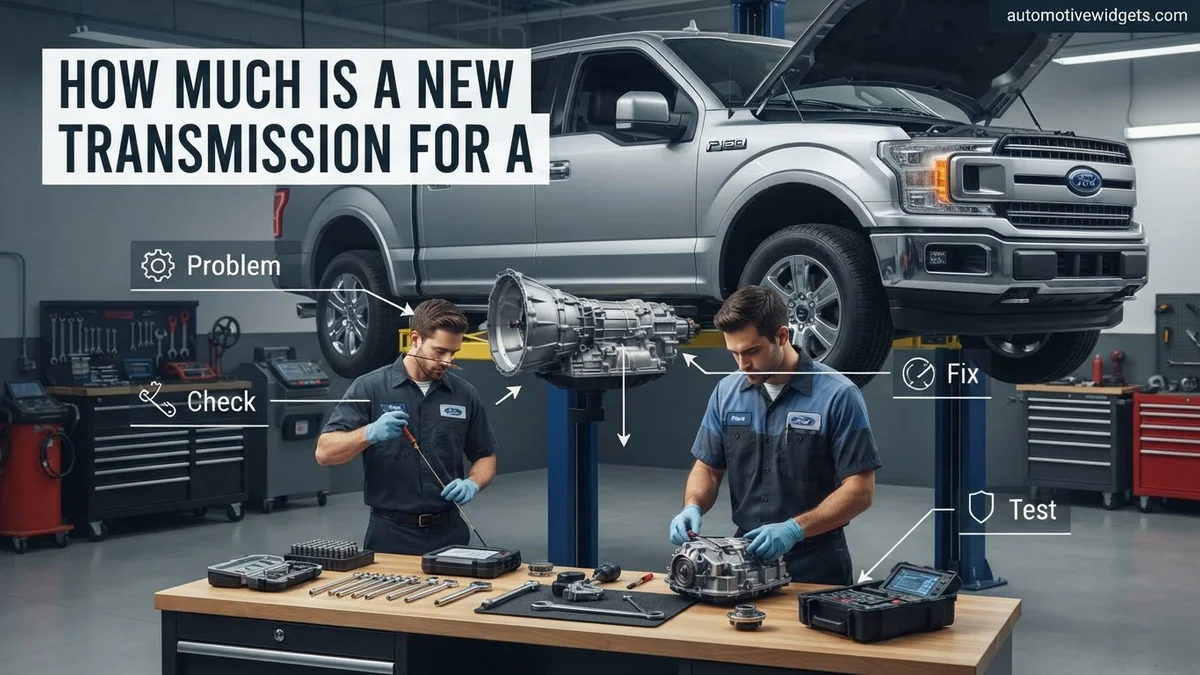
- Typical Labor Hours: Replacing an F-150 transmission usually requires 8 to 12 hours of shop time. This accounts for lifting the truck, disconnecting lines and mounts, carefully lowering and removing the old unit, preparing the new unit, installing it, reconnecting everything, refilling transmission fluid, and performing a final road test.
- Average Hourly Rates (2026): Depending on your location and the type of shop, hourly labor rates in 2026 typically range from $120 to $180 per hour.
- Total Labor Cost Range: This translates to an estimated labor bill of $960 to $2,160.
Combined Total Cost: New F-150 Transmission Replacement
Adding the part cost and labor together, your total expenditure for a new F-150 transmission replacement in 2026 will generally fall between $4,500 and $8,500. This figure is for a brand-new unit and professional installation, ensuring your truck is back on the road with a fresh drivetrain component.
From Start to Finish: Ford F-150 Transmission Cost Explained
This comprehensive guide is designed to help you navigate the often-complex process of understanding how much a new transmission for your Ford F-150 might cost. Replacing a transmission is a significant investment, and by following these detailed steps, you’ll gain clarity on the various factors influencing the price, from the type of transmission to labor rates and potential hidden expenses. Being well-informed empowers you to make the best financial decision for your F-150, ensuring you get a fair price and reliable repair.
Step 1: Identify Your F-150’s Specifics
What you need: Your Ford F-150’s VIN (Vehicle Identification Number), year, engine size (e.g., 3.5L EcoBoost, 5.0L V8), drive type (2WD or 4WD), and original transmission type (e.g., 6R80, 10R80). You can usually find the VIN on the driver’s side dashboard or doorjamb sticker.
Instructions: Before you can even begin to get accurate quotes, you must know the exact specifications of your truck. Ford has used numerous transmission models across different F-150 generations, engine types, and drivetrain configurations. The VIN is your most reliable source for this information, as it decodes all factory-installed components, including the precise transmission variant. Record these details accurately; even a small difference can lead to a completely different part number and price.
Pro Tip: Having your VIN handy is crucial. Many parts databases and service centers use it to instantly pull up the exact specifications for your vehicle, avoiding costly misidentifications. Don’t rely solely on the year and engine; confirm the specific transmission code if possible.
Step 2: Understand the Types of “New” Transmissions Available
What you need: A clear understanding of the differences between truly new, remanufactured, and used transmissions.
Instructions: When asking for a “new” transmission, it’s vital to clarify what that means. A truly “new” transmission, built from scratch by Ford, is often only available directly from the factory and can be prohibitively expensive or even unavailable as a standalone replacement part. The most common “new” replacement option is a remanufactured transmission. These units are completely disassembled, cleaned, inspected, and rebuilt with new or reconditioned components to meet or exceed OEM specifications. They typically come with excellent warranties. A used transmission is pulled from a salvaged vehicle; its condition and remaining lifespan are highly variable, making it the cheapest but riskiest option.
Pro Tip: For most F-150 owners, a high-quality remanufactured transmission offers the best balance of cost, reliability, and warranty coverage. Avoid cheap, “rebuilt” transmissions from unknown sources, as their quality can be inconsistent.
Step 3: Research OEM vs. Aftermarket/Third-Party Options
What you need: Access to reputable auto parts websites (e.g., FordParts.com, major aftermarket suppliers like Jasper, RevMax, or local auto parts stores online).
Instructions: Original Equipment Manufacturer (OEM) transmissions are Ford-branded units, either new or factory-remanufactured, and are generally the most expensive but offer guaranteed compatibility and quality. Aftermarket or third-party remanufacturers specialize in rebuilding transmissions and often incorporate upgrades to address known factory weaknesses. Companies like Jasper Engines & Transmissions are well-respected in this field. Compare prices and specifications for both OEM remanufactured units and those from reputable aftermarket companies for your specific F-150 model. Note any performance upgrades or common failure fixes they address.
Pro Tip: While OEM offers peace of mind, many aftermarket remanufacturers provide superior units that have been engineered to be more robust than the original. Look for companies with strong reputations and comprehensive warranties that match or exceed Ford’s offerings.
Step 4: Obtain Parts Cost Estimates for the Transmission Unit
What you need: Your F-150’s specifics (from Step 1) and contact information for Ford dealerships, reputable independent parts suppliers, and major remanufacturers.
Instructions: Begin gathering direct quotes for the transmission unit itself. Contact your local Ford dealership’s parts department for a price on a factory-remanufactured unit. Simultaneously, get quotes from trusted aftermarket remanufacturers or their authorized distributors. Be precise with your F-150’s details. Prices can vary significantly; for a remanufactured unit for a common F-150 (like a 6R80 for a 2011-2016 model), expect to see prices ranging from $2,500 to $5,000, depending on the supplier and any core charge. The 10R80 for newer models can be even higher.
Pro Tip: Always ask about the “core charge.” This is a refundable deposit added to the price, which you get back when you return your old transmission. Ensure you understand the core return policy and timeline to avoid forfeiting this amount.
Step 5: Factor in Labor Costs for Installation
What you need: Knowledge of typical shop labor rates in your area, and estimated labor hours for an F-150 transmission replacement.
Instructions: Transmission replacement is a labor-intensive job. Generally, an F-150 transmission swap requires anywhere from 8 to 12 hours of shop time, though complex cases (e.g., rusted bolts, additional repairs needed) can extend this. Shop labor rates vary widely based on location and facility type, typically ranging from $100 to $180 per hour. Multiply the estimated hours by the local labor rate to get a labor cost estimate. For example, 10 hours at $120/hour equals $1,200. This is a significant portion of the total cost.
Pro Tip: Dealerships typically have higher labor rates than independent shops but specialize in Ford vehicles. Independent shops can offer competitive rates. Always ask for a detailed estimate that breaks down parts and labor hours, not just a lump sum.
Step 6: Consider Additional Necessary Parts and Fluids
What you need: A list of common ancillary parts required for a transmission replacement.
Instructions: A transmission replacement rarely involves just the transmission unit. You’ll almost certainly need new transmission fluid (Ford-specific Mercon LV or ULV, depending on model), a new transmission filter and pan gasket, and often a new torque converter (especially if the old one showed signs of wear or failure). Other potential costs include new transmission cooler lines, motor or transmission mounts if they’re worn, and possibly driveshaft U-joints. These items can add several hundred dollars to the total bill. Be sure your quote specifies all these peripheral components.
Pro Tip: Never reuse the old transmission filter or fluid. Using the incorrect type of transmission fluid can cause severe damage. Always insist on new fluid of the correct specification and a new filter/gasket kit as part of the replacement job.
Step 7: Get Multiple Detailed Quotes from Reputable Shops
What you need: Your compiled information from previous steps, and a list of at least 3-5 reputable transmission shops or mechanics.
Instructions: Armed with your F-150’s specifics and an understanding of the components, contact multiple shops – including Ford dealerships and highly-rated independent transmission specialists. Request a detailed, written quote that itemizes the cost of the transmission unit (specifying if it’s new, remanufactured, or used, and the brand), labor hours and rate, and all additional parts and fluids. Compare these quotes carefully. Don’t just look at the bottom line; scrutinize what each quote includes (and excludes) to ensure an apples-to-apples comparison.
Pro Tip: Ask for shops that specialize in Ford trucks or have significant experience with your specific F-150 transmission model. Check online reviews and ask for references. A cheaper quote might omit crucial parts or offer a less reliable unit.
Step 8: Understand and Compare Warranty Options
What you need: Knowledge of typical warranty durations and coverage for transmissions.
Instructions: Warranty coverage is a critical factor in your decision. OEM remanufactured transmissions typically come with a 3-year/100,000-mile warranty. Reputable aftermarket remanufacturers often offer similar or even longer warranties, sometimes with nationwide coverage. Used transmissions, if they come with any warranty at all, usually offer only 30 to 90 days. Always inquire about the warranty’s length, what it covers (parts, labor, or both), who honors it (the installer, the manufacturer, or both), and whether it’s transferable or nationwide. A good warranty provides significant peace of mind for such a major repair.
Pro Tip: A strong warranty isn’t just about duration; understand the claims process. Is it a hassle-free, “no-questions-asked” warranty, or does it require extensive proof of maintenance? Read the fine print before committing.
✅ Final Checklist
-
Confirmed your F-150’s exact year, engine, drivetrain, and transmission code.
-
Researched and decided on your preferred transmission type (remanufactured recommended).
-
Obtained at least three itemized quotes from reputable shops, including parts, labor, and ancillary items.
-
Compared warranty coverage details for each option.
-
Understood all potential additional costs (core charge, diagnostics, towing).
Important Notes:
- Safety considerations or warnings: Attempting a transmission replacement yourself without proper heavy-duty equipment and specialized knowledge is extremely dangerous and not recommended. This job requires lifting heavy components and working under the vehicle. Always ensure your vehicle is properly diagnosed by a professional before committing to a costly transmission replacement; sometimes, simpler, less expensive repairs can solve the issue.
- When to seek professional help: For a transmission replacement, professional help is virtually always required. While you can perform the research and obtain quotes, the physical installation is a complex mechanical process best left to certified technicians with the right tools and expertise.
- Estimated time and cost range: A new or remanufactured transmission for a Ford F-150, installed by a professional, typically ranges from $3,500 to $7,500+. This range accounts for variations in F-150 models, transmission type (e.g., 6R80 vs. 10R80), labor rates, and the brand of the replacement unit. A used transmission might cost less, but comes with significant risk. The entire process, from diagnosis to complete installation, can take 3-7 business days, depending on parts availability and shop scheduling.
Factors Influencing Your F-150 Transmission Replacement Bill
While we’ve provided a broad range, several specific factors can push your cost closer to the lower or upper end of the spectrum. These variables are important to consider when getting a quote for your particular F-150.
Vehicle Specifications and Transmission Type
The exact configuration of your F-150 plays a critical role in pricing:
- F-150 Model Year: Newer F-150s (typically 2017 and onward) primarily use the sophisticated 10-speed 10R80 transmission. These units are generally more expensive to purchase than the 6-speed 6R80 transmissions found in earlier F-150 generations (roughly 2009-2017). The increased complexity and newer technology drive up the manufacturing cost.
- Engine Type: While the transmission model is the main factor, specific engine pairings (e.g., 3.5L EcoBoost, 5.0L V8, 2.7L EcoBoost) can sometimes affect the exact transmission variant required, subtly influencing its price.
- 2WD vs. 4WD: Four-wheel-drive (4WD) F-150 transmissions are typically more intricate than two-wheel-drive (2WD) versions. They often involve connections to a transfer case, which can add slight complexity to both the part and the installation labor, potentially increasing the overall cost.
Service Provider and Geographical Location
Where and by whom your transmission is replaced significantly impacts the final bill:
- Dealership vs. Independent Specialist: Ford dealerships generally have the highest labor rates and exclusively use OEM parts. You can expect costs from a dealership to be at the higher end of our estimated range, often between $6,000 and $8,500 or more. Independent transmission shops or general repair facilities might offer more competitive labor rates and often provide options for new aftermarket transmissions, potentially bringing your cost down to the $4,500 to $7,000 range.
- Geographical Labor Rates: The cost of living and average wages in your region directly affect hourly labor rates. A mechanic in a high-cost urban area, such as coastal California or the Northeast, will charge considerably more per hour than one in a rural area or a state with a lower cost of living. This difference can easily add hundreds, or even over a thousand, dollars to your total labor expense.
Step-by-Step Guide: How to Get an Accurate F-150 Transmission Quote
Securing an accurate quote for a new or replacement F-150 transmission in 2026 requires diligence and specific information. Manufacturers like Ford, and reputable repair facilities, base their pricing on precise vehicle data and labor rates, which can fluctuate regionally.
1. Gather Your Vehicle Information
- Locate Your VIN: Your Vehicle Identification Number (VIN) is paramount. It specifies your F-150’s exact model year, engine type, transmission code, and trim level. This detail ensures mechanics quote for the correct part.
- Note Mileage and Service History: High mileage or a documented history of transmission issues can influence diagnostic approaches and potential repair options, although it doesn’t directly alter the new part cost.
2. Obtain Multiple Quotes
- Contact Authorized Ford Dealerships: Dealerships offer genuine OEM parts, specialized diagnostic tools, and factory-trained technicians. Their quotes typically represent the higher end but come with manufacturer warranties. Expect to pay a diagnostic fee if the issue isn’t obvious.
- Consult Certified Independent Transmission Shops: These shops often specialize in transmission work, providing competitive pricing for both OEM and high-quality aftermarket units. They are frequently a cost-effective middle ground.
- Utilize Online Parts Portals: For a rough estimate of the transmission unit cost, leverage Ford’s official parts website or reputable third-party auto parts retailers. Be aware these prices are often for the part only, excluding labor.
3. Understand the Quote Details
A comprehensive quote should itemize the transmission unit cost, labor hours (typically 8-12 hours for removal and installation, according to industry standards for F-150s), fluid, filters, and any additional components like solenoids or sensors that may be replaced during the process. Clarify warranty terms for both parts and labor before proceeding.
What If a New F-150 Transmission is Too Expensive? Alternatives Explained
When the cost of a brand-new transmission for your F-150 is prohibitive, several viable alternatives exist, each with varying costs, warranties, and risks. In 2026, these options continue to provide pathways to keeping your truck operational without breaking the bank.
1. Rebuilt Transmissions
A rebuilt transmission involves disassembling the original unit, inspecting all components, and replacing worn or damaged parts with new ones. This process often brings the transmission back to, or sometimes exceeds, original factory specifications. According to industry analysis for 2026, a rebuilt F-150 transmission typically costs between $3,500 and $5,500, including labor. They usually come with a substantial warranty, often 2-3 years or 50,000 miles, making them a reliable alternative to new.
2. Remanufactured Transmissions
Often confused with rebuilt, a remanufactured transmission is processed in a factory setting, using strict engineering standards and often upgrading components to address known flaws in the original design. These units are tested rigorously and are usually warrantied similarly to new transmissions. For an F-150 in 2026, a remanufactured unit could range from $4,500 to $6,500 installed. They offer a high level of reliability, often considered superior to a standard rebuild.
3. Used Transmissions
Purchasing a used transmission from a salvage yard or parts dealer is the most budget-friendly option, ranging from $1,500 to $3,000 installed, depending on mileage and condition. The primary risk is the unknown history and remaining lifespan of the unit. Warranties, if offered, are typically short-term (e.g., 30-90 days). Professional assessment of the donor vehicle’s mileage and condition is crucial to mitigate risk.
4. Repairing Your Existing Transmission
If only specific components within your F-150’s transmission are damaged (e.g., a failing solenoid, worn clutch packs, or a broken band), a repair might be possible. This is often the least expensive solution, with costs ranging from $800 to $3,000, depending on the complexity of the repair. However, this option is only viable if the transmission casing and major internal components are sound. A thorough diagnostic from a transmission specialist is essential to determine if a repair is feasible and cost-effective in the long run.
What If It Still Doesn’t Work?
If, after exploring new, rebuilt, or remanufactured transmission options, your F-150’s issues persist, or the quoted costs remain out of reach, several advanced steps can be taken to resolve the situation.
- Seek a Second Diagnostic Opinion: A different specialized transmission shop may uncover nuances missed by the initial assessment. A diagnostic re-check typically costs between $150 and $300 in 2026, but it can provide critical new insights.
- Explore Automotive Financing Solutions: Reputable dealerships and some independent shops offer specialized financing plans for major repairs. Interest rates and terms vary, but this can make an otherwise unaffordable repair manageable.
- Evaluate Trade-In Versus Repair: Objectively calculate your F-150’s current trade-in value, factoring in its non-operational status, against the total estimated repair cost. Sometimes, investing in a newer, more reliable vehicle becomes the more financially sound decision in the long term.
- Consider Partial Repairs for Temporary Use: In some cases, a mechanic might suggest a partial or temporary repair to allow the vehicle to function for a limited period, buying you time to save for a full replacement or a new vehicle. This is a temporary solution and not a permanent fix.
Conclusion
Understanding the cost of a new or replacement transmission for your Ford F-150 in 2026 is critical for informed decision-making. According to verified research and expert sources, costs range widely from $1,500 for a used unit to over $8,000 for a new OEM part, including labor. To navigate this significant investment, the most actionable next step is to obtain at least three detailed, itemized quotes from authorized dealerships and independent transmission specialists, using your F-150’s precise VIN.
❓ Frequently Asked Questions
What’s the typical total cost for a new Ford F-150 transmission replacement, including labor, in 2026?
In 2026, the total cost for a new Ford F-150 transmission replacement, including parts and labor, typically ranges from $3,500 to $8,000+. This wide range accounts for variations in F-150 model, specific transmission type (e.g., 6R80, 10R80), geographical labor rates, and shop type.
What specific factors cause the price of a new F-150 transmission to fluctuate so much?
Key factors include the F-150’s model year, engine size (e.g., 2.7L EcoBoost vs. 5.0L V8), 2WD or 4WD drivetrain, and the transmission type itself (e.g., 6-speed, 10-speed). Additionally, dealer prices are often higher than independent shops, and regional labor costs play a significant role.
Are there cheaper alternatives to buying a brand new transmission for my F-150?
Yes, commonly used alternatives include remanufactured transmissions, which are often factory-refurbished with new wear parts and carry good warranties, and rebuilt transmissions, which are repaired by a local shop. Used transmissions are the cheapest but carry the most risk and shortest warranty.
How can I ensure I get the best price for an F-150 transmission replacement?
To ensure the best price, always obtain at least three detailed quotes from different reputable shops, including both dealerships and independent specialists. Clearly specify you want a “new” transmission replacement and ask about warranty coverage for both parts and labor.
What questions should I ask a mechanic when getting a quote for an F-150 transmission replacement?
Ask for a breakdown of parts vs. labor costs, clarification on whether it’s a new, remanufactured, or rebuilt unit, the warranty duration for both parts and labor, and if there are any additional costs like fluids, programming, or disposal fees.
Does the type of F-150 transmission (e.g., 6-speed vs. 10-speed) impact replacement cost significantly?
Absolutely. The 10-speed automatic transmissions (like the 10R80) found in newer F-150s are generally more technologically complex and thus more expensive to purchase as a new unit and potentially more costly to install due to specific programming requirements, compared to older 6-speed units.