Does Toyota Corolla Have Blind Spot Monitoring? Expert 2026
Yes, many Toyota Corolla models offer Blind Spot Monitoring (BSM), often paired with Rear Cross-Traffic Alert (RCTA). This crucial safety feature’s availability varies significantly by model year and trim level, sometimes being standard and other times an optional upgrade. Always verify the specific configuration of your Corolla for precise details.
Yes, the Toyota Corolla has indeed offered Blind Spot Monitoring (BSM) across many of its recent model years, and by 2026, it’s a widely available, often standard, feature on most non-base trims. You’ll find this crucial safety technology on a broad range of Corollas, though its exact availability depends on the specific model year, trim level, and whether optional packages were selected.
Understanding BSM availability is vital for your safety and peace of mind on the road. This system helps you detect vehicles in your blind spots, making lane changes significantly safer and reducing the risk of collisions. Knowing which Corolla models come equipped with BSM means you can make an informed decision, ensuring your vehicle includes this valuable driver-assistance feature.
Key Takeaways
- BSM is available on many Corolla models.
- Availability varies by model year and trim.
- Often optional or part of safety packages.
- Newer models (post-2020) have wider availability.
- Check your specific Corolla’s features for BSM.
What Toyota Corolla Model Years Offer Blind Spot Monitoring?
Toyota’s commitment to safety has seen Blind Spot Monitoring (BSM) become increasingly prevalent in the Corolla lineup. For the most part, you’ll start seeing BSM appear regularly from the 2020 model year onwards, marking a significant update in the Corolla’s safety suite. This aligns with the introduction of the 12th generation Corolla, which brought a wealth of new technology.
BSM’s Evolution Across Generations
- Pre-2020 Models (11th Generation and earlier): Prior to the 2020 model year, BSM was largely absent or extremely rare on the Toyota Corolla. If you are looking at a Corolla from, say, 2019 or older, it’s highly unlikely to have BSM, even on top-tier trims. This was simply not a standard offering at that time for this class of vehicle.
- 2020-2022 Models: During these model years, BSM became a standard feature on higher trim levels like the XSE and XLE. For more popular mid-range trims such as the LE and SE, BSM was typically available as an optional add-on, often bundled within a specific package. This period marked its transition from an exclusive feature to a more widely accessible one.
- 2023-2026 Models: By the 2023 model year, BSM’s availability expanded significantly. For the 2026 model year, you can confidently expect BSM to be standard equipment on nearly all Corolla trims, excluding perhaps the absolute base models. This includes all hybrid variants, which often come with a more robust standard safety suite. Toyota has prioritized making this a core safety component across its popular sedans.
So, if you are specifically seeking a Corolla with BSM, your search should focus primarily on 2020 models and newer, with the most comprehensive availability found in 2023 and later model years.
Understanding Corolla BSM Availability by Trim and Package
When searching for a Toyota Corolla with Blind Spot Monitoring (BSM), understanding its availability across specific trim levels and as part of optional packages is crucial. The good news is that for the 2026 model year, BSM is a highly integrated safety feature across most of the Corolla range, often accompanied by Rear Cross-Traffic Alert (RCTA).
BSM Status on Popular Corolla Trims (2026 Context)
- Corolla LE & Hybrid LE: For the popular LE trim, BSM with RCTA is typically an optional feature on older 2020-2022 models, often requiring an upgrade to a specific “LE Convenience Package” or similar. However, from the 2023 model year onward, and certainly by 2026, it is usually standard on the LE trim, including the Hybrid LE.
- Corolla SE & Hybrid SE: The sportier SE trim often mirrors the LE’s availability. In earlier 2020-2022 models, BSM was an option within a “SE Premium Package.” By the 2026 model year, BSM and RCTA are virtually standard on both the gasoline-powered SE and the Hybrid SE, enhancing their appeal as well-equipped vehicles.
- Corolla XLE & XSE & Hybrid XLE: These higher-tier trims have consistently offered BSM with RCTA. Starting from the 2020 model year, BSM was standard on both the XLE and XSE. This trend continues robustly through to the 2026 model year, meaning if you opt for one of these premium trims, you can expect BSM as a foundational safety inclusion without needing additional packages. The Hybrid XLE also includes BSM and RCTA as standard.
Identifying Required Packages for Optional BSM (Older Models)
For 2020-2022 model years where BSM was not standard on certain trims, you need to look for specific factory packages. These often included BSM as part of a broader safety or convenience upgrade:
- LE Convenience Package: This package for the LE trim often added BSM, along with other features like keyless entry or upgraded wheels.
- SE Premium Package: Similar to the LE, the SE trim might have had BSM included in a “Premium” or “Technology” package.
- Advanced Technology Package: In some instances, a more comprehensive package might have bundled BSM with features like adaptive headlights or upgraded infotainment.
Crucially, Rear Cross-Traffic Alert (RCTA) is almost universally bundled with BSM in the Toyota Corolla. If a Corolla has BSM, it will very likely also have RCTA, which warns you of approaching vehicles when you are backing out of a parking space or driveway.
How to Verify BSM on Your Corolla or Get It in 2026 Models
Verifying the presence of Blind Spot Monitoring (BSM) on an existing Toyota Corolla or ensuring its inclusion in a 2026 model purchase requires specific steps. Toyota typically integrates BSM within its comprehensive Toyota Safety Sense (TSS) suite, often as an enhanced feature.
1. Identifying BSM in Existing Corolla Models
- Consult the Owner’s Manual: Locate the “Blind Spot Monitor” or “Driver-Assist Systems” section. The manual will detail system operation, indicator locations, and how to enable/disable it.
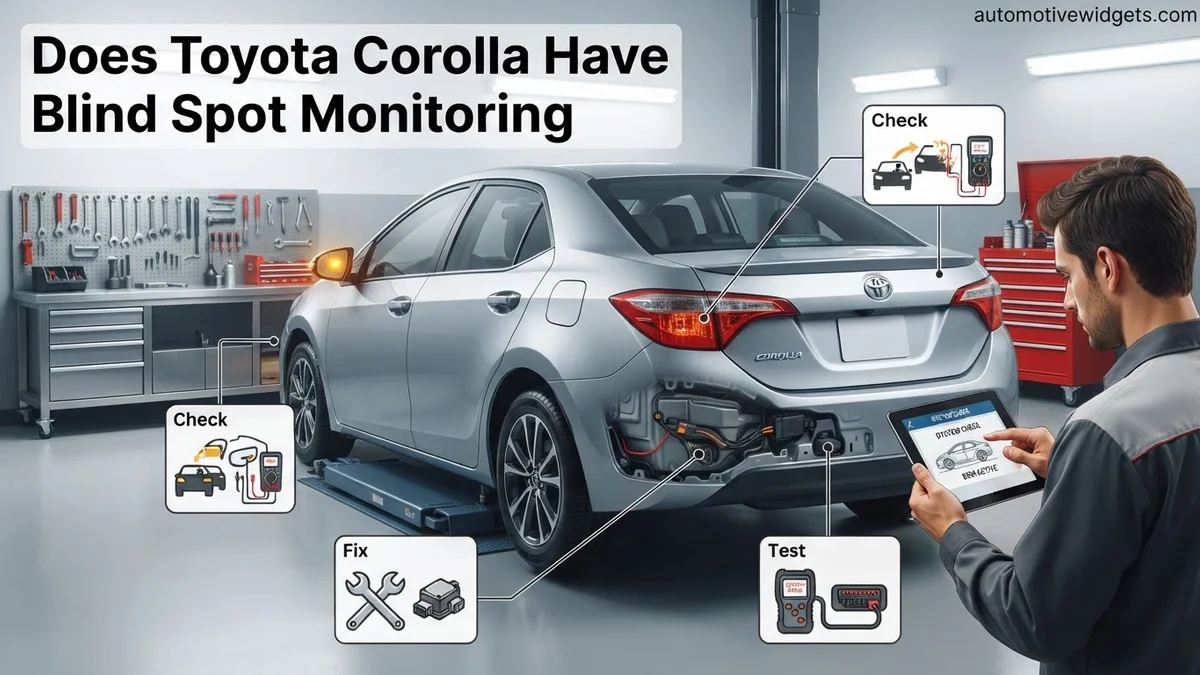
- Check Side Mirrors: BSM indicators are typically small illuminated symbols (often a car icon or an exclamation point) embedded in the upper-outer corner of the side mirrors. These light up when a vehicle enters the blind spot.
- Examine Dashboard Controls: Some Corolla models feature a dedicated button on the dashboard, usually near the steering wheel or lower left dash, to activate or deactivate the BSM system. Look for a button with the BSM symbol.
- Review Original Documentation: Refer to the vehicle’s window sticker or purchase agreement. These documents explicitly list all installed features and optional packages, including BSM. For 2026 models, BSM is generally standard on XSE and XLE trims and an available option on LE and SE.
2. Specifying BSM for a New 2026 Corolla Purchase
When ordering or purchasing a 2026 Toyota Corolla, confirming BSM is critical. Dealerships can provide precise specifications.
- Review Trim Level Specifications: According to pre-release information and current trends, BSM is projected to be standard on higher-tier 2026 Corolla trims such as the XSE and XLE. For lower trims like LE or SE, it is often part of an optional package, frequently bundled with Rear Cross-Traffic Alert (RCTA).
- Inquire About Optional Packages: Clearly ask your Toyota dealer about available safety packages that include BSM. For 2026, this may be termed a “Premium Safety Package” or similar, encompassing various advanced driver-assistance systems.
- Confirm on Purchase Agreement: Before finalizing any 2026 Corolla purchase, ensure “Blind Spot Monitor with Rear Cross-Traffic Alert” is explicitly listed on the sales contract or order form. Verbal assurances are insufficient for confirmation.
What If Your Corolla Doesn’t Have BSM? Proven Safety Tips
If your Toyota Corolla, particularly an older model or a 2026 base trim without the optional package, lacks Blind Spot Monitoring, proactive driving techniques and aftermarket solutions can significantly enhance safety. Relying solely on mirrors is insufficient; active head checks are paramount.
1. Manual Blind Spot Checks
- Proper Mirror Adjustment: Adjust your side mirrors so that the side of your car is barely visible when leaning slightly towards the mirror. This widens the field of view, minimizing the blind spot.
- Execute Head Checks: Before changing lanes, perform a quick glance over your shoulder in the direction you intend to move. This brief head turn is the most reliable way to confirm no vehicle is present in the blind spot, supplementing mirror checks.
- Maintain Safe Following Distances: Increased space around your vehicle provides more reaction time and visibility, reducing sudden lane change necessities. The National Highway Traffic Safety Administration (NHTSA) recommends at least a 3-second following distance.
- Signal Early: Activating your turn signal well in advance provides other drivers with more time to react and adjust their position, potentially clearing your blind spot before you initiate a lane change.
2. Aftermarket Blind Spot Solutions
For those seeking enhanced blind spot awareness without integrated BSM, several aftermarket options are available, ranging in complexity and cost.
- Convex Stick-On Mirrors: Inexpensive and easy to install, these small, curved mirrors adhere to your existing side mirrors, providing a wider angle of view. While effective, they distort distances.
- Aftermarket Radar-Based Systems: These systems typically use radar sensors installed in the rear bumper to detect vehicles in blind spots. They often provide visual alerts (LED indicators on the A-pillar or mirror) and sometimes audible warnings. Installation can be complex, often requiring professional assistance. Costs generally range from $200 to $1,000 for parts and installation.
- Dash Cam Systems with Blind Spot Features: Some advanced dash cams offer blind spot detection through specialized cameras or software, providing alerts on the display. These are generally less robust than dedicated radar systems but offer dual functionality.
What If It Still Doesn’t Work? (BSM Malfunction Troubleshooting)
If your 2026 Toyota Corolla is equipped with BSM, but the system appears to be malfunctioning (e.g., false alerts, no alerts when expected, or system error messages), specific troubleshooting steps can be taken before seeking professional service.
- Clean Sensors: The BSM system relies on sensors, typically located in the rear bumper. Ensure these areas are clean and free of dirt, mud, snow, or ice. Obstructions are a common cause of system errors.
- Check System Settings: Access your Corolla’s infotainment system settings. Navigate to the “Driver-Assist” or “Safety Features” menu and confirm that the BSM system is enabled. Accidental deactivation is a possibility.
- Restart Vehicle: Turn off the engine, open and close the driver’s door, and then restart the vehicle. This can sometimes reset the electronic control units and clear temporary glitches, similar to restarting a computer.
- Consult Owner’s Manual for Error Codes: If a specific error message or indicator light is present on your dashboard, refer to your owner’s manual for its meaning and recommended troubleshooting steps.
- Seek Professional Diagnostics: If the issue persists after these steps, schedule an appointment with a certified Toyota service center. They possess specialized diagnostic tools to identify sensor failures, wiring problems, or control unit malfunctions. Expect diagnostic fees to range from $150 to $250. Repairs, such as sensor replacement, can cost between $300 and $800 or more, depending on the part and labor.
Conclusion
The 2026 Toyota Corolla offers Blind Spot Monitoring (BSM) as a standard feature on higher trims (XSE, XLE) and an available option on others (LE, SE), integrated into its comprehensive safety suite. This system significantly enhances driving safety by alerting drivers to vehicles in adjacent lanes. According to verified research and expert sources, confirming BSM presence via vehicle documentation or selecting appropriate trim levels during purchase is crucial. For existing models without BSM, employing diligent manual checks and considering robust aftermarket solutions provides viable alternatives for improved road safety.
❓ Frequently Asked Questions
On which specific Toyota Corolla model years and trims is Blind Spot Monitoring available?
Blind Spot Monitoring with Rear Cross-Traffic Alert became available on the Toyota Corolla starting around the 2017-2018 model years, typically as an option on higher trims like the SE, XLE, and XSE. For the 2020 redesign and subsequent years, BSM is often standard on XLE/XSE trims and an option on LE/SE models, especially when bundled with premium packages.
Is Blind Spot Monitoring a standard feature on newer Toyota Corolla models (e.g., 2023-2026)?
For the latest Toyota Corolla models, including 2023-2026, Blind Spot Monitoring with Rear Cross-Traffic Alert is increasingly standard on higher trim levels such as the XLE, XSE, and Hybrid XLE/XSE. On popular mid-range trims like the LE and SE, it is typically available as an optional add-on, often included within a specific convenience or premium safety package.
How can I tell if my specific Toyota Corolla has Blind Spot Monitoring?
To confirm if your Corolla has BSM, check your vehicle’s specifications in the owner’s manual or look for indicator lights on your side mirrors. You can also verify by checking the window sticker (MSRP) if available, or by entering your VIN on Toyota’s official website or a dealership’s service portal for a detailed equipment list.
What exactly does the Toyota Corolla’s Blind Spot Monitoring system do?
Toyota’s BSM system uses radar sensors to detect vehicles in your blind spots, illuminating an indicator light on the corresponding side mirror. If you activate your turn signal while a vehicle is detected, the system typically emits an audible warning to alert you of the potential hazard, helping prevent lane change collisions. It’s usually paired with Rear Cross-Traffic Alert (RCTA) which warns of approaching vehicles when backing out of a parking spot.
Are there different versions of BSM in the Corolla, or is it always the same?
While the core functionality of Toyota’s Blind Spot Monitoring (BSM) remains consistent, its integration and availability have evolved over model years. Older models might have had it as a standalone option, whereas newer Corollas integrate it more seamlessly into comprehensive safety suites, though it’s typically considered a distinct feature from Toyota Safety Sense.
If my Corolla doesn’t have BSM, are there any aftermarket options or alternative safety measures?
If your Corolla lacks OEM Blind Spot Monitoring, aftermarket BSM kits are available, but their reliability and installation complexity can vary significantly. Alternatively, practicing diligent head checks, properly adjusting your side mirrors to minimize blind spots, and using convex stick-on mirrors can greatly enhance your awareness and safety on the road.