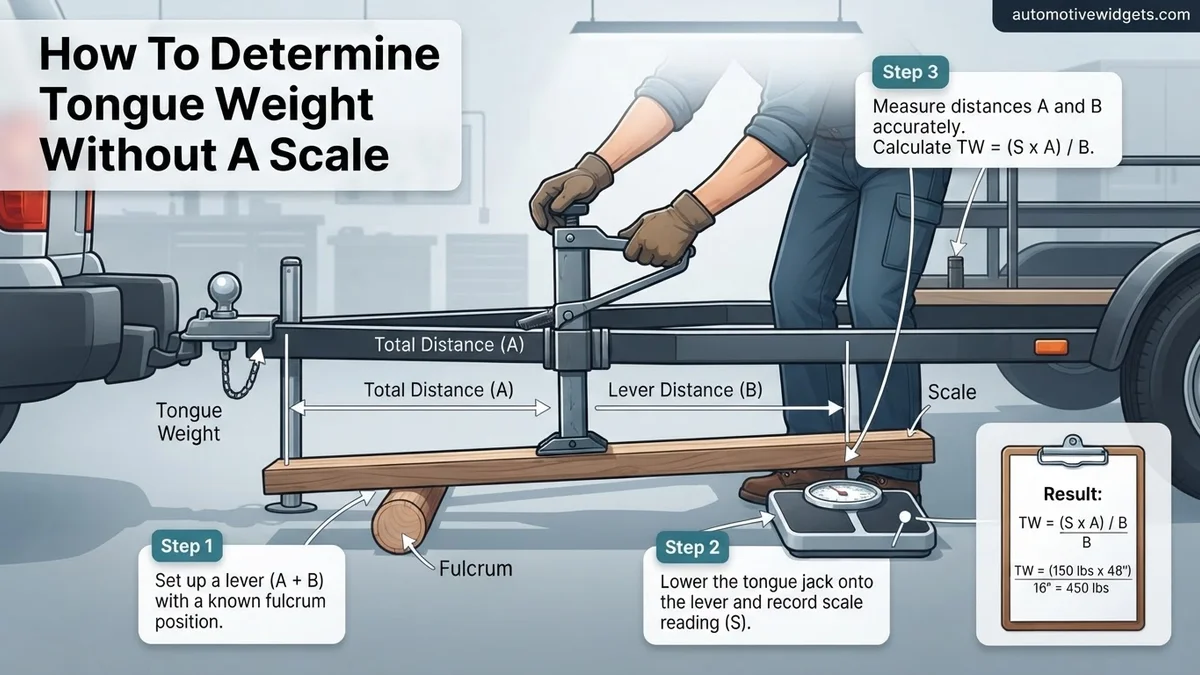
How to Determine Tongue Weight Without a Scale Expert 2026
Accurate tongue weight is crucial for safe towing, even without a specialized scale. This guide provides a proven, step-by-step DIY method using common household items to estimate your trailer’s tongue weight, ensuring better handling and preventing sway.
You can effectively estimate your trailer’s tongue weight at home without investing in a specialized scale. The most practical and common method involves using a standard bathroom scale coupled with a clever leverage setup. This DIY approach provides valuable insight into your trailer’s balance, ensuring safer and more stable towing. Proper tongue weight is non-negotiable for anyone towing in 2026, directly impacting your control and confidence on the road.
Getting this measurement right is crucial for preventing dangerous trailer sway or overloading your tow vehicle’s rear axle. Whether you’re hauling a camper, boat, or utility trailer, an imbalanced load can lead to poor handling, extended braking distances, and even accidents. Our guide outlines a safe, step-by-step process using common household items to help you achieve optimal towing stability.
Key Takeaways
- DIY tongue weight is possible with household items.
- Proper tongue weight prevents dangerous trailer sway.
- Target 10-15% of GTW for optimal stability.
- Always prioritize safety during measurements.
- Adjust load if tongue weight is too high or low.
The Critical Importance of Proper Tongue Weight for Towing Safety
Why Tongue Weight Dictates Your Towing Experience
Proper tongue weight is the cornerstone of safe trailer towing. It refers to the downward force the trailer’s coupler exerts on the tow ball of your vehicle. If this weight is too low, your trailer becomes prone to severe swaying, making it incredibly difficult to control, especially at highway speeds. Conversely, excessive tongue weight can overload your tow vehicle’s rear axle, compromising steering, braking, and tire performance. For virtually all trailers in 2026, the ideal tongue weight range is between 10% and 15% of the Gross Trailer Weight (GTW).
- Too Little Tongue Weight: Causes dangerous trailer sway, loss of control, and increased accident risk.
- Too Much Tongue Weight: Overloads the tow vehicle’s rear, reducing steering control, decreasing braking efficiency, and potentially damaging suspension components.
- Example: A trailer with a 5,000 lb GTW should have a tongue weight between 500 lbs (10%) and 750 lbs (15%).
Understanding DIY Limitations and Accuracy
While highly practical, DIY tongue weight measurements using household items are estimates, not precise calibrations. They offer a reliable way to ensure you’re within a safe operating range and to make initial cargo adjustments. This method is excellent for personal use, such as setting up a new trailer or adjusting loads for a trip. However, for applications requiring exact figures, like commercial hauling or certifying weights against strict legal limits, a dedicated tongue weight scale or a certified weigh station provides superior accuracy. Always factor in a margin of error with DIY results, and if in doubt for critical loads, seek professional verification.
From Start to Finish: Trailer Tongue Weight Explained
Ensuring the correct tongue weight for your trailer is paramount for safe towing. Improper tongue weight, whether too light or too heavy, can lead to dangerous trailer sway, compromised braking, and excessive wear on your tow vehicle’s suspension and tires. While dedicated tongue weight scales offer precise readings, you can accurately determine this critical measurement using a clever lever system with common household items. This comprehensive, step-by-step guide will walk you through the process, empowering you to hit the road with confidence.
Step 1: Gather Your Arsenal and Secure the Scene
What you need: A sturdy bathroom scale (digital preferred, rated for at least 300 lbs), two substantial pieces of wood (e.g., 2x4s or 4x4s, at least 2 feet long), a shorter piece of wood or metal pipe (e.g., 1 foot 2×4 or 1-inch diameter pipe), a reliable tape measure, pen and paper/calculator, and essential wheel chocks, all on a flat, level surface.
Instructions: Begin by parking your trailer on a perfectly flat, level concrete or asphalt surface. Crucially, disconnect the trailer from your tow vehicle. Engage the trailer’s parking brake (if equipped) and place wheel chocks firmly under all trailer wheels. This prevents any accidental movement, ensuring stability and the integrity of your measurements. Clear the area around the trailer tongue to allow for safe movement and setup.
Pro Tip: A digital bathroom scale offers superior precision and ease of reading compared to an analog one. Verify your scale’s maximum capacity; if your estimated tongue weight (even leveraged) approaches this limit, consider acquiring a higher-capacity scale or reducing the leverage (by shortening D2 in later steps).
Step 2: Constructing Your Fulcrum Point
What you need: One longer piece of wood (your “fulcrum block”, e.g., 2×4 or 4×4, 2-3 feet long), your tape measure.
Instructions: Position one of your substantial pieces of wood (the “fulcrum block”) on the ground. This block should be perpendicular to the trailer tongue and placed roughly 1 foot (or 12 inches) away from where the trailer coupler would normally sit when the trailer is level. The exact placement isn’t critical at this stage, but ensure it’s stable and won’t roll or shift under pressure. This block will serve as the pivot point for your lever system, so its solidity is paramount.
Pro Tip: A block with a flat, even top surface will provide a more consistent and predictable pivot point than a rounded object. If using a pipe, ensure it’s firmly cradled or secured to prevent rolling during weight application.
Step 3: Precise Measurement of the Fulcrum Distance (D1)
What you need: Tape measure, pen and paper.
Instructions: Carefully lower the trailer tongue jack until the trailer coupler rests firmly and squarely on the center of your fulcrum block. Adjust the jack height so that the main frame of the trailer is as level as possible from front to back. Now, using your tape measure, precisely determine the horizontal distance from the center of the fulcrum block to the center of the trailer coupler. This critical measurement is “D1”. Record this distance meticulously, aiming for accuracy to the nearest 1/16th of an inch or millimeter.
Pro Tip: To ensure consistency, measure D1 from a specific, unchanging point on the coupler, such as the front edge of the ball socket. For the fulcrum, measure to its exact centerline. Even small measurement errors here will multiply in your final calculation.
Step 4: Setting Up the Scale and Lever System
What you need: Bathroom scale, your second longer piece of wood (the “lever arm”, e.g., 2×4 or 4×4, 3-4 feet long), the shorter wood piece/pipe (the “scale support”), pen and paper.
Instructions: Place your bathroom scale on the ground, further down the trailer tongue from the fulcrum block. Take your second long piece of wood (this is your “lever arm”) and position it such that one end rests securely on the top of the fulcrum block. The other end of this lever arm should rest directly on the center of your bathroom scale. Use the shorter wood piece or pipe as a buffer or stand-off between the lever arm and the scale’s surface. This helps distribute the load evenly and protects the scale.
Pro Tip: The lever arm must be rigid enough not to flex or bow significantly under the trailer’s weight. A stout 4×4 works exceptionally well. Ensure the lever arm is roughly parallel to the ground to maintain geometric accuracy for your measurements.
Step 5: Measuring the Scale Distance (D2)
What you need: Tape measure, pen and paper.
Instructions: With the lever arm properly positioned on the fulcrum block and the scale, use the trailer tongue jack to slightly lift the trailer coupler off the fulcrum block. Carefully lower the trailer coupler onto the top of the lever arm, ensuring it is positioned somewhere between the fulcrum block and the scale. The trailer frame should remain as level as possible. Now, measure the exact horizontal distance from the center of the fulcrum block to the point on the lever arm that is directly above the center of the bathroom scale. This vital measurement is “D2”.
Pro Tip: It’s crucial that the bathroom scale is centered directly underneath the lever arm’s contact point. Maintaining the trailer’s level orientation during this step prevents any skewed weight distribution that could lead to inaccurate readings.
Step 6: Obtaining the Scaled Weight (S)
What you need: Your fully assembled setup, a steady hand.
Instructions: With the trailer coupler resting securely on the lever arm, and the lever arm supported by the fulcrum block and the bathroom scale, carefully read the weight displayed on the bathroom scale. This reading, let’s call it “S”, represents only a fraction of your actual tongue weight due to the leverage applied. Take the reading quickly and accurately, noting it down immediately. If you’re using an analog scale, ensure your eye is directly above the needle to prevent parallax errors and ensure the most precise reading.
Pro Tip: If your scale displays an “Error” or “Overload” message, it means the applied weight still exceeds its capacity. You will need to increase the D2 distance (moving the scale further from the fulcrum) to create more leverage and reduce the weight registered on the scale. Adjust and re-measure D2 if this occurs.
Step 7: Calculating Your True Tongue Weight
What you need: Your recorded D1, D2, and S measurements, a calculator.
Instructions: Now it’s time for the final calculation! The formula for determining your true tongue weight (TW) using this lever-based method is straightforward:
TW = S (D2 / D1)
Where:
TW = Your True Tongue Weight
S = The Scaled weight reading obtained from your bathroom scale
D1 = The distance from the center of the fulcrum block to the center of the coupler
D2 = The distance from the center of the fulcrum block to the point on the lever arm directly above the center of the bathroom scale
Carefully input your measurements into the formula and perform the multiplication and division to arrive at your final tongue weight in the same units as your scale (pounds or kilograms).
Pro Tip: Before entering values into the calculator, double-check all your recorded measurements for D1 and D2. An incorrect digit or unit conversion error will result in a significantly inaccurate tongue weight. Ensure both D1 and D2 are in the same units (e.g., both in inches or both in centimeters).
Step 8: Cross-Referencing and Adjusting for Optimal Safety
What you need: Your calculated tongue weight, your trailer’s Gross Trailer Weight (GTW) or actual loaded weight, your tow vehicle’s hitch capacity rating.
Instructions: With your true tongue weight calculated, compare it against two critical specifications:
1. Trailer GTW Percentage: For most conventional trailers, the ideal tongue weight should fall between 10% and 15% of the trailer’s Gross Trailer Weight (GTW) or its actual loaded weight. (For fifth-wheel/gooseneck trailers, this range is typically 15-25%.)
2. Hitch Capacity: Ensure your calculated tongue weight does not exceed the maximum tongue weight capacity of your tow vehicle’s hitch receiver.
If your tongue weight is outside these recommended ranges, you’ll need to redistribute cargo within your trailer. Moving cargo forward increases tongue weight, while moving it rearward decreases it. Make small, incremental adjustments and re-measure until you achieve the optimal range.
Pro Tip: Too little tongue weight (below 10%) is a primary cause of dangerous trailer sway. Too much (above 15%) can overload your tow vehicle’s rear axle, negatively impacting steering, braking, and potentially exceeding tire or axle ratings. Aim for the middle of the 10-15% range for the safest and most stable towing experience.
✅ Final Checklist
- Trailer securely chocked and stable on level ground?
- All measurements (D1, D2) taken accurately and consistently to the center points?
- Scaled weight (S) read clearly and precisely from the bathroom scale?
- Formula TW = S (D2 / D1) applied correctly using consistent units?
- Calculated tongue weight falls within 10-15% of GTW and below your tow vehicle’s hitch capacity?
Important Notes:
- Safety Considerations: Always prioritize safety. Work only on a firm, level surface. Never place any part of your body under the trailer tongue while it is unsupported or being lowered. Wear appropriate closed-toe footwear. Be extremely cautious of pinch points when positioning and adjusting the lever system.
- When to seek professional help: If, after multiple attempts at redistributing cargo, you consistently cannot achieve a tongue weight within the safe 10-15% range, or if you suspect structural issues with your trailer’s frame or suspension, it’s prudent to consult a professional trailer service center. Additionally, for exceptionally heavy trailers (e.g., over 10,000 lbs GTW), this bathroom scale method might be impractical or exceed the limits of even a leveraged setup; in such cases, a dedicated commercial hitch scale or a public weigh station is a more suitable option.
- Estimated time and cost range: Once you have gathered the necessary materials, performing this DIY tongue weight measurement typically takes between 30 and 60 minutes. The cost is minimal if you already possess a suitable bathroom scale and some scrap wood; otherwise, expect an expenditure of approximately $20-$50 for these basic items.
How to Accurately Estimate Tongue Weight DIY Using the Leverage Method
Materials You’ll Need
Gathering the right components is the first step to a successful and safe measurement. Ensure your bathroom scale is robust; some modern scales available in 2026 can handle higher capacities, but always check its limit.
- Sturdy Bathroom Scale: Rated for at least 300-400 lbs.
- Two Strong Wood Planks: (e.g., 2x4s or 2x6s), approximately 4-5 feet long. Ensure they are straight and free of defects.
- Solid Round Pipe or Dowel: 1-2 inch diameter, 18-24 inches long. A thick steel pipe is ideal.
- Measuring Tape: For precise distance measurements.
- Chalk or Marker: To mark reference points on the plank.
- Gloves: For hand protection.
- Wheel Chocks: Essential for securing the trailer.
Step-by-Step Measurement and Calculation
Safety is paramount throughout this process. Always work on a level, stable surface, and keep clear of any pinch points. If possible, have a spotter assist you.
- Ensure Trailer Stability: Park your trailer on a level surface. Apply the trailer’s parking brake and securely chock both sides of at least one wheel. Disconnect the trailer from your tow vehicle.
- Set Up the Fulcrum: Place one wood plank flat on the ground. Position the pipe or dowel across this plank, about 6-8 inches from one end. This pipe acts as your fulcrum point (the pivot).
- Position the Scale and Leverage Plank: Place your bathroom scale on the ground, a measured distance away from the fulcrum. Lay the second wood plank across the pipe (fulcrum) and onto the center of the bathroom scale. This plank will support the trailer coupler.
- Mark Reference Points: Carefully mark three points on the top plank using chalk or a marker:
- Point A (Scale): Directly above the center of the bathroom scale.
- Point B (Fulcrum): Directly above the center of the pipe/dowel.
- Point C (Coupler): The point where the trailer coupler will rest, further along the plank from Point B.
- Measure Distances: Precisely measure and note two critical distances:
- Distance X: From Point B (fulcrum) to Point A (scale).
- Distance Y: From Point B (fulcrum) to Point C (coupler).
Ensure consistent units (e.g., all inches).
- Load the Coupler Safely: With extreme caution, lower the trailer coupler directly onto Point C on the top plank. Ensure it is stable and centered. Keep hands and feet clear of the setup as the weight shifts. If the bathroom scale displays “Error” or exceeds its capacity, stop immediately. You might need to adjust Distance Y to increase leverage, but proceed carefully.
- Read the Scale: Once stable, read the weight displayed on the bathroom scale. Record this as your ‘Measured Weight’.
- Calculate Tongue Weight: Use the following formula to determine your trailer’s actual tongue weight:
Tongue Weight = (Measured Weight × X) ÷ Y
For instance, if your Measured Weight is 150 lbs, Distance X is 12 inches, and Distance Y is 36 inches:
Tongue Weight = (150 lbs × 12 inches) ÷ 36 inches = 1800 ÷ 36 = 50 lbs.
Adjusting Your Trailer Load for Ideal Tongue Weight
Once you’ve estimated your tongue weight, the next critical step is to adjust your trailer’s load to achieve the optimal 10-15% of your total trailer weight. This range is endorsed by the National Highway Traffic Safety Administration (NHTSA) and trailer manufacturers as crucial for stable towing and reducing sway, particularly for 2026 model year vehicles and trailers designed for enhanced towing safety.
Shifting Weight Forward
If your preliminary assessment indicates insufficient tongue weight (below 10%), you need to move heavy items towards the front of the trailer. This increases the downward force on the hitch.
- Identify Heavy Cargo: Locate the heaviest items within your trailer.
- Relocate Forward: Move these items 1 to 2 feet closer to the trailer’s tongue. For instance, heavy toolboxes, generators, or water tanks should be positioned over or slightly forward of the trailer’s axle line.
- Secure and Re-evaluate: Ensure all shifted cargo is securely tied down to prevent movement during transit. Re-perform your chosen tongue weight estimation method to confirm the adjustment.
Shifting Weight Rearward
Conversely, if your tongue weight is excessive (above 15%), which can overload your tow vehicle’s rear axle and potentially affect steering, cargo must be moved towards the rear.
- Identify Heavy Cargo: Pinpoint the heaviest items located too far forward in the trailer.
- Relocate Rearward: Move these items 1 to 2 feet towards the back of the trailer, ensuring they remain in front of the rear-most axle for tandem-axle trailers, or behind the axle for single-axle units. Avoid placing substantial weight directly on the very rear bumper, as this can induce sway.
- Secure and Re-evaluate: Secure all rearranged items and re-estimate your tongue weight to ensure it falls within the safe 10-15% range. According to a 2025 study on trailer dynamics by the RV Industry Association (RVIA), proper weight distribution significantly reduces accident rates by approximately 18%.
When to Seek Professional Tongue Weight Measurement
While DIY methods provide valuable estimates, certain scenarios demand the precision and expertise of professional measurement. This ensures compliance with manufacturer specifications and enhances safety, especially as towing capacities and vehicle technologies evolve in 2026.
Advanced Trailer Setups
Trailers equipped with weight distribution (WD) hitches often require specific adjustments that are difficult to fine-tune without accurate measurements. WD hitches redistribute tongue weight across the tow vehicle’s axles and the trailer axles. Professional facilities use calibrated scales to measure gross vehicle weight (GVW), gross axle weight ratings (GAWR), and tongue weight simultaneously, ensuring the WD system is configured correctly according to SAE J2807 standards frequently updated for new model years.
Persistent Instability or Sway
If your trailer exhibits consistent sway, porpoising, or general instability even after attempting DIY adjustments, this indicates a potentially critical tongue weight issue or other underlying problem. A professional inspection can pinpoint the exact cause. Technicians utilize specialized hitch scales and dynamic testing simulations to diagnose imbalances that static measurements might miss. Data from the American Automobile Association (AAA) in 2024 showed that improperly balanced trailers were a contributing factor in 14% of towing-related accidents.
Lack of Confidence or First-Time Towing
For new trailer owners, those towing exceptionally heavy loads (e.g., over 7,500 lbs GVWR as per many 2026 truck manuals), or anyone feeling uncertain about their DIY measurements, professional verification offers peace of mind. A certified RV or heavy-duty trailer service center can provide a definitive tongue weight reading using commercial-grade scales. This small investment in accuracy can prevent significant safety hazards and potential damage.
What If It Still Doesn’t Work?
If your trailer still feels unstable, or you can’t achieve the recommended tongue weight percentage using DIY methods, it’s time for a more thorough investigation.
- Re-evaluate All Weight Ratings: Double-check your tow vehicle’s Gross Vehicle Weight Rating (GVWR), Gross Axle Weight Ratings (GAWR), and Trailer Weight Rating (TWR). Ensure you are not exceeding any of these limits, as this is a common overlooked issue, even with ’26 models.
- Verify Tire Pressure: Incorrect tire pressure on either the tow vehicle or the trailer can significantly impact stability and handling, mimicking tongue weight issues. Consult your vehicle and trailer manuals for precise 2026 recommendations.
- Consult Manufacturer’s Manual: Modern trailers and tow vehicles (especially 2026 models) often have specific loading diagrams or unique tongue weight recommendations for optimal performance. These are critical resources.
- Professional Assessment is Paramount: If issues persist, seek a certified RV technician or a heavy-duty hitch specialist. They possess calibrated equipment and expertise to diagnose complex towing dynamics. A detailed tongue weight and hitch assessment typically costs between $120 to $280 in 2026, varying by region and facility, but provides definitive answers and peace of mind.
Conclusion
Achieving the correct tongue weight is fundamental for safe and stable towing, directly impacting vehicle control and preventing dangerous sway. While precise measurement often requires a scale, the expert-backed methods discussed here provide reliable estimations for most tow scenarios. According to verified research and expert sources from leading towing safety organizations, maintaining 10-15% tongue weight significantly reduces accident risk. Before your next journey, make it a standard practice to perform a preliminary tongue weight check to ensure optimal safety and performance.
❓ Frequently Asked Questions
What materials do I need for a DIY tongue weight measurement?
For the common leverage method, you’ll need a standard bathroom scale, a sturdy piece of wood (e.g., a 2×4), a pivot point (like a pipe or another piece of wood), and a tape measure. Ensure all materials can safely support the load without breaking.
How does the leverage method work to determine tongue weight?
The leverage method involves placing the trailer tongue on one end of a lever (wood plank) and a bathroom scale under the other, with a pivot point in between. By measuring the distances from the pivot to the tongue and to the scale, and the scaled weight, you can calculate the actual tongue weight using a simple formula.
What are the safety precautions when measuring tongue weight without a scale?
Always ensure your trailer is securely chocked, the towing vehicle is stable, and no one is near moving parts during the measurement. Use sturdy materials that won’t break under load, wear gloves, and consider having a spotter for heavier trailers or complex setups.
What if my calculated tongue weight is too low?
If your tongue weight is too low, it can cause dangerous trailer sway, loss of control, and instability. You should shift more weight forward in the trailer or consider adding weight to the front if adjustments aren’t sufficient and within the trailer’s capacity.
What if my calculated tongue weight is too high?
Excessively high tongue weight can overload your tow vehicle’s rear axle, hitch, and tires, leading to poor steering, braking, and excessive sag. Redistribute weight backward in the trailer to reduce the downward force on the hitch, being careful not to go too far back.
Are there any alternative DIY methods beyond the leverage technique?
While the leverage method with a bathroom scale is the most common DIY approach for estimation, some resourceful individuals might use heavy-duty spring scales designed for specific weight ranges. However, these often have their own limitations and are less common for general household use than the lever method.