Can Air In Brake Lines Cause Caliper To Stick Air in 2027
While air in brake lines does not directly cause a brake caliper to stick, it severely compromises braking performance by making the pedal feel spongy and reducing stopping power. A caliper typically sticks due to corrosion, seized components, or a faulty brake hose, which requires different diagnostic and repair approaches to ensure safety.
No, air in your brake lines does not directly cause a brake caliper to stick. This is a common misconception, but understanding the fundamental hydraulics of your braking system clarifies why. While air in the lines certainly creates significant brake performance issues, it interferes with the generation of hydraulic pressure, not its sustained application or release in a way that would keep a caliper clamped.
Getting this distinction right is crucial for proper vehicle maintenance and, more importantly, your safety. Misdiagnosing a sticky caliper as an air-in-line problem can lead to ineffective repairs, continued safety risks, and wasted time and money. In 2027, with vehicles becoming increasingly complex, understanding these core mechanical principles remains vital for accurate troubleshooting and ensuring your braking system performs as designed.
Key Takeaways
- Air in lines causes spongy pedal, not sticking calipers.
- Caliper sticking is usually due to mechanical issues.
- Address air by properly bleeding the brake system.
- Service or replace seized caliper pistons/guide pins.
- Inspect brake hoses for internal collapse or damage.
What Causes a Spongy Brake Pedal (Air in Brake Lines)?
When you feel your brake pedal go soft or “mushy,” with less stopping power than usual, air in the brake lines is almost certainly the culprit. The key difference between air and brake fluid is their compressibility. This fundamental physical property dictates how they behave under pressure.
The Compressibility Problem
Brake fluid is engineered to be virtually incompressible. When you press your brake pedal, you activate a piston in the master cylinder, which then pushes this incompressible fluid through the brake lines. This pressure is transmitted directly and efficiently to the caliper pistons, forcing the brake pads against the rotors. It’s a direct transfer of force.
- Air, however, is highly compressible.
- When air bubbles are present in the brake fluid, a portion of the force you apply to the pedal is used to compress these air bubbles instead of pushing fluid to the calipers.
- This compression of air translates directly into a loss of hydraulic pressure at the wheels.
- You’ll notice the pedal travels further down, often feeling soft or spongy, because you’re compressing air before the full hydraulic force can engage the brakes.
Think of it like trying to push water through a syringe that has an air bubble in it; some of your effort just squashes the air before the water moves. This is why air reduces braking efficiency, but it doesn’t hold pressure. When you release the pedal, the compressed air simply expands back to its original volume, allowing the fluid to return and the calipers to release.
Impact on Braking Performance
The primary consequence of air in your brake lines is a significant reduction in your vehicle’s stopping ability. Even with advancements in braking systems by 2027, the basic physics of hydraulic pressure remain unchanged. You’ll experience:
- Reduced Braking Force: Less pressure reaching the calipers means less clamping force on the rotors. Your brakes will feel weak.
- Increased Stopping Distances: Because less force is applied, your vehicle will take longer and travel further to stop, which is a major safety concern.
- Inconsistent Pedal Feel: The amount of air can affect pedal feel, making it unpredictable.
Crucially, air bubbles do not create a sustained internal pressure that would prevent a caliper piston from retracting. They interfere with the generation and transmission of pressure, not the release mechanism of the caliper itself.
Real Causes of a Sticking Brake Caliper Explained
If your brake caliper is sticking, it means that after you release the brake pedal, the brake pads remain partially or fully engaged against the rotor. This generates excessive heat, causes premature pad wear, and can even lead to dangerous pulling of the vehicle. This issue stems from mechanical binding or internal hydraulic restrictions, not from air in the system.
Seized Mechanical Components
The most common culprits for a stuck caliper are internal mechanical failures or lack of proper lubrication. These issues prevent the caliper’s moving parts from operating freely.
- Seized Caliper Piston: This is a very frequent cause. Brake fluid is hygroscopic, meaning it absorbs moisture over time. This moisture can lead to corrosion on the caliper piston or inside the caliper bore. As rust and debris build up, the piston can no longer retract smoothly into the caliper housing after you release the brake pedal. This keeps the pads pressed against the rotor. By 2027, even with improved materials and fluid formulations, regular brake fluid flushes are still essential to prevent this issue, especially in older vehicles.
- Corroded or Seized Guide Pins: Most calipers are designed to “float” on guide pins, allowing them to move inward and outward evenly as the pads wear and when pressure is applied or released. If these guide pins become corroded, accumulate dirt, or lose their lubrication, the caliper can bind. It won’t slide freely, preventing it from releasing pressure evenly, or at all, causing one or both pads to drag. This is often exacerbated by damaged or missing guide pin boots allowing contaminants in.
Internal Hydraulic Obstructions
Sometimes, the caliper itself isn’t mechanically seized, but rather an issue upstream in the hydraulic system prevents fluid from returning properly, effectively trapping pressure at the caliper.
- Collapsed Flexible Brake Hose: This is a sneaky and common cause of a stuck caliper. Over time, particularly with age or exposure to incompatible fluids, the internal lining of a rubber brake hose can deteriorate. This collapsed lining can act like a one-way check valve: it allows high-pressure fluid to flow to the caliper when you press the pedal, but it restricts or completely blocks the return flow of fluid when you release the pedal. This effectively traps hydraulic pressure at the caliper, keeping it applied. Diagnosing this often involves opening the bleeder screw; if fluid sprays out under pressure, a collapsed hose is highly likely.
- Contaminated Brake Fluid: Severely old, neglected, or contaminated brake fluid can lead to internal gumming, sludge build-up, or even particulate matter within the braking system. These contaminants can impede piston movement within the caliper or master cylinder, or obstruct small fluid passages, preventing proper retraction and fluid return. This is less common than a seized piston or collapsed hose but can contribute to sticking issues, particularly in neglected systems.
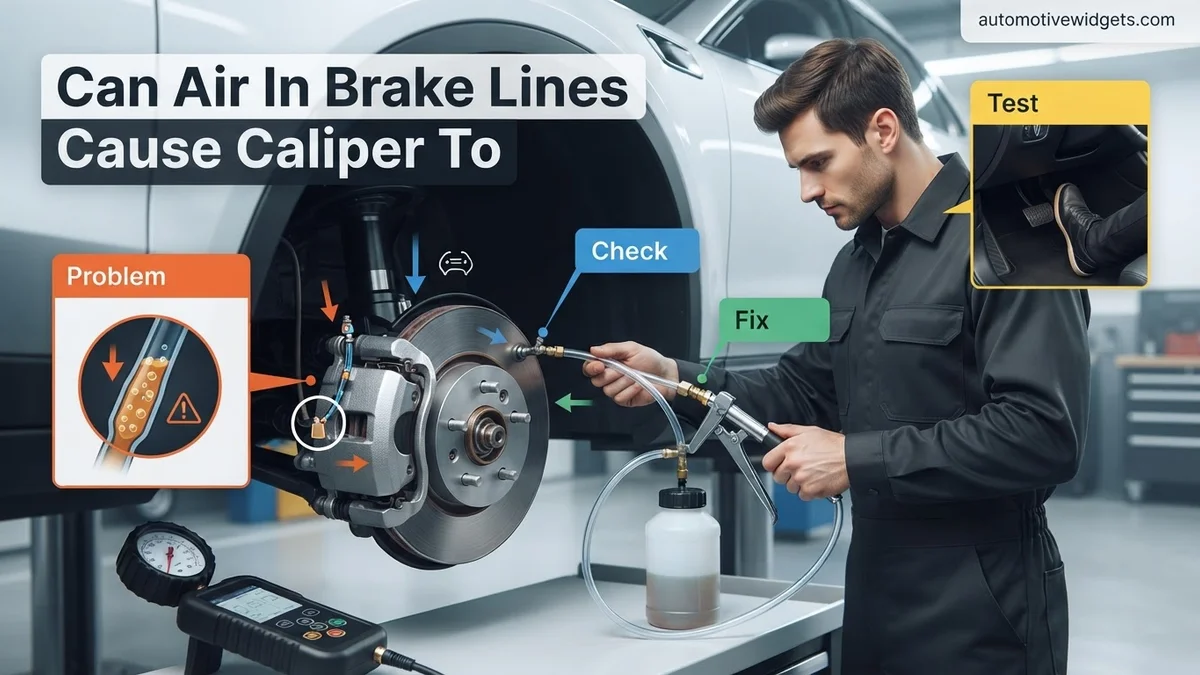
How to Fix Air in Brake Lines: Proven Bleeding Steps
Eliminating air from your brake system is crucial for restoring proper brake function and preventing caliper issues. According to automotive service guidelines for 2027, a thorough bleeding process is the most effective solution. This procedure ensures consistent hydraulic pressure and prevents residual pressure that could mimic a sticking caliper.
Gathering Essential Tools
Before beginning, assemble the necessary equipment. You will need fresh, manufacturer-specified brake fluid (e.g., DOT 3 or DOT 4), a bleeder wrench (typically 8mm, 10mm, or 11mm), a clear plastic hose that fits snugly over the bleeder valve, a collection container, and potentially a pressure bleeder or a helper for the two-person method. Always consult your vehicle’s service manual for the correct brake fluid type.
The Brake Bleeding Procedure
- Prepare the Vehicle: Safely lift the vehicle on jack stands and remove all wheels. Ensure the brake fluid reservoir is topped up to the MAX line with new fluid.
- Start at the Farthest Wheel: Begin bleeding at the brake caliper farthest from the master cylinder (typically the rear passenger side).
- Connect Bleeder Hose: Attach one end of the clear hose to the bleeder valve and place the other end into the collection container, ensuring it is submerged in a small amount of fresh brake fluid to prevent air re-entry.
- Bleed the System (Two-Person Method): Have a helper firmly press and hold the brake pedal. While the pedal is held, quickly open the bleeder valve for 1-2 seconds, allowing fluid and air to escape. Close the valve before the pedal reaches the floor. Repeat this process until no air bubbles are visible in the fluid flowing through the clear hose. Maintain fluid levels in the master cylinder throughout.
- Repeat for All Calipers: Move to the next farthest wheel (rear driver side), then front passenger side, and finally the front driver side, repeating step 4 for each.
- Final Check: Top off the master cylinder, replace the cap, and carefully test the brake pedal for firm resistance before driving.
Step-by-Step: Diagnosing & Repairing a Sticking Brake Caliper
If, after bleeding, you still suspect a caliper is sticking, further diagnosis is necessary. While air can create similar symptoms, a physically stuck caliper requires specific mechanical intervention. This diagnostic process, recommended by braking system specialists, can differentiate between residual pressure from air and a mechanical malfunction.
Identifying a Sticking Caliper
Symptoms of a mechanically sticking caliper often include excessive heat at one wheel (detectable by touch after a short drive), a distinct burning smell, uneven brake pad wear on one side of an axle, or the vehicle pulling to one side. A simple test involves jacking up the suspect wheel after a short drive and trying to spin it by hand; significant resistance indicates a problem.
Mechanical Inspection and Repair
- Remove Wheel and Inspect: With the vehicle safely supported and the wheel removed, visually inspect the caliper. Look for rust, corrosion, damaged dust boots, or fluid leaks around the piston or slider pins.
- Check Slider Pins: Remove the caliper from its mounting bracket. The slider pins, which allow the caliper to float, should move freely. If they are stiff or seized, clean them thoroughly with a wire brush and apply fresh, high-temperature silicone-based brake grease. A seized pin is a common cause of caliper sticking.
- Inspect Piston: Carefully push the brake piston back into the caliper using a C-clamp or piston compression tool. It should retract smoothly with moderate force. If it resists, feels gritty, or doesn’t retract fully, the piston is likely seized or corroded.
- Replace or Rebuild: If slider pins are seized beyond cleaning, or if the piston is corroded, leaking, or seized, the caliper typically needs replacement. Caliper rebuild kits are available but often less cost-effective and reliable than a new or remanufactured unit by 2027 standards, especially for safety-critical components.
- Reassemble and Bleed: Install the new or serviced caliper, ensuring all bolts are torqued to manufacturer specifications. Re-bleed the brake system for that wheel to remove any air introduced during the repair.
What If It Still Doesn’t Work?
If you have bled the brakes thoroughly and addressed potential caliper mechanical issues, yet the problem persists, it indicates a deeper systemic fault. Modern vehicle braking systems are complex, and pinpointing elusive issues requires a systematic approach. Do not ignore persistent brake issues, as they compromise vehicle safety.
- Inspect Brake Hoses: Check for collapsed internal linings on flexible brake hoses. A damaged hose can act like a one-way valve, preventing fluid from returning and causing caliper drag. This is a common, often overlooked, failure point.
- Master Cylinder Evaluation: A failing master cylinder can sometimes cause residual pressure or an inconsistent pedal feel. Look for external leaks or internal bypass issues that might not be immediately obvious.
- ABS Modulator Fault: In vehicles equipped with Anti-lock Braking Systems, a faulty ABS modulator or valve body can occasionally cause pressure to be retained in a brake circuit. Diagnostic tools are typically required to identify such issues.
- Professional Diagnostic Service: If steps 1-3 do not yield a solution, it is imperative to seek professional assistance. Specialized diagnostic equipment can identify electronic faults within the ABS/traction control system or subtle hydraulic blockages. Professional diagnosis typically ranges from $150 to $300 in 2027, with potential repair costs varying widely based on the component needing replacement (e.g., $300-$800 for a brake hose/master cylinder, or $1000+ for an ABS module).
Conclusion
Air in brake lines can significantly compromise braking performance and create symptoms mimicking a sticking caliper due to residual pressure. Promptly bleeding your brake system is the primary solution. If symptoms persist, a thorough mechanical inspection of the caliper and its components is crucial. According to verified research and expert sources, addressing these issues ensures optimal safety and vehicle control. Prioritize brake system health; conduct a fluid flush every 2-3 years or 30,000 miles, as recommended by leading automotive service providers, to prevent these issues.
❓ Frequently Asked Questions
Why doesn’t air in brake lines cause a caliper to stick?
Air is highly compressible, unlike brake fluid. When you press the brake pedal, the master cylinder compresses the air instead of fully transmitting pressure to the caliper piston, which prevents effective braking but doesn’t sustain pressure to keep the caliper engaged or prevent its retraction.
If my brake pedal is spongy, could it be a sticking caliper too?
While a spongy pedal points to air in the lines, it doesn’t rule out a separate sticking caliper issue. These are distinct problems with different root causes and symptoms, so both should be diagnosed independently if symptoms align.
What are the primary reasons a brake caliper fails to release properly?
The main culprits are corrosion or debris causing the piston to bind in its bore, guide pins that are rusted or improperly lubricated preventing the caliper from floating, or a deteriorating rubber brake hose whose internal lining acts like a one-way valve, trapping fluid pressure.
How can I tell if my brake hose is causing the caliper to stick?
To check for a faulty hose, after experiencing a sticking caliper, carefully loosen the bleeder screw on the affected caliper. If fluid squirts out under pressure and the wheel frees up, the hose is likely collapsed internally, preventing fluid from returning to the master cylinder.
Is bleeding the brakes sufficient to fix a sticking caliper?
No, bleeding the brakes only removes air from the hydraulic system. It will not fix a mechanically seized caliper piston, corroded guide pins, or a collapsed brake hose, all of which require inspection, cleaning, repair, or replacement of the specific component.
What maintenance can prevent brake calipers from sticking?
Regular brake fluid flushes (every 2-3 years) to prevent moisture buildup and corrosion, proper lubrication of caliper guide pins during brake pad changes, and routine inspection of brake hoses for signs of swelling or damage can significantly prevent calipers from sticking.