What Is The Difference Between 94V and 94H Tires Real 2026
The main difference between 94V and 94H tires lies strictly in their speed ratings, while their load capacities are completely identical. Both tires support up to 1,477 pounds per tire (load index 94), but an H-rated tire is certified for speeds up to 130 mph, whereas a V-rated tire handles speeds up to 149 mph.
When you look at the sidewall of your car tires in 2026, codes like 94V and 94H dictate exactly how your vehicle handles performance and safety limits. The core difference between a 94V and a 94H tire comes down to one critical factor: maximum speed capability. While both tires share the exact same weight-bearing capacity, the V-rated tire is engineered to safely sustain higher velocities than the H-rated alternative.
Choosing between these two specifications impacts your vehicle’s handling limits during highway driving, emergency maneuvers, and track days. If your vehicle manufacturer specifies a V-rated tire, stepping down to an H-rated tire changes your vehicle’s high-speed safety margin. Let us break down what these alphanumeric codes actually mean for your daily drive.
Key Takeaways
- Both 94V and 94H tires share a load index of 94, supporting 1,477 lbs each.
- The H speed rating allows safe driving up to 130 mph (210 km/h).
- The V speed rating allows safe driving up to 149 mph (240 km/h).
- You can safely replace an H-rated tire with a V-rated tire, but not vice versa.
- Always match or exceed your vehicle manufacturer’s original equipment speed and load specifications.
Diagnosing Tire Ratings: Understanding What 94V and 94H Mean
Breaking Down the Service Description Code
Every modern tire features a service description stamped on its sidewall, typically formatted as a number followed by a letter, such as 94V or 94H. The numbers and letters are standardized codes established by organizations like the Tire and Rim Association and the European Tyre and Rim Technical Organisation.
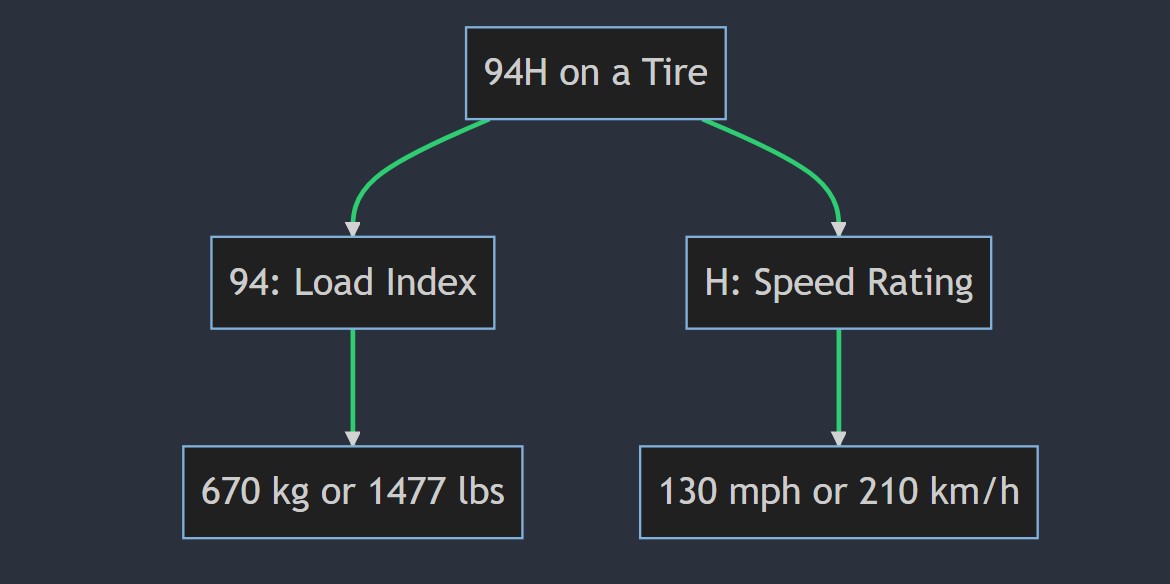
- The 94 represents the load index of the tire.
- The V or H represents the speed rating of the tire.
- These two metrics dictate the operational limits of your tire under load and velocity.
What the Letter Suffix Controls
The letter at the end of the sequence tells you the maximum safe speed the tire can maintain over extended periods. In the tire industry, these letter codes correlate directly to rigorous laboratory testing standards. Manufacturers test these tires under heavy loads at continuous speeds to ensure structural integrity. When you compare 94V to 94H, you are looking at two distinct speed categories within passenger car and crossover tire lineups for 2026.
How to Compare Speed and Load Capacity Step-by-Step
Evaluating the Speed Rating: H up to 130 mph vs V up to 149 mph
The primary differentiator between these two tires is how fast they can safely travel before heat buildup compromises the rubber compound. Speed ratings are not a recommendation to speed, but rather a measure of high-speed durability and thermal tolerance.
- H Rating: Certified for speeds up to 130 mph (210 km/h). This is a common rating for standard sedans, family crossovers, and grand touring vehicles.
- V Rating: Certified for speeds up to 149 mph (240 km/h). This rating is typically reserved for performance sedans, sports cars, and heavy electric vehicles that require higher speed thresholds.
Analyzing the Load Index: Why ’94’ Means Identical Weight Limits
Many drivers incorrectly assume that a higher letter rating also means a stronger tire structure for weight. However, the number ’94’ in both 94V and 94H means they are identical twins when it comes to supporting your vehicle’s mass.
- A load index of 94 corresponds to a maximum weight capacity of 1,477 pounds (670 kg) per individual tire.
- When multiplied across a standard four-tire setup, your vehicle can support a maximum load of 5,908 pounds.
- Because the load index is identical, both tires handle the exact same vehicle weight, cargo, and passenger loads safely.
What If Your Vehicle Requires a Specific Speed Rating?
Modern vehicle manufacturers specify exact tire speed ratings to match the vehicle’s maximum capability and electronic stability control systems. Installing tires with a lower speed rating than originally specified compromises vehicle handling.
Consequences of Lower Speed Ratings
Dropping from a V-rated tire to an H-rated tire on a high-performance sedan introduces noticeable tread squirm during high-speed cornering. According to National Highway Traffic Safety Administration (NHTSA) tire safety data, mismatched speed ratings can alter the critical understeer/oversteer balance engineered into modern stability control modules.
Adhering to Manufacturer Guidelines
Vehicle manufacturers explicitly state that replacement tires must match or exceed the original equipment (OE) speed and load index. Upgrading from 94H to 94V is always mechanically safe because the higher rating signifies greater high-speed durability. However, dropping from 94V to 94H violates safety protocols on vehicles engineered for the 149 mph threshold.
Expert Guidance on Mixing and Substituting Tire Ratings Safely
Proper tire mixing and substitution require strict adherence to industry standards set by the Tire and Rim Association (T&RA) and the Rubber Manufacturers Association (RMA) for safe operation on public roads.
Can You Mix H and V Rated Tires?
Mixing different speed ratings on the same axle creates dangerous handling imbalances due to varying sidewall stiffnesses. If different speed-rated tires must be mixed across axles, industry experts mandate placing the tires with the higher speed rating on the rear axle. This prevents dangerous oversteer conditions during emergency braking or cornering maneuvers in wet weather.
Substitution Best Practices
When replacing worn rubber in 2026, adhere to these mandatory installation steps for maximum safety:
- Verify the vehicle placard located inside the driver-side door jamb for minimum required load and speed specifications.
- Select replacement tires that match both the exact 94 load index and the V or H speed rating specified by the factory.
- Consult a certified tire technician before substituting any speed rating to ensure electronic driver aids remain fully compatible.
What If It Still Doesn’t Work?
If you have installed the incorrect tire rating or encounter persistent handling issues after a tire swap, specific fallback actions are required to restore vehicle safety and compliance.

Follow these professional troubleshooting steps if your tire setup fails to meet safety standards:
- Visit a certified tire dealer or dealership service center to inspect the current tire placard versus the installed tires.
- Request a complete axle replacement if mismatched speed ratings are causing instability or triggering electronic stability control faults.
- Budget for professional corrective services, which typically range from $150 to $400 for a new pair of correctly rated tires including mounting and balancing.
- Consult your automotive insurance provider or vehicle lease agreement regarding compliance penalties for operating vehicles with substandard safety equipment.
Conclusion
Understanding the difference between 94V and 94H tires ensures your vehicle maintains optimal handling, safety, and high-speed durability. While both share an identical 1,477-pound load capacity, the V rating supports speeds up to 149 mph compared to the H rating’s 130 mph limit. According to verified research and automotive safety experts, always match or exceed your vehicle manufacturer’s original speed rating specification to guarantee optimal performance.
❓ Frequently Asked Questions
What do the numbers and letters in the tire service description mean?
The number (such as 94) represents the load index, which tells you the maximum weight capacity of the tire. The letter (such as H or V) indicates the maximum speed rating that the tire can safely sustain.
Will a V-rated tire give me a stiffer ride than an H-rated tire?
Generally, higher speed-rated tires feature stiffer sidewalls to handle cornering forces and heat at higher velocities. However, the difference between H and V ratings from the same brand is often minimal in daily driving comfort.
Do V-rated tires wear out faster than H-rated tires?
Treadwear depends heavily on the rubber compound, driving habits, and maintenance rather than the speed rating alone. A V-rated tire does not inherently wear out faster simply because it has a higher speed capability.
How do I find the correct tire rating for my specific vehicle?
You can check the tire placard located on the driver’s side door jamb, consult your owner’s manual, or inspect the size and rating of the tires currently installed on your vehicle.
Can I mix H-rated and V-rated tires on the same axle?
No, you should never mix different speed ratings or load indices on the same axle. It is best practice to match all four tires or at least match tires by axle to ensure predictable handling.
Does a higher speed rating cost more money?
V-rated tires often carry a slightly higher price tag than H-rated tires because they require more advanced internal construction to handle higher heat and centrifugal forces safely.