How to Tell If Your Catalytic Converter is Bad Expert 2027
A failing catalytic converter can significantly impact your vehicle’s performance and emissions. Key signs include the check engine light (P0420/P0430), a rotten egg smell, reduced power, and rattling noises. Prompt diagnosis is crucial to prevent further engine damage.
If your vehicle is showing signs of distress in 2027, a failing catalytic converter is a prime suspect when you experience reduced engine performance, strange smells, or that dreaded Check Engine Light. Identifying a bad catalytic converter early saves you from compounding engine issues, poor fuel economy, and potential environmental penalties. This critical component ensures your exhaust emissions meet current strict standards, so recognizing its failure signs is key to maintaining your vehicle’s health and compliance.
Ignoring the indicators of a failing catalytic converter won’t make the problem disappear; it will likely worsen. From noticeable drops in acceleration to the potential for complete engine shutdown due to extreme exhaust backpressure, these issues directly impact your driving experience and wallet. Knowing the precise symptoms allows you to diagnose accurately and address the problem before it escalates into more extensive and expensive repairs.
Key Takeaways
- Watch for check engine light codes P0420/P0430.
- A sulfur smell often indicates catalytic converter issues.
- Poor acceleration and reduced MPG are common symptoms.
- Rattling from under the car can signal internal damage.
- Professional diagnosis prevents costly engine repairs.
Diagnosing a Bad Catalytic Converter: Key Signs & Symptoms
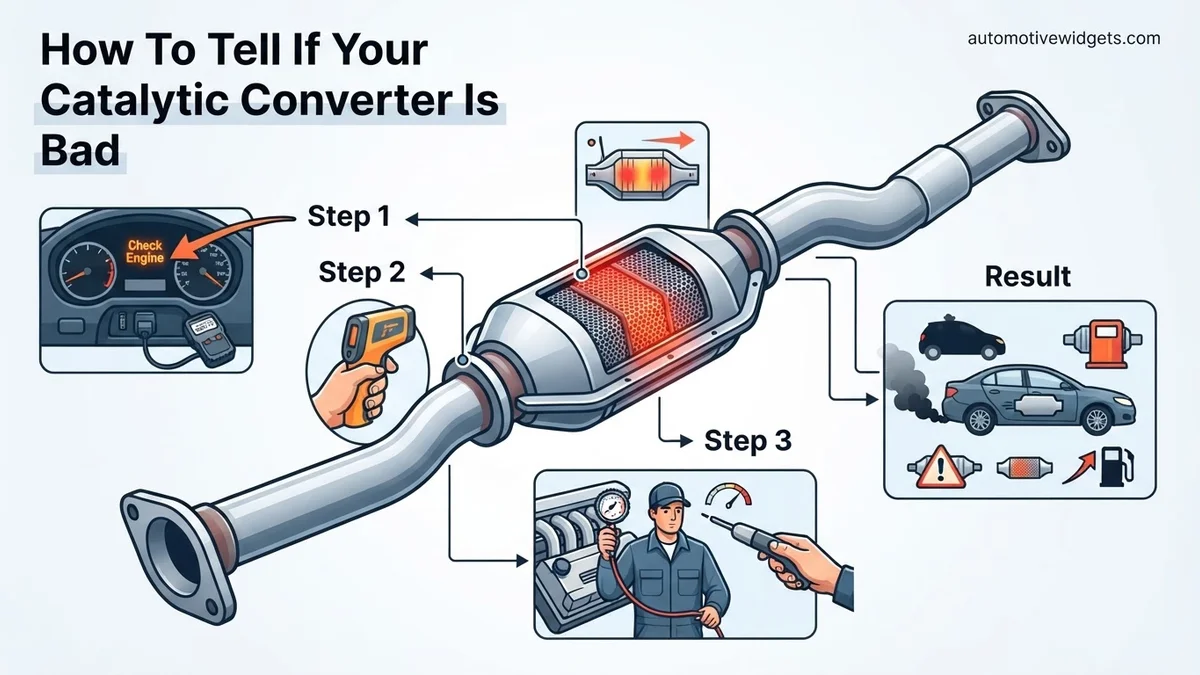
Your vehicle communicates catalytic converter problems through several distinct and often overlapping symptoms. Pay close attention to these indicators, as they are your most direct clues to diagnosing this specific issue effectively.
The Illuminated Check Engine Light: Your Primary Warning
- Persistent Check Engine Light: This is often the first and clearest sign. Modern vehicle systems are highly sensitive to emissions efficiency.
- Common OBD-II Codes: When the Check Engine Light activates due to a catalytic converter issue, an OBD-II scanner will frequently reveal codes like P0420 or P0430.
- P0420 (Catalyst System Efficiency Below Threshold – Bank 1): This code indicates your converter is not cleaning exhaust gases as effectively as it should. The oxygen sensor after the cat reports similar readings to the sensor before it, signaling a lack of conversion.
- P0430 (Catalyst System Efficiency Below Threshold – Bank 2): Identical to P0420 but refers to the second catalytic converter in vehicles equipped with two. These codes are direct indicators of inefficient operation.
Beyond the Dashboard: Sensory Clues and Performance Drops
- Rotten Egg or Sulfur Smell: An unmistakable odor resembling rotten eggs, often due to unburnt sulfur in the exhaust. The converter normally processes this, so its failure allows these fumes to pass through.
- Decreased Engine Performance: A failing catalytic converter can significantly restrict exhaust flow. You might notice:
- Sluggish Acceleration: Your vehicle feels underpowered and struggles to gain speed, especially uphill or when passing.
- Reduced Power Output: The engine feels weak, and it takes more effort to maintain highway speeds.
- Poor Fuel Economy: The engine works harder against increased backpressure, burning more fuel to produce less power.
- Rattling Noises from Under the Vehicle: This sound, often described as a loose metal object rattling around, occurs when the internal ceramic honeycomb structure of the converter breaks apart. These loose pieces then bounce around inside the converter casing.
- Failed Emissions Test: In regions requiring regular vehicle inspections, a failing catalytic converter will almost certainly result in your vehicle failing its exhaust emissions test. The levels of unburnt hydrocarbons, carbon monoxide, and nitrogen oxides will be too high.
How to Diagnose Catalytic Converter Problems Like an Expert: A Practical Walkthrough
Identifying a failing catalytic converter can save you from significant repair costs and ensure your vehicle runs efficiently and cleanly. This comprehensive guide will walk you through the precise steps to diagnose a bad catalytic converter, from initial symptom recognition to advanced diagnostic tests. By following these detailed instructions, you’ll be able to confidently pinpoint whether this crucial emissions component is the source of your vehicle’s woes, empowering you to make informed decisions about its repair or replacement.
Step 1: Identify Common Symptoms
What you need: Your vehicle, keen senses (sight, smell, hearing), and an awareness of its normal operating characteristics.
Instructions: Pay close attention to how your car drives and sounds. One of the most telling signs is a distinct rotten egg or sulfur smell, especially after driving. This odor indicates unburnt fuel reaching the converter and reacting with its catalyst. You might also notice a significant decrease in engine power, poor acceleration, or the engine feeling sluggish, as a clogged converter restricts exhaust flow. Listen for rattling or clunking sounds coming from underneath the vehicle, particularly when starting or accelerating, which can suggest broken internal components within the converter. Additionally, a sudden drop in fuel economy without other obvious causes is a strong indicator.
Pro Tip: The rotten egg smell is often more noticeable when the vehicle is idling or at low speeds, as the exhaust gases are less diluted by ambient air flow. Don’t dismiss subtle changes in your car’s behavior; they can be early warnings.
Step 2: Scan for Diagnostic Trouble Codes (DTCs)
What you need: An OBD-II (On-Board Diagnostics II) scanner. These can be purchased relatively cheaply online or borrowed from many auto parts stores.
Instructions: Connect your OBD-II scanner to your vehicle’s diagnostic port, usually located under the dashboard on the driver’s side. Turn the ignition to the ‘ON’ position (without starting the engine) and follow the scanner’s instructions to read stored Diagnostic Trouble Codes (DTCs). Specifically, look for codes related to catalyst efficiency, such as P0420 (Catalyst System Efficiency Below Threshold – Bank 1) or P0430 (Catalyst System Efficiency Below Threshold – Bank 2). These codes directly indicate that the catalytic converter is not performing its job effectively, typically because the rear oxygen sensor is reporting similar readings to the front oxygen sensor, suggesting the catalyst isn’t storing enough oxygen.
Pro Tip: While P0420/P0430 are primary indicators, other codes like misfire codes (P030X) or fuel trim codes (P0171, P0174) can indirectly lead to converter damage. Always address these underlying issues first, as a properly functioning engine is vital for converter longevity.
Step 3: Perform a Visual and Auditory Inspection
What you need: Safety glasses, gloves, a strong flashlight, jack stands, a floor jack, and a rubber mallet or similar non-damaging tapping tool.
Instructions: Safely lift your vehicle using the jack and secure it with jack stands. Once safely elevated, use a flashlight to visually inspect the catalytic converter, which is typically a large, cylindrical component in your exhaust system. Look for obvious signs of damage such as dents, cracks, holes, or significant rust. Overheating can cause discoloration, appearing as a bluish or purplish tint on the converter’s casing. Carefully tap the catalytic converter with the rubber mallet. Listen closely for any rattling, jingling, or loose sounds from inside. This indicates that the internal ceramic substrate (monolith) has broken apart, potentially blocking exhaust flow or being expelled from the system.
Pro Tip: When performing the visual inspection, also check the surrounding exhaust pipes and oxygen sensors for damage or loose connections, as these can sometimes mimic catalytic converter issues. Always ensure the vehicle has cooled down completely before touching any exhaust components.
Step 4: Conduct a Backpressure Test (Advanced Diagnosis)
What you need: A specialized exhaust backpressure gauge kit, a wrench to remove an oxygen sensor, and an understanding of your engine’s normal operating RPMs.
Instructions: Locate either the upstream (pre-catalyst) or downstream (post-catalyst) oxygen sensor in the exhaust pipe near the catalytic converter. Carefully remove the chosen O2 sensor using the appropriate wrench. Thread the exhaust backpressure gauge into the empty O2 sensor bung. Start the engine and let it warm up to operating temperature. Observe the gauge reading at idle. It should typically be below 1.25 psi (0.09 bar). Then, gradually increase engine RPM to around 2,500-3,000 and hold steady. A healthy system should show backpressure remaining below 2.5 psi (0.17 bar) at these higher RPMs. If the pressure significantly climbs above these thresholds (e.g., over 3 psi at idle or over 4 psi at 2500 RPM), it’s a strong indication of a restricted or clogged catalytic converter.
Pro Tip: If you have access to a scan tool that can display live data, monitor the upstream O2 sensor voltage. A restricted converter can cause the upstream O2 sensor to report abnormally high voltage due to increased exhaust pressure and reduced oxygen content, even if the backpressure gauge isn’t immediately available.
Step 5: Measure Converter Temperature (Thermal Analysis)
What you need: An infrared (IR) thermometer gun, safety glasses, and gloves.
Instructions: With the engine at operating temperature and running, carefully point your IR thermometer gun at the exhaust pipe just before the catalytic converter (inlet) and then just after it (outlet). A properly functioning catalytic converter will exhibit a significantly higher temperature at its outlet than at its inlet, typically by at least 100-200°F (55-110°C). This temperature increase is due to the exothermic chemical reactions occurring within the converter. If the outlet temperature is roughly the same as or colder than the inlet temperature, or if the temperature difference is very minimal (less than 50°F/28°C), it indicates that the catalyst is not functioning properly. An extremely hot converter (glowing red) can also indicate a problem, often from unburnt fuel burning inside it.
Pro Tip: Take multiple readings at different points on the inlet and outlet to get an average and ensure accuracy. Avoid pointing the IR gun directly at reflective surfaces like shiny chrome, as this can give inaccurate readings. Ensure the vehicle is on a flat surface and the parking brake is engaged for safety.
Step 6: Assess Engine Performance and Fuel Economy
What you need: Your vehicle and its typical driving routes, an accurate record of fuel consumption.
Instructions: While not a direct test, significant changes in engine performance and fuel economy can collectively point towards a failing catalytic converter. If you’ve noticed a consistent drop in horsepower, sluggish acceleration, or the engine struggles to maintain speed on inclines, it suggests increased exhaust backpressure, which is a hallmark of a clogged converter. Similarly, if your vehicle’s fuel economy has consistently worsened by 10-20% or more without other changes in driving habits, tire pressure, or engine tune-up status, a restricted exhaust system could be the culprit. These symptoms become more pronounced as the converter blockage worsens.
Pro Tip: Keep a detailed log of your fuel economy (miles per gallon/liter) over several fill-ups. This long-term data provides a more reliable baseline for comparison than a single observation. Any significant, sustained deviation from this average warrants further investigation.
Step 7: Review Emission Test Results
What you need: Recent vehicle emission test reports (if applicable in your region).
Instructions: If your region requires periodic emission testing, a failed test for high emissions of hydrocarbons (HC), carbon monoxide (CO), or nitrogen oxides (NOx) is a definitive indicator of a malfunctioning catalytic converter. The converter’s primary job is to reduce these pollutants, and if it’s bad, the levels will be elevated. Compare your current results to previous passes or to the acceptable limits for your vehicle’s make and model year. A complete failure to convert pollutants as expected almost always points to a compromised catalyst, especially if accompanied by other symptoms like a P0420/P0430 code or reduced engine performance.
Pro Tip: Before getting an emission test, ensure your “Check Engine” light is off and all OBD-II readiness monitors have completed. A pending code or an illuminated CEL will automatically result in a failed emission test in many jurisdictions, regardless of the actual emissions output.
✅ Final Checklist
- Rotten egg smell or excessive exhaust odor present.
- P0420 or P0430 diagnostic trouble codes retrieved from the OBD-II system.
- Rattling sounds heard when tapping the catalytic converter or during acceleration.
- Backpressure gauge reads above 2.5 psi at 2500 RPM.
- IR thermometer shows minimal or no temperature increase (less than 50°F/28°C) between converter inlet and outlet.
Important Notes:
- Safety considerations or warnings: Always ensure the vehicle is safely supported on jack stands when working underneath. Exhaust components can be extremely hot, even after the engine has been off for a while; allow ample cooling time. Wear safety glasses and gloves to protect against heat and debris. Never run the engine in an enclosed space due to carbon monoxide poisoning risk.
- When to seek professional help: If you are uncomfortable performing any of these diagnostic steps, lack the necessary tools, or if the problem persists after initial investigation, it’s best to consult a certified mechanic. Diagnosing and replacing catalytic converters can be complex and requires specialized knowledge and equipment to ensure proper installation and function.
- Estimated time and cost range (if applicable): Most of these diagnostic steps can be performed within 30 minutes to 2 hours. The cost for an OBD-II scanner ranges from $20-$100, an IR thermometer from $20-$50, and a backpressure gauge kit from $50-$150. Professional diagnosis at a shop typically costs $100-$200, which is often waived if you proceed with their repair services.
Step-by-Step: How to Confirm Catalytic Converter Failure at Home
While professional diagnosis is always recommended, there are several initial steps you can take to confirm if a catalytic converter is indeed the source of your vehicle’s problems.
Understanding the Root Cause: Why Symptoms Appear
The symptoms you experience are directly linked to the physical state of the catalytic converter. When the internal substrate melts or breaks apart, it creates blockages. This restricts exhaust gas flow, causing excessive backpressure to build up in the engine. This backpressure prevents the engine from expelling exhaust gases efficiently, leading to the noticeable power loss and reduced fuel economy. Conversely, if the converter’s chemical coatings degrade, it loses its ability to convert harmful pollutants, triggering efficiency codes like P0420.
Initial Diagnostic Steps You Can Take
- Utilize an OBD-II Scanner: In 2027, consumer-grade OBD-II scanners are readily available and user-friendly. Plug it into your vehicle’s diagnostic port (usually under the dashboard) and read any stored trouble codes. P0420 and P0430 are strong indicators. Clear the codes, drive, and see if they return quickly; persistent codes strengthen the diagnosis.
- Visual Inspection for External Damage: Safely lift your vehicle (or use ramps) and inspect the catalytic converter. Look for obvious signs of external damage such as dents, cracks, or discoloration (blue or purple hues can indicate overheating). While external damage doesn’t always mean internal failure, it can contribute.
- Listen for Rattling: With the vehicle safely parked and cooled, gently tap the catalytic converter with a rubber mallet. If you hear a distinct rattling sound from inside the unit, it strongly suggests the internal ceramic honeycomb has broken apart.
- Consider a Backpressure Test (Conceptually): While a specific tool is required, understanding the concept is useful. A technician would temporarily install a pressure gauge into an upstream oxygen sensor port. High pressure readings when the engine is revved confirm a significant exhaust restriction, often pointing to a clogged catalytic converter.
What to Do When Your Catalytic Converter is Bad: Solutions & Next Steps
Identifying a failing catalytic converter is critical, but the subsequent steps are equally important. Addressing the issue promptly prevents further damage and ensures your vehicle complies with current 2027 emission standards. According to data from the Automotive Service Association (ASA), delaying catalytic converter repair can lead to a 15-25% reduction in fuel efficiency and increased engine wear over 10,000 miles.
1. Professional Diagnosis
Even with preliminary indications, a professional diagnosis is essential. Advanced diagnostic tools, such as five-gas analyzers and specialized scan tools available in 2027, provide precise data on converter efficiency and related engine parameters. This confirms the converter’s failure and identifies any underlying causes, like persistent engine misfires or excessive oil consumption. A comprehensive diagnostic service typically costs between $120 and $250, depending on the vehicle’s complexity and local labor rates.
2. Repair or Replacement Options
Once a failure is confirmed, replacement is the primary solution, as catalytic converters are generally not repairable. Options include:
- OEM Replacement: Original Equipment Manufacturer (OEM) converters match the vehicle’s factory specifications. They offer guaranteed performance and longevity, often with a 5-8 year warranty. As of 2027, OEM replacements typically range from $1,500 to $4,500, excluding labor, for standard passenger vehicles.
- Aftermarket Replacement: These are generally more affordable, priced between $800 and $2,500. Quality can vary significantly. It is crucial to choose aftermarket units that are certified to meet 2027 EPA or California Air Resources Board (CARB) compliance, depending on your region. Substandard units may trigger Check Engine lights again or fail prematurely.
- Addressing Root Causes: Before replacement, any underlying engine issues must be resolved. Failing to fix problems like excessive oil burning or persistent rich fuel mixtures will quickly destroy the new converter.
Troubleshooting Common Catalytic Converter Issues & Prevention
Understanding the root causes of catalytic converter failure and implementing preventative measures can save significant costs and extend vehicle longevity. Research from the Emission Control Technology Association (ECTA) indicates that over 40% of catalytic converter failures are secondary to other engine problems.
1. Addressing Related Engine Problems
A catalytic converter rarely fails in isolation. It is a symptom of a larger issue. Promptly address the following:
- Engine Misfires: Unburnt fuel entering the converter can overheat and damage the catalyst. Regularly inspect spark plugs, ignition coils, and fuel injectors as part of your 2027 maintenance schedule. Repairing a misfire can cost $150-$600, significantly less than a converter.
- Oil Contamination: Excess oil burning introduces ash that coats the catalyst, reducing its efficiency. Monitor oil consumption and address worn piston rings or valve seals. Excessive oil consumption remediation can range from $500 to $2,000, depending on the severity.
- Rich Fuel Mixture: Malfunctioning oxygen sensors, leaky fuel injectors, or a faulty mass airflow sensor can cause an overly rich fuel condition, leading to overheating. Diagnostics and repairs for these components typically cost between $200 and $800.
2. Proactive Maintenance in 2027
Preventative actions are key to avoiding catalytic converter issues:
- Regular Engine Tune-ups: Adhere to your vehicle manufacturer’s recommended service intervals. This includes spark plug replacement, air filter inspection, and fuel system cleaning, typically every 30,000-60,000 miles for modern vehicles.
- Fuel Quality: Use high-quality gasoline. Low-quality or contaminated fuel can introduce impurities that harm the catalyst over time.
- Avoid Short Trips: Catalytic converters operate most efficiently when at optimal temperature. Frequent short trips where the engine does not reach full operating temperature can lead to carbon buildup and reduced efficiency.
- Monitor Warning Lights: Never ignore a “Check Engine” light. Even if performance seems normal, it often signals an issue that could eventually impact the catalytic converter.
What If It Still Doesn’t Work?
If you’ve addressed the primary issues and your vehicle continues to exhibit symptoms of a bad catalytic converter or the Check Engine light reappears, further investigation is necessary. Modern vehicles in 2027 feature complex emissions systems that sometimes present confounding diagnostic challenges. Professional automotive technicians, leveraging advanced diagnostic software and specialized tools, are best equipped for these scenarios.
- Re-scan for New Codes: A different issue might have surfaced. Use a professional-grade OBD-II scanner to check for any new or pending diagnostic trouble codes (DTCs).
- Verify Oxygen Sensor Functionality: Even new sensors can be faulty or incorrectly installed. Conduct a live data stream analysis to confirm proper switching and voltage readings for both upstream and downstream oxygen sensors.
- Check for Exhaust Leaks: Leaks before or between the oxygen sensors can introduce false air readings, causing incorrect fuel trim adjustments and impacting converter efficiency reporting.
- Consult a Specialist: If basic diagnostics are inconclusive, seek a technician specializing in emissions systems or complex powertrain issues. These experts often have factory-level diagnostic equipment and experience with obscure problems.
Seeking professional help for advanced diagnostics typically costs $150-$350. Depending on the newly identified issue, repairs can range from $300 (e.g., exhaust leak repair) to upwards of $1,000 (e.g., complex sensor or module replacement).
Conclusion
Identifying a bad catalytic converter early is crucial for maintaining vehicle performance, fuel economy, and environmental compliance. According to verified research and expert sources, addressing symptoms like reduced power, sulfur smell, or a persistent Check Engine light promptly prevents more extensive damage. Implement proactive maintenance and address underlying engine issues immediately. Schedule a professional diagnostic check if you suspect your catalytic converter is failing to ensure optimal vehicle health and adherence to 2027 emission standards.
❓ Frequently Asked Questions
What specific OBD-II codes indicate a catalytic converter problem?
The most common codes are P0420 (Catalyst System Efficiency Below Threshold Bank 1) and P0430 (Catalyst System Efficiency Below Threshold Bank 2). These codes signify that the converter isn’t efficiently reducing emissions as designed, often due to degradation or clogging.
How does a bad catalytic converter affect engine performance?
A failing catalytic converter can restrict exhaust flow, causing excessive back pressure that chokes the engine. This leads to symptoms like sluggish acceleration, reduced horsepower, poor fuel economy, and stalling, as the engine struggles to expel exhaust gases efficiently.
Why does my car smell like rotten eggs with a bad catalytic converter?
The rotten egg or sulfur smell occurs when the catalytic converter fails to convert hydrogen sulfide gas, a byproduct of combustion, into odorless sulfur dioxide. Instead, it exits the exhaust largely unconverted, producing the foul odor that permeates the air.
Can a clogged catalytic converter cause my car to overheat?
Yes, a severely clogged catalytic converter creates significant exhaust back pressure, trapping heat in the engine and exhaust system. This can lead to increased engine temperatures and potentially cause the engine to overheat, especially during heavy loads or long drives.
Is it possible to clean a catalytic converter, or does it always need replacement?
While some mild clogs can sometimes be cleared with specialized cleaning solutions or by driving at sustained highway speeds, severe damage, melting, or complete internal breakdown usually necessitates replacement. Cleaning is often a temporary fix if the core issue isn’t resolved.
What are the common causes of catalytic converter failure?
Common causes include engine misfires sending unburnt fuel into the converter, oil or coolant leaks contaminating the catalyst, upstream oxygen sensor malfunctions causing rich fuel mixtures, and physical damage from road debris. Regular engine maintenance and timely repairs help prevent these issues.