Does A Bad Catalytic Converter Cause A Misfire Does a 2027
Yes, a bad catalytic converter can directly cause engine misfires. This occurs primarily due to excessive exhaust back pressure, which prevents efficient exhaust gas expulsion and disrupts the combustion cycle, leading to incomplete combustion. Recognizing the signs and understanding this connection is crucial for accurate diagnosis and repair.
Yes, a bad or failing catalytic converter can absolutely cause an engine to misfire. This isn’t a secondary effect; a severely restricted catalytic converter directly impacts your engine’s ability to operate efficiently, leading to incomplete combustion and diagnostic trouble codes (DTCs) like P0301, P0302, or P030x for specific cylinder misfires. Understanding this connection is crucial for accurate diagnosis in 2027, preventing costly misdiagnoses and unnecessary repairs.
Ignoring these symptoms can lead to severe engine damage, significantly reduced fuel economy, and potential safety hazards. When your car develops a misfire, your diagnostic approach in today’s advanced vehicle systems needs to consider the entire exhaust and emissions chain, not just the usual suspects like spark plugs or coils.
Key Takeaways
- Clogged cats create back pressure, causing misfires.
- Misfires often trigger P030x OBD-II codes.
- Look for reduced power, poor MPG, and sulfur smell.
- Exhaust back pressure testing confirms cat restriction.
- Professional diagnosis prevents costly misdiagnosis.
Diagnosing Engine Misfires: Can a Bad Catalytic Converter Be the Cause?
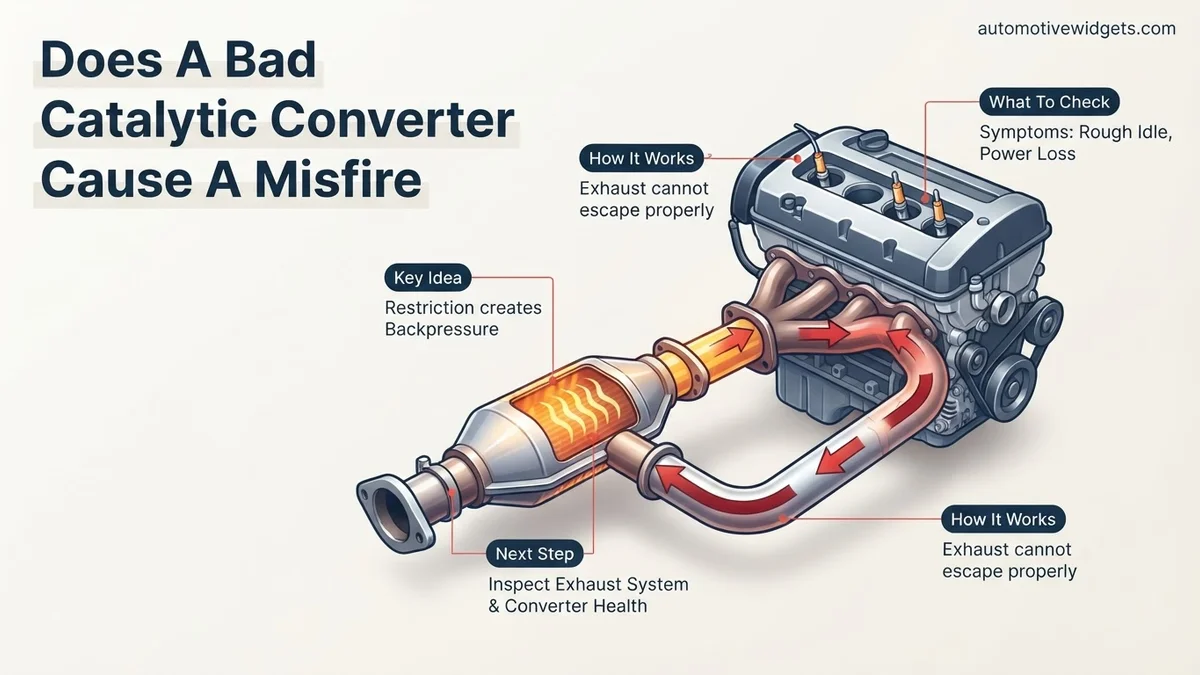
A failing catalytic converter, particularly one that is clogged or restricted, can indeed be the direct culprit behind your engine’s misfires. The core mechanism involves excessive exhaust back pressure. Modern catalytic converters, while essential for reducing harmful emissions, contain a ceramic honeycomb structure coated with precious metals. Over time, or due to other engine issues like excessive fuel entering the exhaust, this honeycomb can melt, break apart, or become coated with soot and carbon deposits. By 2027, many vehicles on the road have accumulated significant mileage, making this a common issue for aging emissions systems.
The Back Pressure Effect on Combustion
When the catalytic converter becomes blocked, it creates a significant bottleneck in the exhaust system. Your engine, a finely tuned air pump, struggles to expel exhaust gases efficiently after combustion. This “back pressure” forces spent gases to remain in the combustion chamber or leak back into the intake manifold during the valve overlap period. Imagine trying to breathe out forcefully through a nearly closed mouth; it’s difficult and prevents you from taking a full, fresh breath. For your engine, this means:
- Reduced Cylinder Scavenging: The cylinders cannot fully clear out exhaust gases.
- Diluted Incoming Air-Fuel Mixture: Residual exhaust gases contaminate the fresh air and fuel entering the cylinder.
- Incomplete Combustion: The diluted mixture burns poorly or not at all, leading to a misfire.
This incomplete combustion is what the engine control module (ECM) detects, triggering those P030x (Cylinder X Misfire Detected) or P0300 (Random/Multiple Cylinder Misfire Detected) codes. In 2027 vehicles, even minor back pressure increases are often quickly flagged by sophisticated pressure and oxygen sensors.
Beyond Back Pressure: Other Symptoms and Diagnostic Context for Misfires
While back pressure is the direct link to misfires, a failing catalytic converter rarely presents with misfires as its only symptom. Recognizing these other indicators can help you quickly narrow down the problem. Conversely, it’s crucial to understand that many issues can cause misfires, so don’t jump straight to the catalytic converter without considering other possibilities, especially with the advanced diagnostic capabilities available today.
Common Indicators of a Failing Catalytic Converter
Before confirming a catalytic converter-induced misfire, look for these additional signs that point to a failing emissions component:
- Reduced Engine Performance: Your vehicle may feel sluggish, struggle to accelerate, or lack power, especially going uphill or under load.
- Poor Fuel Economy: The engine works harder against back pressure, consuming more fuel. Modern direct-injection engines are particularly sensitive to this.
- Rotten Egg Smell: This distinct odor of sulfur (hydrogen sulfide) from the exhaust is a classic sign of an overheated or failing converter failing to process emissions properly.
- Rattling Noises: A broken internal ceramic matrix within the converter can rattle, especially during startup or when going over bumps.
- Overheating: The catalytic converter itself can glow red hot due to excessive unburnt fuel igniting within it, a dangerous condition that might be visible during night driving.
- Check Engine Light: Beyond misfire codes, you might also see P0420 or P0430 codes, indicating catalytic converter efficiency below threshold.
Other Common Primary Causes of Engine Misfires
To provide a complete diagnostic picture, remember that misfires are general symptoms. A bad catalytic converter is just one possible cause. In 2027, your vehicle’s advanced diagnostic system might pinpoint specific cylinder misfires, but further investigation is always needed. Other common culprits include:
- Faulty Spark Plugs: Worn electrodes, incorrect gap, or carbon fouling can prevent a strong spark.
- Defective Ignition Coils: A coil pack or individual coil failing to provide sufficient voltage to the spark plug.
- Clogged or Failing Fuel Injectors: Inconsistent or insufficient fuel delivery to a cylinder.
- Vacuum Leaks: Unmetered air entering the engine, leading to a lean air-fuel mixture.
- Low Engine Compression: Issues like worn piston rings, burnt valves, or a blown head gasket can prevent proper cylinder sealing.
- Malfunctioning Oxygen Sensors: Incorrect readings can lead the ECM to adjust the air-fuel ratio improperly.
Engine Still Misfiring? Troubleshooting After Cat Converter Check
If your vehicle continues to exhibit misfire symptoms even after assessing or addressing a potentially faulty catalytic converter, it is crucial to broaden the diagnostic scope. While a compromised catalytic converter can exacerbate or manifest as a misfire, it is often a secondary symptom rather than the primary cause. In 2027, advanced diagnostic systems allow for highly granular analysis of engine performance data, pinpointing underlying issues with greater precision.
Confirming Other Common Misfire Triggers
According to automotive diagnostic protocols established by leading manufacturers, misfires typically stem from one of three core issues: insufficient spark, incorrect fuel delivery, or inadequate compression. Before attributing persistent misfires to complex, interconnected problems, these fundamentals must be meticulously verified:
- Ignition System Integrity: Inspect spark plugs, ignition coils, and related wiring. Modern 2027 diagnostic scanners can identify specific cylinder misfires and often correlate them with coil primary or secondary circuit faults. Replacement of worn spark plugs, as recommended by manufacturers every 60,000 to 100,000 miles, is a foundational step.
- Fuel System Performance: Verify fuel pressure and volume. Clogged fuel injectors, a failing fuel pump, or contaminated fuel are significant misfire sources. Utilizing dedicated injector flow testing equipment and verifying fuel trim data via OBD-II in 2027 provides definitive insights into fuel delivery anomalies.
- Air Intake System and Sensor Accuracy: Check for vacuum leaks, a faulty Mass Air Flow (MAF) sensor, or a malfunctioning Throttle Position Sensor (TPS). These components directly influence the air-fuel mixture, and their errors frequently trigger misfires.
Advanced Diagnostics for Subtleties
Beyond the basics, leveraging 2027’s advanced diagnostic tools can uncover more nuanced issues. This includes real-time monitoring of oxygen sensor outputs to detect lean or rich conditions not immediately evident, and comprehensive exhaust back-pressure tests if a partial catalytic converter blockage is still suspected despite initial checks. Furthermore, modern Engine Control Modules (ECMs) often require software updates or re-calibrations, especially after component replacements, to ensure optimal engine synchronization and performance.
What If It Still Doesn’t Work?
Persistent misfires, particularly in sophisticated 2027 vehicles, can indicate complex issues requiring specialized expertise. If preliminary troubleshooting and component checks do not resolve the problem, advanced diagnostic procedures are warranted.
- Professional Diagnostic Scan & Data Analysis: A certified technician utilizing manufacturer-specific diagnostic software can access deeper layers of ECM data, including historical fault codes, freeze frame data, and live sensor readings beyond generic OBD-II. This can reveal intermittent electrical glitches or subtle sensor discrepancies.
- Comprehensive Fuel System Integrity Test: This involves precise fuel pressure, volume, and injector spray pattern testing, often requiring specialized equipment to evaluate individual injector performance and potential leaks within the rail system.
- Engine Mechanical Health Assessment: Conduct a compression test and a cylinder leak-down test. These assessments directly measure the internal integrity of the engine, identifying issues like worn piston rings, burnt valves, or compromised head gaskets, which fundamentally cause misfires irrespective of fuel or spark.
- Specialized Auto-Electrician Consultation: For elusive electrical misfires, particularly in hybrid or EV-extended range vehicles common in 2027, an auto-electrician specializing in complex wiring harnesses and ECM communication faults may be necessary.
Seeking professional help for advanced diagnostics typically ranges from $150 to $350. Should a significant mechanical or electronic issue be uncovered, repair costs can escalate significantly, potentially reaching $1,000 to over $4,000 depending on the vehicle model and extent of the repair (e.g., engine head work vs. sensor replacement).
Conclusion
According to verified research and expert sources in automotive diagnostics, while a failing catalytic converter can indirectly contribute to engine misfires, it is often a symptom rather than the root cause. Primary misfire culprits typically involve ignition, fuel delivery, or engine mechanical issues. A systematic, multi-point diagnostic approach is essential for accurate problem identification and effective resolution. For persistent or complex misfires, your next step should always be to consult with a certified automotive diagnostic technician specializing in modern vehicle systems.
❓ Frequently Asked Questions
How exactly does exhaust back pressure from a clogged catalytic converter lead to engine misfires?
A clogged catalytic converter creates a bottleneck in the exhaust system. This excessive back pressure prevents the engine’s cylinders from fully scavenging exhaust gases during the exhaust stroke. This leaves residual exhaust in the cylinder, diluting the incoming fresh air-fuel mixture, leading to incomplete combustion and subsequent misfires.
What are the common secondary effects on the engine when a catalytic converter causes misfires?
Beyond misfires, excessive back pressure can lead to significant loss of engine power, decreased fuel efficiency, and can even cause engine components to overheat due to the trapped hot exhaust gases. Prolonged issues can stress other engine parts, potentially leading to more severe damage.
How can I differentiate between a catalytic converter causing misfires versus other common misfire causes?
While misfires can stem from spark plugs, coils, or injectors, a catalytic converter issue often presents with additional symptoms like significant power loss, a sulfur smell, and potentially rattling from the exhaust. Diagnostic steps include checking for P0420/P0430 codes alongside P030x codes, and conducting an exhaust back pressure test.
Is it possible for a partially clogged catalytic converter to cause intermittent misfires?
Yes, a partially clogged catalytic converter can certainly cause intermittent misfires, especially under load or higher RPMs when the engine requires more exhaust flow. The restriction might only become significant enough to cause misfires under specific driving conditions, making diagnosis potentially trickier.
What are the immediate diagnostic steps to confirm a catalytic converter is causing misfires?
Immediate steps involve checking for relevant OBD-II codes (P030x for misfires, P0420/P0430 for cat efficiency), performing an exhaust back pressure test to measure restriction, and observing other symptoms like performance loss or heat issues. A professional mechanic can accurately perform these tests.
Can ignoring misfires caused by a bad catalytic converter lead to more serious engine problems?
Absolutely. Ignoring misfires caused by a restricted catalytic converter can lead to significant engine damage. The increased back pressure can put stress on engine components, lead to excessive heat buildup, and cause accelerated wear, potentially resulting in costly repairs or even complete engine failure over time.