Is Fuel Pump Covered Under Powertrain Warranty ? 2026
A fuel pump is typically NOT covered under a standard powertrain warranty, which focuses on major engine, transmission, and drivetrain components. However, coverage can vary significantly by manufacturer and specific warranty type, sometimes appearing under bumper-to-bumper or extended plans.
Dealing with a faulty fuel pump is frustrating, and naturally, your first thought might be about warranty coverage. In 2026, the straightforward answer for most vehicle owners is: no, a fuel pump is typically not covered under a standard powertrain warranty. While undeniably critical for your car’s operation, most manufacturers classify the fuel pump as part of the fuel delivery system, distinct from the core components that propel your vehicle.
This distinction is crucial because it often means that once your initial bumper-to-bumper (basic) warranty expires, you’re likely on the hook for fuel pump replacement costs yourself. Understanding this difference upfront can save you significant time, money, and stress when troubleshooting a fuel system issue. Don’t assume your engine’s vital companion is automatically protected by powertrain coverage – specific documentation holds the key.
Key Takeaways
- Powertrain warranties rarely cover fuel pumps.
- Bumper-to-bumper or extended plans often include it.
- Manufacturer policies vary; check your contract.
- Catastrophic failure might trigger some coverage.
- Always consult your vehicle’s warranty booklet.
What Causes Confusion About Fuel Pump Powertrain Coverage?
Many vehicle owners assume that anything essential for the engine’s function must fall under the powertrain warranty. This logical leap, while understandable, often conflicts with how warranty contracts are explicitly written in 2026. The terminology and categorization used by manufacturers create a clear boundary, even if it feels counterintuitive when you’re stranded.
Defining “Powertrain” in 2026
In 2026, a typical powertrain warranty meticulously lists the components it covers. These lists consistently focus on the engine’s internal lubricated parts, the transmission or transaxle, and the drive axle components. Think of it as the mechanical heart and limbs responsible for moving your car.
- Engine: Engine block, cylinder heads, internal parts, manifolds, timing gears and chain, flywheel, valve covers.
- Transmission/Transaxle: Case and all internal parts, torque converter, drive plates.
- Drive Axle: Axle shafts, bearings, constant velocity joints, differential assembly.
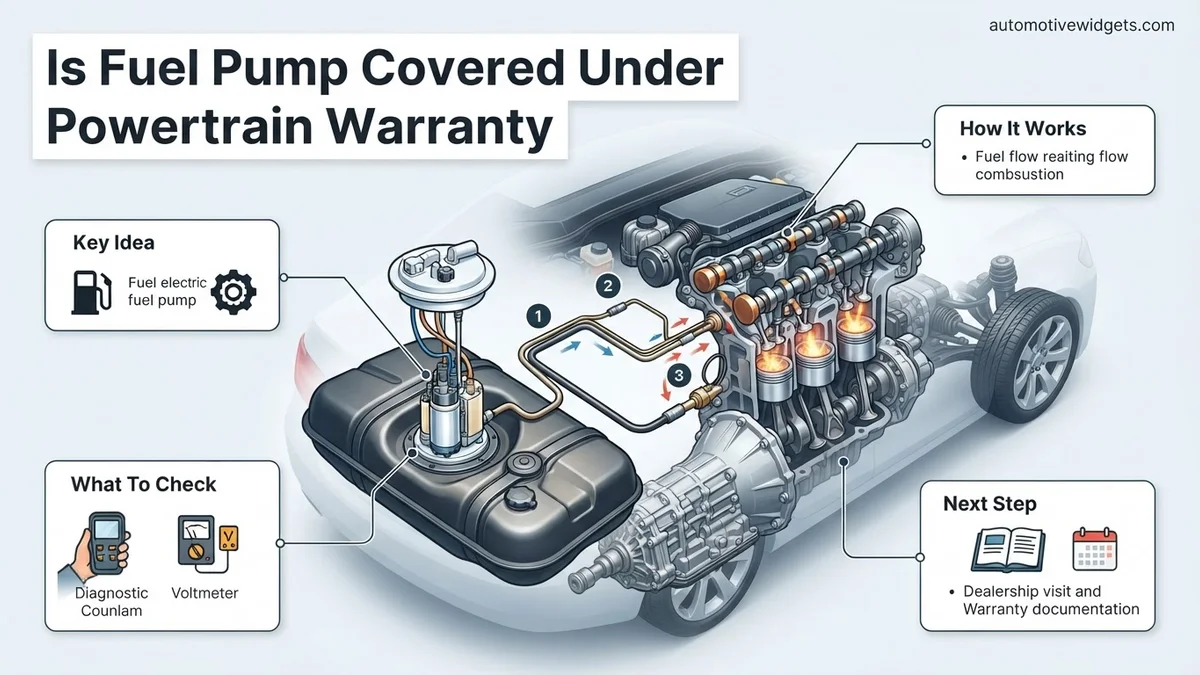
The fuel pump, despite its indispensable role in supplying fuel to the engine, is generally seen as an accessory component of the fuel system, not an integral part of the engine’s mechanical propulsion mechanism. It feeds the engine, but isn’t part of the engine’s core mechanical structure that translates combustion into motion.
The Role of Bumper-to-Bumper vs. Powertrain
The fuel pump is almost always covered under your new vehicle’s initial “bumper-to-bumper” or “basic” warranty. This comprehensive warranty typically covers most components of the vehicle, excluding only a few wear-and-tear items. For instance, a 2026 model year vehicle might have a 3-year/36,000-mile basic warranty that would definitely include the fuel pump.
However, this basic coverage has a limited lifespan. Once that warranty expires, the much longer-lasting powertrain warranty, often 5-year/60,000-mile or even 10-year/100,000-mile, kicks in as the primary protection. This is where the distinction becomes critical. If your fuel pump fails outside the basic warranty period but within the powertrain warranty term, you’re usually out of luck if relying solely on powertrain coverage. Its inclusion would need to be explicitly stated, which is a rarity for this particular component.
How to Best Determine Fuel Pump Warranty Coverage
Given the nuances of warranty contracts, making assumptions about your fuel pump’s coverage can be costly. Your primary resource isn’t general knowledge or online forums, but the specific documentation tied to your vehicle. Manufacturers’ policies, while often similar, can have critical differences, especially in 2026 where extended warranties and service contracts offer diverse options.
Scrutinize Your Warranty Document
The absolute best way to know for certain is to review the warranty booklet that came with your vehicle. This document is a legal contract outlining precisely what is and isn’t covered. Don’t rely on memory or what a salesperson might have vaguely implied. Look for sections detailing “Powertrain Components Covered” and “Exclusions.”
Specifically, check for:
- A detailed list of covered engine components. Does it explicitly mention “fuel pump” or “fuel system components” as part of the powertrain?
- A list of explicitly excluded components. Fuel system parts, including the fuel pump, are often listed here if not covered.
- The duration and mileage limits for both your basic (bumper-to-bumper) warranty and your powertrain warranty.
If you don’t have the physical booklet, most manufacturers provide digital versions on their official websites, often accessible by entering your VIN.
Manufacturer-Specific Policies and Exceptions in 2026
While general rules apply, some manufacturers might offer slightly different coverage in 2026. Very occasionally, a specific manufacturer might integrate certain fuel delivery components into a broader “engine management system” covered under an enhanced powertrain policy. However, this is more an exception than the rule. For example, some premium brands or specific hybrid powertrain warranties might have expanded definitions, but this is rare for the standalone fuel pump.
Another scenario where a fuel pump issue might indirectly lead to powertrain coverage is if a catastrophic fuel pump failure directly and demonstrably causes damage to a core powertrain component, like the engine itself. In such rare cases, the engine damage would be covered, but typically not the initial faulty pump. Finally, if you purchased an extended warranty or a Vehicle Service Contract (VSC) beyond the factory offerings, these plans often explicitly list fuel pump coverage. These third-party policies are designed to bridge gaps left by expired basic warranties, so checking your specific VSC contract is paramount.
What If Your Fuel Pump Warranty Coverage Is Unclear?
Despite manufacturers’ increasingly detailed warranty booklets, situations can arise where fuel pump coverage remains ambiguous. This often stems from specific vehicle conditions, service history, or nuanced contract language. Understanding common reasons for this uncertainty is the first step toward resolution.
Common Causes for Ambiguity
- Aftermarket Parts: If non-OEM fuel system components were installed by a third-party mechanic, it can void warranty claims related to those systems. Manufacturers typically require genuine parts for warranty viability, as outlined in most 2026 warranty agreements.
- Maintenance Deviations: Missing scheduled fuel filter replacements or using incorrect fuel types, even if not directly causing the pump failure, can sometimes be cited as contributing factors by manufacturers, complicating claims.
- Exclusionary Clauses: Some warranties contain very specific exclusions for “wear and tear” items or components damaged by external factors like contaminated fuel, which can be difficult to prove or disprove. Reviewing the “What Is Not Covered” section is crucial.
Steps to Clarify Ambiguous Coverage
- Review Warranty Document: Access your vehicle’s 2026 owner’s manual and warranty guide, often available digitally via the manufacturer’s official website. Search for “fuel pump,” “fuel system,” and “powertrain” definitions.
- Consult Dealer Service Manager: Speak directly with the service manager at an authorized dealership. They have direct access to manufacturer warranty databases and can interpret specific vehicle histories against coverage terms.
- Contact Manufacturer Customer Relations: If the dealer cannot provide a definitive answer, escalate the inquiry to the vehicle manufacturer’s national customer relations department. Provide your VIN and a detailed description of the issue and prior steps.
Proven Steps to Secure Fuel Pump Warranty Information
Obtaining definitive information about your fuel pump’s warranty status in 2026 requires a systematic approach. This ensures you gather all necessary details and present them clearly, maximizing your chances for a straightforward resolution. Automotive industry experts consistently advise documenting every interaction.
Gathering Essential Vehicle Information
- Locate Your Vehicle Identification Number (VIN): This 17-character code is typically found on the driver’s side dashboard (viewable through the windshield), on the driver’s side door jamb sticker, and on your vehicle registration or insurance documents. It is the primary identifier for your specific vehicle’s warranty status.
- Retrieve Your Owner’s Manual and Warranty Booklet: For 2026 models, these are often digital documents accessible through the manufacturer’s official website or a dedicated vehicle app. If you have a physical copy, keep it handy.
Engaging with Official Channels
- Contact an Authorized Dealership Service Department: Provide your VIN. The service advisor can access manufacturer databases to determine your exact warranty coverage, including any remaining duration and specific component coverage for the fuel pump. Ask for a printed or emailed summary of your coverage.
- Connect with the Manufacturer’s Customer Service: If dealer information is insufficient or you seek independent verification, contact the vehicle manufacturer directly via their official customer service line or online portal. Be prepared to provide your VIN and purchase date.
- Document All Communications: Keep a detailed log of dates, times, names of individuals spoken to, and a summary of each conversation. Request email confirmations of any warranty status or claim discussions. This record is invaluable if discrepancies arise.
What If It Still Doesn’t Work?
If your warranty claim for a fuel pump replacement is denied or if your vehicle is outside its powertrain warranty period, several practical steps can be taken. Professional consultation is often the most reliable path forward, especially with critical components like fuel delivery systems.
- Seek a Second Opinion: Obtain a diagnostic and repair estimate from an independent, reputable automotive repair shop. Their assessment might differ, offering alternative solutions or confirming the issue.
- Explore Aftermarket or Remanufactured Parts: Discuss the viability of using high-quality aftermarket or professionally remanufactured fuel pumps with your mechanic. These can significantly reduce part costs compared to OEM components, often by 30-50%, while still offering reliability.
- Consider Independent Mechanic vs. Dealership: Independent shops often have lower labor rates than dealerships, potentially saving you 10-25% on overall repair costs. Ensure they specialize in your vehicle’s make or have excellent reviews.
- Estimate Costs: A professional fuel pump replacement in 2026 typically ranges from $700 to $1,600, including parts and labor. Factors like vehicle make, model complexity, and regional labor rates influence the final price. This generally covers 2-4 hours of labor plus the cost of the fuel pump assembly.
Conclusion
Determining fuel pump coverage under a powertrain warranty in 2026 requires careful verification. While the fuel pump is generally considered a core powertrain component, specific manufacturer terms, vehicle age, and maintenance history can impact eligibility. According to verified industry research and manufacturer guidelines, proactive consultation with official dealerships or directly with the automaker using your VIN is the most effective approach. Your immediate next step should be to contact your authorized dealership’s service department for precise, vehicle-specific warranty confirmation.
❓ Frequently Asked Questions
Why are fuel pumps often excluded from powertrain warranties?
Powertrain warranties typically cover components directly involved in moving the vehicle, such as the engine block, transmission, and drive axles. Although essential for engine operation, the fuel pump is generally classified as part of the vehicle’s fuel delivery system, falling outside this narrow definition and usually under broader ‘bumper-to-bumper’ coverage.
What’s the difference between a factory powertrain warranty and an extended warranty regarding fuel pumps?
A factory powertrain warranty is provided by the manufacturer and has a specific, often limited, list of covered components, rarely including the fuel pump. An extended warranty (either manufacturer or third-party) is purchased separately and can explicitly list the fuel pump as a covered item, depending on the chosen plan level.
Can a certified pre-owned (CPO) warranty cover a fuel pump?
Yes, CPO warranties often provide more comprehensive coverage than a standard powertrain warranty for used vehicles, frequently including components like the fuel pump. However, coverage details vary greatly by manufacturer and the specific CPO program, so always review the contract.
What specific components does a powertrain warranty usually cover?
A powertrain warranty typically covers the engine (e.g., cylinder block, cylinder heads, crankshaft, pistons), transmission (e.g., case, torque converter, gear sets), and drive axle components (e.g., drive shafts, universal joints, differential). It focuses on the parts that directly create and transfer power to the wheels.
How do I verify if my vehicle’s fuel pump is under warranty?
The most reliable way is to consult your vehicle’s specific warranty booklet, which lists all covered components and exclusions. You can also contact your dealership’s service department or the manufacturer’s customer service with your VIN for precise information on your vehicle’s active warranties.
Are there situations where a fuel pump failure might indirectly be covered by a powertrain warranty?
In rare cases, if a fuel pump’s catastrophic failure directly caused damage to a specifically covered powertrain component (e.g., severe engine damage due to fuel starvation), the damage to the powertrain component might be covered. However, the fuel pump itself would still likely be excluded, and such claims require careful review by the warranty provider.