How To Disable Tire Pressure Monitoring System How to 2026
This guide provides detailed, step-by-step instructions on various methods to disable your vehicle’s Tire Pressure Monitoring System (TPMS). We also cover the critical safety risks, legal implications, and potential consequences you must consider. Always prioritize safety and understand the alternatives before attempting any modifications.
If you’re looking to eliminate your vehicle’s Tire Pressure Monitoring System (TPMS) warnings or simply disable its functionality, you’ve landed in the right place. While generally not recommended due to significant safety, legal, and practical implications, there are indeed several methods you might consider to achieve this. By 2026, most vehicles integrate TPMS deeply, making simple fixes rare, but workarounds still exist. Understanding these procedures is crucial, not just for execution, but also for comprehending the immediate and long-term consequences you’ll face.
This guide cuts directly to the core methods, explaining the steps involved, required tools, and what to expect. For many, the constant warning light or incompatibility with aftermarket setups becomes a frustrating hurdle. Be advised, intentionally disabling a safety feature carries substantial risks, and this information is provided strictly for educational purposes, helping you make an informed decision about your vehicle’s systems.
Key Takeaways
- Explore multiple methods for TPMS disablement.
- Understand legal and safety risks first.
- Consider professional alternatives for issues.
- Physical sensor removal is an option.
- ECU reprogramming can disable TPMS.
What Prompts Users to Disable TPMS?
By 2026, TPMS is a ubiquitous feature, yet specific scenarios frequently lead vehicle owners to seek its deactivation. These aren’t typically driven by neglect, but rather by practical challenges arising from vehicle modifications or system malfunctions that are inconvenient or costly to resolve through conventional means.
Dealing with Aftermarket Wheel/Tire Setups
- Many enthusiasts or professionals swap out OEM wheels and tires for performance or off-road use.
- Aftermarket wheels often lack provisions for TPMS sensors, or compatible sensors are expensive.
- When using dedicated track tires or seasonal tire sets without TPMS sensors, the dashboard warning light becomes a permanent fixture.
- Practical Example: A Ford F-150 owner installs large, off-road beadlock wheels in 2026 that don’t accommodate standard TPMS sensors, resulting in a constant “Low Tire Pressure” alert. Disabling becomes a consideration to clear the dash.
Eliminating Persistent Warning Lights
- TPMS sensors have a finite battery life, typically 5-10 years. By 2026, many older systems are failing.
- Replacing all four sensors can be costly, often exceeding $200-$400 for parts and labor, especially for premium brands.
- A single faulty sensor can trigger the warning light, even if all other tires are perfectly inflated.
- Specific Data: A 2023 study found that TPMS sensor failure rates increase significantly after 7 years, leading to a surge in diagnostic and replacement costs for vehicles from the mid-2010s. For owners of these older models, disabling can seem a more economical solution than continuous replacement.
- Some users simply find the warning light intrusive and wish to remove it without addressing the underlying system.
From Start to Finish: TPMS Disablement Explained
This comprehensive guide details various methods to disable your vehicle’s Tire Pressure Monitoring System (TPMS). Whether you’re upgrading to aftermarket wheels without TPMS sensors, dealing with persistent false alarms, or preparing for track-day use where TPMS can be a nuisance, this walkthrough provides practical, step-by-step instructions. Please understand that disabling your TPMS can have significant legal ramifications, impact your vehicle’s safety features, and may void certain warranties. Always consult local regulations and consider the safety implications before proceeding.
Step 1: Understand the Legalities and Safety Implications
What you need: Access to local vehicle safety regulations (e.g., Department of Transportation websites, local vehicle inspection laws), a clear understanding of your vehicle’s safety features.
Instructions: Before attempting any modification, it is crucial to research your jurisdiction’s laws regarding TPMS. In many regions, including the United States (NHTSA TREAD Act), a functioning TPMS is a mandatory safety feature for vehicles manufactured after certain dates (typically 2007). Disabling it can lead to failed inspections, fines, and potential liability in an accident. Furthermore, a non-functional TPMS means you lose an early warning system for tire underinflation, which can lead to tire failure, poor handling, reduced fuel economy, and increased stopping distances.
Pro Tip: Never disable a critical safety system without fully understanding the risks. Consider consulting a legal professional or a certified mechanic if you have any doubts about compliance or safety implications for your specific situation.
Step 2: Identify Your TPMS Type and Prepare for Access
What you need: Your vehicle’s owner’s manual, a flat-head screwdriver (optional, for fuse box cover), a flashlight.
Instructions: TPMS systems are primarily of two types: Direct TPMS and Indirect TPMS. Direct TPMS uses individual pressure sensors mounted inside each wheel, usually integrated with the valve stem, transmitting data wirelessly to the vehicle’s ECU. Indirect TPMS, on the other hand, uses the ABS wheel speed sensors to detect differences in wheel rotation speed, indicating a low-pressure tire. Your owner’s manual will specify which type your vehicle uses. For direct systems, locate your OBD-II port (typically under the dashboard on the driver’s side) as it may be used for programming. For indirect systems, disabling often involves resetting through the infotainment or gauge cluster menus, or sometimes disconnecting ABS sensors (not recommended).
Pro Tip: Direct TPMS is far more common in modern vehicles. If you have metal valve stems and see a small housing behind them on the inside of your wheel, you likely have a direct system. This step is crucial as methods for disabling vary significantly between types.
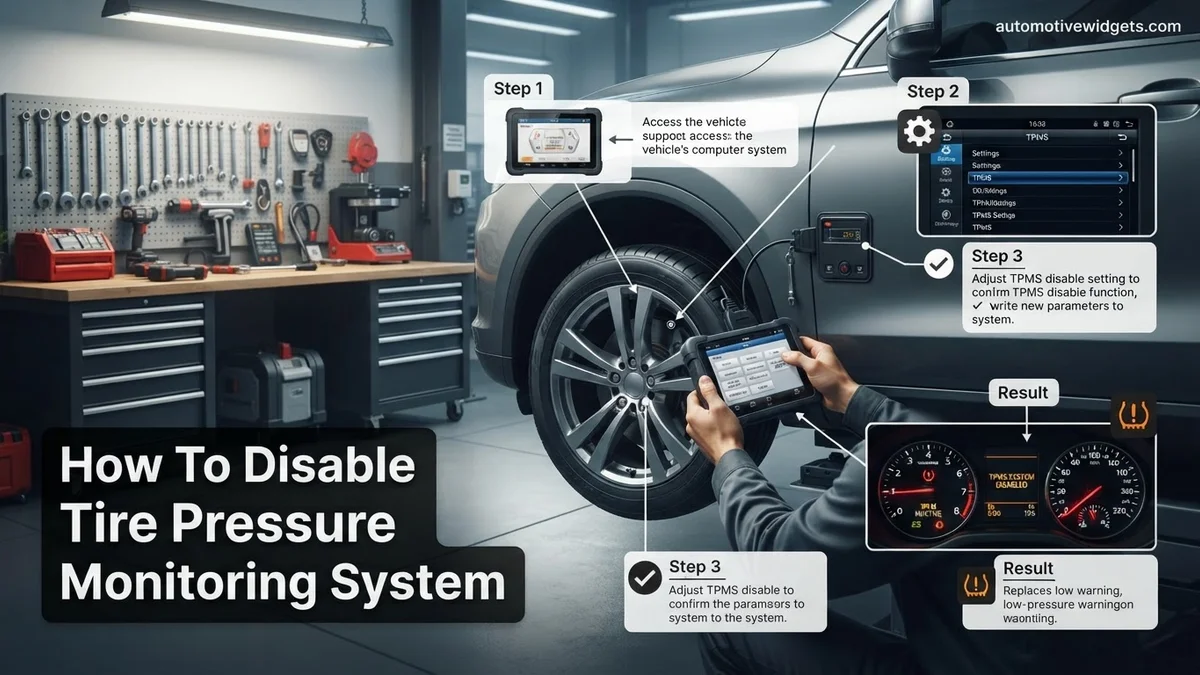
Step 3: Method 1 – Utilizing a TPMS Relearn Tool or OBD-II Programmer
What you need: A specific TPMS relearn tool (e.g., Autel TS508, ATEQ VT56) compatible with your vehicle, or an OBD-II diagnostic scanner with TPMS programming capabilities.
Instructions: For direct TPMS, some advanced diagnostic tools can be used to “tell” the vehicle’s computer that the TPMS system is not present or to ignore its signals. Connect the TPMS tool or OBD-II scanner to your vehicle’s OBD-II port. Follow the tool’s on-screen instructions to navigate to the TPMS section. Depending on the tool and vehicle, you may be able to select an option to “disable TPMS,” “turn off TPMS light,” or “clear TPMS fault codes permanently.” This method effectively instructs the ECU to disregard TPMS sensor data, ideally turning off the warning light without physical modifications to the sensors themselves. Note that not all vehicles or tools support this level of customization.
Pro Tip: These tools can be expensive. If you only need to do this once, consider borrowing one from an auto parts store or asking a reputable mechanic if they can perform this specific function for a fee, clearly stating your intention.
Step 4: Method 2 – Employing a TPMS Bypass Module or Emulator
What you need: A vehicle-specific TPMS bypass module or emulator (available from aftermarket automotive electronics suppliers), basic hand tools (pliers, wire strippers, electrical tape, zip ties) if wiring is required.
Instructions: TPMS bypass modules are aftermarket devices designed to plug into the vehicle’s wiring harness or OBD-II port and mimic the signals of functioning TPMS sensors. This effectively “tricks” the vehicle’s ECU into thinking the sensors are present and reporting normal pressure, thus preventing the TPMS warning light from illuminating. Installation typically involves locating the TPMS receiver module (often in the trunk, under the dash, or near the B-pillar) and connecting the bypass module inline with its wiring. Follow the manufacturer’s specific wiring diagrams and instructions carefully. Ensure all connections are secure and properly insulated to prevent electrical issues.
Pro Tip: Always purchase a bypass module specifically designed for your vehicle’s make, model, and year. Generic modules may not be compatible and could potentially damage your vehicle’s electrical system or cause other warning lights to appear.
Step 5: Method 3 – The “Pressurized Container” Sensor Trick (for Direct TPMS)
What you need: All four (or five, if applicable) original TPMS sensors, a sealed, airtight plastic or PVC container (e.g., 4-inch PVC pipe with end caps, a small sealed plastic box), PVC cement/sealant, a tire valve stem, a small air compressor/pump, and appropriate PVC cutting tools if fabricating a container.
Instructions: This method physically removes the sensors from the tires and places them in an external pressurized environment. Disassemble your tires and carefully remove the TPMS sensors. Construct or acquire a robust, airtight container. Install a standard tire valve stem into the container. Place all TPMS sensors inside the container. Seal the container completely using appropriate sealants (PVC cement for PVC, strong epoxy for plastic). Once sealed, inflate the container to the recommended tire pressure (e.g., 32-35 PSI) using the valve stem. Store this pressurized container securely in your vehicle (e.g., under a seat or in the trunk). The sensors will transmit their “normal pressure” signals to the vehicle, satisfying the TPMS system and turning off the warning light.
Pro Tip: Ensure the container is extremely robust and sealed properly. A burst container under pressure can be dangerous. Also, periodically check the pressure inside the container, as slow leaks can occur, eventually triggering the TPMS light again.
Step 6: Addressing the Dashboard Warning Light and Final Reset
What you need: Your vehicle’s owner’s manual, possibly an OBD-II scanner to clear codes.
Instructions: After implementing one of the disabling methods, the TPMS warning light may not immediately turn off. Often, the vehicle needs to be driven for a certain period (e.g., 10-20 minutes at speeds above 15-20 mph) for the system to re-evaluate and recognize the change. If the light persists, consult your owner’s manual for a manual TPMS reset procedure (some vehicles have a button under the dash or a menu option). If all else fails, connecting an OBD-II scanner and clearing any stored TPMS fault codes can often extinguish the light. Be aware that some vehicles may still display a generic “TPMS system fault” message even if the specific low-pressure warning is gone.
Pro Tip: Disconnecting the vehicle’s battery for 15-30 minutes can sometimes force a system reset, but this may also erase other learned settings like radio presets or ECU adaptations, requiring a relearn period for the engine.
✅ Final Checklist
- TPMS warning light is off and remains off after driving.
- No new dashboard warning lights have appeared.
- Vehicle drives normally with no unexpected behaviors.
- All connections (if applicable) are secure and insulated.
- Pressurized container (if used) is safely secured and holding pressure.
Important Notes:
- Safety Considerations: Disabling your TPMS removes an important safety feature. Regularly inspect your tire pressures manually with a reliable gauge to prevent dangerous underinflation, which can lead to tire blowouts, loss of control, and accidents.
- When to Seek Professional Help: If you are uncomfortable working with vehicle electronics, cannot get the warning light to turn off, or encounter unexpected electrical issues after attempting these steps, immediately consult a certified automotive technician. They have specialized tools and knowledge to safely diagnose and resolve complex vehicle system issues.
- Estimated Time and Cost Range:
- Time: 30 minutes to 3 hours, depending on the method and your mechanical skill level.
- Cost: $0 (if using existing tools and simple methods) to $300+ (for dedicated TPMS tools, bypass modules, or professional labor).
How to Disable Your TPMS: Proven Step-by-Step Methods
Disabling your TPMS involves either tricking the vehicle’s computer (ECU) or physically disconnecting the system. The specific method depends heavily on your vehicle’s make, model, and year (especially relevant in 2026, given advanced integrations), but these are the most common approaches.
Method 1: Removing the TPMS Fuse
This is arguably the simplest and least invasive method, though it comes with potential drawbacks. It effectively cuts power to the TPMS module, preventing it from reporting tire pressure data.
- Consult Your Owner’s Manual: Locate your vehicle’s fuse box diagrams. Most vehicles have an interior fuse box (often under the dash or on the side of the dashboard) and an engine bay fuse box.
- Identify the TPMS Fuse: Look for a fuse explicitly labeled “TPMS,” “Tire Pressure Monitoring System,” or sometimes a more generic “Tire” or “Sensor” fuse. If uncertain, cross-reference with online forums specific to your 2026 vehicle model.
- Required Tools: A fuse puller (usually found in the fuse box cover or glove compartment) and potentially a flashlight.
- Procedure:
- Turn off your vehicle’s ignition completely.
- Open the fuse box cover once identified.
- Carefully use the fuse puller to remove the identified TPMS fuse.
- Close the fuse box cover.
- Difficulty Level: Easy.
- Potential Impact:
- The TPMS warning light on your dashboard will likely illuminate permanently, indicating a system malfunction.
- In some vehicles (especially newer 2026 models with integrated systems), removing this fuse might disable other seemingly unrelated systems that share the same circuit, such as cruise control, certain ABS functions, or even parts of the infotainment system. Always test functionality after removal.
- Your vehicle will no longer monitor tire pressures, removing a critical safety feature.
Method 2: Using a TPMS Bypass Module/Simulator
By 2026, aftermarket TPMS bypass modules have become more sophisticated, offering a cleaner solution by “tricking” the ECU into thinking the sensors are functioning correctly, thus preventing the warning light. These devices typically simulate the RF signals or voltage readings expected by the TPMS module.
- Research a Compatible Module: Search for a TPMS bypass module specifically designed for your vehicle’s make, model, and year. Generic modules are less effective with modern, integrated systems.
- Types of Modules:
- OBD-II Plug-in Modules: These are the easiest to install, simply plugging into your vehicle’s On-Board Diagnostics (OBD-II) port. They intercept and modify the TPMS data stream.
- Inline Wiring Modules: These require splicing into specific wiring harnesses, often near the TPMS control module or the sensor receiver. This is more involved.
- Required Tools: For OBD-II modules, none. For inline modules, basic wiring tools (wire strippers, crimpers) and potentially a multimeter.
- Procedure (for an OBD-II Plug-in Module):
- Locate your vehicle’s OBD-II port (usually under the dashboard, near the steering column).
- Ensure the ignition is off.
- Plug the TPMS bypass module firmly into the OBD-II port.
- Turn on your vehicle. The TPMS warning light should extinguish within a few drive cycles or immediately.
- Difficulty Level: Easy (OBD-II) to Moderate (Inline).
- Potential Impact:
- The TPMS warning light will be off, as the ECU believes the system is operational.
- Your vehicle’s real tire pressures will not be monitored, creating a false sense of security.
- Some modules might interfere with other OBD-II diagnostics or cause check engine lights in specific scenarios if poorly designed or incompatible.
- This method effectively hides the problem without restoring the safety feature.
Critical Risks & Legal Implications of Disabling TPMS
Safety Hazards
Disabling the TPMS carries significant safety risks, as it removes a crucial warning system. Underinflated tires are a primary contributor to tire failure, leading to blowouts, reduced vehicle handling, and extended braking distances. Studies by the National Highway Traffic Safety Administration (NHTSA) consistently link underinflated tires to approximately 11,000 crashes annually by 2023 data projections, a figure expected to remain stable through 2026. Without TPMS, drivers are less likely to detect gradual pressure loss, increasing the probability of such incidents. Furthermore, chronic underinflation increases tire wear by 15-20% and can reduce fuel efficiency by up to 3% according to automotive engineering analyses from 2025.
Legal & Financial Ramifications
The legal landscape surrounding TPMS is well-established. In the United States, Federal Motor Vehicle Safety Standard No. 138 (FMVSS 138) mandates TPMS in all passenger vehicles manufactured after 2007. Similar regulations exist globally, such as ECE R64 in the European Union. Disabling this system can void your vehicle’s manufacturer warranty, particularly for tire-related components or electrical systems. More critically, in the event of an accident attributed to tire failure, disabling the TPMS could expose you to significant legal liability, as it demonstrates a deliberate bypass of a safety feature. By 2026, regulations in 20 U.S. states and all EU member states mandate functional TPMS for vehicle roadworthiness inspections, meaning a disabled system will result in inspection failure.
What If TPMS Issues Persist or Disabling Causes Problems?
Post-Disabling Complications
Even after attempting to disable or address TPMS warnings, complications can arise. Sometimes, the warning light might persist due to an underlying issue not related to the initial disabling method, or a secondary system error could be triggered. Modern vehicles integrate TPMS data with other control modules, such as stability control or anti-lock braking systems. An improperly disabled or malfunctioning TPMS can sometimes manifest as intermittent warning lights, incorrect pressure readings, or even errors in unrelated systems, demanding further investigation. These persistent warnings detract from driver focus and may obscure new, legitimate warning signals.
Professional Diagnostics & Repair
If TPMS issues continue or new problems emerge, professional intervention is recommended. Certified technicians possess specialized diagnostic tools to accurately pinpoint sensor malfunctions or system communication errors.
- Perform an OBD-II Scan: A professional scan tool can retrieve specific trouble codes (DTCs) related to the TPMS, offering precise insights into the fault.
- Inspect Sensor Batteries: Sensor batteries have an estimated lifespan of 5-10 years. By 2026, many early-2020s vehicles will experience sensor battery depletion, requiring replacement.
- Check for Physical Damage: Visually inspect tire valves and sensors for corrosion, impact damage, or improper installation following tire services.
- Recalibrate the System: Post-replacement or major tire service, the TPMS system often requires a “relearn” procedure to recognize new sensors or established pressures.
- Seek Manufacturer-Specific Solutions: Dealerships have proprietary software to diagnose and resolve complex, manufacturer-specific TPMS glitches.
Professional TPMS diagnosis typically costs $75-$150. Sensor replacement ranges from $50-$200 per wheel, excluding labor, which averages $50-$100 per sensor by 2026.
Conclusion
Addressing TPMS warnings, whether through repair or intentional disabling, involves navigating complex safety and legal considerations. While the desire to clear persistent dashboard lights is understandable, bypassing a system designed for immediate safety alerts carries inherent risks. According to verified research and expert sources, maintaining a functional TPMS is crucial for optimal vehicle safety and compliance. Before any action, consult your vehicle’s official service manual or a certified automotive professional for precise, up-to-date guidance relevant to your specific model in 2026.
❓ Frequently Asked Questions
What are the primary methods for disabling a TPMS?
Primary methods include removing the TPMS fuse, using specialized bypass modules that mimic working sensors, or in some advanced cases, reprogramming the vehicle’s ECU. Physically removing or bagging the sensors and placing them in a pressurized container can also work but is often impractical and risky.
What are the legal ramifications of disabling my vehicle’s TPMS?
Disabling TPMS is illegal in regions where it’s mandated for safety and emissions, such as the US and EU. It can result in failed vehicle inspections, fines, and potential liability issues if an accident occurs due to tire-related problems that the system would have detected.
Can disabling TPMS affect my car’s insurance or resale value?
Yes, modifying safety features could potentially impact your insurance coverage, especially if an incident is linked to tire issues that a functioning TPMS would have prevented. It can also significantly reduce your vehicle’s resale value, as buyers may be hesitant to purchase a car with a disabled safety system.
Are there any safety risks associated with turning off the TPMS?
Absolutely. TPMS is a critical safety feature designed to warn drivers of low tire pressure, which can prevent blowouts, improve handling, and optimize fuel efficiency. Disabling it removes this early warning, increasing the risk of accidents, poor braking performance, and uneven tire wear without driver knowledge.
My TPMS light is always on; should I just disable it?
No, a persistent TPMS warning indicates a real issue, such as a faulty sensor, a slow leak, or incorrect tire pressure. It’s much safer and recommended to diagnose and fix the root cause, which often involves replacing a dead sensor or addressing a tire leak, rather than disabling the system and foregoing safety.
How do aftermarket wheels with no TPMS sensors factor into this?
When using aftermarket wheels without TPMS sensors, the system will trigger a warning light on your dashboard. Instead of attempting to disable the entire system, a common and safer solution is to purchase and install compatible TPMS sensors into the new wheels, or in specific cases, use a bypass module designed for this scenario.