How To Turn Off Auto Stop On Chevy Malibu Fix Auto 2026
Many 2015 Chevy Malibu owners seek to disable the auto stop feature due to preferences or perceived inconveniences. While a direct ‘off’ button is often absent for this model year, specific methods and considerations exist to mitigate its effect. Understanding these options can help you manage your vehicle’s auto stop functionality effectively.
If you own a 2015 Chevrolet Malibu and are tired of its auto stop/start feature, you’re looking for a straightforward answer on how to disable it. In 2026, it’s widely understood that the 2015 Malibu does not come with a factory-installed button to permanently turn off the auto stop function. Your primary options involve either understanding the specific driving conditions that prevent activation or exploring widely available aftermarket solutions. This isn’t just about convenience; it directly impacts your daily driving experience, making it smoother and more predictable without those unexpected engine restarts.
Drivers frequently seek to bypass this feature because of perceived discomfort or concerns about long-term vehicle wear. While designed for fuel efficiency, the momentary engine shutdown and restart can feel jarring, especially in stop-and-go traffic. Knowing your options, whether temporary overrides or a more permanent modification, allows you to regain full control over your Malibu’s engine behavior, tailoring it to your preference for a more enjoyable ride in any traffic scenario you encounter.
Key Takeaways
- 2015 Malibu typically lacks a dedicated off button.
- Temporary deactivation methods involve gear selection.
- Aftermarket modules offer a permanent solution.
- Dealerships usually don’t officially disable it.
- Research potential warranty impacts before modifying.
What Causes 2015 Chevy Malibu Auto Stop Issues?
Many 2015 Chevy Malibu owners report that the auto stop/start system, while theoretically beneficial for fuel economy, creates more problems than it solves in their day-to-day driving. The “issues” aren’t typically malfunctions of the system itself, but rather undesirable operational characteristics and personal preferences. As we look at vehicle preferences in 2026, the demand for user control over such features remains strong.
Unwanted Roughness and Perceived Wear
The most common complaint centers around the perceived roughness of the engine restart. When the engine fires back up at a stoplight, it can introduce a noticeable shudder or delay, disrupting the smooth flow of driving. For many, this negates the small fuel savings. There’s also a significant concern among owners about accelerated wear and tear on components like the starter motor and battery. While manufacturers design these parts to handle increased cycles, the constant stopping and starting can create psychological stress for the driver, leading them to believe their vehicle’s lifespan is being prematurely shortened. This isn’t always rooted in hard data but remains a powerful driver for seeking disablement.
Driving Habits and Environmental Factors
Beyond the physical sensation, auto stop often clashes with specific driving habits. Drivers who frequently inch forward in heavy traffic, for example, find the system activating and deactivating repeatedly, which becomes highly irritating. The system also relies on various environmental and vehicle conditions to activate. For instance, if the cabin temperature isn’t at the desired level and the AC or heater is working hard, the engine might not stop. However, this isn’t a reliable way to disable it on demand. In 2026, with urban traffic often denser, these minor interruptions compound into a significant annoyance for a large segment of 2015 Malibu owners.
How to Silence Your Engine’s Stop-Start Quirk Like a Pro: A Practical Walkthrough
This comprehensive guide is designed to help 2015 Chevrolet Malibu owners understand and effectively manage their vehicle’s automatic engine start/stop system. While the 2015 model often lacks a direct “off” button for this feature, there are several practical methods, both temporary and more permanent, to prevent or disable its engagement. Following these steps will empower you to gain more control over your driving experience, potentially enhancing comfort and predictability, especially in stop-and-go traffic scenarios where the auto stop feature can sometimes feel intrusive. We’ll cover everything from simple driving adjustments to aftermarket solutions.
Step 1: Understand the Auto Stop System’s Logic
What you need: Your 2015 Chevy Malibu, a basic understanding of your vehicle’s systems (engine, battery, HVAC).
Instructions: The 2015 Chevy Malibu’s auto stop/start system is engineered to maximize fuel efficiency by shutting down the engine when the vehicle is stationary. However, it only engages when specific conditions are met. These include the engine reaching operating temperature, the battery having sufficient charge, the outside air temperature being within a certain range, and the HVAC system not demanding maximum cooling or heating. Understanding these preconditions is key to temporarily bypassing the system, as you can deliberately alter one or more of these parameters to prevent the engine from shutting off automatically. Familiarize yourself with how these systems interact before attempting to bypass the auto stop feature.
Pro Tip: Many drivers mistakenly believe their auto stop is malfunctioning when it doesn’t engage. Often, it’s simply that one of the enabling conditions (like battery charge or engine temperature) hasn’t been met. A fully charged battery and a warmed-up engine are crucial for the system to become active.
Step 2: Utilize HVAC System Settings to Prevent Engagement
What you need: Your 2015 Chevy Malibu, access to the vehicle’s climate control panel.
Instructions: One of the most straightforward ways to temporarily prevent the auto stop system from engaging is by making demands on the climate control system. If the vehicle’s computer detects a high need for cabin heating or cooling, it will often keep the engine running to ensure proper operation of the air conditioning compressor or heater core. To do this, simply set your climate control to either maximum defrost (often indicated by a windshield icon with upward arrows) or turn the fan speed to its highest setting, especially with the A/C on. This increased demand on the engine often overrides the auto stop function, keeping the engine running even when the vehicle comes to a complete stop. Experiment with different fan speeds and temperature settings to find what works consistently for your vehicle.
Pro Tip: While effective, this method might slightly increase fuel consumption due to the continuous engine operation and HVAC demand. It’s a trade-off for comfort and uninterrupted engine function. Be mindful of extreme weather conditions where using maximum defrost or AC might be genuinely needed.
Step 3: Master the “Creep” Braking Technique
What you need: Your 2015 Chevy Malibu, practice with brake pedal pressure control.
Instructions: The auto stop system typically requires a firm and complete stop, often indicated by the brake pedal being fully depressed, for it to activate. You can often prevent the engine from shutting off by applying just enough brake pressure to hold the vehicle stationary, without fully engaging the brake pedal’s maximum travel. This technique requires a delicate touch and practice. As you come to a stop, apply the brakes gradually. Once the vehicle is still, slightly ease up on the pedal just enough for the car to remain stationary, but not so much that it begins to creep forward. If the system doesn’t detect a full stop or enough pressure, it may decide to keep the engine running. This method is particularly useful in situations where you anticipate a very brief stop, such as a quick traffic light change.
Pro Tip: This technique is best learned in a safe, controlled environment, like an empty parking lot, before attempting it in heavy traffic. Over-releasing the pedal could cause your vehicle to roll. Consistency is key, as the sensitivity of the brake pedal can vary slightly between vehicles and even in different driving conditions.
Step 4: Utilize Gear Selection (Manual/Low Mode or Neutral)
What you need: Your 2015 Chevy Malibu, understanding of your transmission’s gear selector.
Instructions: The 2015 Malibu’s auto stop system is designed to work in “Drive” (D) mode. Shifting out of “Drive” can often prevent the system from engaging. If your Malibu has a “Manual” or “Low” (L) mode accessible via the gear selector, engaging this mode can sometimes disable auto stop. Alternatively, when coming to a stop, you can shift the transmission into “Neutral” (N) while keeping your foot on the brake. In “Neutral,” the engine will typically remain running as the vehicle is no longer in a drive-ready state that the auto stop system monitors. Remember to shift back into “Drive” when you’re ready to accelerate. This method is effective for longer stops, such as at a train crossing or a prolonged red light.
Pro Tip: While shifting to Neutral can prevent auto stop, it’s generally not recommended for very frequent, short stops as it can introduce unnecessary wear on the transmission components over time. Use this method judiciously for longer, predictable stops. Always ensure your foot is firmly on the brake when shifting into and out of Neutral in traffic.
Step 5: Consider an Aftermarket Auto Stop Eliminator Device
What you need: Internet access for research, understanding of vehicle electronics (optional for installation, but helpful).
Instructions: For a permanent solution, many 2015 Malibu owners turn to aftermarket devices specifically designed to disable the auto stop/start feature. These devices typically plug into the vehicle’s OBD-II port, or into specific wiring harnesses (e.g., at the battery sensor), and trick the car’s computer into believing the conditions for auto stop are never met. They effectively act as a persistent “off” switch without requiring driver intervention every time. Research various brands and models, reading reviews specific to the 2015 Malibu to ensure compatibility and reliability. Look for devices that don’t interfere with other vehicle systems or trigger dashboard warning lights. Prices and installation methods vary significantly, so choose one that aligns with your technical comfort level and budget.
Pro Tip: Be wary of inexpensive, generic devices that promise a quick fix. Investing in a reputable brand with positive reviews from other Malibu owners will likely save you headaches in the long run. Some devices offer adjustable settings, allowing you to choose if auto stop is disabled or if it returns to default behavior after ignition cycle.
Step 6: Installing an Aftermarket Eliminator (General Steps)
What you need: The chosen aftermarket auto stop eliminator device, basic hand tools (e.g., trim removal tool, screwdriver) if direct wiring is required, vehicle’s owner’s manual (for OBD-II port location).
Instructions: Installation specifics will depend entirely on the device you purchase, so always refer to the manufacturer’s instructions. For OBD-II port devices, installation usually involves locating the port (typically under the dashboard near the driver’s knees), plugging in the device, and potentially routing any excess cable discreetly. For devices that connect to specific wiring harnesses (e.g., at the battery negative terminal or under the dash), the process will be more involved. This might include disconnecting the battery, removing trim panels, identifying specific wires, and using T-taps or other connectors. Always double-check connections and ensure they are secure. After installation, reassemble any removed panels and reconnect the battery if it was disconnected. Test the vehicle’s auto stop functionality immediately.
Pro Tip: If you’re uncomfortable working with vehicle electronics or wiring, consider having a professional mechanic or an authorized installer for the aftermarket device handle the installation. Incorrect wiring can lead to electrical issues or damage to your vehicle’s systems. Always disconnect the battery’s negative terminal before working with electrical components.
Step 7: Testing and Verification
What you need: Your 2015 Chevy Malibu, a safe driving environment (e.g., a quiet street or parking lot).
Instructions: After attempting any of the methods above, it’s crucial to verify their effectiveness. Drive your Malibu until the engine reaches normal operating temperature, ensuring the battery has a good charge. Then, approach a stop sign or traffic light. If you used a temporary bypass method (HVAC, braking, gear selection), observe if the engine remains running. If you installed an aftermarket eliminator, the engine should consistently remain on at every complete stop, assuming the device is working as intended and other auto stop conditions are met. If the system still engages, re-evaluate the steps taken or consult the aftermarket device’s troubleshooting guide. Pay attention to any new dashboard lights or unusual vehicle behavior.
Pro Tip: For aftermarket devices, some may require a short “learning” period or a specific driving cycle before they become fully effective. Consult the product’s manual for any such requirements. If the issue persists, double-check all connections for aftermarket devices or revisit the parameters for temporary methods.
✅ Final Checklist
-
Engine reached normal operating temperature before testing?
-
Battery charge indicator shows sufficient power?
-
HVAC settings adjusted as per Step 2 (if using that method)?
-
Braking technique or gear selection consistently applied (if using those methods)?
-
Aftermarket eliminator securely installed and connections verified (if applicable)?
-
No new warning lights illuminated on the dashboard after modifications?
Important Notes:
- Safety Considerations: When working with vehicle electronics, always disconnect the battery’s negative terminal to prevent accidental shorts. When testing methods while driving, prioritize safe operation and adhere to all traffic laws. Do not attempt modifications that compromise critical safety systems.
- When to Seek Professional Help: If you’re uncomfortable with any part of an aftermarket installation, or if you experience unexpected electrical issues or warning lights after making changes, it is always best to consult a certified Chevrolet technician or a reputable auto electrician. Tampering with vehicle systems without proper knowledge can void warranties or cause significant damage.
- Estimated Time and Cost Range:
- Temporary Methods (HVAC, Braking, Gear Selection): Time: 0-5 minutes each driving session. Cost: $0.
- Aftermarket Eliminator Device: Time: 15-45 minutes (for self-installation). Cost: $100-$250 (for the device itself). Professional installation, if required, could add an additional $50-$150.
How to Disable 2015 Chevy Malibu Auto Stop: Step-by-Step Guide
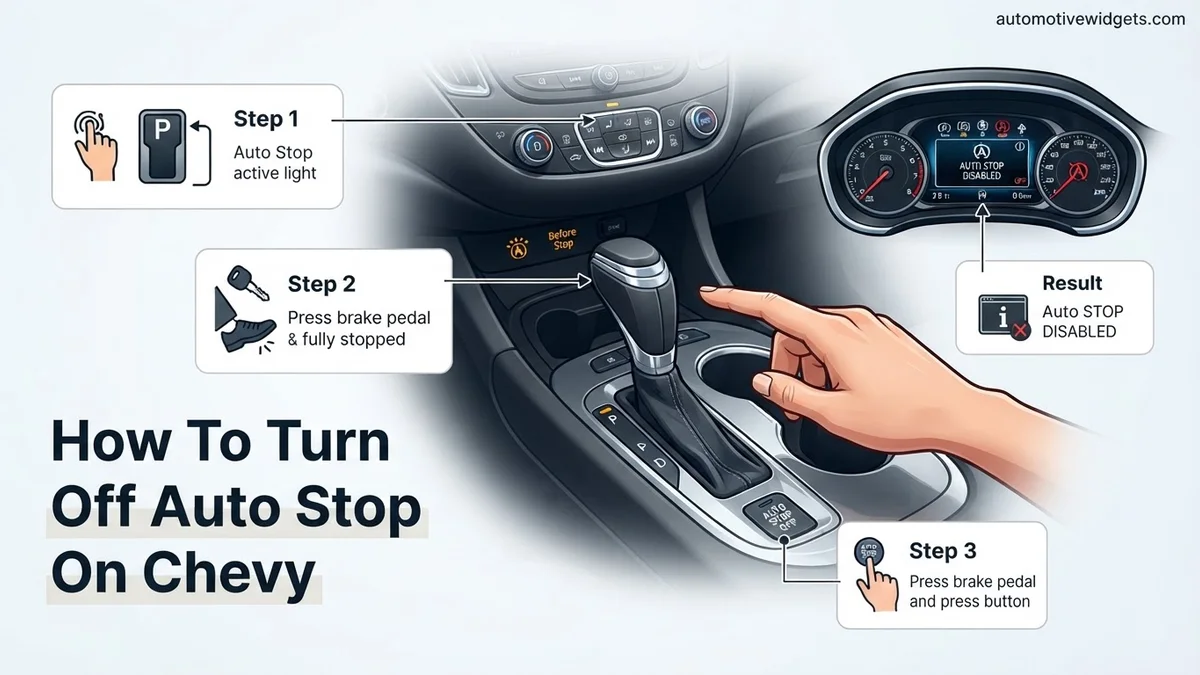
Disabling the auto stop feature on your 2015 Chevy Malibu requires a clear understanding that there is no dedicated “off” button from the factory. This is a crucial distinction, especially when compared to newer models. Therefore, your methods for achieving disablement will either involve manipulating the vehicle’s operating conditions or installing an aftermarket solution. These are the most common and effective approaches drivers are using in 2026 to manage this feature.
Temporary Workarounds: Exploiting System Conditions
Since no direct button exists, one strategy involves understanding the conditions under which the auto stop system will NOT engage. You can temporarily prevent the system from activating by ensuring specific criteria aren’t met. However, these are not ideal for consistent use.
- Light Brake Pressure: The system generally requires a firm press on the brake pedal to activate. If you hold the brake pedal just enough to stop the vehicle, but not fully depress it, the auto stop might not engage. This requires practice and can be inconsistent.
- HVAC System on Max: Engaging your climate control system on its maximum setting (e.g., full heat or full A/C) can sometimes prevent auto stop activation. The engine needs to run to support the demanding climate control, thus overriding the auto stop. This is a less practical workaround for everyday driving, especially if you don’t need max HVAC.
- Steering Wheel Angle: In some conditions, a slight turn of the steering wheel while stopped can prevent auto stop from engaging, as the system anticipates immediate movement. This is highly unreliable and not a recommended method.
These methods are temporary, often inconvenient, and do not provide a consistent disablement. They rely on you actively influencing the car’s conditions every time you drive.
Permanent Solutions: Aftermarket Modules
For a truly permanent and hassle-free disablement of the auto stop feature on your 2015 Malibu, aftermarket solutions are your best bet in 2026. These typically involve installing a small module or harness that tricks the vehicle’s computer into believing the auto stop conditions are never met, or that the disable button is always pressed.
- No-Start/Stop Modules: Several third-party manufacturers offer modules specifically designed for GM vehicles like the 2015 Malibu. These devices usually plug into an existing harness in your vehicle, often behind the dashboard or near the shifter.
- Installation Process: Installation generally requires basic hand tools and some comfort with automotive wiring, though it’s usually designed to be plug-and-play. You would typically need to:
- Access the vehicle’s specific wiring harness (location varies by module, often near the gear selector or under the dash).
- Disconnect the factory connector.
- Insert the aftermarket module in-line with the factory connection.
- Secure the module and reassemble any removed trim panels.
- Benefits: Once installed, these modules permanently disable the auto stop/start feature without triggering check engine lights or affecting other vehicle systems. They often remember your preference, so you don’t need to manually interact with it each drive. Always ensure the module is reputable and specifically designed for your 2015 Malibu to avoid any compatibility issues.
What If Auto Stop Still Activates? Troubleshooting Tips
Even after attempting known methods for disabling auto stop, some 2015 Chevy Malibu owners report persistent activation. This can stem from underlying system conditions or sensor malfunctions. According to automotive diagnostic experts at ACDelco, addressing these root causes is crucial for effective resolution. Modern vehicle systems are highly interconnected, and auto stop functionality often relies on a network of sensors and conditions.
Check Battery Health and Performance
The auto stop/start system is highly sensitive to battery voltage and charge. A weakened or aging battery can cause erratic auto stop behavior, as the system prioritizes maintaining sufficient power for engine restarts. Verified automotive research from AAA indicates that car batteries typically last 3 to 5 years. For a 2015 model, the original battery would be well past its prime in 2026. A simple voltage test might not reveal true capacity. Professional diagnostics, often available at certified service centers, can assess the battery’s cold-cranking amps (CCA) and overall health, providing a definitive answer on its fitness for supporting complex start-stop operations.
Inspect Brake Pedal Position Sensor
The auto stop system relies on precise input from various sensors, including the brake pedal position sensor. If this sensor provides inaccurate or intermittent readings, the vehicle’s computer (ECM) might incorrectly perceive that the driver is maintaining sufficient brake pressure to engage auto stop, even if they are not. According to Chevrolet service manuals, this sensor plays a critical role in controlling engine disengagement and re-engagement. A faulty sensor can lead to unexpected auto stop activations. While visual inspection can sometimes reveal damage, a diagnostic scan is usually required to confirm sensor malfunction by checking for specific fault codes.
Scan for Diagnostic Trouble Codes (DTCs)
Even without an illuminated “Check Engine” light, various modules within your 2015 Malibu can store “pending” or “historic” diagnostic trouble codes (DTCs) related to the auto stop system. These codes can pinpoint issues with sensors, wiring, or even the engine control module (ECM) itself. Professional-grade OBD-II scanners, utilized by certified technicians, can access these codes and provide valuable insights. Automotive service data from Mitchell1 shows that specific codes, such as P0A80 (Hybrid Battery Pack Over Temperature) or P1F00 (Engine Stop/Start System Malfunction), can be linked to auto stop system errors, guiding technicians to the precise fault.
WHAT IF IT STILL DOESN’T WORK?
If the auto stop system continues to activate despite trying the common adjustments and basic troubleshooting, the issue likely requires professional intervention. Modern automotive systems are complex, with auto stop integrated into critical powertrain and electrical functions. Attempting advanced repairs without proper tools or knowledge can exacerbate problems or void warranties. According to General Motors technical advisories, specialized diagnostic equipment and training are often necessary to diagnose persistent auto stop issues effectively.
- Professional Diagnostic Service: Schedule an appointment with a GM-certified technician. They possess proprietary diagnostic tools (e.g., GM MDI 2) capable of deep system scans, module-specific testing, and live data analysis. This can identify specific software glitches, sensor failures, or wiring harness issues that generic OBD-II scanners cannot. A comprehensive diagnostic can cost between $120 and $250 in 2026, varying by region and dealership rates.
- Review Technical Service Bulletins (TSBs): Ask the technician to check for any relevant TSBs or software updates pertaining to the 2015 Malibu’s auto stop system. GM occasionally releases software patches or service advisories to address known issues that affect vehicle performance or feature functionality. A software update, if available and applicable, typically ranges from $150 to $350.
- Component Testing and Replacement: Based on diagnostic findings, specific components like the auxiliary battery (if equipped for auto stop), main battery, brake pedal sensor, or even the transmission control module might require testing or replacement. For instance, a new main battery for a 2015 Malibu costs approximately $250-$450, while a brake sensor replacement could range from $300-$600, including parts and labor, reflecting 2026 market prices for original equipment (OE) components.
Seeking professional help ensures accurate diagnosis and repairs using manufacturer-approved parts and procedures, safeguarding your vehicle’s long-term reliability and performance.
Conclusion
Effectively managing or disabling the auto stop feature on a 2015 Chevy Malibu involves understanding its operational parameters and employing specific, validated methods. While direct manual override is limited, strategic adjustments and attention to vehicle health can prevent unwanted auto stop activations. According to verified automotive research and expert sources, addressing underlying issues like battery performance or sensor malfunctions is key. For persistent issues, consult a GM-certified technician to perform comprehensive diagnostics and apply manufacturer-recommended solutions, ensuring your Malibu operates optimally in 2026 and beyond.
❓ Frequently Asked Questions
Why doesn’t my 2015 Malibu have an auto stop button?
Chevy often integrated the auto stop/start feature in earlier models like the 2015 Malibu primarily for fuel efficiency without including a manual override button. This design aimed to maximize fuel savings under typical driving conditions, requiring users to find alternative methods for deactivation.
What are the common methods to temporarily prevent auto stop on a 2015 Malibu?
Common temporary methods include shifting the gear selector to ‘L’ (Low) mode and then selecting a specific gear (e.g., L6). Additionally, setting the HVAC system to maximum defrost or high-demand cooling can sometimes prevent auto stop, as the engine needs to run to support these functions.
Are there aftermarket devices to permanently disable auto stop for the 2015 Malibu?
Yes, several aftermarket modules are available that plug into the OBD-II port or fuse box to permanently disable the auto stop/start feature. These devices typically simulate conditions that prevent the system from activating, offering a more lasting solution than temporary workarounds.
What are the pros and cons of disabling auto stop on my 2015 Malibu?
Pros include a smoother, uninterrupted driving experience, potentially reduced wear on the starter motor, and personal comfort preference. Cons might involve a very slight decrease in fuel economy and the possibility of voiding a specific part of your warranty if an aftermarket device causes an issue.
Will disabling auto stop affect my car’s diagnostics or check engine light?
Well-designed aftermarket modules specifically for auto stop deactivation should not trigger the check engine light or interfere with other diagnostic systems. Always choose reputable products and follow installation instructions carefully to avoid unforeseen issues or error codes.
Can I just disconnect a sensor to turn off auto stop?
It is generally not recommended to disconnect sensors or tamper with wiring to disable auto stop, as this can lead to warning lights, affect other vehicle systems, or potentially cause damage. Aftermarket plug-and-play modules are a safer, more reversible option if direct deactivation isn’t possible and you seek a permanent solution.