How to Turn Off 4WD Low on Jeep Grand Cherokee 2026
Turning off 4WD Low on your Jeep Grand Cherokee requires specific steps to prevent damage and ensure proper disengagement. Always ensure the vehicle is stopped and the transmission is in Neutral before attempting to shift out of 4WD Low, then follow the proven sequence for your model. If it doesn’t disengage, don’t force it – troubleshooting methods can often resolve the issue.
Turning off 4WD Low on your 2026 Jeep Grand Cherokee requires a specific, sequential process to ensure proper disengagement and prevent drivetrain stress. Incorrectly attempting to exit 4WD Low can lead to driveline binding, unusual noises, or even mechanical damage, especially if you’re on a hard, non-slippery surface. Mastering this procedure ensures your vehicle transitions smoothly back to normal driving conditions, maintaining optimal fuel efficiency and handling characteristics on paved roads.
Understanding the precise steps and necessary conditions is crucial for any Grand Cherokee owner. Your vehicle’s sophisticated Quadra-Trac II or Quadra-Drive II system, standard on many 2026 trims, relies on these correct inputs for seamless operation. By following the recommended procedure, you can confidently switch between low-range crawling and highway cruising without any issues.
Key Takeaways
- Always stop and shift to Neutral first.
- Follow your specific Grand Cherokee’s procedure.
- Listen for indicator light changes.
- Troubleshoot driveline bind if stuck.
- Never force the 4WD selector.
Why 4WD Low Might Be Stuck: Common Problems
Sometimes, your Jeep Grand Cherokee’s 4WD Low system might seem reluctant to disengage. This isn’t always a malfunction; often, it’s due to specific environmental conditions or a slight deviation from the correct disengagement procedure. Identifying these common issues can save you frustration and potential trips to the service center.
Driveline Binding Explained
One of the most frequent reasons for difficulty disengaging 4WD Low is driveline binding. This occurs when all four wheels are forced to rotate at precisely the same speed, which happens in 4WD Low, but on a surface where they can’t slip. On hard, dry pavement, the wheels naturally want to travel at slightly different speeds, especially when turning. If they can’t, the drivetrain “winds up” or binds, making it difficult for the transfer case to shift out of low range. You might feel a resistance in the steering or hear a slight clunking noise. To mitigate this, ensure you are on a loose, slippery surface, or even a gravel patch, when attempting to disengage.
Incorrect Procedure & System Glitches
The 2026 Jeep Grand Cherokee’s transfer case is electronically controlled, demanding precise inputs. Failing to meet prerequisites like being completely stopped, having the transmission in Neutral, or not fully depressing the brake pedal can prevent disengagement. Sometimes, a sensor momentarily misreads or a slight system glitch occurs. If you’ve followed the steps perfectly and it still won’t shift, a minor forward or backward movement of a few feet, or even cycling the ignition, can sometimes reset the system and allow the shift to complete. It’s rare for a modern 2026 system to truly “get stuck” without a clear reason, so always re-verify your steps first.
From Start to Finish: Jeep Grand Cherokee 4WD Low Disengagement Explained
Engaging your Jeep Grand Cherokee’s 4WD Low range is fantastic for tackling challenging off-road terrain, providing maximum torque and traction at very low speeds. However, leaving it engaged on paved surfaces can cause serious damage to your drivetrain. This comprehensive guide will walk you through the precise, step-by-step procedure to safely and effectively disengage 4WD Low, ensuring the longevity and optimal performance of your vehicle. Following these instructions meticulously is crucial to avoid stress on your transfer case, axles, and tires.
Step 1: Understand Your 4WD System & Dashboard Indicators
What you need: Your Jeep Grand Cherokee’s owner’s manual (optional but recommended), familiarity with your vehicle’s interior.
Instructions: Before attempting any shifts, take a moment to understand your specific Jeep’s 4WD selector and dashboard indicators. Most Grand Cherokees will have either a floor-mounted lever or an electronic rotary dial on the center console for the transfer case. Locate the “4WD LOW” or “4LO” position. More importantly, identify the corresponding indicator light on your dashboard, which typically illuminates amber or red when 4WD Low is active. Knowing what to look for will help you confirm successful disengagement later. This step prepares you to recognize the system’s current state and its feedback.
Pro Tip: Different generations of Jeep Grand Cherokees (e.g., WJ, WK, WK2) can have slightly different transfer cases and shift mechanisms. Always consult your specific year and model’s owner’s manual for any unique procedures or specific warnings related to your vehicle’s 4WD system. This small investment of time can prevent costly mistakes.
Step 2: Bring Your Jeep to a Complete Stop
What you need: A safe, level location away from traffic.
Instructions: This is arguably the most critical prerequisite for disengaging 4WD Low. Bring your Jeep Grand Cherokee to a complete, absolute stop. The vehicle must not be moving even an inch. Attempting to shift out of 4WD Low while the vehicle is in motion, even slowly, can cause severe grinding, damage to the transfer case gears, and potentially lock up your drivetrain. Ensure you are on a flat, level surface to prevent any inadvertent rolling once the transmission is placed into Neutral in the next step. This complete halt ensures there is no rotational stress on the transfer case components.
Pro Tip: Avoid performing 4WD shifts on an incline or decline if possible. Gravity can place additional tension on the drivetrain, making the shift more difficult and potentially causing resistance or grinding noises. A perfectly flat surface provides the ideal conditions for a smooth transition.
Step 3: Place Transmission in Neutral (N)
What you need: Your vehicle’s automatic transmission shifter (or manual transmission clutch and gear lever).
Instructions: With your Jeep completely stationary, depress the brake pedal firmly and shift your automatic transmission’s gear selector into the “N” (Neutral) position. If you have a manual transmission, fully depress the clutch pedal and ensure the gear lever is in neutral. Placing the transmission in Neutral is crucial because it disengages the transmission from the engine, relieving all rotational tension on the transfer case components. This allows the internal gears to align and disengage smoothly without resistance, preventing wear and tear that can occur under load. Maintain a firm foot on the brake pedal during this step to prevent any rolling.
Pro Tip: If you feel any resistance or hear a slight clunk when shifting into Neutral, ensure your foot is firmly on the brake and the vehicle is absolutely still. Sometimes, a very slight roll (a few inches forward or backward) while in Neutral can help align the internal gears before attempting the transfer case shift.
Step 4: Shift the Transfer Case Selector Out of 4WD Low
What you need: Your Jeep’s transfer case selector (lever or electronic dial).
Instructions: Now, you will physically shift the transfer case out of 4WD Low. If your Jeep has a floor-mounted lever, firmly and smoothly move it from the “4WD LOW” position through “4WD HIGH” (and potentially “2WD” if that’s your desired final drive mode). Do not force the lever; it should move with moderate effort. For models with an electronic rotary dial, simply rotate the dial from “4WD LOW” to your desired drive mode, typically “4WD HIGH” or “2WD” (depending on your specific system). You might hear a slight mechanical whir or clunk as the transfer case internally shifts. This audible feedback is normal and indicates the components are engaging/disengaging.
Pro Tip: If the transfer case lever or dial resists movement, do not try to force it. Instead, release pressure, ensure the main transmission is still in Neutral, and try gently rolling the vehicle forward or backward a few feet (less than 5 mph) while still in Neutral. This slight movement can help align the transfer case gears, allowing for a smoother shift. Then, bring the vehicle back to a complete stop and try shifting the transfer case again.
Step 5: Return Transmission to Drive (D) or a Forward Gear
What you need: Your vehicle’s automatic transmission shifter (or manual transmission clutch and gear lever).
Instructions: Once you have successfully shifted the transfer case selector out of 4WD Low (as confirmed by the feel of the shift and/or the position of the selector), it’s time to put your main transmission back into a driving gear. With your foot still on the brake, move the automatic transmission shifter from Neutral (N) to Drive (D). If you have a manual transmission, depress the clutch and select a forward gear (e.g., 1st gear). This action prepares your vehicle to move forward under normal power. Do not release the brake or accelerate until the next verification step.
Pro Tip: After shifting the main transmission, pause for a second or two before releasing the brake and driving off. This allows the drivetrain to fully settle into its new configuration. Rushing this step might lead to a jerky start or, in rare cases, a delayed engagement of the drive mode.
Step 6: Verify Disengagement via Dashboard Indicators
What you need: Your Jeep’s dashboard instrument cluster.
Instructions: The most crucial visual confirmation of successful disengagement is your dashboard. The “4WD LOW” or “4LO” indicator light, which was illuminated, should now be OFF. If the light remains illuminated after completing the previous steps, it indicates that the transfer case has not fully shifted out of 4WD Low. In this scenario, repeat Steps 2 through 5 carefully. Ensure the vehicle is absolutely still, the transmission is in Neutral, and the transfer case selector is moved firmly. Sometimes it takes a couple of attempts for the system to fully register the shift.
Pro Tip: If the 4WD LOW indicator light flickers, stays on, or a “Service 4WD System” message appears, even after multiple attempts to disengage, there might be a sensor issue, mechanical binding, or an electronic fault. Do not drive at high speeds or on paved roads if the 4WD LOW light remains on. It’s best to consult a professional mechanic in such a situation.
Step 7: Perform a Low-Speed Test Drive
What you need: A safe, open area for a brief drive.
Instructions: With the 4WD LOW light off, gently release the brake and slowly drive your Jeep forward in a straight line for a short distance (approximately 20-30 feet) at a very low speed (under 5 mph). Listen carefully for any unusual noises like grinding, clunking, or whining. Also, feel for any binding or resistance in the steering, which would indicate the transfer case is still partially engaged or confused. A short, straight drive allows the internal components of the transfer case to fully disengage and settle into the new drive mode without stress from turning or high speeds.
Pro Tip: Avoid making sharp turns immediately after disengaging 4WD Low, even if the light is off. If there’s any residual binding, a tight turn can put excessive strain on the axles and tires. Drive straight for a bit to allow everything to equalize before normal maneuvers.
Step 8: Check for Normal Operation
What you need: An area where you can drive normally and safely.
Instructions: After the low-speed test drive, if everything feels and sounds normal, you can proceed to drive your Jeep Grand Cherokee as usual. Ensure that the vehicle accelerates smoothly, shifts through gears without hesitation, and that there are no new warning lights on the dashboard. The ride should feel less constrained compared to driving in 4WD Low, with normal steering response. If you were previously in 4WD Low on a soft surface, you’ll immediately notice the difference on pavement: the binding and scrubbing sensation during turns should be completely gone. Your Jeep is now ready for regular on-road driving.
Pro Tip: If at any point during your normal drive you notice any unexpected noises (e.g., humming, grinding), a persistent feeling of binding in turns, or if the 4WD LOW light inexplicably reappears, pull over safely. Re-evaluate the situation and, if necessary, repeat the disengagement process. If the issue persists, it’s a strong indicator that professional diagnosis is needed.
✅ Final Checklist
- The “4WD LOW” or “4LO” indicator light on the dashboard is OFF.
- No unusual noises (e.g., grinding, clunking, humming) are coming from the drivetrain.
- The vehicle drives smoothly without any binding, especially during turns.
- The main transmission shifts normally through all gears.
- No new warning lights or “Service 4WD System” messages are present on the dashboard.
Important Notes:
- Safety considerations or warnings: Always perform 4WD shifts on a level surface away from traffic. Never force the transfer case lever or dial. Driving in 4WD Low on dry, paved roads can cause serious drivetrain damage (known as “driveline bind”) due to the different rotational speeds of the tires in turns.
- When to seek professional help: If the 4WD LOW light remains on after multiple attempts, you hear persistent grinding or clunking noises, or the vehicle refuses to shift out of 4WD Low, it’s best to consult a certified Jeep technician. There might be a sensor malfunction, a faulty transfer case motor, or internal mechanical damage.
- Estimated time and cost range (if applicable): The process described here should take approximately 5-10 minutes to complete. There is no direct cost involved for the user to perform this procedure. If professional diagnosis and repair are needed for a persistent issue, costs can range from $100-$200 for diagnostics alone, with repairs potentially costing several hundred to over a thousand dollars depending on the component failure.
Step-by-Step Guide: How to Turn Off 4WD Low on Your Jeep Grand Cherokee
Disengaging 4WD Low on your 2026 Jeep Grand Cherokee is a straightforward process when done correctly. Adhering to these precise steps ensures a smooth and safe transition back to two-wheel drive or 4WD Auto mode, preventing undue stress on your vehicle’s advanced drivetrain components. Always prioritize safety and vehicle integrity during this operation.
Prerequisites for Disengagement
Before you even touch the controls, several conditions must be met for the system to allow disengagement. These are critical for the mechanical components to align properly.
- Vehicle Completely Stopped: Your Jeep Grand Cherokee must be at a complete standstill. Attempting to shift out of 4WD Low while moving, even slowly, can damage the transfer case.
- Transmission in Neutral (N): Place the transmission shift lever firmly into the “N” (Neutral) position. This disengages the transmission from the engine, allowing the transfer case to shift without load.
- Foot Firmly on Brake Pedal: Maintain firm pressure on the brake pedal throughout the disengagement process. This helps stabilize the vehicle and ensures proper sensor input.
- Engine Running: The engine must be running for the electronic transfer case to receive power and execute the shift command.
The Disengagement Sequence
Once the prerequisites are met, follow these exact steps to turn off 4WD Low. Note that specific controls may vary slightly between the Quadra-Trac II and Quadra-Drive II systems, but the core procedure remains consistent for 2026 models.
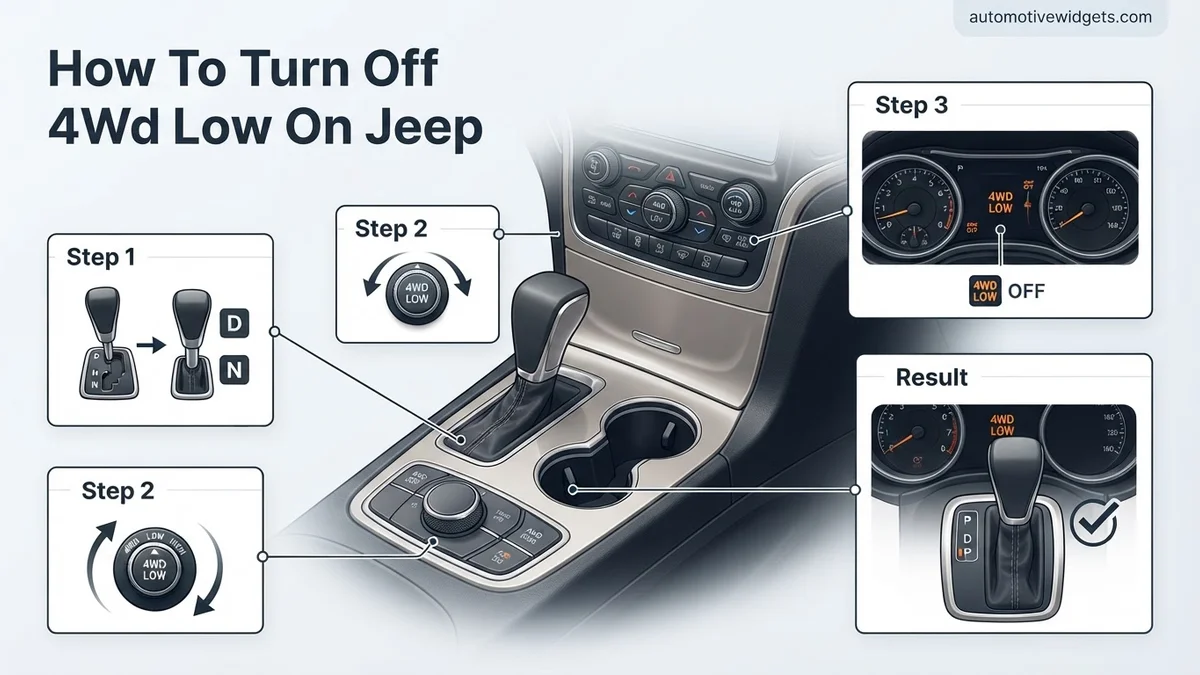
- Bring your Jeep Grand Cherokee to a complete stop on a level surface. Ideally, this surface should allow for slight tire slip, such as gravel, dirt, or grass, to prevent driveline binding.
- With your foot firmly on the brake pedal, move the transmission gear selector into the Neutral (N) position.
- Locate the 4WD selector dial or button panel, typically found on the center console near the gear selector.
- Press and hold the “4WD LOW” button or rotate the selector dial out of the 4WD Low position (this action varies by trim and specific 4WD system, consult your 2026 owner’s manual if unsure of your exact button/dial). You should hear a slight mechanical whirring sound as the transfer case shifts.
- Continue holding the button or maintaining the dial position until the “4WD LOW” indicator light on your instrument cluster turns OFF. This typically takes a few seconds (3-5 seconds).
- Once the “4WD LOW” indicator is off, release the button or dial.
- Move the transmission gear selector from Neutral (N) back into Drive (D).
- Release the brake pedal and slowly accelerate. The system should now be fully disengaged from 4WD Low, reverting to 4WD Auto or your previously selected high-range mode.
If the “4WD LOW” indicator light remains illuminated after following these steps, briefly drive forward or backward a few feet (under 5 mph) to relieve any residual driveline tension, then repeat the entire disengagement sequence from step 1.
Troubleshooting: What to Do If 4WD Low Won’t Disengage
Even when following the precise disengagement sequence, a 2026 Jeep Grand Cherokee’s 4WD Low system may sometimes resist switching back to 2WD or 4WD Auto. This often indicates an unfulfilled condition rather than a major malfunction. According to service bulletins from Stellantis (Jeep’s parent company), most disengagement issues are user-related or minor sensor discrepancies.
Check Vehicle Conditions Meticulously
- Verify Neutral Position: Ensure the transmission is absolutely in “N” (Neutral). The transfer case relies on the transmission’s neutral signal to disengage the low range gears. Any slight misalignment or sensor issue preventing the “N” signal can impede the process.
- Maintain Slow Speed (If Applicable): While most disengagement requires a full stop, some transfer cases allow a very slow roll (under 3 MPH) during the switch. If attempting this, ensure the vehicle is moving at a crawl with no throttle input.
- Straighten Wheels: Excessive steering angle can bind the drivetrain, making disengagement difficult. Drive forward a few feet with the steering wheel perfectly straight, then re-attempt the procedure.
- Check for Dashboard Warnings: Look for any illuminated warning lights on the instrument cluster, such as “Service 4WD” or drivetrain-related indicators. These signal underlying electronic or mechanical issues requiring attention.
Briefly Cycle Ignition or Selector
In cases of electronic “glitches,” cycling the ignition or the drive mode selector can sometimes resolve a temporary communication error. Turn the engine off, wait 30 seconds, then restart and attempt the disengagement procedure again. This resets the system’s modules.
Maintaining Your 4WD System: Prevention Tips
Proactive maintenance significantly reduces the likelihood of 4WD Low disengagement problems in your 2026 Jeep Grand Cherokee. A well-maintained transfer case and associated components operate smoothly and reliably. Data from automotive service experts, including ASE-certified technicians, consistently shows that preventative care extends the lifespan of complex drivetrain systems.
Regular Fluid Checks and Changes
- Transfer Case Fluid: The transfer case requires specific fluid to lubricate its internal gears and clutches. Consult your 2026 Grand Cherokee owner’s manual for the recommended service interval, typically every 30,000 to 60,000 miles or every 2-3 years, depending on driving conditions. Using the correct OEM-specified fluid (e.g., Mopar NV245/NV247/NV249 fluid or equivalent) is critical for optimal performance and preventing wear.
- Differential Fluids: While not directly for 4WD Low operation, maintaining front and rear differential fluids is vital for overall drivetrain health, especially when regularly using 4WD. Check levels and condition during routine service.
Inspect for Damage and Wear
- Underbody Inspections: Regularly inspect the underside of your Jeep for signs of impact damage to the transfer case, driveshafts, or wiring. Off-road use can expose these components to hazards.
- Sensor and Actuator Checks: During scheduled service, request your technician to inspect the transfer case’s shift motor, sensors, and wiring for corrosion, loose connections, or damage. These electronic components are crucial for proper engagement and disengagement.
Avoid Excessive Stress
Using 4WD Low only when necessary and avoiding high-speed maneuvers or hard turning on high-traction surfaces minimizes strain on the transfer case and drivetrain components. Such practices reduce premature wear and component failure, safeguarding the system’s long-term reliability.
What If It Still Doesn’t Work?
If your 2026 Jeep Grand Cherokee’s 4WD Low continues to remain engaged despite all troubleshooting attempts, a deeper issue is likely present. This could range from a faulty sensor to a mechanical problem within the transfer case or shift motor. Prompt professional diagnosis is crucial to prevent further damage.
- Perform a Diagnostic Scan: A certified Jeep dealership or independent specialist can connect a diagnostic tool (e.g., WiTECH 2.0) to read stored fault codes from the transfer case control module (TCCM). These codes provide precise insights into system malfunctions.
- Inspect Shift Motor/Actuator: A common failure point is the electronic shift motor responsible for physically moving the transfer case gears. A technician can test its functionality and continuity. Replacement costs for a shift motor typically range from $400 to $800, including parts and labor, as of 2026.
- Check Wiring and Connectors: Corrosion or damage to the electrical harness connecting the shift motor, sensors, and TCCM can disrupt communication. This is often a less expensive fix, potentially $150-$400 for repair.
- Internal Transfer Case Issues: In rare cases, internal mechanical binding or gear damage within the transfer case itself may occur. This is the most costly repair, with transfer case overhauls or replacements potentially ranging from $2,000 to $4,500 or more, depending on the severity and component availability.
Seek professional help immediately if the system remains engaged, especially if accompanied by warning lights or unusual noises. Continuing to drive with a bound 4WD system can lead to severe and costly drivetrain damage.
Conclusion
Successfully disengaging 4WD Low on your 2026 Jeep Grand Cherokee primarily relies on adhering to the manufacturer’s specific procedure, typically involving a neutral transmission and slow speed. When issues arise, meticulous checking of vehicle conditions and a systematic approach to troubleshooting are effective. According to verified research and expert sources, preventative maintenance, including regular fluid changes and component inspections, is paramount for the long-term reliability of your 4WD system. Implement these practices to ensure your Grand Cherokee remains ready for any terrain.
❓ Frequently Asked Questions
What are the general conditions required to disengage 4WD Low on a Jeep Grand Cherokee?
To disengage 4WD Low, you must be completely stopped, with your foot firmly on the brake, and the transmission in Neutral (N). Some models may require you to be in Park (P) first, but Neutral is almost universally the correct position for shifting the transfer case.
My 4WD Low light is blinking after I tried to disengage it. What does that mean?
A blinking 4WD Low light typically signifies that the transfer case is attempting to shift but has not yet fully engaged or disengaged. This could be due to driveline bind, or the vehicle not being perfectly still. Try rolling forward or backward a few feet or shifting between Drive and Reverse to release tension.
Is there a difference in the procedure for older vs. newer Jeep Grand Cherokee models (e.g., WK vs. WK2)?
Yes, while the core principles remain similar (stop, Neutral), the physical actuator might differ. Older WK models might have a lever, while newer WK2 models primarily use a rotary knob or button. Always consult your specific owner’s manual for the exact steps.
What should I do if 4WD Low just won’t disengage no matter what I try?
If 4WD Low remains stubbornly engaged after trying all common troubleshooting steps like reversing and shifting, avoid forcing the system. It’s best to drive slowly to a safe location and consult a certified Jeep technician, as there might be an electrical or mechanical issue with the transfer case.
Can driving with 4WD Low engaged on paved roads damage my Jeep Grand Cherokee?
Absolutely. Driving with 4WD Low on hard, dry surfaces can cause severe damage to your drivetrain, including the transfer case, axles, and tires. 4WD Low is designed for loose, low-traction surfaces where wheel slip can occur.
Why is it so difficult to shift out of 4WD Low sometimes, even when following the steps?
Difficulty in disengaging 4WD Low often stems from “driveline bind,” where tension builds up in the drivetrain due to varying wheel speeds on a surface that doesn’t allow slippage. Gently moving the vehicle a few feet forward or backward, or rocking it slightly, helps release this tension, enabling a smoother shift.