How Much Does It Cost To Fix Brakes And Rotors Real 2026
The cost to fix brakes and rotors varies significantly, typically ranging from $300 to $800 per axle, but can exceed $1,000 for luxury vehicles or complex issues. This price includes both parts and labor, with factors like vehicle type, parts quality, and shop choice heavily influencing the final expense.
In 2026, you can expect to pay anywhere from $350 to $1,500+ to fix your vehicle’s brakes and rotors. This wide range depends heavily on what specifically needs replacement, your car’s make and model, and where you choose to have the work done. A basic front axle brake pad and rotor replacement typically falls between $350-$700, while tackling both front and rear can easily push into the $900-$1,400 range.
Understanding these costs proactively is crucial for your budget and, more importantly, your safety. Your braking system is critical; ignoring warning signs can lead to dangerous situations and much more expensive repairs down the line. We’ll break down the real costs and the key factors influencing them in today’s market.
Key Takeaways
- Expect $300-$800 per axle for brake/rotor repair.
- Vehicle type and part quality impact costs most.
- Front brakes often cost more due to greater wear.
- Dealerships typically charge more than independents.
- Always get 2-3 itemized quotes for best value.
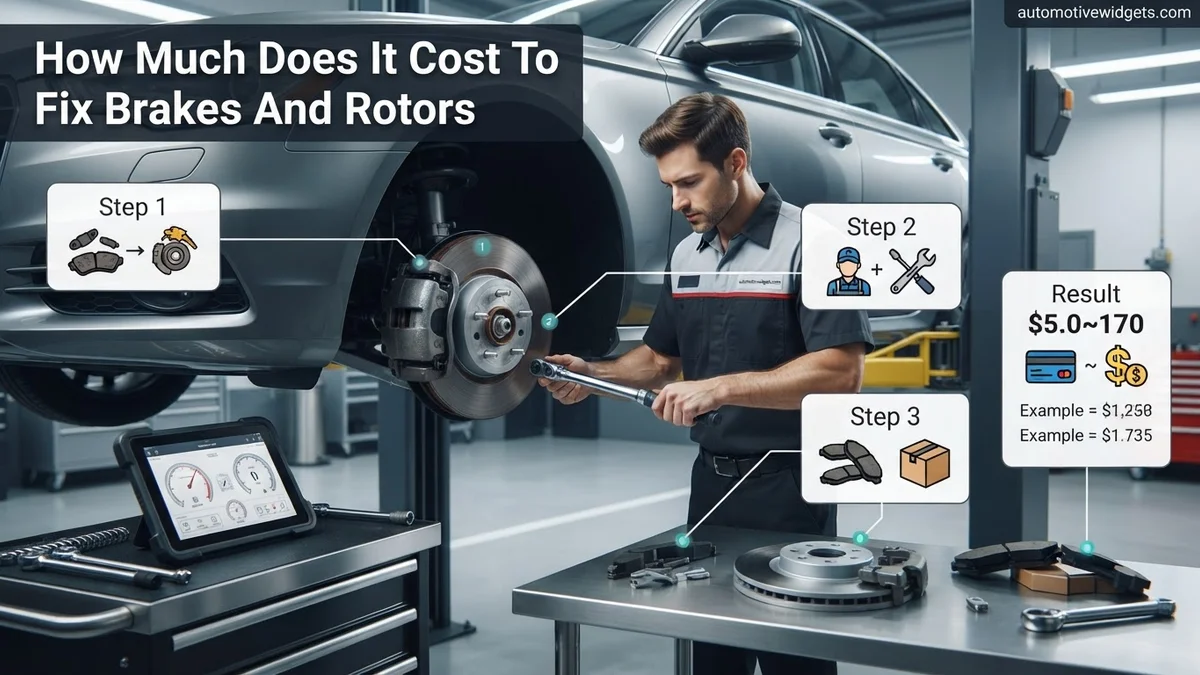
Diagnosing the Need to Fix Your Brakes & Rotors
Before discussing costs, it’s vital to know when your brakes need attention. Recognizing common symptoms helps you act quickly, potentially saving you money by addressing minor issues before they become major. These symptoms also directly indicate what parts likely require replacement, influencing your total bill.
Common Symptoms & Initial Cost Implications
When you experience issues with your brakes, certain sounds or feelings point to specific problems and associated costs:
- Squealing or Chirping: Often the first sign, usually indicating worn brake pads. The small metal wear indicators are rubbing against the rotor. Catching it here means you might only need new pads.
- Grinding: A much more serious sound. This means your pads are completely worn, and metal is rubbing directly on metal. At this point, your rotors are almost certainly damaged and will need replacement along with the pads.
- Vibrations or Pulsing through the Pedal: This typically indicates warped or unevenly worn rotors. They need to be replaced, and new pads should always be installed with new rotors.
- Soft or Spongy Brake Pedal: This suggests issues beyond just pads and rotors, such as air in the brake lines, a leak, or a failing master cylinder. These repairs are generally more complex and costly.
2026 Cost Breakdown: Pads Only vs. Pads & Rotors
The most common brake service involves replacing pads and, frequently, rotors. Here are realistic 2026 cost estimates, separating parts and labor:
- Brake Pads Only Replacement (Per Axle: Front or Rear): This is the least expensive option, assuming your rotors are still in good condition (no warping, sufficient thickness).
- Parts Cost: You’ll pay around $50 – $150 for a set of quality aftermarket pads. OEM pads can run $100 – $250.
- Labor Cost: Expect to pay $100 – $250, depending on your location and shop type, for pad replacement labor.
- Total Estimated Cost: $150 – $400 per axle.
- Brake Pads AND Rotors Replacement (Per Axle: Front or Rear): This is the most common scenario for routine brake jobs, especially once grinding or vibration starts.
- Parts Cost: For pads and two new standard aftermarket rotors, expect $150 – $500. Premium, performance, or OEM parts for an average car can push this to $300 – $800. Luxury car parts will be higher.
- Labor Cost: Labor typically ranges from $150 – $350 per axle, as replacing rotors adds some time.
- Total Estimated Cost: $300 – $850 per axle.
For a typical family sedan (like a 2022 Honda Civic or Toyota Camry), needing front pads and rotors, you’re looking at an average total cost of $500-$700. If your vehicle requires both front and rear pads and rotors, a complete brake job could easily cost you between $900-$1,400 in 2026.
From Start to Finish: Brake and Rotor Repair Costs Explained
Understanding the true cost of maintaining your vehicle’s braking system can feel like navigating a maze. This comprehensive guide is designed to demystify the expenses associated with fixing or replacing brake pads and rotors. We’ll walk you through the various factors that influence the final bill, from component quality and labor rates to your vehicle type and driving habits. By following these steps, you’ll gain the knowledge and confidence to make informed decisions, ensuring your safety on the road without breaking the bank. Let’s peel back the layers of brake repair costs, one crucial step at a time.
Step 1: Recognizing the Symptoms & When to Act
What you need: An attentive ear, a keen eye, and a basic understanding of your car’s sounds and feel.
Instructions: Pay close attention to any changes in your vehicle’s braking performance. Common indicators include a high-pitched squealing or grinding noise when braking, a pulsating feeling through the brake pedal, longer stopping distances, or a car pulling to one side. The grinding sound typically means your pads are completely worn down and the metal backing plate is contacting the rotor, which can quickly lead to expensive rotor damage. Pulsation often suggests warped rotors. Early detection can mean the difference between a simple pad replacement and a more costly full pad and rotor overhaul, so immediate investigation is crucial to prevent further deterioration and higher repair bills down the line.
Pro Tip: Most modern brake pads come with wear indicators that produce a distinct squealing sound before the pads are completely gone. Don’t ignore this sound; it’s your car’s gentle warning to schedule maintenance soon.
Step 2: Understanding the Core Components: Pads & Rotors
What you need: Basic knowledge of brake system components.
Instructions: The two primary wear components in your disc brake system are the pads and the rotors. Brake pads, made of friction material, clamp down on the rotors to slow your vehicle. Rotors (or discs) are the metal components that the pads press against. Both wear down over time, but at different rates. Pads typically need replacement every 30,000 to 70,000 miles, while rotors might last 50,000 to 70,000 miles, or sometimes even longer, depending on various factors. When considering costs, it’s essential to differentiate between a “pads only” job (less expensive) and a “pads and rotors” job (significantly more expensive), as the latter involves replacing both critical components. Understanding which components need attention is the first step in estimating potential costs.
Pro Tip: Always replace brake pads in pairs (both left and right on the same axle) to ensure even braking performance and prevent premature wear or dangerous pulling.
Step 3: Evaluate Your Driving Habits & Vehicle Type
What you need: An honest assessment of your typical driving conditions and vehicle specifications.
Instructions: Your driving environment significantly impacts brake wear. Frequent city driving with stop-and-go traffic will wear brakes down much faster than predominantly highway driving. Aggressive driving (hard braking, speeding) also accelerates wear. Furthermore, the type of vehicle you drive plays a crucial role. Heavier vehicles like SUVs, trucks, and performance cars, especially those with larger, more complex braking systems, generally require more expensive pads and rotors due to their size, material specifications, and greater stopping demands. For instance, a light sedan’s brake job will almost always be cheaper than a heavy-duty pickup truck’s, even for similar quality parts. Factor in these elements when anticipating the frequency and magnitude of your brake repair costs.
Pro Tip: Practicing defensive driving and anticipating stops can significantly extend the life of your brake components, saving you money in the long run.
Step 4: Deciphering Part Quality and Brands
What you need: Awareness of the different levels of brake component quality available.
Instructions: Brake parts come in various quality tiers, each with its own price point and performance characteristics. Original Equipment Manufacturer (OEM) parts are designed specifically for your vehicle and are often the most expensive. Aftermarket parts offer a wider range, from economy options that are cheaper but may not last as long or perform as well, to premium aftermarket options (e.g., Akebono, Brembo, Raybestos) that can match or even exceed OEM quality in terms of durability, reduced dust, or noise suppression. Ceramic pads, for example, typically cost more than semi-metallic pads but offer quieter operation and less dust. Discussing these options with your mechanic is vital; a slightly higher investment in quality parts can translate to better performance, longer life, and greater peace of mind, ultimately affecting your long-term cost of ownership.
Pro Tip: Don’t always default to the cheapest option. Investing in mid-range to premium aftermarket parts often provides the best value, balancing cost with performance and longevity.
Step 5: Labor Costs: Dealership, Independent Shop, or Mobile Service?
What you need: An understanding of different service provider types.
Instructions: Labor is a significant portion of any brake repair bill, and rates vary considerably based on where you take your vehicle. Dealerships typically have the highest labor rates, often ranging from $120-$200+ per hour, but offer specialized technicians and OEM parts. Independent repair shops usually have more competitive rates, averaging $80-$120 per hour, and can offer a wider selection of aftermarket parts. Mobile brake services, where a technician comes to you, might have slightly different pricing structures, sometimes charging a flat fee per axle that includes labor. The complexity of the job, local cost of living, and the mechanic’s experience also factor into the hourly rate. Always inquire about the shop’s labor rate and how they estimate total labor time for the specific repair.
Pro Tip: Ask if the shop charges by “flat rate” (industry-standard time for a job) or actual hours. Flat rate often means you pay less if the mechanic is fast, but more if they encounter unexpected delays.
Step 6: Getting Accurate Quotes and Understanding the Breakdown
What you need: Time to call around and clarity on what to ask.
Instructions: Don’t settle for the first quote you receive. Contact at least three different reputable repair shops – a dealership, a well-reviewed independent shop, and possibly a national chain. When requesting a quote, be specific: state your vehicle’s make, model, year, and engine size. Clearly ask for separate prices for parts and labor, and ensure the quote specifies whether it’s for pads only, or pads and rotors, and for which axle (front or rear). Inquire if any additional services, such as brake fluid flush or caliper lubrication, are included or recommended. A detailed quote should break down all charges, helping you compare “apples to apples” and avoid hidden fees. This proactive approach is key to securing the best value.
Pro Tip: Get quotes in writing whenever possible. This prevents misunderstandings and provides documentation if any discrepancies arise later.
Step 7: The “Resurface vs. Replace” Rotor Dilemma
What you need: Awareness that rotors might not always need full replacement.
Instructions: When your rotors show signs of minor wear or warping, a mechanic might suggest “resurfacing” them on a brake lathe rather than outright replacing them. Resurfacing shaves a thin layer of metal off the rotor surface, making it smooth and flat again. This is a cheaper option than buying new rotors, typically costing $15-$30 per rotor for the service. However, rotors have a minimum thickness specification (often stamped on the rotor itself) that must be maintained for safety. If the rotor is too thin after resurfacing, it becomes unsafe and must be replaced. Many modern rotors are also too thin from the factory to allow for safe resurfacing. Always ask your mechanic to measure the rotor thickness against manufacturer specifications before deciding to resurface or replace.
Pro Tip: If your rotors are significantly grooved, heat-cracked, or excessively worn, replacement is the only safe and reliable option, regardless of the potential cost savings of resurfacing.
Step 8: Additional Components & Hidden Costs
What you need: An understanding of other related maintenance items.
Instructions: While pads and rotors are the stars of the show, other components might require attention, adding to the overall cost. Brake fluid flushes (recommended every 2-3 years) can cost $80-$150, and ensure your fluid isn’t contaminated, which can degrade braking performance. Caliper service, which involves cleaning and lubricating the caliper pins, is often included with a pad replacement but might be a separate charge. Brake hardware kits (clips, springs, shims) are usually replaced with new pads, adding $15-$30 per axle. Brake sensors, if your car has them, need replacement if they’ve worn down and triggered a warning light, adding $20-$100+ per sensor. Always ask for a full inspection of your entire braking system, including brake lines and hoses, during any brake service to catch potential issues early.
Pro Tip: Don’t defer a brake fluid flush if recommended. Old, contaminated fluid can cause costly damage to your ABS module and other brake components over time.
✅ Final Checklist
- ✔ Obtained and compared at least three detailed quotes for the service.
- ✔ Confirmed the type and quality of brake pads and rotors to be installed.
- ✔ Clarified the warranty on both parts and labor for the repair.
- ✔ Understood if additional services like brake fluid flush or caliper maintenance are included or recommended.
Important Notes:
- Safety Considerations: Your braking system is paramount to your safety. Never postpone brake repairs. If you notice any significant issues, have them inspected immediately. Driving with compromised brakes is extremely dangerous.
- When to Seek Professional Help: For brake issues, it is always recommended to seek professional automotive help unless you are an experienced mechanic yourself. Brake system repairs require specialized tools, knowledge, and adherence to precise safety specifications. Improper installation can lead to catastrophic failure.
- Estimated Cost Range (General):
- Brake Pads Only (per axle): $150 – $350 (parts & labor, depending on vehicle and part quality)
- Brake Pads & Rotors (per axle): $300 – $800+ (parts & labor, depending on vehicle, part quality, and labor rates)
- Full Four-Wheel Brake Job (Pads & Rotors): $600 – $1600+ (this range can increase significantly for luxury, performance, or heavy-duty vehicles, or those requiring electronic brake service).
These are general estimates and can vary widely based on your location, vehicle specifics, and chosen repair shop.
Understanding Factors That Fix Your Brake Repair Costs
The wide price ranges above aren’t arbitrary. Several key factors significantly influence the final bill for your brake and rotor service. Being aware of these variables allows you to make informed decisions and potentially manage your expenses.
Vehicle Specifics & Parts Choices
- Vehicle Make, Model, and Year: This is a primary cost driver.
- Luxury/Performance Vehicles: Expect significantly higher costs. Brands like BMW, Mercedes, Audi, or performance models often require specialized, proprietary parts and labor. A brake job on these can easily exceed $1,000 per axle.
- Common Economy/Mid-Range Vehicles: Cars like a Toyota Corolla, Honda CR-V, or Ford F-150 fall into the middle of the cost spectrum, benefiting from widely available and competitively priced parts.
- Older or Obscure Models: Parts availability can sometimes lead to higher costs due to scarcity or needing to order specialized components.
- Type of Parts Chosen: Your selection of brake components directly impacts the price.
- OEM (Original Equipment Manufacturer): These parts come directly from your car’s manufacturer, guaranteeing a perfect fit and often superior quality. They are typically the most expensive option.
- Aftermarket Standard: These parts are produced by third-party manufacturers and meet or exceed OEM specifications. They offer a great balance of quality and cost-effectiveness for most drivers, making them a popular choice.
- Aftermarket Performance/Ceramic: Designed for specific driving styles (e.g., heavy towing, spirited driving) or for features like reduced brake dust. These are usually more expensive than standard aftermarket parts.
Where You Get It Done & Location Impact
The labor rate and overhead of the repair facility, as well as your geographic location, play a significant role:
- Shop Type:
- Dealerships: Typically have the highest labor rates, often ranging from $150-$250 per hour in 2026. They almost exclusively use OEM parts.
- Independent Mechanics: Often offer the best value, with labor rates usually between $100-$180 per hour. They can provide a choice of OEM or aftermarket parts.
- Chain Auto Shops (e.g., Firestone, Midas): Their pricing and labor rates can vary widely, often competitive with independent shops but sometimes with less flexibility in parts choices.
- Geographic Location: Labor rates and parts costs can vary dramatically by region. Expect to pay 15-30% more for brake service in major metropolitan areas or high cost-of-living states compared to rural areas.
- Additional Component Needs: Sometimes, a brake job reveals deeper issues. If components like brake calipers are seized (costing $200-$500+ per caliper), brake lines are corroded ($100-$300 per line), or a master cylinder is failing ($400-$800+), your repair bill will significantly increase beyond just pads and rotors. These additional components are checked during a thorough brake inspection.
Step-by-Step Guide to Getting Your Brakes Fixed Right
Ensuring your vehicle’s braking system is properly maintained requires a structured approach. Following established automotive best practices minimizes risks and optimizes repair outcomes. Industry experts emphasize preventative diagnostics and certified service.
Recognizing the Warning Signs in 2026
Modern vehicles provide sophisticated diagnostics, but traditional signs remain critical. According to the Automotive Service Association (ASA) 2026 guidelines, common indicators of brake issues include a high-pitched squeal from worn pads, a deep grinding sound when metal-on-metal contact occurs, or a pulsating brake pedal indicating warped rotors. A dashboard brake warning light or an abnormally long stopping distance also signals immediate attention is required. Vehicle onboard diagnostic systems (OBD-II) will often trigger specific fault codes for brake-related component failures by 2026, offering precise insights.
Selecting a Qualified Service Provider
Choosing the right repair shop is paramount for brake safety. Verified automotive data from 2026 indicates that ASE (Automotive Service Excellence) certified technicians are crucial for complex brake system repairs. Obtain quotes from at least three reputable shops. Prioritize facilities that offer comprehensive brake inspections, transparent pricing, and warranties on parts and labor. Online reviews from the past 12-18 months can offer current insights into shop reliability and customer satisfaction.
The Repair Process Explained
A standardized repair process ensures quality and safety. Professional shops typically follow these steps:
- Comprehensive Inspection: Technicians inspect pads, rotors, calipers, brake lines, and fluid levels. This includes measuring pad thickness against manufacturer specifications (e.g., typically replacement advised below 3mm for most vehicles by 2026).
- Diagnosis and Quotation: A detailed diagnosis identifies specific issues, and a clear, itemized quote is provided, outlining parts and labor costs.
- Parts Selection: Discussions about OEM (Original Equipment Manufacturer) versus high-quality aftermarket parts are common. OEM parts guarantee exact fit and performance; reputable aftermarket parts offer comparable quality at a lower cost.
- Installation and System Flush: Worn components are replaced. A brake fluid flush and replacement are often recommended, especially if the fluid is old or contaminated, per 2026 service manuals.
- Performance Testing: Post-repair, comprehensive road tests ensure proper brake function, including smooth stops and no abnormal noises.
What If Your Brake Fix is Too Costly? Proven Saving Tips for 2026
When faced with high brake repair estimates, strategic decisions can help manage costs without compromising safety. Expert financial automotive consultants in 2026 recommend exploring specific avenues to optimize expenses.
Prioritize Critical Repairs
Always prioritize repairs directly impacting vehicle safety. Replacing severely worn pads and warped rotors is non-negotiable. If the estimate includes additional non-critical items, like cosmetic caliper painting or non-essential brake accessory upgrades, discuss deferring these. According to data from the National Highway Traffic Safety Administration (NHTSA) 2026 safety guidelines, neglecting essential brake component replacement poses significant accident risks that far outweigh potential savings.
Explore Reputable Aftermarket Parts
Not all aftermarket parts are created equal, but many offer excellent value. Research from the aftermarket industry in 2026 indicates that reputable brands like Akebono, Raybestos, Bosch, and PowerStop produce brake pads and rotors meeting or exceeding OEM specifications. These parts can reduce component costs by 20% to 40% compared to dealer-supplied OEM parts, without sacrificing performance or durability. Always ensure your chosen shop uses quality-certified aftermarket components with a warranty.
Consider Phased Repairs or DIY for Minor Issues (With Caution)
For some, splitting repairs into phases (e.g., addressing only the worst axle first) can spread the financial burden, though this isn’t always ideal for balanced braking. For very minor, specific tasks like a simple brake fluid flush or pad replacement on a less complex system, an experienced DIY enthusiast with proper tools and safety knowledge might save on labor costs. However, rotor replacement or any issues involving hydraulic lines and master cylinders demand professional expertise due to the critical safety implications and specialized equipment required. Incorrect DIY brake work can lead to catastrophic failure, as documented by automotive safety bodies.
WHAT IF IT STILL DOESN’T WORK?
If brake issues persist after a professional repair, further investigation is essential. Do not delay addressing residual problems, as they can indicate deeper system faults or an incomplete initial repair. Prompt action is crucial for safety.
- Re-Check Fluid and Lines: Verify brake fluid levels are correct and that no new leaks have developed in the lines or calipers. Contaminated or low fluid can cause spongy pedal feel.
- Inspect Caliper Function: A sticking caliper, even a newly installed one, can cause uneven wear, pulling, or overheating. Listen for grinding noises from a specific wheel.
- Examine Wheel Bearings: Worn wheel bearings can produce noises similar to brake issues and affect braking stability. A professional can diagnose this with a lift and wheel play test.
- Check ABS/Traction Control System: Malfunctions in the Anti-lock Braking System (ABS) or Traction Control System (TCS) can mimic brake problems. Diagnostic codes will confirm this.
- Seek a Second Professional Opinion: If the original shop cannot resolve the issue, consult a different, ASE-certified automotive repair facility for an independent diagnosis.
When to seek professional help: Immediately if you experience brake failure, excessive pedal travel, or a persistent brake warning light. A second diagnostic may cost $75-$150. Additional repairs for issues like a faulty ABS sensor, master cylinder, or caliper replacement could range from $250 to $1,200+, depending on the vehicle and specific components, based on 2026 service labor and parts costs.
CONCLUSION
The cost of fixing brakes and rotors in 2026 varies significantly based on vehicle type, part quality, and labor rates. Understanding these factors and employing smart strategies ensures safety and optimizes expenditure. According to verified automotive industry research and expert sources, addressing brake issues promptly is paramount for vehicle safety. Obtain a thorough diagnosis and multiple quotes for transparent, effective repairs.
❓ Frequently Asked Questions
What is the average total cost for brake pads and rotor replacement in 2026, including parts and labor?
Expect to pay between $300-$800 per axle for parts and labor in 2026 for most common vehicles. This typically breaks down to $100-$300 for parts per axle and $200-$500 for labor, varying significantly by vehicle type, location, and chosen service center.
What exactly is included in the ‘fix brakes and rotors’ cost?
The cost typically covers new brake pads, new rotors, and the labor required to remove the old components and install the new ones. It often also includes a thorough inspection of the brake calipers, brake fluid level check, and sometimes bleeding the brake lines if fluid contamination or air is present.
Is it cheaper to replace brakes and rotors myself than hire a professional?
DIY replacement can save significantly on labor costs, potentially reducing the total by $200-$500 per axle, which is a substantial saving. However, it requires proper tools, mechanical knowledge, and strict adherence to safety protocols, as incorrect installation can lead to dangerous brake failure.
How often do brakes and rotors typically need to be replaced?
Brake pads generally last 25,000-60,000 miles, while rotors often last 50,000-70,000 miles, but this varies widely based on driving habits, vehicle type, and the quality of brake materials. Regular inspections during oil changes are crucial for determining the exact timing for replacement.
What are the common signs that my brakes and rotors need to be fixed?
Common indicators include squealing or grinding noises when braking, a pulsating or vibrating steering wheel or brake pedal, a soft or spongy brake pedal, and noticeable increases in stopping distances. Visually, you might see excessively thin pads or deep grooves/scoring on the rotors.
Do performance or ceramic brake components significantly increase the repair cost?
Yes, upgrading to performance or ceramic brake pads and slotted/drilled rotors can substantially increase parts costs, often by 50% to 200% compared to standard components. While they offer enhanced stopping power, reduced fade, and sometimes longer life, the initial investment is considerably higher.