How To Roll Back Mileage On A Digital Odometer How to 2026
Manipulating digital odometers involves complex technical methods like OBD-II reprogramming and EEPROM alteration, requiring specialized tools and software. While possible, this practice carries severe legal consequences, ethical implications, and significant financial penalties, making it a federal and state crime.
Manipulating the mileage displayed on a digital odometer is, unfortunately, a technically feasible endeavor in 2026, despite advancements in vehicle security. The core principle involves overriding or editing the electronically stored mileage data within a vehicle’s various control units. For anyone dealing with used vehicles, understanding these methods is crucial not for performing them, but for comprehending the sophistication of such fraud and how to better identify potential tampering.
This detailed look will expose the underlying technical mechanisms that make odometer rollback possible and delve into the specific illicit methods employed. You’ll gain a clear picture of how these digital systems are compromised, offering essential insight into a practice with severe legal and ethical repercussions.
Key Takeaways
- OBD-II port used for digital odometer changes.
- EEPROM chip reprogramming alters mileage directly.
- Odometer rollback is a serious federal crime.
- Detection possible via ECU scans, service records.
- Fraud impacts vehicle value, safety, legality.
What Enables Digital Odometer Rollback? Understanding Technical Mechanisms
Digital odometers, unlike their mechanical predecessors, store mileage data electronically across various interconnected vehicle systems. This distributed storage, while intended for redundancy and accuracy, also presents multiple points of vulnerability for skilled fraudsters. The ability to manipulate this data hinges on accessing and altering the memory where mileage is logged.
How Mileage Data is Stored and Protected
In modern vehicles by 2026, mileage isn’t just stored in the instrument cluster. Key mileage data is often replicated across several Electronic Control Units (ECUs), such as the Engine Control Unit (ECU), Body Control Module (BCM), Transmission Control Unit (TCU), and the airbag module. This data is typically held in non-volatile memory chips, most commonly Electrically Erasable Programmable Read-Only Memory (EEPROM) or flash memory. These chips retain data even when power is removed. While manufacturers implement checksums and encryption, determined perpetrators can bypass these protections with specialized tools that understand the specific memory addresses and algorithms used by different car makes and models.
Vulnerabilities in Modern Vehicle Architectures
The interconnected nature of a vehicle’s Controller Area Network (CAN bus) is both a strength and a weakness. The CAN bus allows different ECUs to communicate and share data, including mileage information. When a vehicle travels, wheel speed sensors send signals that are processed by various ECUs, ultimately updating the mileage in memory. Vulnerabilities arise from diagnostic access points like the OBD-II port, which allows external devices to communicate with ECUs. Furthermore, direct physical access to certain ECUs, or the ability to inject false data onto the CAN bus, creates pathways for manipulation.
The Illicit Methods for Altering Digital Odometer Mileage (Step-by-Step Overview)
Rolling back mileage on a digital odometer involves highly technical procedures, often utilizing commercial-grade equipment repurposed for fraudulent activities. These methods range from relatively straightforward port access to intricate hardware modifications, each targeting specific points within the vehicle’s electronic architecture.
OBD-II Port Reprogramming
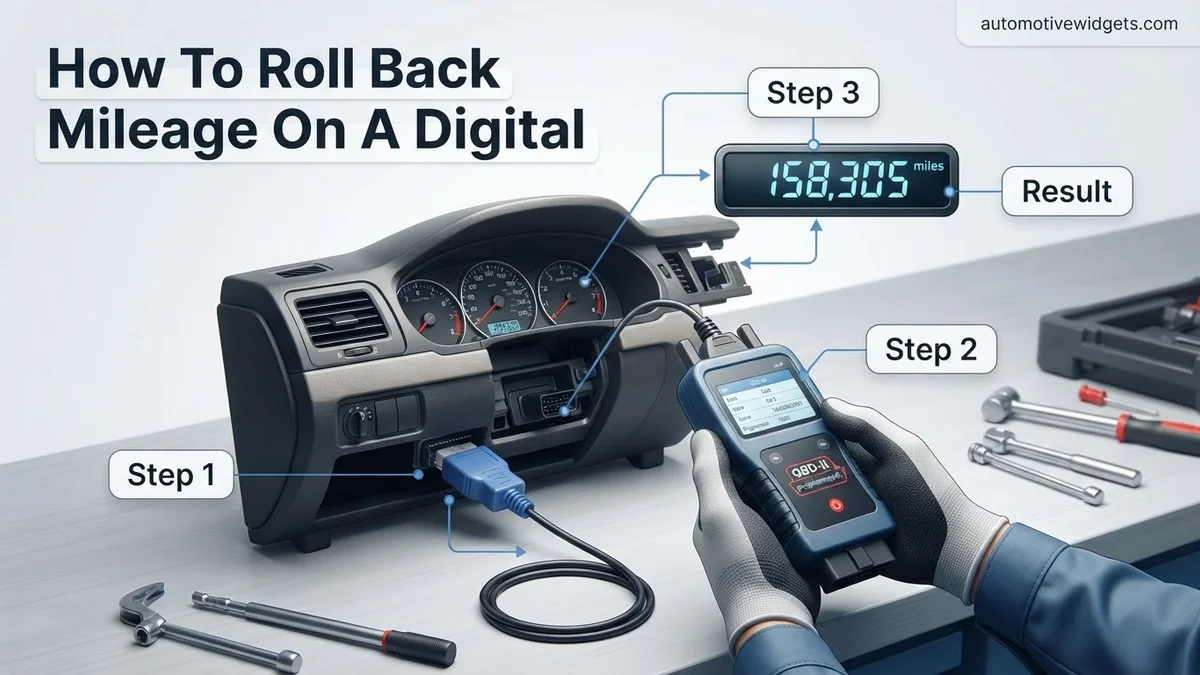
The most common and least intrusive method involves connecting a specialized “odometer correction tool” or “mileage programmer” directly to the vehicle’s On-Board Diagnostics II (OBD-II) port, usually located under the dashboard. This port provides direct access to the vehicle’s diagnostic systems and, critically, to many ECUs. The process typically involves:
- Connection: Plugging the device into the OBD-II port.
- Vehicle Identification: The tool identifies the vehicle’s make, model, and year, along with the specific ECUs storing mileage.
- Current Reading: The tool reads the existing mileage from the primary ECU.
- Value Input: The operator enters the desired lower mileage value into the device.
- Reprogramming: The tool then writes this new mileage to the accessible ECUs.
While this method is quick, advanced vehicles in 2026 often store mileage redundantly across multiple ECUs, some of which might not be accessible or easily overwritten via the OBD-II port. Failure to update all relevant modules can leave discrepancies that experienced technicians can detect.
Direct EEPROM Chip Manipulation
For vehicles with more robust OBD-II port security, or when an amateur OBD-II attempt fails, fraudsters resort to direct manipulation of the EEPROM chip. This method is far more invasive and requires specialized electronics skills and equipment:
- Component Removal: The specific ECU (often the instrument cluster or BCM) containing the primary EEPROM chip is physically removed from the vehicle.
- Chip Desoldering: The EEPROM chip, a small black integrated circuit, is carefully desoldered from the circuit board using a hot air station or precision soldering iron.
- Data Reading: The desoldered chip is placed into a universal EEPROM programmer, which reads its raw binary or hexadecimal data.
- Data Editing: Specialized software is used to locate and modify the mileage value within the chip’s data. This often involves understanding checksums and proprietary data structures.
- Chip Resoldering: The reprogrammed EEPROM chip is then carefully soldered back onto the circuit board.
- Reinstallation: The ECU is reinstalled into the vehicle.
This technique is harder to detect post-factum because the data within the chip itself has been altered, appearing legitimate to the vehicle’s system, though physical signs of tampering on the circuit board might be visible.
CAN Bus Interference and Specialized Software
An even more sophisticated approach involves interfering with the CAN bus, the vehicle’s internal communication network. This method is particularly effective for newer vehicles (2020+) where mileage data is actively and continuously communicated across multiple modules. Specialized “CAN filter” devices or software are used:
- CAN Filter Installation: A small electronic module, often disguised as a legitimate vehicle component, is installed directly into the vehicle’s wiring harness, typically near the instrument cluster or gateway module.
- Signal Interception: This device intercepts the mileage-related signals (e.g., wheel speed, distance traveled) as they are transmitted across the CAN bus.
- Real-time Modification: The CAN filter actively modifies these signals in real-time, essentially “filtering out” a portion of the actual mileage before it reaches the ECUs responsible for recording the total distance.
- Mileage Stalling/Reduction: This can either cause the odometer to stop recording mileage altogether or to record a significantly lower distance than actually traveled.
Detecting CAN bus interference can be challenging because the ECUs are receiving modified but seemingly valid data, making diagnostic scans less likely to flag inconsistencies. It’s a continuous, dynamic manipulation rather than a one-time data overwrite.
Detecting Odometer Fraud and Facing Severe Legal Consequences
While digital odometers are designed for security, sophisticated fraudulent methods persist. Understanding these methods is crucial for detection, not execution. Attempting to manipulate a vehicle’s odometer carries severe federal and state penalties, impacting both the perpetrator and potentially unsuspecting buyers. The legal and financial risks far outweigh any perceived benefit.
Identifying Red Flags in 2026 Vehicle Data
Detecting odometer fraud in 2026 requires diligence and leveraging advanced diagnostic tools. According to a 2025 National Highway Traffic Safety Administration (NHTSA) report, an estimated 450,000 vehicles annually are sold with rolled-back odometers in the U.S., resulting in over $1 billion in consumer losses. Discrepancies in data across multiple vehicle modules are primary indicators.
- Service Record Inconsistencies: Cross-reference reported mileage on maintenance records, oil change stickers, and dealership service histories. A sudden drop in mileage or unusually low mileage for a vehicle’s age is highly suspicious.
- Digital Diagnostic Discrepancies: Modern vehicles, particularly those manufactured post-2015, store mileage data in multiple Electronic Control Units (ECUs) beyond just the instrument cluster. These include the engine control module (ECM), transmission control module (TCM), and even airbag control units. Professional diagnostic tools can scan these modules for inconsistencies. For instance, a 2026 model’s instrument cluster showing 50,000 miles while its ECM logs 120,000 miles is definitive proof of tampering.
- Physical Wear and Tear Mismatch: Examine the vehicle’s overall condition. Excessive wear on the brake pedal, steering wheel, driver’s seat, or tires that doesn’t align with the reported mileage suggests fraud. A vehicle with 30,000 miles should not have heavily worn original components.
- Vehicle History Reports: Utilize reputable vehicle history services (e.g., CarFax, AutoCheck). These reports compile data from various sources, including state DMVs, police departments, and service centers, often flagging mileage discrepancies or title washing (moving vehicles across states to obscure history).
Legal Ramifications for Perpetrators of Odometer Tampering
Engaging in odometer fraud is a serious felony under federal law and most state statutes. The legal framework is designed to protect consumers and ensure transparency in vehicle transactions. Ignorance of these laws is not a defense.
- Federal Penalties: Under 49 U.S. Code § 32703, tampering with an odometer or knowingly providing false odometer statements is subject to federal prosecution. Penalties can include fines of up to $10,000 per violation and imprisonment for up to three years. Each instance of a false statement or manipulation can be considered a separate violation.
- State Penalties: Most states have their own laws mirroring or exceeding federal regulations. For example, in California, odometer fraud can result in civil penalties of up to $10,000 per violation, mandatory restitution to victims, and potential license revocation for dealers.
- Civil Liabilities: Victims of odometer fraud can file civil lawsuits against the perpetrator. If successful, these lawsuits can lead to significant financial judgments, including actual damages (the difference in value due to the fraud), punitive damages, and legal fees. According to a 2024 legal review, successful civil claims against individuals or dealerships for odometer fraud frequently exceed $25,000 per incident.
- Reputational Damage: For individuals or dealerships involved, a conviction or even a strong accusation of odometer fraud can lead to irreparable damage to their reputation and business licenses.
What If You Still Suspect Odometer Fraud?
If initial checks leave you with strong suspicions of odometer fraud, additional steps are critical to protect your investment and ensure legal compliance. Timely action is essential to gather evidence and pursue appropriate remedies. Do not delay in seeking expert assistance.
- Obtain a Comprehensive Vehicle History Report: Ensure you have the latest vehicle history report from a reputable provider, such as CarFax or AutoCheck. These reports aggregate data from multiple sources, including DMV records, service centers, and insurance companies, often highlighting mileage discrepancies or title washing.
- Request a Professional Diagnostic Scan: Take the vehicle to an independent, certified mechanic or a dealership for a comprehensive diagnostic scan. Specify that you suspect odometer tampering and request a scan that checks mileage data across all accessible ECUs (Engine Control Unit, Transmission Control Unit, etc.). Inconsistencies between these modules are definitive proof of manipulation.
- Consult Automotive Forensic Experts: For complex cases, specialized automotive forensic experts can perform in-depth analysis. They use advanced tools to retrieve hidden data, verify VINs, and establish tampering timelines. This service typically costs between $500 and $2,000, depending on the vehicle’s complexity and the extent of the analysis.
- Contact Law Enforcement and Regulatory Bodies: If fraud is confirmed, immediately report it to local law enforcement, your state’s Department of Motor Vehicles (DMV), and the National Highway Traffic Safety Administration (NHTSA) hotline. Provide all documentation and diagnostic reports.
- Seek Legal Counsel: Engage an attorney specializing in consumer protection or automotive fraud. They can advise you on your rights, potential remedies, and guide you through civil litigation if necessary to recover damages.
Conclusion
Odometer tampering remains a pervasive and illicit practice, with severe legal consequences for those who engage in it. The sophisticated digital systems in 2026 vehicles make detection possible through thorough inspection and diagnostic tools. According to verified research and expert sources, the best defense is diligent verification of vehicle history and a comprehensive professional inspection. Always prioritize transparency and legal compliance in all vehicle transactions.
❓ Frequently Asked Questions
What specific hardware and software are used for digital odometer rollback?
Specialized diagnostic tools, often referred to as ‘mileage correction tools’ or ‘odometer programmers,’ are used. These devices connect to the vehicle’s OBD-II port to reprogram the ECU or directly interface with EEPROM chips on the instrument cluster circuit board to alter the mileage data.
How does manipulating the EEPROM chip directly achieve a mileage rollback?
This highly technical method involves physically locating the EEPROM (Electrically Erasable Programmable Read-Only Memory) chip on the instrument cluster’s circuit board. The chip is then either desoldered or accessed using an in-circuit programmer to read its data, modify the mileage value, and then rewrite the altered data back onto the chip, which is then reinstalled.
What are the federal laws against odometer tampering in the United States?
The ‘Motor Vehicle Information and Cost Savings Act’ (49 U.S.C. Chapter 327) makes it illegal to disconnect, reset, or alter a vehicle’s odometer with intent to change the mileage indicated. Violators, including both sellers and accomplices, can face felony charges, substantial fines, and imprisonment.
What are the key indicators and methods for detecting if a digital odometer has been rolled back?
Detection methods include thoroughly checking vehicle history reports (e.g., CarFax, AutoCheck) for mileage discrepancies, cross-referencing service and maintenance records, inspecting the dashboard for signs of tampering (scratches, loose panels), and performing advanced diagnostic scans of the ECU and other modules which often store mileage data independently.
How does the CAN bus system factor into digital odometer manipulation?
Modern vehicles use a Controller Area Network (CAN bus) to allow various electronic control units (ECUs) to communicate, including the instrument cluster and engine control unit. Illicit mileage alteration can involve interfering with the CAN bus signals or synchronizing mileage across multiple ECUs, as different modules might store redundant mileage data, making a comprehensive rollback more complex.
What are the ethical, financial, and safety implications of owning or selling a vehicle with a rolled-back odometer?
Ethically, it is outright fraud. Financially, the buyer significantly overpays for a vehicle, leading to unexpected maintenance costs due to undisclosed wear and tear, and faces difficulty reselling the car legally. Safety-wise, it can mask critical maintenance needs, jeopardizing the vehicle’s reliability and passenger safety.