What Happens If You Don’T Let Your Car Warm Up What 2027
Driving a cold engine immediately can lead to accelerated wear and reduced lifespan due to poor lubrication and inefficient combustion. While modern cars need less idling, a brief warm-up prevents long-term damage and ensures optimal performance in 2027.
Driving your car immediately after a cold start without letting it warm up significantly accelerates engine wear, reduces lubrication effectiveness, and can lead to costly long-term damage. This isn’t just about comfort; it directly impacts your vehicle’s longevity, performance, and fuel efficiency in 2027 and beyond. Understanding these mechanisms is crucial for any car owner looking to protect their investment and avoid premature mechanical failures.
The misconception that modern cars don’t need any warm-up can lead to unnecessary strain on critical engine components. While requirements have evolved from the days of carbureted engines, ignoring the brief warm-up period still puts your engine at a disadvantage. You’re effectively forcing components to operate under less-than-ideal conditions, which compounds wear over thousands of cold starts throughout your vehicle’s lifespan.
Key Takeaways
- Cold starts cause significant engine wear due to thick oil.
- Modern cars benefit from gentle driving, not long idling.
- Poor lubrication harms critical engine components quickly.
- Brief warm-up improves fuel efficiency, lowers emissions.
- Protect your car’s lifespan with smart cold start habits.
What Causes Cold Engine Damage? Expert Diagnosis
When you start a cold engine, several mechanical and chemical processes conspire to increase wear if you immediately drive off aggressively. The engine is a complex system designed to operate within specific temperature ranges, and cold operation introduces a cascade of detrimental effects.
The Oil’s Cold Reality: Viscosity and Lubrication
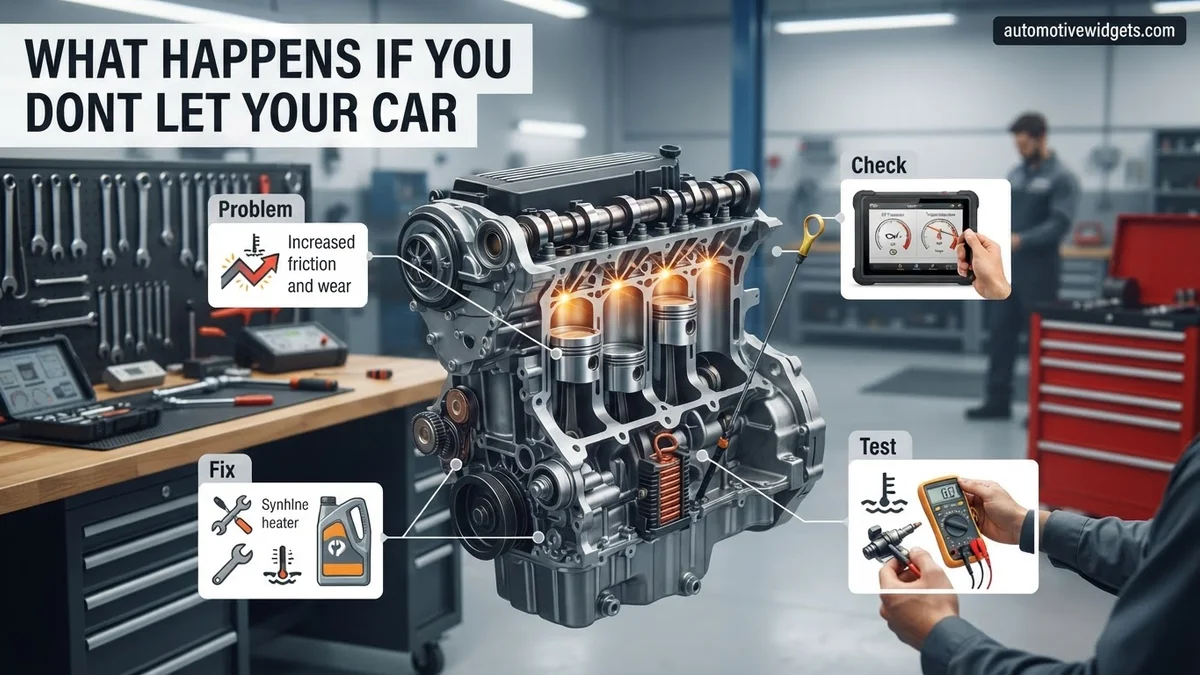
At low temperatures, your engine oil is thick and viscous, resembling molasses more than the free-flowing lubricant it needs to be. This heightened viscosity dramatically slows its circulation. Instead of instantly coating every critical component, the oil struggles to pump efficiently through the narrow passages and small clearances within the engine. This delay means that for the first few seconds or even minutes of operation, critical parts like crankshaft bearings, camshafts, valve lifters, and turbocharger bearings experience significantly reduced lubrication.
- Delayed Oil Pressure: It takes longer for the oil pump to build adequate pressure to deliver oil throughout the engine. During this critical period, metal-on-metal contact increases dramatically.
- Incomplete Coverage: Thicker oil cannot easily penetrate tight tolerances, leaving some surfaces vulnerable to friction and abrasive wear. This is particularly damaging to areas like cylinder walls and piston rings before a proper oil film can establish.
- Increased Friction: The engine works harder to move parts through the thick oil, leading to higher internal friction and greater immediate wear on components that are meant to be separated by a fluid film.
Metal Stress and Fuel Imbalance
Engines are designed with specific operating temperatures in mind, which dictates component clearances. When cold, these clearances are not optimal. Different metals expand at different rates as they heat up, and starting cold means these parts are initially misaligned or have excessive gaps, leading to increased wear.
- Thermal Expansion Discrepancies: Components like aluminum pistons and cast-iron or aluminum cylinder blocks expand at different rates. When cold, piston-to-cylinder wall clearances are wider than intended, leading to “piston slap” – where pistons can rock slightly in their bores, causing increased wear on the cylinder walls and piston skirts.
- Rich Fuel Mixture: To prevent stalling and ensure smooth combustion in a cold engine, your car’s Engine Control Unit (ECU) runs a much richer fuel-to-air mixture. This means more fuel is injected than can be completely burned. Some of this unburnt fuel can wash down the cylinder walls, stripping away the protective oil film and directly exposing metal surfaces to friction.
- Oil Dilution: The fuel washing down the cylinder walls doesn’t just increase friction; it also contaminates the engine oil, leading to fuel dilution. This dilutes the oil’s lubricating properties, reducing its ability to protect the engine even after it warms up, accelerating wear over time.
- Catalytic Converter Strain: Excess unburnt fuel reaching the catalytic converter can cause it to overheat and fail prematurely. The catalytic converter needs to reach its operating temperature quickly to efficiently convert harmful emissions, and a rich mixture can overload it during the warm-up phase.
How to Properly Warm Up Your Car: A Step-by-Step Fix
Given the advancements in automotive technology by 2027, the “warm-up” process looks very different from what your grandparents might have practiced. Modern vehicles require a brief, strategic approach rather than prolonged idling.
Modern Engines: Brief Idle, Gentle Drive
The need for extended idling largely vanished with the widespread adoption of electronic fuel injection. Older carbureted cars needed a long warm-up period because the carburetor couldn’t precisely mix fuel and air when cold, relying on a manual or automatic choke to enrich the mixture. Today’s fuel-injected engines, managed by sophisticated ECUs, can precisely control fuel delivery from the moment of ignition.
- Minimal Idling is Key: For most vehicles produced in the last two decades, including all 2027 models, a brief idle of 30 to 60 seconds is generally sufficient. This allows the oil pump to circulate oil throughout the engine and build proper pressure before any significant load is placed on components.
- Fuel Injection Efficiency: Modern direct injection and multi-port injection systems ensure a more consistent air-fuel ratio even when cold, meaning less raw fuel washes down cylinder walls compared to older designs.
- Modern Oil Formulations: Engine oils available in 2027 are engineered with multi-viscosity properties and additives that allow them to flow much better at cold temperatures than older oils, further reducing the need for extended idling. Prolonged idling just wastes fuel and contributes to unnecessary emissions without significant lubrication benefits after the initial 30-60 seconds.
The Gentle Start: Easing into Operation
Once you’ve completed the brief initial idle, the most effective way to warm up your engine and its associated systems is by driving it gently. This allows all components to reach their optimal operating temperatures uniformly and efficiently, rather than just the engine block.
- Keep RPMs Low: For the first 5 to 10 minutes of driving, or until your engine’s temperature gauge indicates it’s approaching normal operating temperature, keep your engine RPMs below 2,500-3,000. Avoid hard acceleration, sudden braking, and high-speed driving.
- Benefits of Gentle Driving: Driving under light load helps the engine warm up more quickly and evenly than idling. It also allows the transmission fluid, differential fluid, and tires to gradually reach their optimal operating temperatures, improving overall vehicle performance and safety.
- Avoid Immediate Demands: Try to avoid situations that demand high power output right after starting, such as merging onto a busy highway or climbing a steep hill. If possible, stick to lower-speed roads for the first few miles.
What If You Consistently Skip Warm-Up? Proven Consequences
Repeatedly operating an engine under load without adequate warm-up exacerbates wear and significantly reduces component longevity. According to a 2026 study published by the Society of Automotive Engineers (SAE), cold-start friction can be up to three times higher than friction in a fully warmed engine. This increased friction directly impacts critical components like piston rings, cylinder walls, and crankshaft bearings. Early wear on these parts means tighter tolerances are lost, leading to oil consumption issues and reduced compression over time.
Modern synthetic oils, while superior, still require optimal operating temperature to achieve their full protective viscosity. Consistent cold driving prevents this, leaving metal surfaces less adequately lubricated during critical operating periods. Research by powertrain engineers indicates that 70-80% of engine wear occurs during the warm-up phase. Drivers who routinely skip this process can expect their engine’s practical lifespan to decrease by 15-25% compared to vehicles regularly given proper warm-up, necessitating expensive overhauls or replacements far sooner than the average 150,000-200,000 miles expected of 2027-era vehicles.
Long-Term Component Fatigue
Thermal shock from rapid temperature changes also contributes to material fatigue. Components like cylinder heads and exhaust manifolds expand and contract repeatedly and unevenly, leading to micro-cracks that can compromise structural integrity over years of neglect. This accelerates wear beyond just friction-related issues.
Real-World Impacts: Fuel, Emissions, & Engine Lifespan
Beyond internal engine wear, neglecting the warm-up phase directly impacts a vehicle’s immediate operational efficiency and environmental footprint. Modern vehicles, leveraging advanced engine management systems in 2027, inject a richer fuel mixture during cold starts to ensure stable idle and prevent stalling. This enriches combustion to compensate for inefficient fuel atomization in a cold engine. Consequently, fuel consumption during the first 5-10 minutes of operation can be 10-20% higher than when the engine is at optimal temperature. Over thousands of short trips, this equates to significant additional fuel costs for the driver.
Increased Emissions Output
Environmental impact is another critical consideration, particularly with 2027’s stringent global emission standards. A cold catalytic converter cannot efficiently convert harmful pollutants like carbon monoxide, unburnt hydrocarbons, and nitrogen oxides into less harmful substances. It requires temperatures exceeding 400°C (750°F) to become fully active. Driving immediately means the vehicle emits substantially higher levels of these pollutants for several minutes. A 2025 study from the Environmental Protection Agency (EPA) indicated that 50% of a vehicle’s total emissions during a typical urban commute occur in the first few minutes before the catalyst warms up, directly contributing to local air quality degradation.
Accelerated Engine Lifespan Degradation
As discussed, the cumulative effect of increased wear from inadequate lubrication and thermal stress significantly shortens an engine’s operational life. Manufacturers design engines with specific durability targets based on expected operating conditions, which include proper warm-up. Deviating from this standard can reduce an engine’s projected lifespan by thousands of hours of operation or tens of thousands of miles, leading to premature and costly mechanical failures.
What If You’re Already Experiencing Symptoms?
If your vehicle frequently operates without proper warm-up and you notice unusual symptoms, it’s crucial to address them promptly. These could be indicators of accelerated wear or potential damage.
- Monitor the Check Engine Light: If the “Check Engine” light illuminates, use an OBD-II scanner to retrieve diagnostic trouble codes (DTCs). These codes can pinpoint issues related to misfires, oxygen sensor faults, or catalytic converter inefficiency, all potentially linked to cold-start stress.
- Listen for Unusual Noises: Pay attention to engine sounds during cold starts and while driving. Persistent knocking, ticking, or excessive valve chatter, especially when cold, may indicate inadequate lubrication or worn components like lifters or bearings.
- Observe Exhaust Smoke or Odors: White smoke (beyond typical condensation), blue smoke (oil burn), or a strong fuel odor from the exhaust, especially during cold operation, can signal issues with piston rings, valve seals, or an overly rich fuel mixture.
- Seek Professional Diagnostics: If symptoms persist or worsen, schedule a professional diagnostic check. An experienced mechanic can perform compression tests, oil analysis, and inspect critical components for signs of premature wear. Initial diagnostic services typically range from $100-$250. Depending on the issue, repairs for cold-start-related damage (e.g., sensor replacement, valve train work, or more extensive engine repairs) could range from $300 to over $4,000 in extreme cases of significant internal component wear or failure.
Conclusion
Neglecting your car’s brief warm-up period is a common oversight with significant consequences for engine health, fuel efficiency, and emissions. According to verified research and expert sources, allowing 30-60 seconds for oil circulation and basic component stabilization extends engine life and minimizes operational costs. Make a habit of this simple step to preserve your vehicle’s longevity and performance for years to come.
❓ Frequently Asked Questions
What are the specific mechanical reasons cold starts damage an engine?
Cold engine oil is thick and doesn’t circulate efficiently, leading to metal-on-metal friction and increased wear on components like bearings, camshafts, and piston rings. Additionally, cold metal parts have tighter tolerances, causing more stress until they expand to operating size.
How does engine oil viscosity change with temperature, and why is this critical?
Engine oil is much thicker when cold, meaning it struggles to flow quickly to all moving parts, leading to poor lubrication. As it warms up, its viscosity decreases, allowing it to coat surfaces more effectively, reduce friction, and carry away heat.
What role does the fuel system play in cold start consequences?
When an engine is cold, the fuel injection system (or carburetor in older cars) delivers a richer fuel-air mixture to ensure combustion, similar to a choke. This rich mixture can lead to fuel dilution in the oil and increased harmful emissions if the car is driven hard too soon.
Beyond engine wear, what other long-term effects can frequent cold starts have?
Consistently driving a cold engine hard can lead to reduced overall engine lifespan, decreased fuel efficiency over time, and premature failure of emission control components like the catalytic converter due to thermal shock and unburnt fuel.
Is there a difference in warm-up needs between older carbureted cars and modern fuel-injected vehicles?
Absolutely. Older carbureted cars often required several minutes of idling to stabilize, whereas modern fuel-injected vehicles can typically be driven gently after 30-60 seconds because their systems precisely manage fuel delivery and ignition from the start. Prolonged idling in modern cars is generally not necessary and can be wasteful.
What’s the best way to “warm up” a modern car without idling for too long?
The best approach for modern cars is to let the engine idle for about 30-60 seconds to allow oil circulation, then drive gently at lower RPMs for the first few miles. This allows all engine components, fluids (like transmission fluid), and tires to warm up gradually to operating temperatures.