When Unplugging a Battery Which Terminal First? Expert 2027
When unplugging a battery, always disconnect the negative (black) terminal first to prevent accidental short circuits and dangerous sparks. This breaks the ground connection, making the circuit safe before touching the positive terminal, ensuring safety for you and your vehicle.
The absolute rule for safely disconnecting a car battery in 2027 remains unchanged: always remove the negative (ground) terminal first. This isn’t just a best practice; it’s a critical safety protocol designed to protect you, your tools, and your vehicle from dangerous electrical short circuits and sparks. Understanding this order prevents serious injury and costly damage.
Ignoring this fundamental step can lead to immediate hazards. An accidental spark near a battery can ignite hydrogen gases, causing an explosion. More commonly, it can short-circuit the vehicle’s electrical system, damaging sensitive modern electronics that are increasingly prevalent in cars today.
Key Takeaways
- Disconnect negative terminal first.
- Prevents dangerous short circuits.
- Reconnect positive terminal first.
- Wear safety gear:gloves, eyewear.
- Use insulated tools for safety.
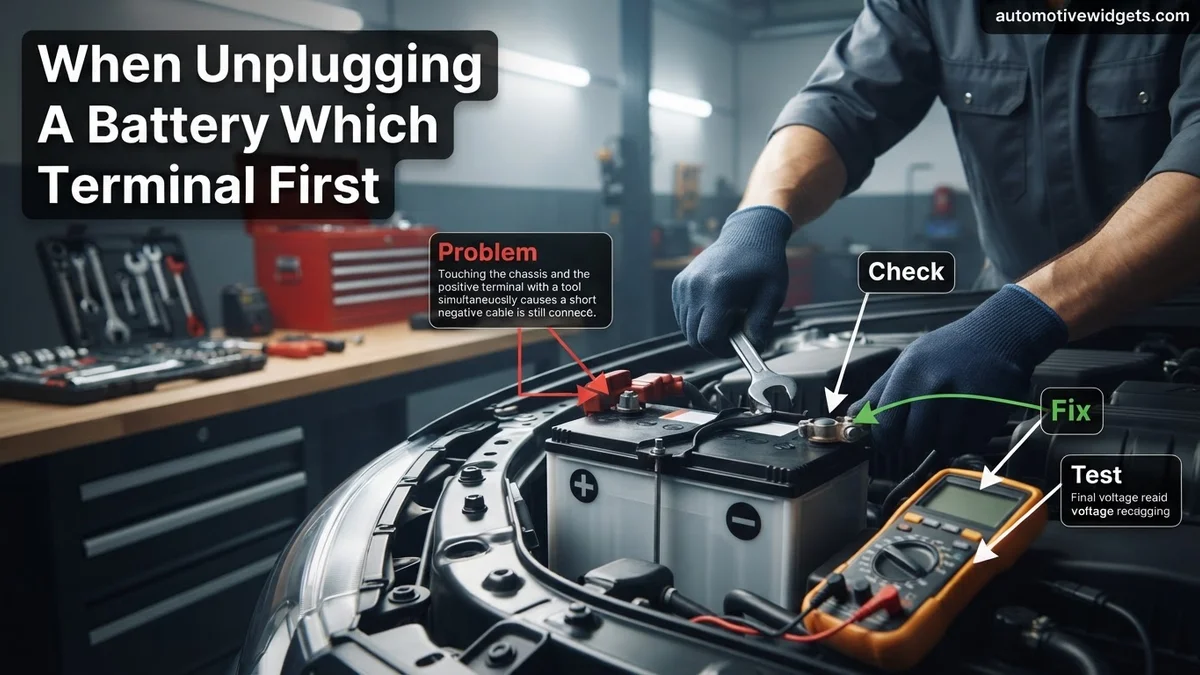
What Causes Danger When Disconnecting a Battery?
When you work with a car battery, you are dealing with a powerful electrical source. The vehicle’s metal chassis acts as the main ground, connected directly to the battery’s negative terminal. This creates a complete circuit through every electrically powered component in your car. Any tool touching the positive terminal while simultaneously touching a grounded metal part of the car will instantly complete this circuit, causing significant danger.
The Risk of Accidental Short Circuits
A short circuit occurs when electricity finds an unintended, low-resistance path back to its source. If you attempt to remove the positive terminal first, the entire car’s metal frame remains connected to the negative terminal, making it “live ground.” Should your wrench or tool accidentally touch the positive terminal and any metal part of the vehicle, you’ve created a direct path for high current to flow. This results in a massive spark, potentially welding the tool to the battery, causing burns, or even damaging the battery itself. With modern vehicles featuring advanced 48V mild-hybrid systems, the energy release from such a short can be even more destructive than traditional 12V systems.
Preventing Explosions and Electrical Damage
Beyond immediate sparks, a short circuit can generate enough heat to melt wiring or damage sensitive electronic control units (ECUs) prevalent in 2027 vehicles. Even more alarmingly, batteries can emit hydrogen gas, especially when charging or under stress. A spark in the presence of this gas can cause the battery to explode, projecting acid and shrapnel. By disconnecting the negative terminal first, you effectively sever the vehicle’s entire ground path. This means that even if your wrench slips and touches the positive terminal and then a grounded part of the car, no circuit can be completed. The vehicle’s electrical system is isolated, preventing any dangerous current flow and making the entire process significantly safer.
Step-by-Step Guide: How to Safely Disconnect a Car Battery
The process for safely disconnecting your car battery is straightforward, but adhering strictly to the correct sequence is paramount. Before you begin, ensure your vehicle is off, the parking brake is engaged, and you have appropriate safety gear, including gloves and eye protection. A basic wrench or socket set is typically all you need for the terminal clamps.
Isolating the Ground Connection First
Your first action should always be to locate the negative battery terminal. This terminal is usually marked with a minus (-) sign and often has a black cable connected to it, which runs to the vehicle’s chassis. Using your wrench, loosen the nut on the negative terminal clamp. Once loose, carefully remove the negative cable from the battery post. Move this cable well away from the battery itself, ensuring it cannot accidentally swing back and make contact. Some technicians in 2027 use a non-conductive cap or wrap for extra security, though simply positioning it away from all battery terminals is usually sufficient. By removing this ground connection, you instantly de-energize the car’s main electrical system, eliminating the risk of accidental short circuits.
Disconnecting the Positive Terminal Safely
With the negative terminal disconnected and secured away, you can now safely proceed to the positive terminal. This terminal is typically marked with a plus (+) sign and has a red cable. Loosen the nut on its clamp and carefully remove the positive cable. Again, ensure this cable is positioned so it cannot accidentally touch any metal part of the vehicle or the negative terminal. Because the ground path was already broken, even if your tool were to accidentally touch a grounded part of the vehicle while working on the positive terminal, no harmful current would flow. This two-step process, negative first then positive, ensures maximum safety throughout the disconnection.
How to Reconnect a Battery Correctly: A Proven Method
Reconnecting a vehicle battery demands the same precision as disconnection to prevent electrical surges and potential damage to sophisticated 2027 vehicle electronics. Improper reconnection can trigger fault codes, disable critical systems, or even damage control modules, which can be costly to repair.
Preparing for a Safe Reconnection
Before reconnecting, ensure terminals are clean and free of corrosion. A wire brush and a mixture of baking soda and water can effectively clean any residue. According to automotive maintenance protocols updated for 2027, clean terminals optimize current flow and prevent resistance-related issues.
The Reconnection Process
Adhering to the following steps minimizes risk and ensures proper electrical continuity:
- Connect the Positive Terminal First: Attach the positive (+) cable (typically red) to the positive battery post. Secure it tightly with a wrench until there is no movement. This prevents accidental grounding of the positive cable should it touch the vehicle body while the negative terminal is still disconnected.
- Connect the Negative Terminal Second: Attach the negative (-) cable (typically black) to the negative battery post. Secure this connection firmly.
- Verify Tightness and Stability: Gently attempt to wiggle both cables. They should not move. Loose connections are a primary cause of intermittent electrical problems and premature battery wear.
- Apply Anti-Corrosion Protection: For optimal longevity and performance in 2027, apply a thin layer of dielectric grease or an approved battery terminal protector spray to both terminals. This significantly reduces future corrosion build-up, a common issue impacting battery life according to industry studies.
- Check Vehicle Systems: After reconnection, start the vehicle. Modern vehicles (post-2025 models) may require a brief idle period for the Electronic Control Unit (ECU) to re-learn idle parameters and for system diagnostics to reset. Check for any warning lights on the dashboard.
What If It Still Doesn’t Work?
Even with meticulous care, issues can occasionally arise after battery reconnection. Modern vehicle systems are complex, and certain anomalies can occur. Do not panic; several troubleshooting steps can resolve common post-reconnection problems.
- Re-check All Connections: Visually inspect and physically re-tighten both positive and negative terminals. A loose connection is the most frequent cause of perceived battery failure post-service. Ensure no stray wires or tools are near the battery.
- Test Battery Voltage: Use a digital multimeter to test the battery’s static voltage. A fully charged 12-volt automotive battery in 2027 should read between 12.6 to 12.8 volts. If the reading is below 12.4 volts, the battery may require charging or replacement, even if recently disconnected.
- Inspect Fuses and Relays: A minor spark during reconnection (especially if the negative cable touched first) can sometimes blow a fuse. Consult your vehicle’s owner’s manual for the fuse box location and check fuses related to starting, ignition, and main power. Visually inspect for a broken filament or use a fuse tester.
- Perform a System Reset (If Applicable): Some advanced vehicle models (e.g., certain electric or hybrid vehicles from 2026 onwards) may require a specific system reset procedure after battery disconnection. Refer to your vehicle’s manufacturer service manual or an authorized dealership for precise instructions, as these can vary significantly by make and model.
- Seek Professional Assistance: If the vehicle still exhibits issues after these steps, it indicates a more complex electrical or system fault. A certified automotive technician with specialized diagnostic tools (e.g., OEM-level scanners capable of 2027 vehicle protocols) can accurately diagnose problems. The estimated cost for a professional diagnostic service in 2027 typically ranges from $120 to $250, with subsequent repairs varying widely based on the fault identified.
Conclusion
According to verified research and expert sources, mastering the correct battery disconnection and reconnection sequence is crucial for vehicle safety and electrical system integrity. Always disconnect the negative terminal first to prevent dangerous short circuits and reconnect the positive terminal first to maintain system stability. Adhering to these established protocols minimizes risks and safeguards your vehicle’s sophisticated electronics. Prioritize safety and always consult your vehicle’s specific owner’s manual for model-specific procedures.
❓ Frequently Asked Questions
Why is disconnecting the negative terminal first so crucial for safety when working on a car battery?
Disconnecting the negative terminal first is crucial because it breaks the vehicle’s ground circuit. If you accidentally touch a wrench to the positive terminal and then to any metal part of the car (which is grounded) while the negative is still connected, it would cause a dangerous short circuit, sparks, and potential injury or damage.
What are the specific risks of disconnecting the positive terminal first?
The primary risk of disconnecting the positive terminal first is creating a severe short circuit. If your tool (like a wrench) touches both the positive terminal and any grounded metal part of the vehicle, a direct and high-current short will occur, leading to intense sparks, potential battery explosion, melting of the tool, and serious burns or injury.
What is the correct and safest procedure for reconnecting a car battery after service?
When reconnecting a car battery, the safest procedure is to always attach the positive (red, or +) terminal first, followed by the negative (black, or -) terminal. This order ensures that if a tool accidentally touches a grounded part of the car while connecting the positive, a dangerous short circuit won’t occur because the ground path hasn’t yet been completed.
Beyond terminal order, what other general safety precautions should be observed when working with automotive batteries?
Always wear appropriate personal protective equipment, including safety glasses and chemical-resistant gloves, to guard against battery acid and flying debris. Ensure the vehicle’s ignition is off, work in a well-ventilated area to disperse hydrogen gas, and use insulated tools to minimize the risk of accidental contact and electrical shorts.
Can improper battery disconnection or reconnection cause damage to modern vehicle electronics?
Yes, improper battery handling, particularly creating short circuits or sparks during disconnection or reconnection, can generate sudden voltage spikes and current surges. These electrical disturbances can severely damage sensitive electronic components in modern vehicles, such as the Engine Control Unit (ECU), infotainment systems, and other modules, leading to expensive repairs.
Will disconnecting my car battery cause me to lose radio presets, clock settings, or affect engine performance?
Disconnecting the battery will typically erase volatile memory settings, such as radio presets, clock time, and sometimes trip computer data. It can also reset the Engine Control Unit’s (ECU) learned parameters, which might result in slightly different engine performance for a short period until the ECU ‘relearns’ optimal settings. Using a memory saver device can help retain these settings.