
How to Reset Tire Pressure Light on Toyota Camry 2026 Guide
To clear the low tire pressure warning on your Toyota Camry, you must first inflate all tires to the manufacturer-recommended PSI. Once pressure is correct, the TPMS light can be reset using either the physical reset button or the digital multi-information display depending on your model year.
Resetting the tire pressure monitoring system (TPMS) light on your Toyota Camry takes less than two minutes once you know where to look. Depending on whether you drive a newer model with a digital instrument cluster or an older generation with a physical button, the reset procedure involves either pressing a dash-mounted switch or navigating the steering wheel menu settings.
Ignoring a persistent TPMS light means you might miss a genuine puncture, while resetting it without fixing the underlying pressure issue is just a temporary fix. This 2026 guide walks you through the exact steps to clear the warning light properly and keep your Camry driving safely.
Key Takeaways
- Check and adjust all tire pressures, including the spare, before attempting a reset.
- Models from 2018 and newer typically use the digital steering wheel controls to reset TPMS.
- Older Camry models feature a physical button usually located under the dashboard steering column.
- Drive the vehicle above 20 mph for several minutes to allow sensors to recalibrate.
- A flashing TPMS light indicates a faulty sensor rather than simply low air pressure.
Why the Toyota Camry Tire Pressure Light Stays On
The Trigger Thresholds
Your Camry’s TPMS sensors continuously monitor the air pressure inside each tire. If any tire drops roughly 25 percent below the manufacturer’s recommended PSI—usually specified on the placard inside the driver door jamb—the system triggers the dashboard warning light. For a typical Camry requiring 35 PSI, the light trips around 26 or 27 PSI.
Solid Versus Flashing Indicators
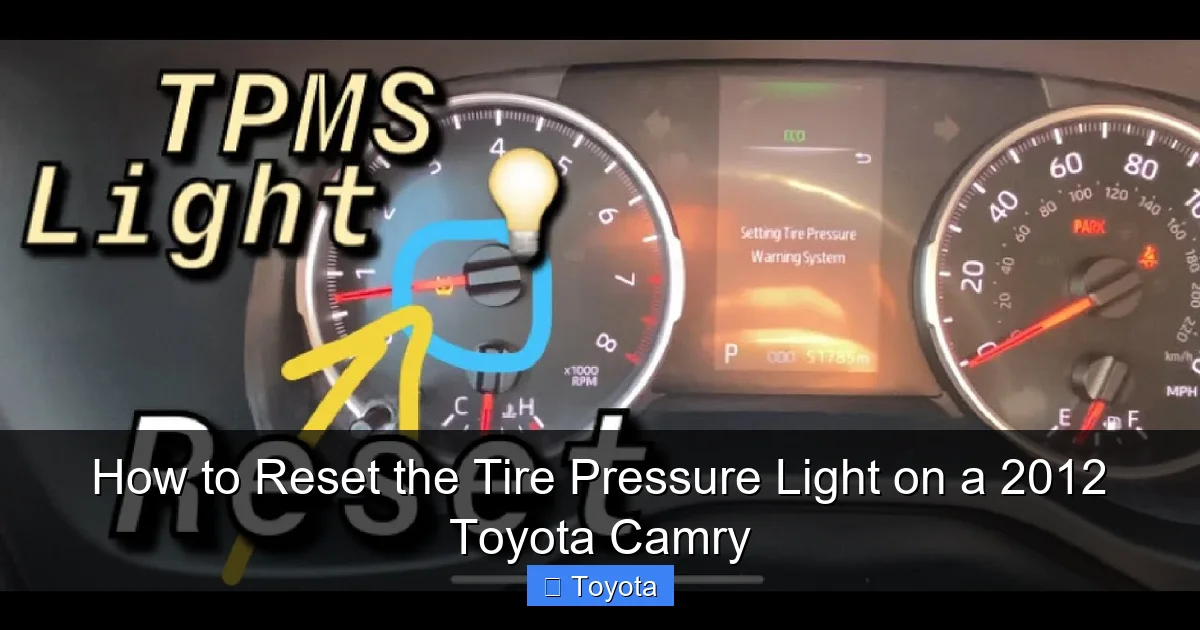
A solid low-pressure light indicates that one or more tires have lost air. This commonly happens due to seasonal temperature drops, where every 10-degree Fahrenheit shift changes tire pressure by about 1 PSI. Conversely, a flashing TPMS light that stays on for a minute after starting your 2026 Camry points to a system malfunction, such as a dead sensor battery or a damaged receiver, which a simple reset will not fix.
Master Tire Pressure Light Reset in 6 Simple Steps
Dealing with an illuminated Tire Pressure Monitoring System (TPMS) light on your dashboard can be frustrating, but ignoring it compromises your vehicle’s safety and fuel economy. This comprehensive walkthrough is designed to help Toyota Camry owners properly diagnose, inflate, and reset the tire pressure warning light across various model years, ensuring your sedan handles predictably and maintains optimal tire longevity.
Step 1: Verify and Inspect All Four Tires
What you need: A reliable digital or dial tire pressure gauge and a portable flashlight.
Instructions: Before attempting any dashboard resets, you must ensure your tires are physically safe and properly inflated. Walk around your Toyota Camry and inspect each tire for visible punctures, embedded nails, or sidewall bulges. Remove the valve stem caps from all four tires (and the spare, if equipped, as some older Camrys monitor the spare). Firmly press your tire pressure gauge onto the valve stem to read the current PSI. Compare these readings against the manufacturer’s official placard located on the driver-side door jamb, which typically recommends 32 to 35 PSI for standard Camry models.
Pro Tip: Always check tire pressure when the tires are cold—meaning the car has been driven less than a mile or has sat parked for at least three hours—because driving generates friction heat that artificially inflates PSI readings.
Step 2: Inflate Tires to Manufacturer Specifications
What you need: An air compressor (found at home, a gas station, or an auto repair shop).
Instructions: Connect your air compressor hose to any tire that fell below the recommended PSI threshold specified on your Camry’s door jamb sticker. Add compressed air in short bursts, periodically removing the nozzle to check the pressure with your gauge. If you accidentally overinflate a tire, gently press the center pin inside the valve stem with a pen tip or key to bleed out excess air until you reach the exact target PSI. Repeat this adjustment process for all four main tires, ensuring every single one matches the factory-specified pressure identically.
Pro Tip: Do not rely solely on the coin-operated air machine’s built-in dial at gas stations, as they are frequently inaccurate or damaged; always verify with your own handheld digital gauge.
Step 3: Locate the Camry TPMS Reset Button
What you need: Your Camry owner’s manual or a flashlight to inspect the lower dash area.
Instructions: Depending on the model year of your Toyota Camry, the physical TPMS reset button can be located in different spots. For many modern Camrys (2018 and newer), this setting is handled entirely through the multi-information display using the steering wheel controls. However, on older generations (roughly 2007 to 2017), the physical reset button is usually a small, black, recessed button located underneath the lower left side of the dashboard near the steering column, or occasionally inside the glove box. Slide into the driver seat and use your flashlight to find this button before turning on the vehicle.
Pro Tip: Do not confuse the TPMS set button with the instrument panel dimmer switch or the trunk release button, which are often grouped closely together in the lower dashboard cluster.
Step 4: Turn the Ignition to the ON Position
What you need: Your Camry key fob or push-to-start keyless ignition system.
Instructions: To power the vehicle’s computer and sensors without cranking the engine, turn your key to the “ON” position (or II position on keyed ignitions). If your Camry features a push-button start, press the Start/Stop button twice without pressing your foot down on the brake pedal. You will see all the dashboard warning lights illuminate, including the horseshoe-shaped TPMS warning light with an exclamation point. Wait approximately five seconds for the electrical system to fully initialize and complete its initial diagnostic check.
Pro Tip: If you accidentally start the engine completely, simply turn the car back off and repeat the ignition-only sequence so the computer can properly register your manual reset inputs.
Step 5: Execute the Reset Button Sequence
What you need: Your finger, a pen, or a small blunt tool to press the recessed button.
Instructions: If your Camry model uses a physical button, press and hold the TPMS reset button continuously. Keep holding it down until you see the TPMS dashboard warning light slowly blink three times. On Camrys that manage resets through the steering wheel digital cluster, navigate to the “Vehicle Settings” menu (represented by a gear icon), scroll down to “TPMS” or ” presión de neumáticos,” and select “Set Pressure” or “Initialize.” Press and hold the enter/dot button on the steering wheel until the system confirms the new baseline pressure has been recorded.
Pro Tip: If the light does not blink after holding the physical button for 5 to 8 seconds, your ignition might not be fully in the ON position, or the vehicle may require you to perform the reset procedure through the steering wheel menu instead.
Step 6: Complete the System Calibration Drive
What you need: An open road or highway where you can safely drive uninterrupted for several minutes.
Instructions: After successfully performing the button or menu reset, start your Camry’s engine normally and drive away. Accelerate smoothly and maintain a speed above 25 MPH for at least 10 to 20 continuous minutes. This driving duration allows the tire pressure sensors inside each wheel rim to wake up, spin fast enough to transmit their radio frequency signals, and update the body control module that all four tire pressures are stable and correctly calibrated. Once the computer validates the readings against the new baseline, the dashboard warning light will extinguish permanently.
Pro Tip: Stop-and-go heavy city traffic can delay the sensor calibration process; try to choose a clear stretch of suburban road or highway for your calibration drive.
✅ Final Checklist
- All four tires inflated to the exact PSI listed on the driver door jamb
- Ignition turned to the ON position (engine off)
- TPMS reset button held until the indicator light blinked 3 times (or steering wheel menu calibration completed)
- Car driven continuously above 25 MPH for 10-20 minutes
- Dashboard TPMS warning light completely turned off
Important Notes:
- If the TPMS light flashes for about a minute upon starting the car and then stays solid, it usually indicates a failing or dead internal sensor battery that requires professional replacement.
- External temperature drops naturally decrease tire pressure by about 1 PSI for every 10-degree Fahrenheit drop; check your tires seasonally.
- Estimated time: 15 to 30 minutes. Estimated cost: Free if using home equipment, or under $2.00 at a local service station air pump.
Essential Preparation Before Resetting Your Camry TPMS
Verify Correct Tire Pressures
Never reset your TPMS light until you have physically checked and adjusted the pressure in all four tires. Grab a reliable pressure gauge and inflate every tire to the exact PSI listed on the driver’s door sticker. Do not guess the pressure or rely solely on a gas station machine’s automatic gauge, as these are frequently inaccurate.
Check the Full-Size or Space-Saver Spare
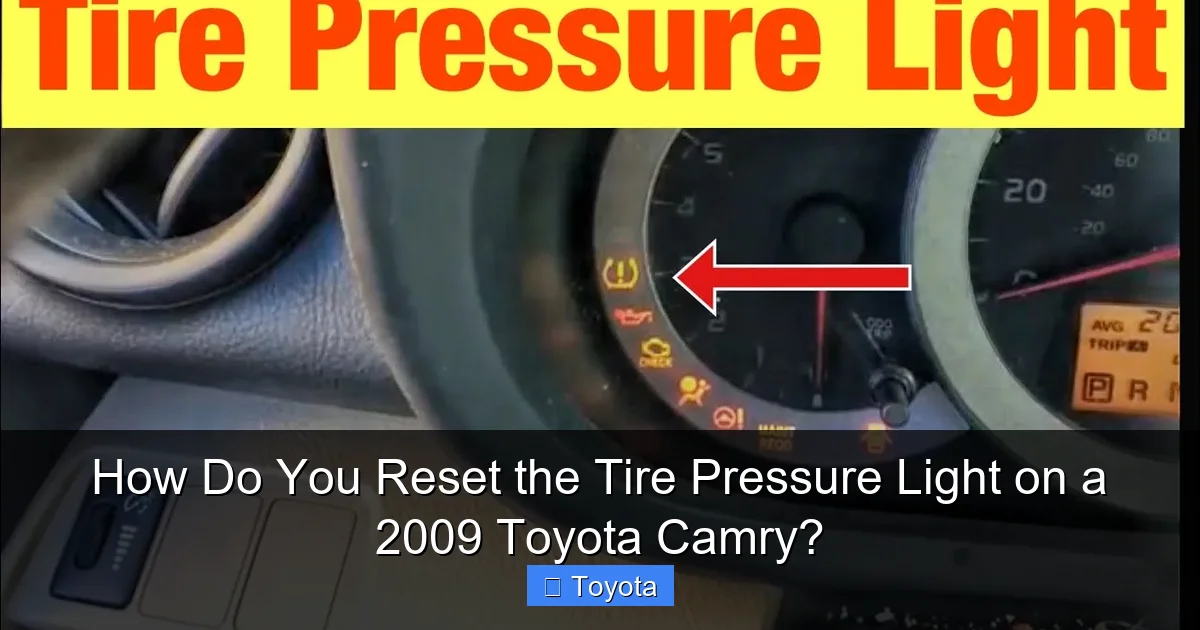
Many Camry drivers make the mistake of inflating the main four tires, resetting the system, and watching the light pop right back on. Several Toyota Camry model years feature a TPMS sensor inside the spare tire located in the trunk. If the spare drops below the safety threshold, the system triggers the dashboard warning light regardless of your main tires.
- Park your Camry on level ground and let the tires cool down for accurate readings.
- Inflate the front and rear tires to the recommended cold PSI (frequently 35 PSI for standard trims).
- Inspect the spare tire pressure if your specific Camry trim level includes a TPMS sensor in the trunk.
- Turn the ignition switch to the ON position without starting the engine before attempting any digital menu resets.
Step-by-Step Guide to Resetting the Tire Pressure Light
Executing the reset procedure on a 2026 Toyota Camry requires following the proper electronic sequence. Before initiating the reset, verify that all four tires and the spare are inflated to the exact cold pressure specifications listed on the driver-side door jamb sticker.
Using the Multi-Information Display (MID)
- Turn the Camry’s ignition switch to the ON position without starting the engine, or press the Push Start button twice without pressing the brake pedal.
- Use the directional control pad on the right side of the steering wheel to navigate the digital instrument cluster.
- Scroll horizontally until you reach the Gear Icon, which represents the vehicle Settings menu.
- Scroll vertically to locate and select the Vehicle Settings or TPMS option.
- Select the Set Pressure or Calibrate sub-menu, then press and hold the center selection button until the tire pressure warning light blinks slowly three times.
- Keep the vehicle ignition in the ON position or drive at speeds above 25 mph for 10 to 20 minutes to allow the sensors to transmit fresh telemetry to the ECU.
What If It Still Doesn’t Work?
If the tire pressure warning light remains illuminated or flashes persistently after completing the reset procedure, a deeper mechanical or electrical fault is likely present. According to automotive service data from the National Highway Traffic Safety Administration (NHTSA), TPMS sensor batteries typically have a lifespan of 5 to 10 years, meaning older sensors or early sensor failures on newer trims can trigger persistent errors. Try these fallback troubleshooting steps:

- Inspect the physical valve stems and sensors for corrosion, damage, or impact from road debris during seasonal tire changes.
- Disconnect the vehicle’s 12-volt negative battery terminal for 15 minutes to perform a hard computer reset, clearing out temporary glitch codes in the body control module.
- Check the pressure in the compact spare tire located in the trunk, as many modern Toyota models feature full TPMS integration for the spare wheel.
- Visit a certified Toyota dealership or professional tire service center to scan individual sensor health using a dedicated OBD-II diagnostic tool.
Professional diagnostic scanning and sensor reprogramming typically ranges from $50 to $150 depending on labor rates. Replacing a faulty OEM sensor generally costs between $100 and $250 including parts and installation.
Conclusion
Clearing a stubborn tire pressure light on a Toyota Camry ensures your vehicle maintains optimal fuel economy, braking performance, and tire longevity. By methodically checking inflation levels, utilizing the digital instrument cluster calibration menu, and addressing potential hardware malfunctions, drivers can safely resolve dashboard warnings. According to verified research and automotive safety experts, maintaining correct tire inflation reduces the risk of tread separation by up to 75 percent. As an actionable next step, invest in a reliable digital pressure gauge and verify your Camry’s tire pressures at least once a month.
❓ Frequently Asked Questions
Why did my Toyota Camry tire pressure light come on suddenly?
Tire pressure naturally drops as outside temperatures fall, typically losing about 1 to 2 PSI for every 10-degree drop in temperature. A sudden pressure loss can also be caused by a slow leak, nail, or damaged valve stem.
How do I reset the TPMS on a newer digital display Camry?
Use the directional pad on the right side of your steering wheel to scroll to the ‘Vehicle Settings’ gear icon on the multi-information display. Navigate to the TPMS or Tire Pressure option, press and hold the center ‘OK’ button until the indicator blinks, and wait for confirmation.
What is the correct tire pressure for a Toyota Camry?
The recommended cold tire pressure for your specific Camry is listed on the placard sticker located on the driver-side door jamb. Standard models usually require between 32 and 35 PSI.
Will disconnecting the car battery reset the tire pressure light?
No, disconnecting the car battery will not clear the TPMS warning light. The vehicle’s computer stores TPMS data in non-volatile memory, meaning the correct pressure must be restored and the reset procedure must be executed.
What should I do if the reset procedure fails completely?
If you have verified correct tire pressures and performed the reset procedure without success, one or more of your tire pressure sensors may have a depleted battery or physical damage. Have a mechanic scan the sensors with a dedicated TPMS tool to identify the failing unit.
Can changing tire sizes affect the TPMS system?
Installing aftermarket tires or wheels with significantly different dimensions or operating pressures can cause compatibility issues with the factory tire pressure monitoring system, leading to persistent warnings.