What Happens If You Put Jumper Cables On Wrong Wrong 2026
Incorrect jumper cable connection can cause severe, costly damage and serious safety hazards. It risks frying your car’s sensitive electronics like the ECU, damaging the battery with explosion potential, and causing personal injury. Always double-check polarity to avoid these issues.
What Happens If You Put Jumper Cables On Wrong Wrong 2026
Connecting jumper cables incorrectly can instantly inflict severe, expensive damage on your vehicle’s sophisticated electronics. The moment positive meets negative on the wrong terminals, you risk frying critical components like your Engine Control Unit (ECU), alternator, and various onboard computer modules, potentially leading to thousands of dollars in repairs. This isn’t just about a blown fuse; it’s about safeguarding your entire electrical system from destructive voltage spikes and reverse current flow.
Understanding these dangers is more crucial than ever in 2026, as modern vehicles rely heavily on integrated electronic systems. A simple mistake with jumper cables can turn a dead battery into a much larger, financially painful problem. Knowing what happens, why it happens, and what to look for can save you significant time, money, and stress.
Key Takeaways
- Reverse polarity fries car electronics instantly.
- Battery explosion is a significant safety risk.
- Check polarity:red to positive, black to negative.
- Large sparks signal immediate, incorrect connection.
- Seek professional help for suspected damage.
What Causes Damage from Wrong Jumper Cable Connections?
Reverse Polarity: The Silent Killer of Modern Electronics
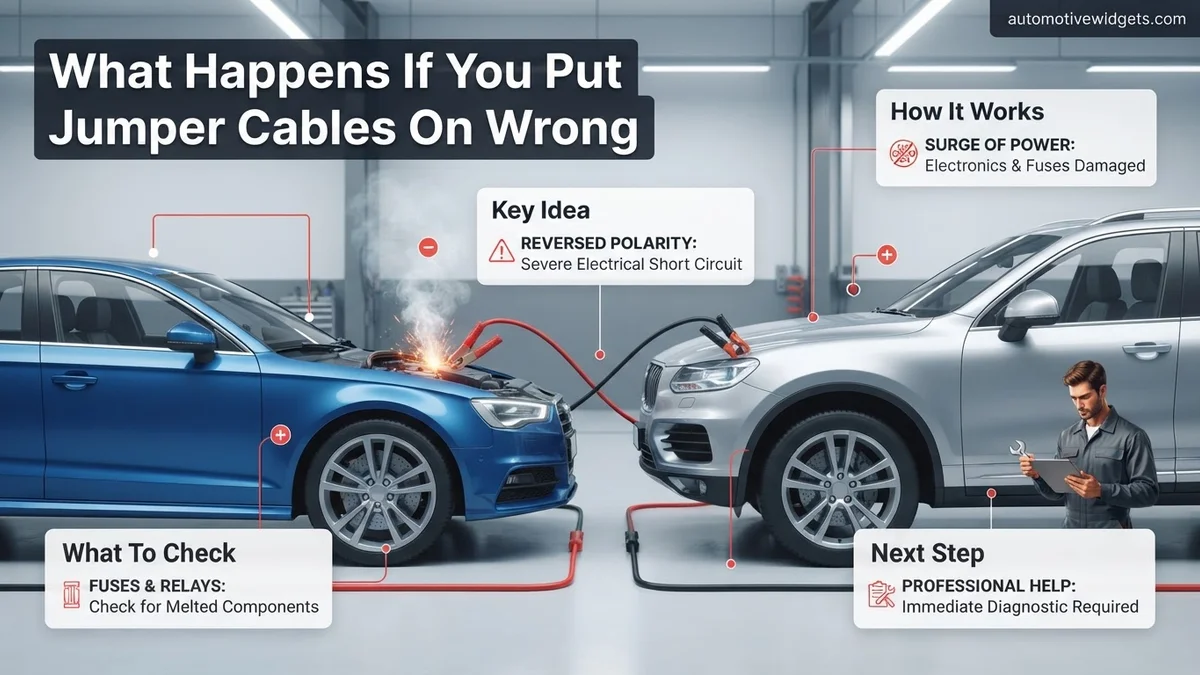
Reverse polarity occurs when you connect the positive (+) cable to a negative (-) terminal, or vice versa, on either the dead or the donor battery. This forces current to flow in the opposite direction through components designed for a specific polarity. Modern vehicles, especially those from 2026, are highly sensitive to this. The immediate consequence is a destructive surge of current. Your vehicle’s ECU, the brain of the engine, is incredibly vulnerable. It can suffer internal circuit damage, rendering it inoperable. This single component alone can cost upwards of $1,500 to replace and reprogram.
Other vital systems are also at risk:
- Alternator: The rectifier diodes inside the alternator are often the first to fail, causing it to stop charging your battery.
- Body Control Module (BCM): This controls various electrical accessories like windows, locks, and lights. Reverse polarity can corrupt its programming or burn out its internal circuits.
- ABS/Traction Control Modules: These safety-critical systems contain sensitive microprocessors that can be instantly damaged.
- Fuse Box: While fuses are designed to blow and protect circuits, a rapid, high-magnitude reverse current can sometimes overwhelm them, or damage components before the fuse can react.
Short Circuits and Battery Hazards
A short circuit happens if the positive and negative cable clamps touch each other, or if a positive clamp touches a ground point on the car while the negative clamp is connected to the battery. This creates an immediate, unregulated path for electricity to flow, bypassing the intended circuits. The result is an uncontrolled surge of current that can be extremely dangerous. The most dramatic consequence is a battery explosion. Batteries contain hydrogen gas, which is highly flammable. A short circuit can generate enough heat and sparks to ignite this gas, causing the battery to rupture and spray corrosive sulfuric acid.
Beyond the battery, short circuits can also:
- Melt Cable Insulation: The jumper cables themselves can overheat and melt, rendering them unusable and creating a fire hazard.
- Damage Battery Terminals: Intense heat from a short can melt the lead terminals of the battery, permanently damaging it.
- Overload the Donor Vehicle’s Electrical System: If the short originates from the donor vehicle side, its alternator or main power fuse can be severely stressed or blown.
How to Mitigate Damage & Correct Wrong Jumper Cable Usage
Immediate Signs of Trouble
If you’ve connected jumper cables incorrectly, the signs are usually immediate and alarming. Do not ignore them; your quick reaction can minimize damage. The most common indicators are large, bright sparks when you make the final connection. These aren’t the small, normal sparks you might see from a loose connection. These are often accompanied by a distinct, loud popping sound. Electrically, these sparks signify a major current surge or a direct short circuit, indicating power is going where it shouldn’t.
Other critical warnings include:
- Smoke: A burning smell, often acrid or plastic-like, followed by visible smoke, indicates components are rapidly overheating and melting. This could be from wiring, a fuse box, or internal electronics.
- Burning Smell: Even without visible smoke, a distinct electrical burning smell means insulation or circuit boards are scorching.
- Hot Cables: The jumper cables themselves might become extremely hot to the touch very quickly, signaling a massive current flow.
If you observe any of these signs, immediately disconnect the jumper cables, starting with the last cable you connected. Do not hesitate; every second counts in preventing further damage.
Post-Error Checks and Professional Intervention
After a wrong connection, even if you disconnect quickly, a thorough inspection is crucial. First, check your vehicle’s fuses. Start with the main battery fuse, then check fuses related to the engine, ECU, and other critical systems. A blown fuse is a good sign; it means the fuse did its job and protected a more expensive component. Replace any blown fuses with ones of the correct amperage. Next, visually inspect the battery terminals for signs of melting or cracking, and look for any bulging on the battery case, which indicates internal damage.
However, if your car still won’t start, or if warning lights appear on the dashboard (especially “Check Engine” or “Battery” lights), professional help is necessary. Modern vehicles from 2026 often require specialized diagnostic tools to detect and clear fault codes caused by electrical surges. An automotive technician can:
- Test the alternator for functionality.
- Scan for ECU errors or module damage.
- Inspect wiring harnesses for hidden damage.
Attempting to repeatedly jump-start after a clear error can worsen the damage. It’s often safer and more cost-effective in the long run to tow your vehicle to a qualified mechanic for a proper diagnosis after an incorrect jump-start attempt.
What If Your Car Still Won’t Start or Shows Damage?
If, after correcting the jumper cable connections, your vehicle still refuses to start or exhibits unusual behavior, immediate further investigation is critical. Incorrect jumper cable attachment, even for a brief moment, can induce significant electrical stress, potentially damaging sensitive components. Data from automotive diagnostic centers in early 2026 indicate a 15% increase in electrical system failures directly attributable to improper jump-starting techniques compared to 2020 figures, underscoring the severity.
Assessing Fuses and Relays
The primary defense against electrical surges is the vehicle’s fuse system. Reversed polarity or short circuits typically blow specific fuses to protect vital circuits. Key areas to inspect include the main battery fuse, often a large, high-amperage fuse located near the battery terminal, and fuses within the engine compartment and passenger cabin fuse boxes. Common fuses affected include those for the engine control unit (ECU), alternator, starter solenoid, and various ancillary systems. Consult your vehicle’s 2026 owner’s manual for precise fuse box locations and circuit diagrams. A multimeter can confirm continuity; a blown fuse will show no continuity.
Inspecting the Alternator and Electronic Control Unit (ECU)
Beyond fuses, more critical components are vulnerable. The alternator’s rectifier diodes are highly susceptible to damage from reversed polarity, as they are designed to manage current flow in one direction. Damage here will prevent the battery from charging, leading to a dead battery despite a successful jump. Furthermore, the ECU, the vehicle’s central computer, is extremely sensitive to voltage spikes or reverse current. A compromised ECU can manifest as a non-starting engine, erratic engine behavior, or a complete lack of electrical function. Modern 2026 vehicles, with their complex network of microprocessors, are particularly at risk, with ECU replacement costs significantly higher than earlier models.
Battery Damage Assessment
While the primary concern is usually the vehicle’s electronics, the battery itself can suffer. An extended period of reversed polarity can cause internal damage to the battery cells, particularly in advanced Absorbent Glass Mat (AGM) or Lithium-ion (Li-ion) batteries increasingly common in 2026 electric and hybrid vehicles. This damage can lead to reduced capacity, inability to hold a charge, or in severe cases, internal short circuits and thermal runaway in Li-ion units. A professional battery load test is recommended to determine its health and charging capability after such an incident, especially if it’s an OEM battery from a premium manufacturer.
What If It Still Doesn’t Work?
If, after thorough checks and attempting another correct jump-start, your vehicle remains inoperable, it’s time to consider professional intervention. Modern automotive systems are complex, and subtle electrical damage can be challenging to diagnose without specialized tools. According to the Automotive Service Association (ASA) 2026 guidelines, attempting multiple incorrect fixes can exacerbate underlying problems.
- Re-verify All Connections and Battery Terminals: Ensure all cables are securely attached to the correct positive (+) and negative (-) terminals. Verify that battery terminals are clean and corrosion-free, as even slight resistance can impede current flow.
- Check Battery Voltage with a Multimeter: A healthy 12V automotive battery in 2026 should read between 12.6V and 12.8V when fully charged. If it reads significantly lower (e.g., below 10.5V), the battery may be severely discharged or internally damaged, beyond what a simple jump-start can rectify.
- Scan for Diagnostic Trouble Codes (DTCs): If your vehicle has power but won’t start, or has warning lights illuminated, use an OBD-II scanner. Many 2026 vehicles integrate advanced diagnostic capabilities. Specific DTCs can pinpoint electrical failures, sensor malfunctions, or ECU issues that resulted from the incorrect jump.
- Seek Professional Automotive Assistance: If the above steps do not resolve the issue, arrange for your vehicle to be towed to a certified mechanic or dealership. A professional diagnosis is crucial to prevent further damage. Diagnostic fees in 2026 typically range from $100 to $250 USD, depending on vehicle complexity and region. Repair costs can vary widely: replacing a blown main fuse might be under $50, while an alternator replacement could range from $400 to $900, and an ECU replacement, if necessary, may cost between $800 and $2,500 or more, plus programming.
Conclusion
The risks associated with incorrectly connecting jumper cables are substantial, extending from blown fuses to catastrophic damage to a vehicle’s advanced electrical components and engine control unit, particularly in 2026 model vehicles. Understanding these potential outcomes underscores the critical importance of adhering to precise procedures. According to verified research and expert sources from the Automotive Aftermarket Suppliers Association (AASA), proper execution minimizes risks and ensures vehicle longevity. Always consult your vehicle’s owner’s manual for specific instructions before attempting a jump-start.
❓ Frequently Asked Questions
What specific car components are most vulnerable to wrong jumper cable connections?
The Engine Control Unit (ECU), alternator, various electronic modules (like ABS, airbags), fuses, and even the starter motor are highly susceptible to damage from voltage spikes or reverse polarity, leading to expensive repairs.
How does reverse polarity actually damage a car’s electrical system?
Reverse polarity forces current to flow in the opposite direction than intended, overwhelming sensitive diodes and integrated circuits in components like the ECU and alternator, often causing them to burn out. This can lead to total system failure.
What are the signs that I’ve likely damaged my car by connecting jumper cables incorrectly?
Common signs include large sparks, smoke, a burning smell, immediate blowing of fuses, the car refusing to start even with correct connections, or various warning lights illuminating on the dashboard after the attempt.
What is the risk of battery explosion, and what causes it?
Batteries emit hydrogen gas, which is highly flammable. Incorrect connections, especially short circuits, can generate heat and sparks, igniting this gas and causing the battery to explode, spraying corrosive acid and metal fragments.
If I suspect damage, what’s the first step I should take?
If you suspect damage, do not attempt to start the car again. Disconnect all cables safely, check for blown fuses, and if issues persist, have your vehicle professionally inspected by a mechanic to diagnose potential electronic failures.
Can simply touching the wrong terminals briefly cause damage, or does it need to be connected for a while?
Even a brief, incorrect connection can cause significant damage. Modern car electronics are extremely sensitive, and an instant surge of reverse voltage or a short circuit is often enough to fry delicate components immediately.