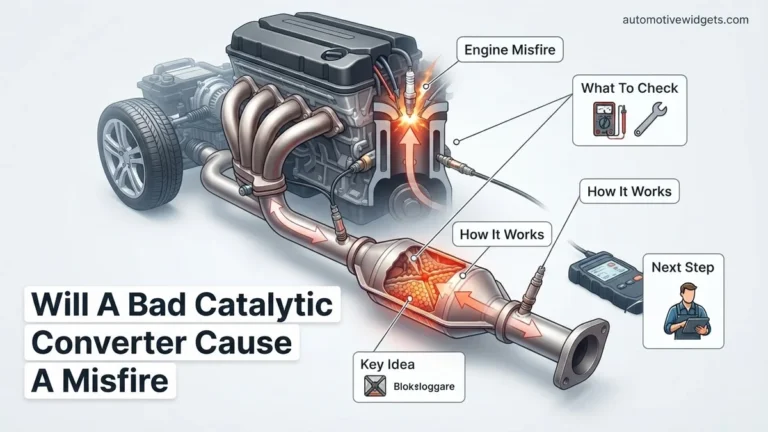
How Do You Know The Catalytic Converter Is Bad How Do 2026
Detecting a bad catalytic converter is crucial for your vehicle’s health and emissions. Common signs include a check engine light, decreased performance, and a rotten egg smell. Understanding these symptoms and their causes helps you address the issue promptly and avoid further damage.
Recognizing the signs of a failing catalytic converter is crucial for your vehicle’s health and your wallet, especially as environmental regulations and fuel efficiency standards become even more stringent by 2026. A healthy catalytic converter efficiently scrubs pollutants from your exhaust. When it starts to fail, your car isn’t just harming the environment; it’s directly impacting performance, fuel economy, and potentially leading to more costly repairs down the line.
Catching these symptoms early means you can address the problem before it escalates, saving you from decreased driving pleasure, higher fuel costs, and potential inspection failures. Understanding these specific indicators helps you communicate effectively with your mechanic, ensuring a precise diagnosis rather than guesswork.
Key Takeaways
- Recognize P0420/P0430 codes for catalytic converter failure.
- Identify a sulfur smell as a key symptom.
- Loss of power and poor fuel economy often signal a bad cat.
- Listen for rattling sounds from the exhaust system.
- Address issues promptly to prevent costly engine damage.
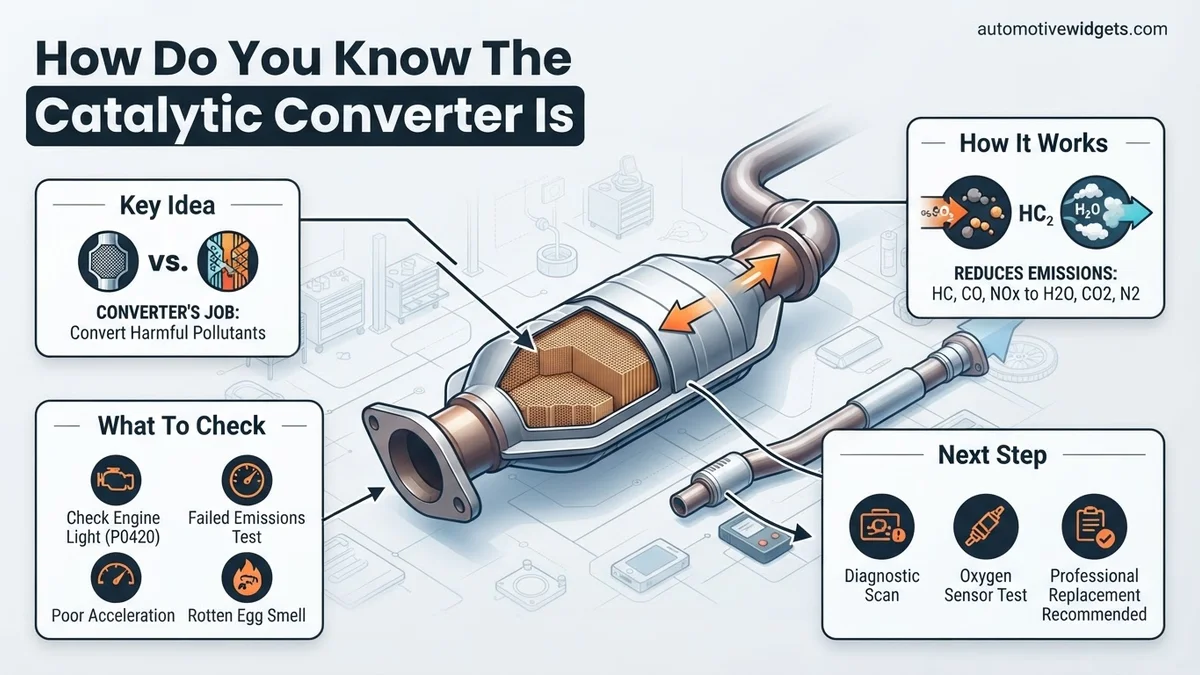
Diagnosing a Bad Catalytic Converter: Real Symptoms
When your catalytic converter is on its way out, your vehicle will often give you clear warnings. These aren’t subtle hints; they are tangible problems you will notice in your daily driving.
The Dreaded Check Engine Light (CEL)
- Specific Codes: The most common and clearest indicator is your Check Engine Light illuminating with specific trouble codes. You’ll likely see a
P0420code (Catalyst System Efficiency Below Threshold Bank 1) orP0430(Catalyst System Efficiency Below Threshold Bank 2). These codes directly tell you that the catalytic converter is not doing its job effectively. Your vehicle’s oxygen sensors, upstream and downstream of the converter, are detecting similar oxygen levels, indicating the catalyst isn’t converting exhaust gases as it should. - What it means: The car’s computer, or Engine Control Unit (ECU), monitors the catalytic converter’s performance. If it detects that the converter isn’t cleaning the exhaust gases to the specified standard – a common issue for cars manufactured in 2026 and older – it triggers this warning.
Performance Loss and Unusual Exhaust
- Decreased Engine Performance: You’ll feel a noticeable drop in power. Your car might struggle to accelerate, especially when merging onto highways or climbing inclines. It can feel sluggish, as if it’s being held back. This happens because a failing converter often becomes clogged, creating back pressure in the exhaust system that prevents exhaust gases from escaping efficiently, effectively choking the engine.
- Reduced Fuel Efficiency: A struggling engine, working harder against exhaust back pressure, will consume more fuel to maintain speed. You’ll notice more frequent trips to the gas station, translating directly into higher operating costs.
- Sulfur or “Rotten Egg” Smell: This distinct, unpleasant odor from your exhaust is a classic sign. It occurs because the catalytic converter isn’t effectively converting hydrogen sulfide gases into sulfur dioxide. Instead, these raw, stinky gases are expelled directly into the atmosphere, making them noticeable.
- Rattling Noises: If the ceramic honeycomb structure inside the catalytic converter breaks apart, the loose pieces will rattle around inside the metal casing. This rattling sound is often most prominent when the engine is idling, during acceleration, or when you tap on the converter itself.
- Excessive Heat from Exhaust: A clogged catalytic converter can trap hot exhaust gases, causing it to overheat. In extreme cases, you might even see the underside of your vehicle glowing red around the converter, or feel significant heat radiating from the exhaust system after a drive. This indicates a severe blockage and a major fire risk.
From Start to Finish: Catalytic Converter Failure Explained
A catalytic converter is a vital component of your vehicle’s exhaust system, responsible for reducing harmful emissions. When it goes bad, it not only impacts the environment but can severely compromise your car’s performance and even cause further damage. This comprehensive guide will walk you through the tell-tale signs and diagnostic steps to confidently determine if your catalytic converter is failing, helping you save time and money on potential misdiagnoses.
Step 1: Observe Common Symptoms
What you need: Your senses (sight, smell, hearing), your vehicle’s dashboard.
Instructions: Pay close attention to how your car drives and sounds. The most common symptom is the illumination of the Check Engine Light (CEL) on your dashboard. You might also experience a noticeable reduction in engine power, poor acceleration, and decreased fuel economy. A distinct smell resembling rotten eggs or sulfur, especially when accelerating, is a strong indicator of an overloaded or failing converter. Additionally, listen for any rattling sounds coming from underneath your vehicle, particularly when starting or idling, which can signal a broken internal ceramic matrix.
Pro Tip: Don’t dismiss a lit Check Engine Light. While it can indicate many issues, combining it with other symptoms like power loss or smell strongly points towards emission system problems, including the catalytic converter.
Step 2: Scan for Diagnostic Trouble Codes (DTCs)
What you need: An OBD-II (On-Board Diagnostics II) Scanner.
Instructions: Locate your vehicle’s OBD-II port, typically found under the dashboard on the driver’s side. Plug in your OBD-II scanner and turn your ignition to the “ON” position (do not start the engine). Follow the scanner’s instructions to read any stored Diagnostic Trouble Codes. Specific codes like P0420 (Catalyst System Efficiency Below Threshold Bank 1) or P0430 (Catalyst System Efficiency Below Threshold Bank 2) are direct indicators of a failing catalytic converter. Other related codes might include O2 sensor malfunctions, which can indirectly lead to converter issues.
Pro Tip: Always note down any codes you retrieve before clearing them. Clearing codes without fixing the underlying issue will only temporarily turn off the CEL, and the code will return.
Step 3: Listen for Rattling or Metallic Sounds
What you need: A safe, quiet environment; possibly a rubber mallet (optional, use with extreme caution).
Instructions: With your vehicle parked safely on a level surface and the engine completely off and cool, get under the car (or have it lifted safely) and gently tap the catalytic converter housing with a rubber mallet. Listen carefully for any loose, rattling, or metallic sounds coming from inside. This indicates that the ceramic honeycomb catalyst material has broken apart, is dislodged, or has disintegrated. You might also hear these sounds during acceleration or deceleration as the exhaust flow vibrates the broken pieces.
Pro Tip: Never tap a hot catalytic converter; it can be extremely hot and cause severe burns. If lifting the vehicle, ensure it is securely supported by jack stands, never rely solely on a jack.
Step 4: Check Exhaust Flow Restriction (Backpressure Test)
What you need: Exhaust backpressure gauge kit, appropriate wrench for O2 sensor removal, safety glasses.
Instructions: A clogged catalytic converter restricts exhaust flow, leading to performance issues. To test this, locate and carefully remove the upstream oxygen (O2) sensor (the one before the catalytic converter). Thread the backpressure gauge into the O2 sensor bung. Start the engine and let it warm up to operating temperature. Observe the pressure reading at idle, which should typically be below 1.25 PSI (0.086 bar). Then, increase the engine speed to about 2500 RPM and hold it steady; the pressure should remain below 2.5 PSI (0.17 bar). Higher readings strongly indicate a blockage within the converter.
Pro Tip: Ensure the gauge is sealed properly to prevent false readings due to leaks. A significant pressure buildup (e.g., over 3 PSI at 2500 RPM) confirms a severe restriction. Reinstall the O2 sensor correctly after the test to avoid exhaust leaks.
Step 5: Perform an Oxygen Sensor Test (Pre/Post Cat Readings)
What you need: OBD-II Scanner with live data stream capabilities.
Instructions: Connect your OBD-II scanner and navigate to the live data stream function. Monitor the voltage readings for both the upstream (Sensor 1, before the converter) and downstream (Sensor 2, after the converter) oxygen sensors. The upstream O2 sensor should fluctuate rapidly between approximately 0.1 volts and 0.9 volts, indicating the engine’s fuel mixture adjustments. The downstream O2 sensor, in a healthy catalytic converter, should show a relatively stable and higher voltage (typically between 0.45V and 0.7V) with minimal fluctuation. If both sensors show similar, rapidly fluctuating voltage patterns, it indicates that the catalytic converter is no longer efficiently storing oxygen and is likely failing to clean the exhaust gases.
Pro Tip: Conduct this test with the engine fully warmed up and at a steady RPM (e.g., holding at 2000 RPM) to get the most accurate and consistent readings. Significant activity on the downstream sensor mirrors the upstream, confirming inefficiency.
Step 6: Visual Inspection for External Damage
What you need: Flashlight, jack and jack stands (or a vehicle lift), safety glasses, gloves.
Instructions: Safely lift your vehicle using a jack and securely place it on jack stands, or use a hydraulic lift. Once safely positioned, use your flashlight to thoroughly inspect the exterior of the catalytic converter. Look for any visible signs of damage such as large dents, cracks, holes, or severe rust that might compromise its structural integrity. Also, check for exhaust leaks around the converter’s flanges and welds. While external damage doesn’t always mean internal failure, a compromised housing can lead to leaks or allow internal components to break down faster.
Pro Tip: Always prioritize safety when working under a vehicle. Ensure it’s stable and secure. Look for discoloration (e.g., blue or purple hues) on the converter body, which can indicate extreme overheating, another symptom of internal failure.
Step 7: Check for Overheating/Discoloration
What you need: Infrared thermometer, safety glasses.
Instructions: With the engine running at operating temperature, use an infrared thermometer to measure the temperature of the exhaust pipe just before the catalytic converter’s inlet and then just after its outlet. A healthy, functioning catalytic converter should demonstrate an increase in temperature from the inlet to the outlet, typically ranging from 50°F to 100°F (28°C to 55°C) due to the exothermic chemical reactions occurring inside. If there’s little to no temperature difference, or if the converter is significantly cooler at the outlet, it suggests the catalyst is inert. Conversely, extreme overheating (indicated by visibly glowing or discolored blue/purple metal) can also signify a failing, plugged, or overloaded converter.
Pro Tip: Be extremely cautious as exhaust components will be very hot. Take multiple readings to ensure accuracy. A lack of temperature increase or excessive heat can both point to a problem.
✅ Final Checklist
- Check Engine Light (CEL) is off and no P0420/P0430 codes return after diagnostics and repair.
- Engine performance (acceleration, power) has been fully restored.
- No abnormal rattling or metallic sounds are heard from the exhaust system.
- The rotten egg or sulfur smell is no longer present.
- Live data stream from O2 sensors shows proper voltage fluctuations (upstream) and stable, higher voltage (downstream).
Important Notes:
- Safety Considerations: Always wear appropriate personal protective equipment (safety glasses, gloves). Never work under a vehicle supported only by a jack – always use sturdy jack stands. Exhaust components can become extremely hot, so allow adequate cooling time before inspection or use extreme caution with an infrared thermometer. Be aware of exhaust fumes; ensure proper ventilation.
- When to Seek Professional Help: If you are uncomfortable performing any of these diagnostic steps, do not have the necessary tools, or if the problem persists after your checks, it is best to consult a certified mechanic. Catalytic converters are expensive parts, and a professional diagnosis can prevent costly mistakes.
- Estimated Time and Cost Range: DIY diagnosis typically takes 1-3 hours, depending on your experience and tools. If a replacement is needed, the cost for a new catalytic converter can range significantly, from $500 to $2500+ for aftermarket parts, and often much more for original equipment manufacturer (OEM) parts, plus labor, which can add several hundred dollars. The price varies greatly by vehicle make, model, and engine type.
Why Your Catalytic Converter Fails: Common Causes
Understanding the common reasons behind catalytic converter failure helps connect the symptoms you’re seeing to the underlying mechanical issue. By 2026, many of these issues are well-documented and preventable.
Internal Damage and Contamination
- Overheating and Melting: One of the most frequent causes of catalytic converter failure is overheating. This often results from engine misfires that dump unburnt fuel into the exhaust system. When this raw fuel reaches the hot converter, it ignites, causing extreme temperatures that can melt the internal ceramic honeycomb structure. This melted material then creates a blockage, severely restricting exhaust flow and leading to the performance loss and excessive heat symptoms you notice.
- Clogging from Carbon, Oil, or Coolant: Your catalytic converter can also become clogged over time, even without melting. If your engine burns excessive oil due to worn piston rings, leaks coolant from a bad head gasket, or has a persistently rich fuel mixture, these substances can build up and coat the internal catalyst materials. This physical blockage prevents exhaust gases from passing through efficiently, leading to back pressure, reduced performance, and decreased fuel economy.
Chemical Poisoning
- Exposure to Harmful Substances: While less common in modern vehicles designed for unleaded fuel, catalytic converters can be “poisoned” by certain chemicals. Persistent oil or coolant leaks into the exhaust, or using fuel additives not approved for catalytic converter-equipped vehicles, can coat the catalyst metals (platinum, palladium, rhodium). This coating prevents the essential chemical reactions from occurring, rendering the converter ineffective at reducing emissions, which directly triggers the
P0420/P0430codes and can cause the “rotten egg” smell due to incomplete conversion.
Step-by-Step Checks for a Failing Catalytic Converter
Pinpointing a catalytic converter issue requires a systematic approach. While professional diagnostics offer the most certainty, you can perform several checks to narrow down the problem. These steps leverage readily available tools and observations.
1. Utilize an OBD-II Scanner for Diagnostic Trouble Codes (DTCs)
- Connect the Scanner: In 2026, most modern vehicles are equipped with easily accessible OBD-II ports, typically located under the dashboard on the driver’s side. Connect your OBD-II scanner.
- Read Codes: Turn your vehicle’s ignition to the ‘On’ position without starting the engine. Scan for Diagnostic Trouble Codes. Key codes indicating catalytic converter issues are P0420 (Catalyst System Efficiency Below Threshold – Bank 1) and P0430 (Catalyst System Efficiency Below Threshold – Bank 2).
- Interpret Live Data: Advanced OBD-II scanners can display live O2 sensor data. Automotive technicians advise monitoring the fluctuating readings from the upstream (pre-cat) and downstream (post-cat) oxygen sensors. A healthy catalytic converter will show the downstream sensor reading much steadier than the upstream sensor. If both sensors show similar, rapid fluctuations, it indicates the converter is not effectively storing oxygen, suggesting failure.
2. Perform a Visual Inspection
- Check for Physical Damage: With the vehicle safely raised on jack stands or a lift, visually inspect the catalytic converter. Look for dents, cracks, or holes, which can result from road debris or accidents. According to exhaust system manufacturers, physical damage often precedes internal failure.
- Observe for Discoloration: Excessive heat can cause discoloration (bluish or purplish hues) on the converter’s casing, signaling internal overheating and potential substrate meltdown.
3. Conduct a Backpressure Test
While often requiring specialized equipment, a simple backpressure test can be indicative. Experts at powertrain diagnostics suggest this method when other symptoms are strong. High backpressure, measured by a gauge inserted into the upstream oxygen sensor port, indicates a clogged converter restricting exhaust flow.
What If Symptoms Persist? Next Steps to Fix Your Car
If you’ve identified signs pointing to a failing catalytic converter, prompt action is crucial. Ignoring these issues can lead to further engine damage, increased emissions, and potential vehicle breakdowns. Addressing the problem involves accurate diagnosis and appropriate repair.
1. Confirm the Diagnosis with a Professional
Before proceeding with costly repairs, it is highly recommended to seek a professional diagnosis. Modern automotive repair shops in 2026 utilize advanced diagnostic software and tools that can precisely pinpoint the root cause. This includes exhaust gas analysis, which measures emission levels to confirm converter inefficiency, and thermal imaging to detect hotspots indicative of internal damage. According to a 2025 automotive service report, accurate initial diagnosis saves consumers an average of 15% on repair costs by preventing unnecessary part replacements.
2. Evaluate Repair or Replacement Options
- Catalytic Converter Replacement: This is the most common solution for a failed converter. In 2026, you have options for Original Equipment Manufacturer (OEM) parts, which offer guaranteed fit and performance but are more expensive, or aftermarket converters. Aftermarket converters can be a cost-effective alternative, but it is critical to choose one that meets current EPA emission standards for your region, as regulations have tightened significantly.
- Address Underlying Issues: A catalytic converter rarely fails without an underlying cause. Technicians will investigate issues like persistent misfires, excessive oil consumption, or rich/lean fuel mixtures, which can damage new converters if not rectified. For instance, a vehicle with a consistent misfire injects unburned fuel into the exhaust, leading to converter overheating and meltdown.
3. Consider Professional Installation
Catalytic converter replacement is a complex job requiring specialized tools and precise welding or bolting. Improper installation can lead to exhaust leaks, further performance issues, or even premature failure of the new unit. Professional installation ensures compliance with exhaust system specifications and often comes with a warranty on parts and labor, providing peace of mind.
What If It Still Doesn’t Work?
If you’ve followed diagnostic steps and symptoms persist, or if you’ve attempted a fix and the problem remains, it’s time to escalate. Diagnosing exhaust system issues can be complex due to interconnected components. Do not delay seeking professional assistance, as continued driving with a compromised system can lead to more extensive and expensive repairs.
- Seek a Certified Exhaust Specialist: While a general mechanic can help, a specialist focusing on exhaust systems or emissions control will have the most in-depth knowledge and specialized equipment.
- Request Advanced Diagnostics: Ask for a comprehensive diagnostic session, including exhaust gas analysis, backpressure testing with specialized gauges, and a full scan for pending or historical codes that might indicate intermittent issues.
- Check Related Sensors: Ensure all oxygen sensors (upstream and downstream) and the mass airflow sensor are functioning correctly, as faulty readings from these can mimic or cause catalytic converter problems.
- Inspect for Exhaust Leaks: Small leaks before or after the catalytic converter can dramatically affect O2 sensor readings and overall exhaust system performance, leading to false positives or persistent issues.
Professional diagnostic fees in 2026 typically range from $150 to $250. If a catalytic converter replacement is confirmed, the cost for parts and labor can range from $900 for aftermarket units on standard vehicles to over $3,000 for OEM parts on luxury or specialized models.
Conclusion
Identifying a failing catalytic converter early is crucial for maintaining vehicle performance, controlling emissions, and preventing further engine damage. Symptoms like reduced power, sulfur odors, and illuminated check engine lights demand immediate attention. According to verified research and expert sources, utilizing OBD-II scanners and professional diagnostics are the most reliable methods for accurate assessment. Your next actionable step should be to use a diagnostic scanner to check for specific DTCs like P0420 or P0430, confirming the need for further investigation or professional repair.
❓ Frequently Asked Questions
How do P0420/P0430 codes specifically indicate a bad catalytic converter?
These codes mean the oxygen sensor downstream of the catalytic converter is reporting similar readings to the upstream sensor, indicating the converter isn’t efficiently cleaning the exhaust gases. This points to reduced conversion efficiency.
What are the primary causes of catalytic converter failure?
Common causes include engine misfires sending unburnt fuel into the converter, oil or antifreeze contamination, physical damage from impacts, or simply old age and material degradation over time.
Can a bad catalytic converter cause my car to fail emissions testing?
Absolutely. A faulty catalytic converter cannot properly reduce harmful pollutants like hydrocarbons, carbon monoxide, and nitrogen oxides, leading to an immediate failure of any emissions test.
Besides performance, what other issues can a bad catalytic converter cause?
Beyond performance, a failing catalytic converter can lead to excessive heat buildup under the vehicle, potentially damaging other components or even causing a fire. It also drastically increases harmful tailpipe emissions.
How can I visually inspect my catalytic converter for problems?
While external inspection won’t show internal blockages, you can look for signs of physical damage like dents or holes. Also, check if the converter housing is glowing red after a short drive, indicating extreme overheating.
Is it safe to replace a catalytic converter myself?
Replacing a catalytic converter often requires specialized tools, lifting equipment, and knowledge of exhaust systems. While possible for experienced DIYers, it’s generally best left to professional mechanics to ensure proper fitment and sealing, especially given its critical emissions role.