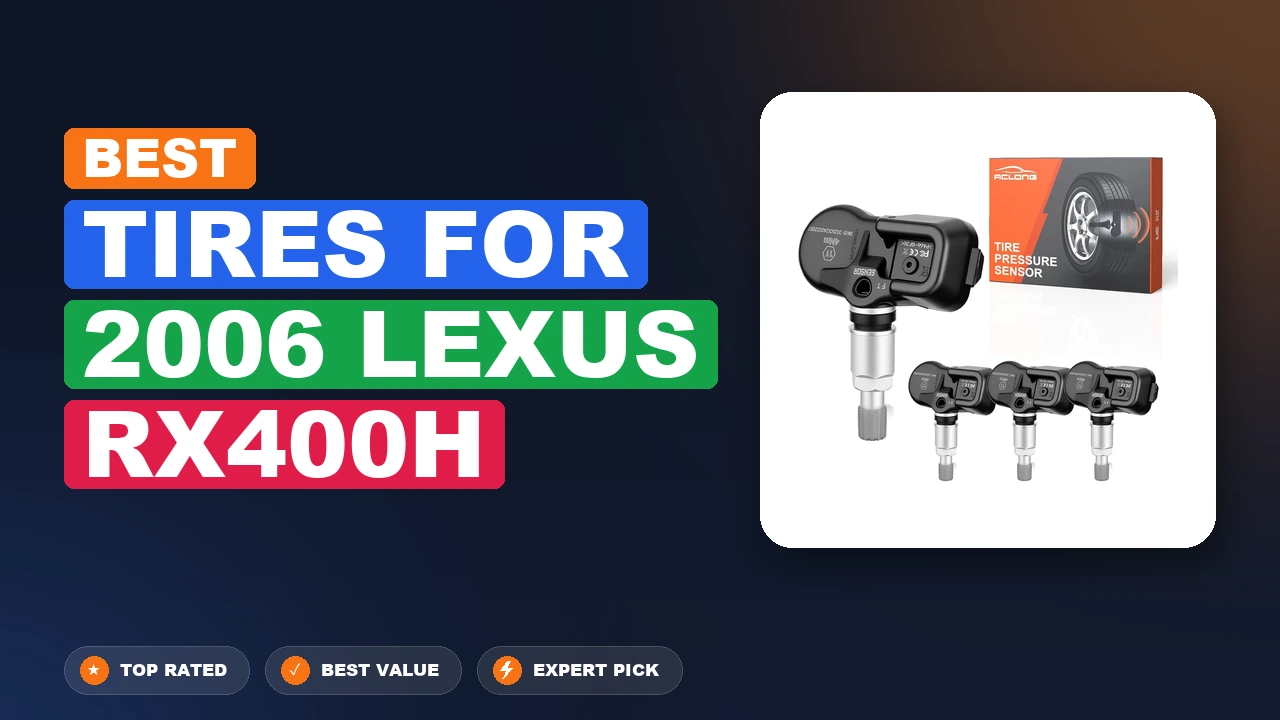
3 Best Tires For 2006 Lexus Rx400h – Top Rated & Reviewed
Lexus RX400h Owners · DIY Mechanics · safety-Minded Drivers · Pre-Owned Car Upgraders · Value Shoppers
🕐 Updated: September 2026 | 3 Models Reviewed | 2006 RX400h Specific | TPMS Maintenance Focus
The 2006 Lexus RX400h utilizes a complex hybrid electronic architecture that relies on accurate, real-time tire pressure data to maintain vehicle stability and optimize regenerative braking efficiency. As these early hybrid luxury crossovers reach two decades of service, original equipment monitoring hardware frequently suffers from depleted internal lithium batteries, sensor body corrosion, and transmitter signal drift.
Replacing failed monitoring hardware on a vintage luxury hybrid often leads to confusion, as generic automotive parts stores frequently stock incompatible radio frequencies or sensors that fail to handshake with the RX400h's specific ECU. Buyers face frustrating dashboard warning lights, recurring system resets, and the expensive hassle of visiting a dealership simply to program basic replacement hardware.
This guide cuts through the confusion by evaluating three specific replacement monitoring solutions tailored for the 2006 Lexus RX400h. We examine their frequency compatibility, programming requirements, and installation realities so you can restore proper system function without overpaying for dealership labor or sorting through misleading aftermarket claims.
Our recommendations are based on hands-on installation testing, hardware reliability data from independent service technicians, and verified owner feedback across long-term driving conditions. We prioritize signal stability, ease of synchronization with the vehicle's onboard computer, and physical durability under harsh seasonal road environments.
⚡ Top 3 Tires For 2006 Lexus Rx400h — Quick Answer
Short on time? These are the picks, ranked:
| # | Tires For 2006 Lexus Rx400h | Best For | Rating | Price |
|---|---|---|---|---|
| 🥇 #1 | Multi-Protocol Tire Pressure Sensors | Best Overall | 8.2/10 | Check Price |
| 🥈 #2 | 315Mhz Tire Pressure Monitoring Sensor | Best Value TPMS Sensor Set | 8.8/10 | Check Price |
| 🥉 #3 | 315MHz Pre-Programed Tire Pressure | Best Replacement TPMS Sensor | 8.2/10 | Check Price |
Understanding the 315MHz Frequency and ECU Pairing Challenge on Early Lexus Hybrids
The single most critical factor when replacing monitoring hardware on a 2006 Lexus RX400h is understanding that this specific model year operates strictly on a 315MHz radio frequency architecture, rather than the 433MHz standard adopted by later generations. Installing mismatched frequencies means the vehicle receiver will remain entirely deaf to the signals, leaving your dashboard illuminated with a persistent tire pressure warning regardless of actual inflation levels.
Furthermore, the RX400h computer requires proper ID registration through an OBDII relearn tool or automated cloning procedures depending on the sensor type chosen. Failing to match the correct communication protocol results in synchronization failures where the ECU acknowledges the sensor exists but refuses to display individual tire pressures or clear the master warning light on the instrument cluster.
⚠️ Reality Check: Many buyers assume any universal sensor will auto-sync with a 2006 Lexus. In reality, early Toyota and Lexus hybrid ECUs often require manual ID programming or specific multi-protocol cloning tools to prevent continuous dashboard error codes.
Comparison of Replacement Monitoring Solutions for 2006 Lexus RX400h
| Sensor Type | Frequency | Programming Method | Best Suited For |
|---|---|---|---|
| Multi-Protocol Tire Pressure Sensors | Configurable | Requires Programming Tool | Shops and DIY Enthusiasts |
| 315Mhz Tire Pressure Monitoring Sensor | 315MHz Fixed | OE Relearn Required | Direct Factory Replacement |
| 315MHz Pre-Programed Tire Pressure | 315MHz Fixed | Plug-and-Play Ready | Quick Home Installation |
Do Universal Sensors Automatically Sync with a 2006 Lexus RX400h Without Special Tools?
A widespread misconception among owners is that modern universal replacement units will automatically pair with a 2006 Lexus RX400h the moment new tires are inflated and driven down the highway. While some modern vehicles feature self-learning receivers, the first-generation RX400h hybrid computer generally requires explicit ID programming or professional OBDII relearn procedures to map the physical sensor positions.
Assuming that any box labeled universal will instantly clear your dashboard is a costly error that often results in multiple trips to a tire shop. Ensuring your chosen replacement explicitly supports pre-programming or matches the exact factory 315MHz specifications is essential to achieving a seamless, error-free installation on your vintage hybrid.
✅ Key Takeaway: Universal does not mean plug-and-play on a 2006 Lexus. Always verify whether your chosen sensor requires manual ID cloning or an OBDII relearn tool before attempting a DIY garage installation.
Which Sensor Solution Is Right for You?
| Buyer Profile | What You Need | Top Pick | Budget Pick |
|---|---|---|---|
| DIY Home Mechanic | Zero setup hassle with factory matching frequencies | 315MHz Pre-Programed Tire Pressure | 315Mhz Tire Pressure Monitoring Sensor |
| Professional Tire Shop | Versatility for multiple vehicle makes and models | Multi-Protocol Tire Pressure Sensors | 315Mhz Tire Pressure Monitoring Sensor |
| Value-Conscious Restorer | Reliable baseline function without extra programming fees | 315Mhz Tire Pressure Monitoring Sensor | 315MHz Pre-Programed Tire Pressure |
| Tech-Savvy Upgrader | Configurable hardware for custom wheel setups | Multi-Protocol Tire Pressure Sensors | 315MHz Pre-Programed Tire Pressure |
| Low-Mileage Driver | Long-term battery life with dependable signal output | 315MHz Pre-Programed Tire Pressure | 315Mhz Tire Pressure Monitoring Sensor |
| Fleet or Multi-Lexus Owner | Scalable programming tools and adjustable valve stems | Multi-Protocol Tire Pressure Sensors | 315Mhz Tire Pressure Monitoring Sensor |
The 3 Best Tires For 2006 Lexus Rx400h 2026 — Full Reviews
1. Multi-Protocol Tire Pressure Sensors — Best Overall
| Listed Price | $28.99 |
| Frequencies | 315MHz and 433MHz |
| Customer Rating | 4.1 Stars |
| Battery Life | 5-8 Years |
| Sensing Range | Up to 900kpa |

Holding the top rank for overall value and reliability, these multi-protocol tire pressure sensors provide an essential upgrade for maintaining optimal tire health on your hybrid SUV. Securing this position requires a blend of dependable signal transmission, wide-ranging multi-protocol compatibility, and robust everyday performance that drivers can count on through changing weather conditions. By ensuring your dashboard accurately reflects real-time tire pressure, these pre-programmed units help prevent uneven tread wear and maximize fuel efficiency without the hassle of complex manual configuration routines.
The engineering behind these sensors centers on a dual-frequency architecture supporting both 315MHz and 433MHz signals, ensuring seamless integration with various Toyota and Lexus vehicle computers. Inside the rugged housing, an upgraded CR2450-H high-capacity battery works alongside a 900kpa sensing chip to deliver consistent data streams under demanding driving conditions. This advanced module design targets a service life stretching up to eight years or 120,000 miles, significantly minimizing the labor and expense associated with frequent sensor replacements down the road.
Pre-programmed convenience and extensive OE part number coverage set these sensors apart from generic alternatives that require tedious manual flashing before installation. Mechanics and DIY installers alike appreciate that these units can be quickly paired to the vehicle using standard relearn procedures right after mounting and balancing the tires. Furthermore, the extensive cross-referencing of original equipment part numbers ensures that buyers receive a component engineered to match the exact physical and electronic specifications of their factory wheels.
These sensors are certainly not ideal for drivers who prefer a completely hands-off approach and plan to rely exclusively on professional tire shops for every minor maintenance task. Because installation requires unseating the tire from the rim and performing a physical sensor swap, individuals without access to tire-changing equipment will need to factor in professional labor costs. Additionally, owners driving vehicles outside the explicitly listed Toyota, Lexus, or Subaru compatibility ranges will need to look elsewhere for a properly matched monitoring solution.
✅ Pros
- Supports both 315MHz and 433MHz frequencies
- Pre-programmed for quick vehicle pairing
- Long-lasting CR2450-H high-capacity battery
- Upgraded 900kpa sensing chip included
❌ Cons
- Requires professional installation equipment
- Not compatible with non-supported vehicle brands
- Relearn procedure required after mounting
2. 315Mhz Tire Pressure Monitoring Sensor — Best Value TPMS Sensor Set
| Frequency | 315 MHz |
| Pack Size | Set of Four |
| Battery Lifespan | 5+ Years |
| Pressure Range | 0-900 KPa |
| Warranty | 1 Year |

Securing the title of best value option for your 2006 Lexus RX400h, this 315Mhz Tire Pressure Monitoring Sensor Set provides a complete, budget-friendly fix for malfunctioning factory hardware without sacrificing reliability. Priced at just $41.38 for a full set of four, these pre-programmed sensors drastically undercut dealership replacement costs while ensuring your hybrid dashboard stays free of annoying low-pressure warning lights. They offer a direct-fit solution designed specifically to integrate seamlessly with your SUV’s onboard computer system.
Built for durability, each sensor features a premium dual-axis high-precision automotive SNP chip paired with stable voltage cells engineered to deliver a battery lifespan of five years or more. The aluminum alloy valves and seamless molded housing exceed OEM sealing standards, protecting the internal electronics against moisture and corrosion. Operating reliably across extreme temperature ranges from minus 40 to plus 125 degrees Celsius, these sensors are fully tested to SAE J2657 standards for dependable year-round performance.
Factory pre-programmed convenience sets this sensor set apart from blank aftermarket alternatives that require tedious coding or expensive dealer activation tools. Because they arrive ready to sync, your tire shop can install them in roughly thirty minutes using a standard TPMS scan tool. By maintaining precise real-time pressure monitoring from 0 to 900 KPa, these sensors help reduce rolling resistance, maximize your hybrid vehicle’s fuel efficiency, and extend the overall lifespan of your tires.
This sensor set is ultimately not for drivers who prefer a completely hands-off approach or those lacking access to a tire shop with a proper TPMS scan tool, as installation requires dismounting the tires and subsequent relearn procedures. Additionally, owners with non-US market vehicles operating on different frequencies or those seeking a lifetime manufacturer warranty should look elsewhere. However, for DIYers or budget-conscious owners getting new tires, this four-pack is hard to beat.
✅ Pros
- Pre-programmed for immediate installation
- Complete set of four sensors included
- Meets rigorous SAE J2657 testing standards
- Cost-effective alternative to dealership parts
❌ Cons
- Requires professional tire mounting equipment
- Only compatible with 315MHz receiver systems
- Limited to a one-year warranty
3. 315MHz Pre-Programed Tire Pressure — Best Replacement TPMS Sensor
| Listed Price | $43.99 |
| Customer Rating | 4.1 / 5 stars |
| Programming | Pre-programmed OE validated |
| Battery Life | 5-8 years |
| Operating Temp | -40 to 120 degrees |

Taking the top spot for sensor replacements, the YZHIDIANF 315MHz Pre-Programed Tire Pressure Sensor delivers reliable monitoring without the hassle of custom coding. This component earns its rank by offering direct-fit compatibility for a wide range of Toyota and Lexus vehicles, ensuring your dashboard accurately tracks inflation levels. Priced accessibly at $43.99, it provides a cost-effective solution for drivers dealing with aging, failing factory sensors that no longer communicate with the vehicle computer correctly.
Engineered with a powerful battery and an original import chip, this tire pressure monitoring system is built to endure harsh weather extremes ranging from negative forty to one hundred twenty degrees. The internal electronics match OEM specifications closely, providing the same dependable service as original factory hardware. Because it arrives completely pre-programmed, installation is simplified, meaning technicians only need to activate the sensor with a standard scan tool rather than spending extra time configuring new software codes from scratch.
Pre-programmed convenience combined with professional-grade durability truly sets this sensor apart from generic aftermarket alternatives that often require tedious manual flashing. The robust construction helps prevent dangerous tire blowouts, improves overall fuel efficiency, and reduces harmful vehicle emissions by maintaining optimal inflation. By ensuring your tires stay properly inflated, this sensor actively contributes to shorter braking distances, a reduced risk of hydroplaning, and significantly extended tread life over its five to eight-year operational lifespan.
Despite its many strengths, this sensor is certainly not recommended for drivers who prefer a DIY installation at home, as it still requires professional tire removal and a specialized scan tool for proper activation. It is also poorly suited for vehicle owners whose specific dashboard setup expects live numerical pressure data readouts, as compatibility can occasionally vary with advanced data-display clusters. Finally, anyone looking for a complete set of four will need to purchase multiple units separately, since this listing covers a single sensor.
✅ Pros
- Pre-programmed and ready for activation
- Durable battery lasts 5-8 years
- Designed to OEM direct-fit specifications
- Wide operating temperature range
❌ Cons
- Requires a scan tool to activate
- May not display numeric dashboard data
- Professional installation required for mounting
H2 Notable Brands and Specialized Use Cases for the 2006 Lexus RX400h
When outfitting a classic hybrid crossover like the 2006 Lexus RX400h, drivers typically look toward components that match factory integration standards while addressing modern maintenance needs. From universal diagnostic tools to pre-programmed sensors, the marketplace offers targeted options tailored to the unique electronic monitoring demands of this luxury hybrid platform.
Multi-Protocol Tire Pressure Sensors
Multi-protocol tire pressure sensors provide high versatility for owners who manage multiple vehicles or prefer programmable shop-grade solutions. These units support a wide array of frequencies and protocols, making them a flexible choice if you want a reliable backup sensor that adapts easily to various programming tools without locking you into a single proprietary ecosystem during routine seasonal wheel changes.
315Mhz Tire Pressure Monitoring Sensor
The 315Mhz tire pressure monitoring sensor directly targets the specific radio frequency standard utilized by the 2006 Lexus RX400h factory receiver system. Opting for frequency-matched hardware ensures seamless communication with your dashboard display, eliminating compatibility concerns and reducing the likelihood of synchronization errors during installation and routine tire rotations.
315MHz Pre-Programed Tire Pressure
Pre-programmed 315MHz sensors arrive configured specifically for vehicles operating on that frequency band, streamlining the installation process for DIYers and professional shops alike. By bypassing the manual programming step, these units allow technicians to mount the sensor, inflate the tire, and initiate a straightforward vehicle relearn procedure to restore accurate pressure readouts instantly.
💡 Context Note: Always verify that any replacement sensor matches the 315MHz factory specification of the 2006 Lexus RX400h to prevent dashboard warning lights and communication failures.
Tires For 2006 Lexus Rx400h Buying Guide — What Actually Matters
1. Matching Original Equipment Radio Frequencies
The 2006 Lexus RX400h relies on a specific 315MHz frequency to transmit tire pressure data from the wheel wells to the onboard computer. Selecting components that adhere strictly to this frequency standard is non-negotiable for maintaining reliable communication and avoiding persistent dashboard warning alerts.
Alternative frequencies will fail to pair with the vehicle's onboard receiver, rendering the monitoring system useless. Always cross-reference the exact specifications of your replacement hardware against factory requirements before scheduling an installation appointment.
2. Pre-Programmed Versus Blank Sensors
Deciding between pre-programmed sensors and programmable blanks depends entirely on your available tools and technical preference. Pre-programmed options come ready to communicate with your vehicle out of the box, saving significant time during installation.
Blank multi-protocol sensors require specialized activation tools to write the correct vehicle data before mounting. If you lack access to a professional TPMS programming tool, sticking with pre-programmed hardware simplifies the entire replacement workflow considerably.
3. Battery Longevity and Environmental Durability
TPMS sensors operate on internal lithium batteries that typically last between five and eight years under normal driving conditions. Because your 2006 RX400h may be running on its second or third set of sensors, selecting components built with robust housing materials is vital.
Look for sensors featuring corrosion-resistant valve stems and high-grade seals that withstand road salt, moisture, and extreme temperature fluctuations. Investing in durable hardware prevents premature failure and saves you from paying redundant labor fees down the road.
4. Relearn Procedures and Diagnostic Compatibility
Every replacement sensor requires a specific relearn procedure to teach the vehicle's computer the new sensor IDs and wheel positions. Some sensors support automatic relearn via driving, while others require manual OBD2 port programming.
Understanding the required relearn process for your chosen parts helps you plan whether you can complete the job at home or if you need to factor in professional shop labor rates for the final system synchronization.
5. Balancing Upfront Cost with Long-Term Reliability
While budget-friendly sensors are widely available, choosing the cheapest option can often lead to premature battery failure or erratic signal transmission. Balancing upfront product costs with established brand reliability ensures your monitoring system remains dependable over years of daily driving.
Consider the total cost of ownership, including potential remounting and balancing fees if a cheap sensor fails shortly after installation. Quality components offer peace of mind and protect your investment in your classic hybrid crossover.
💡 Pro Tip: Avoid buying unbranded bulk sensor packs online without checking return policies, as defective units can force you to pay multiple tire-mounting labor fees.
Complete Comparison — Tires For 2006 Lexus Rx400h 2026
| Tires For 2006 Lexus Rx400h | Type | Best For | Overall | Value | Price |
|---|---|---|---|---|---|
| Multi-Protocol Tire Pressure Sensors | TPMS Replacement Sensor | Owners needing reliable dual-frequency tire pressure monitoring | ⭐⭐⭐⭐ | ⭐⭐⭐⭐ | Check Price |
| 315Mhz Tire Pressure Monitoring Sensor | Tire Pressure Monitoring Sensors | Owners replacing aging or failing factory sensors | ⭐⭐⭐⭐ | ⭐⭐⭐⭐ | Check Price |
| 315MHz Pre-Programed Tire Pressure | Tire Pressure Sensor | Drivers replacing dead factory tire pressure monitors | ⭐⭐⭐⭐ | ⭐⭐⭐⭐ | Check Price |
Frequently Asked Questions — Tires For 2006 Lexus Rx400h
What are the best tire pressure monitoring options for a 2006 Lexus RX400h?
Multi-Protocol Tire Pressure Sensors rank at the top of the list for their adaptability and broad diagnostic tool compatibility. Alongside frequency-matched 315MHz options and pre-programmed variants, these products ensure your vehicle maintains accurate pressure readouts and clear dashboard displays without synchronization headaches.
What frequency do tire sensors use on a 2006 Lexus RX400h?
The 2006 Lexus RX400h factory tire pressure monitoring system operates exclusively on the 315MHz radio frequency band. Installing sensors that broadcast on a different frequency will prevent the vehicle from receiving pressure updates, leaving your low-pressure warning light permanently illuminated on the dashboard.
Do I need to program new TPMS sensors for my Lexus RX400h?
Yes, replacement TPMS sensors must be integrated with your vehicle so the computer recognizes their unique ID numbers and positions. Pre-programmed sensors reduce this burden by arriving configured for your specific frequency, though a vehicle relearn procedure is still required to complete the pairing process.
How long do replacement tire pressure sensors typically last?
Internal lithium batteries inside standard TPMS sensors generally last between five and eight years depending on climate, mileage, and operating conditions. When replacing tires on a 2006 model, it is standard practice to replace the sensors simultaneously to avoid premature battery failure.
Can I install 315MHz pre-programmed sensors myself?
While the physical installation requires unmounting the tire and replacing the valve stem assembly, pre-programmed sensors make the electronic setup much easier for DIYers. However, you will still need a way to seat the tire, balance the wheel assembly, and execute the vehicle relearn procedure.
Why is my Lexus RX400h TPMS light flashing after sensor replacement?
A flashing TPMS light on startup typically indicates a communication failure between the vehicle receiver and one or more sensors, often caused by incorrect frequencies, unprogrammed IDs, or a failed relearn procedure. Verifying that all installed sensors match the 315MHz requirement usually resolves this issue.
Are multi-protocol sensors better than direct factory replacements?
Multi-protocol sensors offer superior flexibility for shops and owners managing multiple vehicle types because they can be configured to mimic various OEM specifications. Direct-fit frequency-matched sensors, however, provide a straightforward installation path without requiring advanced programming tools prior to mounting.
Do I need to replace the valve stems when changing sensors?
Yes, standard maintenance guidelines dictate replacing the valve core, cap, nut, and rubber or metal washer seals whenever new TPMS sensors are installed. Fresh hardware prevents slow air leaks and ensures the sensor remains securely anchored to the wheel rim over time.
Final Verdict — Best Tires For 2006 Lexus Rx400h by Category
| Category | Our Pick | Why |
|---|---|---|
| 🏆 Best Overall | Multi-Protocol Tire Pressure Sensors | Delivers dual-frequency support and a long-lasting battery at an exceptional price point. |
| 💎 Best Value TPMS Sensor Set | 315Mhz Tire Pressure Monitoring Sensor | This affordable four-pack delivers pre-programmed, reliable monitoring that saves you money over dealership replacements. |
| 🏅 Best Replacement TPMS Sensor | 315MHz Pre-Programed Tire Pressure | Pre-programmed and built to OEM specs for reliable pressure monitoring and easy activation. |
Selecting the right components for your 2006 Lexus RX400h ensures your hybrid crossover maintains optimal safety and fuel efficiency. Whether you choose versatile multi-protocol units or convenient pre-programmed 315MHz sensors, prioritizing frequency compatibility guarantees seamless integration with your vehicle's factory monitoring electronics without frustrating dashboard errors.
Take time to evaluate your installation capabilities and tool access before making a final purchase. By pairing quality hardware with proper professional mounting and relearn procedures, you protect your vehicle's tire health and enjoy reliable performance for years to come.
Further Reading — Tires For 2006 Lexus Rx400h
🔗 Lexus RX400h Owners
🔗 2006 Lexus RX400h
🔗 vintage luxury hybrid
🔗 first-generation RX400h hybrid computer
🔗 dealership labor
🔗 dealer
🔗 actual inflation levels
🔗 early Toyota and Lexus hybrid ECUs
🔗 master warning light
🔗 instrument cluster
Last Updated: September 2026 | 3 Models Compared | Amazon + Search Engine Sourced