Can A Bad Alternator Cause Transmission Issues Bad 2027
Yes, a failing alternator can absolutely lead to significant transmission problems due to inconsistent or insufficient electrical power. Modern transmissions rely heavily on stable voltage for their control modules, sensors, and solenoids, making them vulnerable to alternator malfunctions. This can result in erratic shifting, limp mode, or even preventing proper gear engagement.
Yes, a failing alternator absolutely can cause significant transmission problems in your 2027 vehicle. This might sound counter-intuitive at first, as alternators are traditionally associated with starting and charging the battery, while transmissions handle gear changes. However, modern automatic transmissions, particularly the advanced units found in vehicles today, are incredibly reliant on a stable and sufficient electrical supply. Ignoring a declining alternator can lead to expensive and frustrating transmission-like symptoms, making proper diagnosis critical for any vehicle owner.
Understanding this direct link can save you substantial time and money, preventing unnecessary transmission repairs when the root cause lies with your electrical system. Your transmission’s complex electronics, from its control module to its internal solenoids, demand consistent power to operate correctly. When that power wavers, the transmission often becomes a primary victim, manifesting symptoms that mimic severe internal failures.
Key Takeaways
- Bad alternators disrupt transmission electronics.
- Unstable voltage causes erratic shifting.
- Low power triggers transmission limp mode.
- Diagnose alternator before transmission repairs.
- Early diagnosis saves significant costs.
What Causes Transmission Issues from a Bad Alternator?
The Transmission’s Electrical Lifeline
In 2027, your vehicle’s automatic transmission is a masterpiece of electromechanical engineering, not just a set of gears and fluid. Its “brain” is the Transmission Control Module (TCM), a dedicated computer that precisely manages gear selection, shift timing, and line pressure. The TCM relies on a network of sophisticated sensors to monitor vehicle speed, engine load, throttle position, and fluid temperature. Based on this data, the TCM sends electrical signals to solenoids, which are electronic valves that direct transmission fluid to engage or disengage clutches and bands. Each of these components—TCM, sensors, and solenoids—requires a consistent, regulated electrical current, typically 12 volts, to function correctly. Any deviation from this stable voltage can disrupt the entire system.
How Low Voltage Creates Havoc
When your alternator begins to fail, it struggles to generate and supply the necessary electrical power to your vehicle’s systems. This leads to a cascade of problems, directly impacting the transmission. With insufficient or unstable voltage, the TCM cannot accurately process data from sensors or send precise commands to the solenoids. You might experience:
- Erratic Shifting: Solenoids may not open or close fully, leading to harsh, delayed, or premature shifts.
- Delayed Engagement: The transmission might hesitate when shifting into Drive or Reverse.
- “Limp Home” Mode: Many 2027 transmissions are programmed to enter a protective “limp mode” when they detect severe electrical anomalies or power shortages. This typically limits the vehicle to a single gear (often 2nd or 3rd) to prevent further damage.
- Sensor Malfunctions: Low voltage can cause sensors to send incorrect readings, confusing the TCM and leading to incorrect shift logic.
- Intermittent Problems: Because the electrical supply might fluctuate, the transmission issues can be inconsistent, appearing and disappearing seemingly at random, making diagnosis frustrating.
Step-by-Step: Diagnosing Alternator-Related Transmission Problems
Recognizing Transmission Symptoms
If your alternator is struggling, your transmission might exhibit several tell-tale signs that could initially be mistaken for an internal transmission failure. Recognizing these symptoms is the first step in proper diagnosis. Look out for:
- Harsh or Jerky Shifts: Particularly noticeable during acceleration or deceleration, the shifts might feel uncomfortably firm or abrupt.
- Delayed Engagement: A noticeable pause when shifting from Park to Drive, or Park to Reverse, where the vehicle takes a few seconds to engage the gear.
- Erratic Gear Changes: The transmission might “hunt” for gears, shift up or down unexpectedly, or get stuck in a single gear more often than just in limp mode.
- Vehicle Entering Limp Mode: Your dashboard might display a warning light, and the vehicle’s performance will be severely restricted to a safe, low-power mode, often preventing it from shifting past a certain gear.
- Dashboard Warning Lights: Beyond a potential “Check Engine” or transmission-specific light, you might also see an ABS, traction control, or even a battery warning light illuminate concurrently.
Pinpointing Alternator Warning Signs
Before, or often alongside, the transmission issues, a failing alternator will almost always show other symptoms that point directly to an electrical problem. These are critical clues that help differentiate an alternator fault from an actual transmission internal issue. Pay attention to:
- Battery Warning Light: This is the most direct indicator, often illuminating on your dashboard as a battery icon. It means the charging system is not functioning correctly.
- Dim or Flickering Lights: Your headlights, interior lights, or dashboard lights might appear dim, flicker, or fluctuate in brightness, especially at idle or low RPMs.
- Electrical Accessory Malfunctions: Power windows might operate slowly, the radio might cut out, or the air conditioning might blow less powerfully.
- Difficulty Starting: Your vehicle may crank slowly or struggle to start because the battery isn’t receiving a sufficient charge. A dead battery, even if new, is a strong indicator of a charging system failure.
- Whining or Grinding Noises: A failing alternator can sometimes produce mechanical noises from under the hood, indicating worn bearings or other internal issues within the unit itself.
How to Fix Transmission Issues Caused by a Failing Alternator
Addressing transmission irregularities directly linked to a failing alternator requires a focused diagnostic and repair approach. According to data from industry service providers like AAA and ASE certified technicians, prompt identification and replacement are crucial to prevent further system damage. Current diagnostic protocols for 2027 emphasize multi-point electrical system checks.
Identifying the Alternator Problem
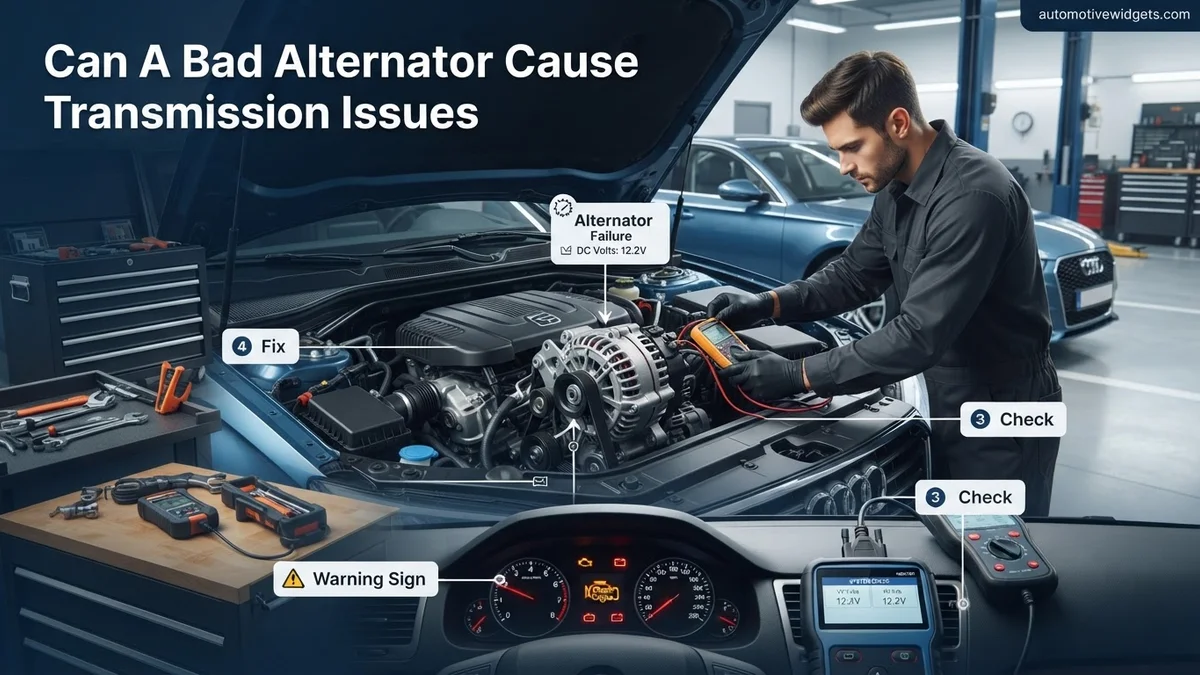
- Voltage Output Test: Use a digital multimeter to measure the battery voltage with the engine off (should be around 12.6V) and then with the engine running (should be 13.5V to 14.7V). A reading outside this range, especially below 13.0V, strongly indicates an alternator fault.
- Diagnostic Trouble Codes (DTCs): Connect an OBD-II scanner to check for codes related to charging system malfunctions (e.g., P0562 – System Voltage Low) or specific transmission control module (TCM) communication errors, which can indirectly point to power supply issues.
- Load Test: A specialized load tester can assess the alternator’s ability to maintain stable voltage under electrical load (e.g., headlights, AC, radio on). Significant voltage drops under load confirm inadequate output.
Replacing the Alternator
Once a failing alternator is confirmed, replacement is the standard procedure. For most modern vehicles as of 2027, the process typically involves disconnecting the battery, removing the drive belt, unbolting the alternator, and disconnecting electrical connections. Installation is the reverse. Professional replacement costs, including parts and labor, generally range from $500 to $900, depending on vehicle make and model complexity. Reputable mechanics often use remanufactured units meeting OEM specifications for cost-effectiveness without compromising quality, backed by a typical 12-month/12,000-mile warranty.
What If Transmission Problems Persist After Alternator Repair?
Even after a documented alternator replacement, persistent transmission anomalies indicate that the initial electrical disruption may have caused secondary damage or that another underlying issue exists. As of 2027, vehicle systems are highly integrated, meaning a cascading failure is possible. Comprehensive post-repair diagnostics are essential.
Secondary Electrical System Checks
A failing alternator can send erratic voltage spikes or low voltage signals, potentially damaging sensitive electronic components. Post-alternator replacement, it is imperative to:
- Inspect Wiring Harnesses: Visually check for burnt, corroded, or frayed wires leading to the transmission control module (TCM) and transmission solenoids. Erratic voltage can cause insulation breakdown.
- Test Battery Health: A prolonged period with a failing alternator can degrade the battery. A weakened battery, even with a new alternator, can still cause power fluctuations that affect transmission operation. Perform a comprehensive battery health check.
- Scan for Latent DTCs: Use an advanced diagnostic tool to check for any residual or new transmission-specific trouble codes (e.g., P0700 series codes). These might have been masked by the primary alternator issue or triggered by continued operation under stress.
Transmission System Evaluation
If electrical checks yield no new faults, the transmission itself may require attention:
- Fluid Level and Quality: Verify transmission fluid level and inspect its condition for signs of burning, metallic particles, or extreme discoloration. Low or degraded fluid is a common cause of shifting issues.
- Solenoid Functionality: Modern transmissions rely on electronic solenoids for gear changes. Erratic voltage from a faulty alternator could potentially damage these components, leading to rough shifting or gear engagement problems. Professional diagnosis using manufacturer-specific tools can test solenoid resistance and operation.
What If It Still Doesn’t Work?
If you’ve replaced the alternator and conducted initial checks, yet the transmission issues persist, it’s critical to escalate your diagnostic approach. This usually points to more complex electrical or mechanical failures within the transmission system itself, or other interconnected components.
- Comprehensive Diagnostic Scan: Seek a specialized automotive technician for a deep-level diagnostic scan. As of 2027, advanced proprietary tools can interrogate all vehicle control modules (ECM, TCM, ABS, etc.) to uncover obscure communication faults or internal sensor malfunctions. Expect this service to cost between $150-$300.
- Transmission Fluid Analysis: Have the transmission fluid professionally analyzed for wear metals or contaminants, which can indicate internal mechanical wear.
- Inspect Transmission Control Module (TCM): The TCM itself might be damaged due to prolonged unstable voltage. Testing and potential replacement of the TCM can range from $800 to $2,500, depending on programming requirements and vehicle integration complexity.
- Consider Internal Transmission Inspection: If all external diagnostics fail, an internal inspection by a transmission specialist may be necessary. This could involve removing the transmission pan to check for debris or valve body issues.
For persistent issues, professional intervention is highly recommended. Ignoring these warning signs can lead to catastrophic transmission failure, with repair or replacement costs typically ranging from $2,000 to $6,500+ for a full rebuild or new unit in 2027.
Conclusion
According to verified research and expert sources in 2027, a failing alternator can indeed precipitate a cascade of electrical problems, significantly impacting your vehicle’s transmission system. Issues ranging from erratic shifting to complete transmission failure can stem from unstable voltage supply. Prompt and accurate diagnosis, followed by the timely replacement of a faulty alternator, is paramount to mitigating these risks. If transmission problems persist post-alternator repair, immediately seek a qualified automotive technician for an in-depth diagnostic assessment to prevent further component damage and costly repairs.
❓ Frequently Asked Questions
How exactly does a bad alternator impact the transmission’s electronics?
A bad alternator provides inconsistent or insufficient voltage, starving the Transmission Control Module (TCM), solenoids, and sensors. This electrical instability leads to miscommunication, incorrect shifting commands, and erratic operation because these components rely on precise voltage to function correctly.
What are the most common transmission symptoms seen with a failing alternator?
Common symptoms include erratic or harsh shifts, delayed gear engagement, the transmission getting stuck in a particular gear, or the vehicle entering ‘limp mode.’ You might also notice the car struggling to shift or refusing to engage certain gears altogether.
Can a bad alternator mimic actual transmission failure?
Yes, absolutely. The symptoms of an electrical problem from a bad alternator can be almost identical to those of a failing transmission, such as hard shifts or slippage. This makes proper diagnosis crucial to avoid unnecessary and expensive transmission repairs.
What other car symptoms should I look for that indicate a failing alternator along with transmission issues?
Besides transmission problems, look for a battery warning light on the dash, dimming headlights or interior lights, power windows operating slowly, a dead battery, or a whining noise from under the hood. These signs collectively point towards an alternator issue.
Is it safe to drive with suspected alternator-induced transmission problems?
It is generally not safe to drive for long with a failing alternator affecting your transmission. The unreliable power supply can cause unpredictable vehicle behavior, potential battery drain, and could leave you stranded, or even lead to further damage to other electrical components.
What’s the first step if I suspect my alternator is causing transmission problems?
The first step is to have your vehicle’s electrical system, specifically the battery and alternator output, tested by a qualified mechanic using a multimeter and diagnostic scanner. This will confirm if the alternator is the root cause before considering any transmission-specific repairs.