Can I Drive My Car With a Bad Catalytic Converter 2026
Wondering if you can drive my car with a bad catalytic converter depends entirely on the severity of the damage; you can temporarily handle a minor efficiency code, but a fully clogged converter will stall your engine or cause dangerous overheating within miles.
This article covers the critical warning signs of a failing exhaust, the risks of ignoring a check engine light, and how to tell the difference between a safe-to-drive code and a roadside emergency. Here is what you need to know about driving with a bad catalytic converter.
5 Most Common Causes of Catastrophic Converter Failure
Unburned fuel entering the exhaust system is the primary reason converters fail prematurely. When raw gasoline reaches the internal honeycomb matrix, it ignites inside the housing and melts the delicate precious metal catalysts.
According to the United States Environmental Protection Agency (EPA) compliance regulations, standard catalytic converters are federally mandated to last for at least 8 years or 80,000 miles, whichever comes first (epa.gov/transportation-air-pollution-and-climate-change).
Oil and coolant contamination from leaking head gaskets or failing piston rings will coat the internal substrate with chemical residues. This sludge blocks the chemical reaction sites and burns onto the matrix surfaces.
Internal substrate melting occurs when a persistent misfire or faulty ignition coil pumps continuous heat down the exhaust pipe. Once the ceramic structure deforms, exhaust flow chokes completely.
Aging components simply degrade after years of thermal shock and constant exposure to high-pressure exhaust pulses. Even well-maintained vehicles experience material fatigue over long operational lifespans.
Physical impacts from road debris or speed bumps can crack the external metal shell and shatter the fragile internal honeycomb core. Understanding these root causes helps you address upstream mechanical faults before they destroy a brand new exhaust component. Recognizing those root causes is only half the battle, because figuring out the exact issue requires some diagnostic work.
How to Diagnose a Clogged Converter Versus Broken Efficiency
You can test the exhaust system without specialized tools by observing how the engine behaves under heavy acceleration. A clogged unit causes severe power loss, sluggish throttle response, and an inability to climb highway speeds.
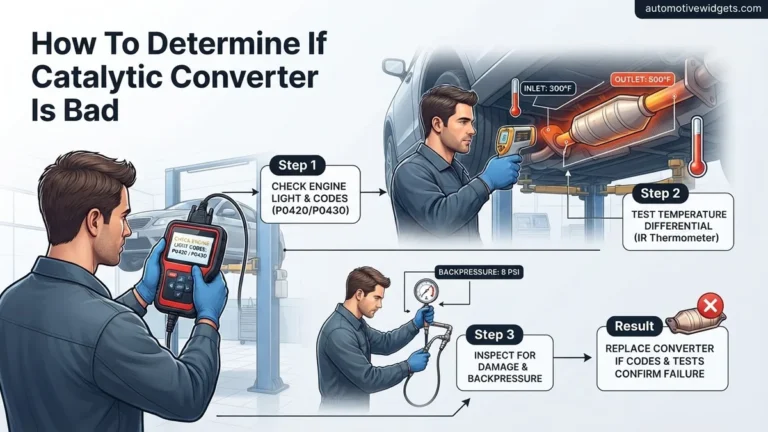
Exhaust backpressure PSI thresholds can be verified by removing the upstream oxygen sensor and attaching a pressure gauge. If backpressure exceeds 1.5 PSI at idle or rises above 3 PSI at 2,500 RPM, your converter is dangerously blocked.
Checking infrared temperature differentials provides another reliable diagnostic method for your exhaust piping. A healthy converter runs significantly hotter at the outlet than at the inlet due to ongoing chemical reactions.
If the outlet temperature is cooler than the inlet, or if the entire housing glows dull orange under light load, the internal matrix is completely obstructed. Accurate diagnostics protect you from wasting money while planning for upcoming exhaust system repair costs. Those diagnostic clues point you toward the engine bay, where mounting backpressure begins silently tearing your motor apart.
What Happens When Backpressure Destroys Your Engine
Exhaust valve overheating occurs when trapped combustion gases have nowhere to go during the exhaust stroke. The intense heat concentrates against the valve faces, causing them to warp, burn, and lose proper seating compression.
According to RepairPal data from 2025, severe engine damage caused by a clogged or failing catalytic convertersuch as scoring from ingested ceramic debristypically costs between $2,500 and $4,500 to repair, depending on the vehicle’s make and model [RepairPal | repairpal.com].
Piston ring wear accelerates rapidly from the extreme thermal load and oil dilution caused by trapped heat inside the combustion chambers. Hot exhaust gases push past the rings down into the crankcase, breaking down engine oil viscosity.
Complete loss of engine power happens when backpressure chokes out incoming fresh air and fuel charges. The engine starves for oxygen, leading to persistent stuttering, rough idling, and sudden roadside stalls.
Ignoring these progressive mechanical symptoms forces your engine to work against itself on every single stroke. Addressing a restricted exhaust path promptly prevents minor backpressure issues from turning into complete engine rebuilds. Engine damage scales up fast, making it critical to replace your exhaust system before total failure strands you.
When to Replace Your Exhaust System Before Failure
Typical converter mileage lifespan generally ranges between 100,000 and 150,000 miles under normal driving conditions. If your vehicle has crossed this mileage threshold and displays persistent emission codes, replacement is likely imminent.
Rattling metallic noises inside the housing indicate that the internal ceramic substrate has broken loose and shattered into pieces. This debris will eventually migrate downstream and block the rear exhaust piping.
A sulfur rotten egg smell from the tailpipe confirms that the internal catalyst can no longer process hydrogen sulfide gases properly. Monitoring these warning signs ensures you replace failing components before they strand you during your daily commute. Knowing when to install a brand-new exhaust keeps you asking one final question about daily driving safety.
7 Most Common Questions About Failing Exhaust Emission Parts
Can I Pass My State Emissions Test With a Bad Catalytic Converter?
No, you cannot pass a state emissions test with a bad catalytic converter because the vehicle’s onboard computer will record a catalyst efficiency failure code. Furthermore, testing facilities perform tailpipe or OBD2 scans that immediately flag broken emissions equipment, resulting in an automatic inspection rejection.
Will Temporary Fuel Additives Fix a Clogged Catalytic Converter?
Chemical fuel additives can clean minor carbon deposits from a slightly degraded converter, but they cannot fix a physically melted or structurally broken substrate. If your internal honeycomb matrix is fractured or completely blocked, replacement is the only permanent solution available.
How Long Can I Drive With a P0420 Check Engine Code?
You can typically drive for several weeks or months with a P0420 efficiency code if the car runs smoothly and exhibits no power loss. However, you should schedule a diagnostic check soon because ignoring the underlying issue can eventually lead to a severe clog.
What Does a Failing Catalytic Converter Smell Like?
A failing catalytic converter often produces a distinct rotten egg or sulfur smell from the exhaust pipe. This unpleasant odor happens because the damaged unit fails to convert hydrogen sulfide gases properly, releasing raw sulfur compounds into the atmosphere.
Can a Bad Catalytic Converter Cause My Car to Stall?
Yes, a severely clogged catalytic converter restricts exhaust flow so much that exhaust gases choke the engine cylinders, causing the car to stall when idling or accelerating. If your vehicle struggles to maintain speed or dies under load, stop driving immediately.
Conclusion on Driving With a Failing Catalytic Converter
Efficiency codes permit short cautious trips while clogs require immediate towing to prevent engine failure. Trapped exhaust backpressure causes expensive internal engine damage over time if left unaddressed. State emissions tests and vehicle registrations cannot pass with broken emissions gear active on your vehicle.
Schedule a professional diagnostic scan today to determine if your catalytic converter needs replacement before it strands you on the road.