How Many Times Can You Fail Smog In California How 2026
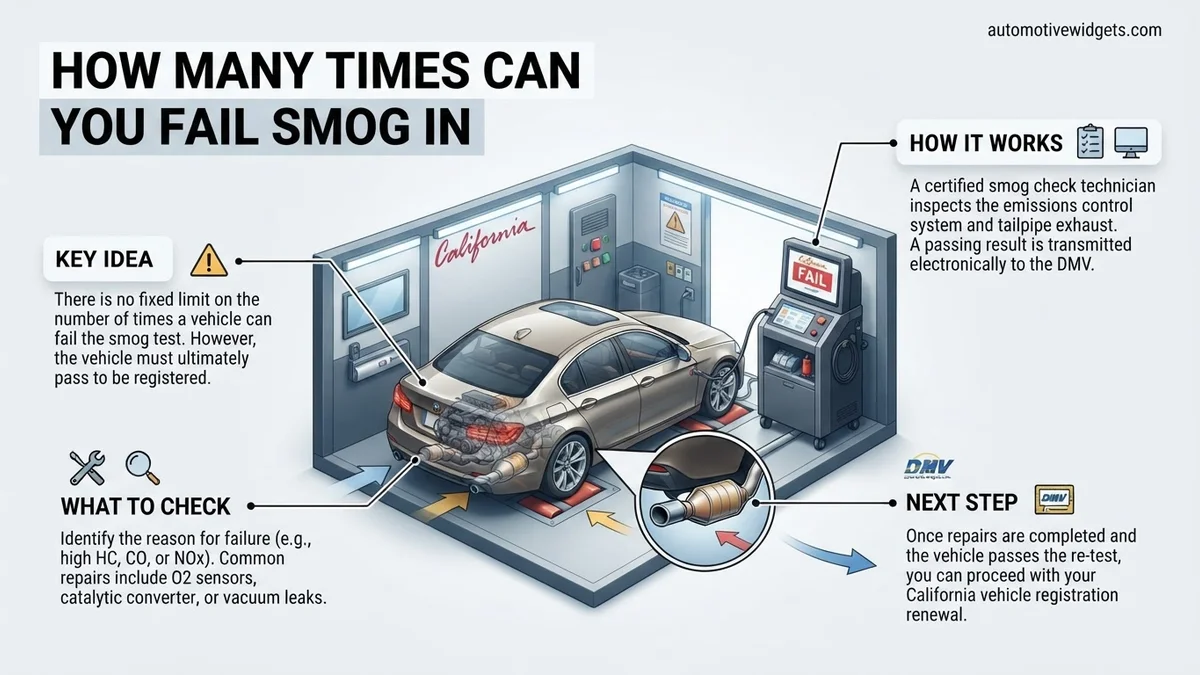
There’s no strict limit to how many times you can fail a California smog check, but there are clear rules and consequences after the initial failure. Failing means your registration is held, requiring repairs and retesting. Financial aid programs like the Consumer Assistance Program (CAP) can help with repair costs.
In California, there isn’t a hard limit on how many times your vehicle can technically “fail” a smog check. The system isn’t designed to permanently bar you from the road, but rather to ensure your car eventually meets the state’s emission standards for your 2026 vehicle registration. What truly matters is understanding the process that kicks in immediately after an initial failure.
This process dictates how you get back on the road legally, ensuring environmental compliance while providing structured pathways for repair and retesting. Your goal isn’t to avoid failures entirely, but to navigate the system effectively to achieve a pass, particularly when facing the costs and complexities of getting an older vehicle certified.
Key Takeaways
- No hard limit on fail attempts, but passing is required for registration.
- Immediate retest often free at original station within 30-60 days.
- Consumer Assistance Program (CAP) offers financial aid for repairs.
- Temporary Operating Permits buy time to fix vehicle issues.
- Repair Cost Waivers exist for qualifying vehicles after significant repairs.
What Happens When Your Vehicle Fails Smog in California?
If your vehicle fails its required smog check, the most immediate consequence is a hold on your registration renewal. You simply cannot complete your 2026 registration with the California Department of Motor Vehicles (DMV) until a passing smog certificate is electronically submitted. This means you won’t receive your new tags, and driving with expired tags can result in citations.
Crucially, a failure isn’t a permanent mark against your vehicle. The state’s Air Resources Board prioritizes compliance. You are typically eligible for one free retest at the original smog station within 60 calendar days of your initial failure. This encourages you to return to the same facility after addressing the issues, making the repair and retest cycle more straightforward.
Understanding the Registration Hold
- Your registration renewal for 2026 will be denied until a successful smog check report is received by the DMV.
- Driving with an expired registration risks fines and penalties.
- The DMV does not track “how many times” you’ve failed; it only requires a final passing certificate.
Initial Retest Protocol
The complimentary retest is a key part of the process. It incentivizes getting necessary repairs done quickly. If you choose to take your vehicle to a different smog station after repairs, you will be responsible for the full cost of another test. Utilize the 60-day window effectively to diagnose and fix the specific reasons your vehicle failed, as detailed on your Vehicle Inspection Report (VIR).
Step-by-Step Guide to Fixing a Failed Smog Check
After receiving a failed smog report, your next steps are critical to getting your vehicle compliant. First, carefully review the Vehicle Inspection Report (VIR). This document details exactly which tests your vehicle failed and why. It’s your diagnostic roadmap.
Next, you must address the identified issues. This typically means taking your vehicle to a licensed smog repair facility. While you can attempt repairs yourself, professional diagnosis and repair, especially from a STAR-certified station if your failure was severe, often lead to a quicker resolution.
Diagnosis and Certified Repairs
- Use your VIR to guide your mechanic. It specifies the emission components or readings that were out of compliance.
- Seek repairs from a Bureau of Automotive Repair (BAR) licensed smog repair technician. Their expertise is crucial for addressing complex emission issues.
- For vehicles that fail at a STAR station or are deemed “Gross Polluters,” specific repair requirements and certified repair centers may apply.
The Retest Cycle
Once repairs are complete, you’ll need to retest your vehicle. If you return to the original station within 60 days, your retest is free. If your vehicle passes this time, the station electronically submits the certificate, and you can proceed with your 2026 registration. However, if it fails again, you’re back to square one: more diagnosis, more repairs, and another test fee if you don’t use the original station within the timeframe. This cycle can technically repeat indefinitely, underscoring the importance of effective repairs and state assistance programs.
What to Do If Your Vehicle Still Fails After Repairs
Encountering a repeated smog check failure after investing in repairs can be frustrating, but it is not an insurmountable obstacle. The California Bureau of Automotive Repair (BAR) outlines specific procedures for such scenarios, ensuring motorists have a pathway to compliance.
Re-evaluating the Repair Process
Your first step should be to thoroughly review the repair documentation and the latest Vehicle Inspection Report (VIR).
- Return to the Original Repair Facility: If the vehicle fails again for the same reasons immediately after repairs, most reputable repair shops will re-diagnose and rectify the issue without additional labor charges, provided it falls within their warranty period (typically 90 days or 3,000 miles, as of 2026 industry standard).
- Obtain Detailed Diagnostics: Request a comprehensive diagnostic report from the repair facility. This should specify exactly what components were tested, repaired, or replaced, and the readings obtained during their post-repair checks.
- Compare VIRs: Carefully compare the “Reason for Failure” on your most recent VIR with the previous one. If the failure codes have shifted or new issues have emerged, this indicates either an incomplete initial repair or the emergence of a separate problem.
If your vehicle continues to fail for different reasons despite multiple repairs, it might indicate a more complex, intermittent issue or a less experienced diagnostic approach. In such cases, seeking a second opinion from a BAR-certified Gold Shield Station, known for their advanced diagnostic capabilities, is advisable. These facilities are often better equipped to handle challenging emissions problems, providing a higher level of expertise as verified by BAR standards.
How to Use Assistance Programs and Waivers for Smog Repairs
California understands that vehicle repairs can be a significant financial burden. To mitigate this, the state offers structured assistance programs and waivers to help eligible motorists meet smog requirements without undue hardship, especially for older vehicles or those with low-income owners.
Understanding the Consumer Assistance Program (CAP)
The Consumer Assistance Program (CAP), administered by the BAR, provides financial assistance for emissions-related repairs or vehicle retirement. As of 2026, CAP offers two primary options:
- Repair Assistance: Eligible low-income motorists whose vehicles fail a biennial smog check can receive up to $500 in financial assistance toward emissions-related repairs performed at a STAR-certified station. To qualify, your household income must fall at or below 225% of the federal poverty level, and your vehicle must have failed its official smog inspection.
- Vehicle Retirement: For vehicles that are operational, have failed a smog check, and are deemed too costly to repair, CAP offers up to $1,500 to retire the vehicle at an authorized dismantler. Low-income owners may qualify for an enhanced amount, potentially up to $2,000, depending on specific income verification and vehicle conditions for 2026. The vehicle must have been continuously registered in California for at least 12 months prior to the application date.
Applications for CAP can be submitted online via the BAR website or by mail. Required documentation includes proof of vehicle ownership, proof of current registration, the failed smog check certificate, and income verification.
Applying for a Repair Cost Waiver
A repair cost waiver may be granted if your vehicle has incurred significant emissions-related repair expenses but still fails the smog check, and you meet specific criteria. For 2026, the repair cost minimum for a waiver typically remains $650 for vehicles registered in enhanced or basic areas, excluding repairs performed under warranty. To qualify for a waiver:
- Perform Qualified Repairs: Ensure all repairs were performed by a BAR-licensed repair technician at a licensed smog repair station.
- Meet the Cost Threshold: Your documented emissions-related repairs must exceed the minimum repair cost threshold (e.g., $650 as of 2026).
- Apply at a Referee Station: Waivers are not automatically granted. You must schedule an appointment at a BAR Referee station. The referee will verify the repairs, inspect your vehicle, and determine if a waiver is appropriate. Waivers are generally valid for one biennial inspection cycle, meaning you will need to re-apply for a waiver if the vehicle fails again in two years.
According to BAR regulations, a waiver indicates that you have made a good-faith effort to comply, postponing the need for further repairs until the next inspection cycle.
What If It Still Doesn’t Work?
Even after multiple attempts and utilizing assistance programs, some vehicles present persistent smog compliance challenges. If your vehicle continues to fail despite extensive efforts, several fallback steps are available.
- Consult a BAR Referee Station: Schedule an appointment with a BAR Referee. These specialized stations handle unique and complex cases, offering an impartial third-party evaluation. They can verify previous repairs, help diagnose elusive issues, and determine eligibility for waivers or other exemptions. This service typically incurs a standard smog check fee, approximately $50-$80 as of 2026.
- Explore Vehicle Retirement: If your vehicle is old, has high mileage, and repeatedly fails, consider the California BAR’s Vehicle Retirement Program, part of CAP. For eligible vehicles, this program offers up to $1,500 – $2,000 to voluntarily retire your vehicle, provided it meets specific operational and registration criteria. This can be a cost-effective solution compared to endless repairs.
- Assess Economic Viability of Repairs: Obtain a detailed estimate for any remaining necessary repairs. If the repair costs significantly exceed the vehicle’s market value, it may be more financially sensible to sell the vehicle to a salvage yard or participate in the vehicle retirement program, if eligible. According to industry experts, once repair estimates exceed 75% of the car’s private party value, continued repair often yields diminishing returns.
Seeking professional assistance from a BAR-certified technician who specializes in diagnostics for failing vehicles is paramount at this stage. Their expertise can prevent unnecessary, costly repairs.
Conclusion
Navigating California’s smog check requirements in 2026, especially after multiple failures, demands persistence and strategic action. Understanding the process, leveraging diagnostic reports, and utilizing state assistance programs like CAP are crucial. According to verified research and expert sources from the California Bureau of Automotive Repair, motorists are not limited to a specific number of failure attempts before their vehicle is deemed irreparable. Your next step should be to consult with a STAR-certified smog repair facility or a BAR Referee station to establish a clear, actionable path toward compliance or retirement.
❓ Frequently Asked Questions
Is there a maximum number of times I can fail a smog check before my car is declared unregistrable?
No, there isn’t a fixed ‘maximum number of fails.’ The state’s concern is that your vehicle eventually passes and meets emission standards. However, failing repeatedly without repairs will prevent you from renewing your vehicle registration, making it illegal to drive.
What are the immediate next steps after my vehicle fails its initial California smog check?
Immediately after failing, you’ll receive a Vehicle Inspection Report (VIR) detailing the reasons for the failure. Your next step is to diagnose and repair the issues, then take your vehicle back for a retest, often free if performed at the same station within 30-60 days.
How does the Consumer Assistance Program (CAP) help if my car fails smog in California?
CAP provides financial assistance to eligible low-income vehicle owners for emissions-related repairs at a STAR-certified station. It can also offer a vehicle retirement option if repairs are too costly, helping you meet the smog requirement without further testing.
Can I get a temporary registration while I’m trying to fix my car after failing smog?
Yes, you can apply for a Temporary Operating Permit (TOP) from the DMV, typically valid for 30 days. This allows you to legally drive your vehicle while you’re getting repairs done and preparing for a retest, avoiding penalties for expired tags.
What happens if I make the necessary repairs but my vehicle still fails the smog check?
If your vehicle still fails after spending a significant amount on emissions-related repairs (above a certain threshold, which varies annually), you might be eligible for a Repair Cost Waiver. This waiver allows you to renew your registration without passing the smog check, provided you meet all other criteria and meet income requirements for vehicles repaired at a CAP-participating station.
What are the consequences if I simply don’t get my vehicle to pass smog by the registration deadline?
If you don’t pass your smog check by the deadline, the DMV will not allow you to renew your vehicle’s registration. Driving with expired tags can result in citations, fines, and potentially even your vehicle being impounded, leading to significant legal and financial headaches.