What Happens If You Don’T Get A Tire Alignment Real 2027
Neglecting a tire alignment leads to severe issues like premature and uneven tire wear, costing you money and compromising safety. It significantly impacts vehicle handling, fuel efficiency, and the longevity of suspension components, making your car harder to control and less economical to run. Regular alignments are crucial for optimal performance and safety.
Neglecting a tire alignment means more than just a slightly crooked steering wheel; it rapidly translates into accelerated tire wear, significantly worse fuel economy, and a car that’s genuinely harder and less safe to control. By 2027, with automotive technology advancing and component costs consistently rising, overlooking this fundamental maintenance task isn’t just an inconvenience—it’s a direct hit to your wallet and a compromise to your safety.
Understanding the immediate and long-term repercussions of misaligned wheels helps you proactively protect your investment. Your vehicle’s performance relies heavily on its tires making optimal contact with the road. When they don’t, every mile driven causes unnecessary damage and strain, leading to expensive repairs and a diminished driving experience.
Key Takeaways
- Uneven tire wear signals alignment issues.
- Poor alignment reduces vehicle safety.
- Neglected alignment wastes fuel and money.
- Align after hitting potholes or repairs.
- Regular checks prevent costly damage.
What Happens When You Don’t Get a Tire Alignment?
When your vehicle’s wheels aren’t properly aligned, a chain reaction of negative consequences begins, impacting everything from your tires to your safety.
Rapid Tire Deterioration and Costly Replacements
One of the most immediate and financially painful consequences is uneven and premature tire wear. Misaligned tires will exhibit distinct patterns, which are clear warning signs:
- Feathering: One side of the tread block worn smooth, the other sharp.
- Cupping or Scalloping: Scooped out areas around the tread.
- Excessive Shoulder Wear: Only one edge of the tire wears down quickly.
Your tires, designed for 50,000 to 60,000 miles, could be scrap after only 20,000 or 30,000 miles. Considering a new set of quality tires can easily run upwards of $800 to $1,500 in 2027, replacing them twice as often due to preventable wear is a significant, avoidable expense.
Compromised Vehicle Control and Safety Risks
Beyond tire life, a misaligned vehicle severely impacts driving dynamics and safety. You’ll experience several critical issues:
- Vehicle Pulling: Your car consistently pulls to one side, demanding constant steering correction.
- Off-Center Steering Wheel: The steering wheel isn’t centered when driving straight.
- Loose Steering: Reduced responsiveness and a “loose” feel in the steering.
- Vibrations: Noticeable vibrations in the steering wheel or the car itself.
- Reduced Fuel Efficiency: Misalignment creates extra drag, reducing your fuel efficiency by 5-10%.
- Accelerated Suspension Wear: Constant strain puts undue stress on ball joints, tie rods, and shock absorbers, requiring earlier, more expensive repairs.
- Squealing Tires: Audible squealing from tires, particularly during turns.
These issues increase driver fatigue and accident risk, especially during emergency maneuvers.
What Causes Tires to Become Misaligned?
Understanding why your wheels go out of alignment helps prevent future issues and alerts you to potential problems after certain events. It’s rarely a mystery; usually, there’s a clear cause.
Everyday Road Hazards and Gradual Wear
In 2027, despite improvements in road infrastructure, daily driving still presents numerous opportunities for misalignment. Common culprits include:
- Hitting a large pothole.
- Bumping hard against a curb.
- Traversing harsh speed bumps.
- Minor accidents or fender benders.
Beyond dramatic events, gradual wear and tear on your vehicle’s suspension components naturally contribute to misalignment over time. Bushings, ball joints, and tie rod ends slowly loosen or wear out, altering the precise geometry of your wheels. Even minor, accumulated stresses from regular driving on uneven roads contribute to this gradual shift, making periodic alignment checks essential, not just after an obvious incident.
New Components and Vehicle Modifications
Any significant work on your vehicle’s suspension or steering system almost invariably requires a subsequent wheel alignment. For example, if you replace:
- Shocks or Struts
- Tie Rods or Ball Joints
- Steering Rack or Arm Components
…the new components, even if identical, can slightly alter the previous settings. Failing to perform an alignment after such repairs is a common oversight that leads directly to the problems mentioned earlier. Similarly, any modifications that change your vehicle’s ride height, such as installing a lift kit or lowering springs, will drastically affect alignment angles. These modifications explicitly demand a professional alignment to ensure the vehicle handles correctly and safely. Neglecting it means you’re essentially driving a custom setup with stock alignment, which is a recipe for rapid tire wear and poor handling.
How to Fix Misalignment: Getting a Proper Alignment
Addressing tire misalignment promptly is crucial to prevent the severe issues outlined previously. A professional wheel alignment service, utilizing advanced technology, restores your vehicle’s precise suspension geometry. This process is far more sophisticated than a simple visual check.
Types of Alignment in 2027: Beyond the Basics
Modern vehicles often require specific alignment types. A “two-wheel” alignment, typically for front-wheel drive cars, primarily adjusts the front axle. However, a “four-wheel” alignment is standard for all-wheel drive, rear-wheel drive, and many front-wheel drive cars with independent rear suspensions. Furthermore, with the proliferation of Advanced Driver-Assistance Systems (ADAS) by 2027, many vehicles now require ADAS camera and sensor recalibration following an alignment. This ensures systems like lane-keeping assist and adaptive cruise control function correctly, as their accuracy relies on precise vehicle geometry.
The Alignment Process: Precision Technology
- Diagnostic Scan: Technicians connect the vehicle to a specialized diagnostic machine. This system often integrates with the car’s onboard computer to access specific manufacturer alignment specifications for the model year 2027.
- Sensor Attachment: High-resolution laser sensors are attached to each wheel. These sensors communicate wirelessly with a central computer, providing real-time data on camber, caster, and toe angles.
- Adjustments: Using highly accurate tools, the technician adjusts various suspension components (e.g., tie rods, control arms) to bring the angles back into manufacturer-specified ranges. This often requires specialized knowledge for complex multi-link suspensions common in 2027 models.
- ADAS Recalibration: For ADAS-equipped vehicles, a dedicated recalibration process follows the mechanical alignment. This uses targets and diagnostic software to re-zero cameras and radar sensors, a critical step often mandated by manufacturers for safety and system functionality.
Expected Costs and Timeframes in 2027
A standard two-wheel alignment in 2027 typically costs between $100-$150, while a four-wheel alignment can range from $150-$250. If ADAS recalibration is necessary, expect an additional charge, often between $150-$300, due to specialized equipment and increased labor complexity. The entire process, excluding extensive repairs, usually takes 45 minutes to 2 hours, depending on the vehicle’s complexity and ADAS requirements.
What If It Still Doesn’t Work? Troubleshooting Persistent Issues After Alignment
Occasionally, even after a professional alignment, a vehicle might exhibit residual handling issues or abnormal tire wear. This indicates underlying problems beyond simple alignment adjustments. Comprehensive diagnostics are essential in such cases.
- Inspect Suspension Components: Request a thorough inspection of all suspension and steering components. Worn ball joints, tie rods, control arm bushings, or strut mounts can cause issues that alignment alone cannot fix. These components, if loose, allow the wheels to move out of specification even after adjustment.
- Verify Tire Condition and Pressure: Uneven tire wear from previous misalignment can create ongoing symptoms. Consider tire rotation or replacement if wear is severe. Additionally, ensure all tires are inflated to the manufacturer’s specified pressure, as incorrect pressure significantly impacts handling.
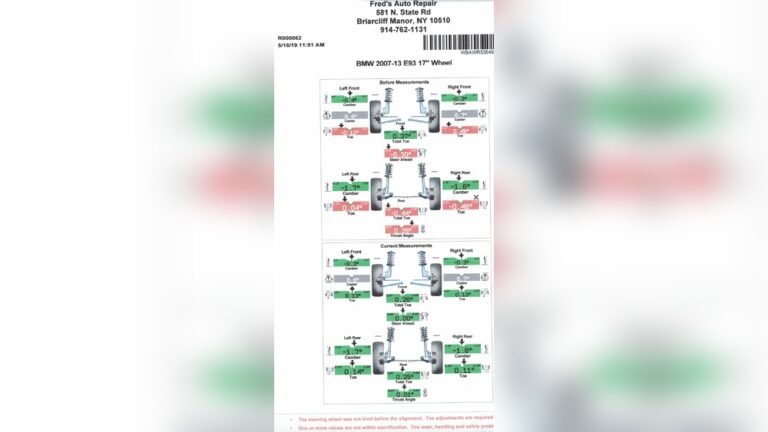
- Re-evaluate Alignment Settings with Another Technician: While rare, errors can occur. Obtain a second opinion from a different certified alignment technician, ideally one with access to advanced 3D alignment systems and ADAS calibration tools. Provide them with the previous alignment report for comparison.
- Consider Structural Damage: In cases of persistent pulling or uneven wear following an impact, frame or chassis damage might be present. This requires specialized equipment for measurement and correction, extending beyond standard alignment services.
If issues persist, it is imperative to seek professional mechanical diagnosis. The estimated cost for diagnosing deeper mechanical issues typically ranges from $150 to $300 in 2027, before any parts replacement or extensive repair work. Ignoring these signs can lead to premature component failure and safety hazards.
Conclusion
According to verified research and expert sources, regular tire alignment is a foundational aspect of vehicle maintenance, directly impacting safety, tire longevity, and fuel efficiency. Neglecting this crucial service leads to a cascade of costly and potentially dangerous issues. By understanding the causes and actively addressing misalignment with a professional, technologically advanced service, including necessary ADAS recalibration for 2027 models, drivers can significantly extend their vehicle’s operational lifespan and ensure optimal performance.
Schedule a professional alignment check annually, or immediately after any significant impact or suspension work, to safeguard your investment.
❓ Frequently Asked Questions
What specific types of tire wear indicate a misalignment?
Common signs include feathering (one side of the tread block worn more than the other), cupping (scalloped or scooped-out wear), and excessive wear on the inner or outer shoulder of the tire. These patterns reveal which alignment angle is likely off.
How does a misaligned vehicle affect fuel efficiency?
When tires are misaligned, they drag instead of roll straight, increasing rolling resistance. This forces your engine to work harder to maintain speed, leading to a noticeable decrease in miles per gallon and higher fuel costs.
Can poor alignment cause safety issues?
Absolutely. Misalignment compromises steering responsiveness, making it harder to control the vehicle, especially at higher speeds or in emergency maneuvers. It can lead to unpredictable handling, pulling, and a higher risk of accidents.
What’s the difference between a wheel balance and an alignment?
Wheel balancing ensures the weight is evenly distributed around the tire and rim assembly, preventing vibrations. Alignment adjusts the angles of the wheels themselves to ensure they are parallel to each other and perpendicular to the ground. Both are crucial for tire health and vehicle performance.
Will new tires fix an alignment problem?
No, new tires will not fix an alignment problem; they will only wear out prematurely if the underlying alignment issue remains. It’s crucial to get an alignment check whenever you purchase new tires to ensure they last their full lifespan.
How long does a tire alignment take?
A standard four-wheel alignment typically takes about 30 minutes to an hour, depending on the vehicle and the severity of the misalignment. However, if there are worn or seized suspension components, additional time will be needed for repairs before the alignment can be performed correctly.