How Do I Know Which Catalytic Converter is Bad? 2027
Identifying a bad catalytic converter involves recognizing specific symptoms like reduced performance, strong odors, and specific OBD-II codes. It’s crucial to differentiate these from other engine issues to avoid misdiagnosis. This guide provides a step-by-step approach to help you accurately determine if your catalytic converter is failing and which one it might be.
How Do I Know Which Catalytic Converter is Bad? 2027
Pinpointing a faulty catalytic converter is critical for your vehicle’s performance and avoiding unnecessary repair costs. It’s not just about a “Check Engine” light; ignoring these issues impacts fuel efficiency, engine health, and can lead to more expensive damage down the road. With many modern vehicles, especially V6 and V8 engines, featuring multiple catalytic converters, accurately identifying which one is failing is key to a precise and economical repair in 2027.
Understanding the specific symptoms and leveraging diagnostic tools effectively allows you to differentiate a genuine catalytic converter problem from other common vehicle malfunctions. This guide will help you confidently identify the signs and interpret the data, saving you time and money by directing your attention to the right component. Don’t guess; diagnose with confidence.
Key Takeaways
- Monitor for common symptoms:power loss, rotten egg smell, rattling.
- Check OBD-II codes:P0420 and P0430 are key indicators.
- Perform visual inspections:Look for glow or physical damage.
- Differentiate symptoms:Rule out O2 sensor or misfire issues.
- Seek professional diagnosis:Confirm with backpressure or temp tests.
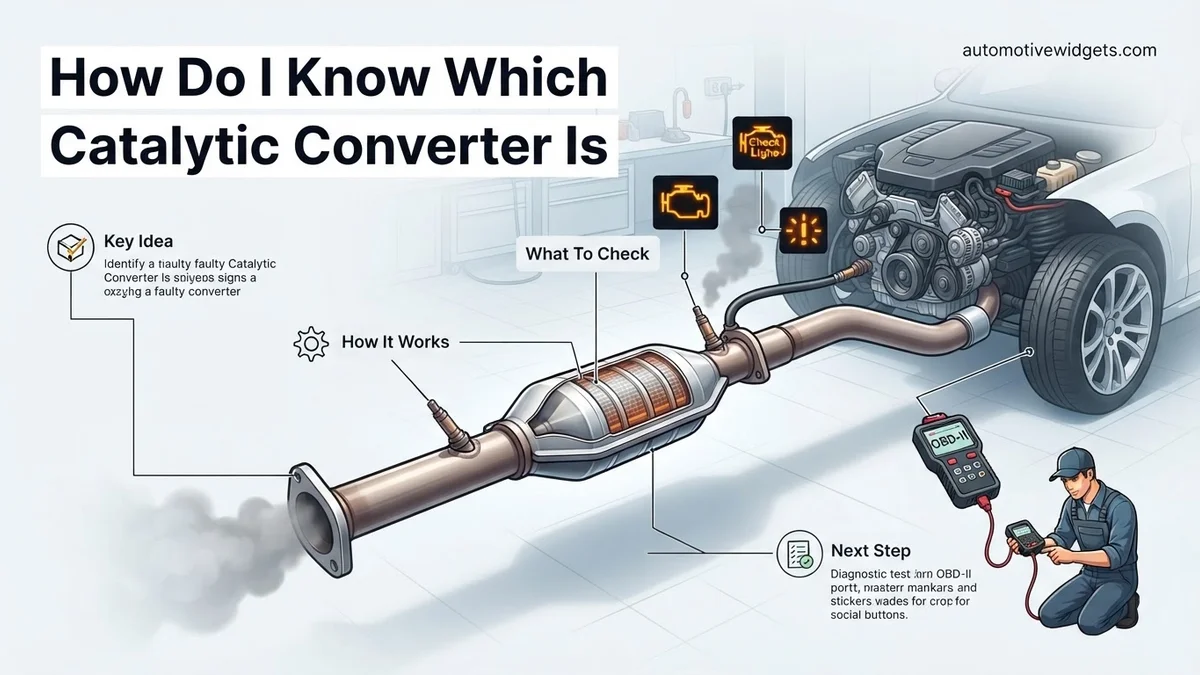
What Causes Catalytic Converter Failure? Diagnosis Guide
Identifying a bad catalytic converter starts with recognizing its tell-tale signs. These symptoms aren’t just annoying; they are your vehicle’s way of telling you a crucial emissions control component is failing. By 2027, vehicles are even more sensitive to emissions, making accurate diagnosis essential for both performance and compliance.
Common Symptoms You Can’t Ignore
- Reduced Engine Performance: You’ll notice sluggish acceleration, a distinct lack of power, or your engine struggling more than usual to maintain speed, especially uphill. This happens because a clogged converter restricts exhaust flow.
- Rotten Egg Smell: A strong odor resembling sulfur or rotten eggs emanating from the exhaust is a classic sign. This smell occurs when the converter fails to process hydrogen sulfide in the exhaust gases.
- Rattling Noise: Listen for a distinct rattling sound coming from underneath your vehicle, particularly when starting or accelerating. This indicates the internal ceramic matrix of the converter has broken apart and is loose inside the housing.
- Increased Exhaust Emissions: While not always visibly obvious, a failing cat will cause your vehicle to produce higher levels of pollutants, which can trigger emissions test failures. You might even notice darker or thicker exhaust smoke in severe cases.
- Engine Overheating: A severely clogged catalytic converter can cause exhaust gases to back up into the engine, leading to excessive heat buildup and potential overheating.
Critical OBD-II Codes to Watch For
When your “Check Engine” light illuminates, an OBD-II scanner is your first line of defense. Specific codes directly point to catalytic converter efficiency issues.
- P0420 (Catalyst System Efficiency Below Threshold – Bank 1): This is the most common code for a bad catalytic converter. It means the oxygen sensor after the catalytic converter on Bank 1 is reporting exhaust gas levels too similar to the sensor before it, indicating the converter isn’t efficiently cleaning the exhaust.
- P0430 (Catalyst System Efficiency Below Threshold – Bank 2): Identical to P0420, but it applies to Bank 2. Many V6 and V8 engines have two catalytic converters, one for each bank of cylinders. If your vehicle has this configuration, and you see P0430, you know the converter on Bank 2 is the culprit.
It’s crucial to differentiate these from codes indicating O2 sensor failures (P0133, P0134, etc.) or misfires (P030x), which can sometimes trigger P0420/P0430 indirectly. Always check for other codes and address them first if present.
How to Diagnose and Fix a Bad Catalytic Converter Like an Expert
A properly functioning catalytic converter is crucial for your vehicle’s emissions control and overall performance. When it fails, it can lead to a cascade of problems, from reduced fuel efficiency and power loss to the dreaded “rotten egg” smell and a lit check engine light. This comprehensive guide will walk you through the essential steps to pinpoint whether your catalytic converter is indeed the culprit, empowering you to make informed decisions about its repair or replacement. By following these detailed instructions, you’ll gain the knowledge to diagnose this common issue with confidence and precision.
Step 1: Understand and Identify Common Symptoms
What you need: Your vehicle, your senses (hearing, smell, touch), and a notepad or smartphone for documenting observations.
Instructions: Pay close attention to how your car performs and sounds. Common indicators of a failing catalytic converter include a noticeable decrease in engine power and acceleration, especially when climbing hills or during hard acceleration. You might also hear a rattling noise coming from underneath the vehicle, often more pronounced when starting the engine or accelerating; this indicates a broken internal honeycomb structure. Another tell-tale sign is a strong smell of sulfur (like rotten eggs) from the exhaust, which occurs when the catalyst can no longer convert hydrogen sulfide gas. Finally, the “Check Engine” light on your dashboard is a very strong indicator, often accompanied by specific diagnostic trouble codes (DTCs).
Pro Tip: Don’t dismiss intermittent symptoms. A catalytic converter might be failing slowly, exhibiting symptoms only under specific driving conditions (e.g., highway speeds) before becoming constant. Document when and how these symptoms appear to help narrow down the cause.
Step 2: Scan for Diagnostic Trouble Codes (DTCs)
What you need: An OBD-II (On-Board Diagnostics II) scanner. A basic code reader will suffice for reading codes, but a more advanced scanner with live data capability is highly recommended for later steps.
Instructions: Connect your OBD-II scanner to your vehicle’s diagnostic port, usually located under the dashboard on the driver’s side. Turn the ignition to the “ON” position (without starting the engine) or start the engine, depending on your scanner’s requirements. Navigate through the scanner’s menu to read current or pending diagnostic trouble codes. Look specifically for codes related to catalyst system efficiency, such as P0420 (Catalyst System Efficiency Below Threshold – Bank 1) or P0430 (Catalyst System Efficiency Below Threshold – Bank 2). These codes directly indicate that the catalytic converter is not performing its job effectively.
Pro Tip: Never clear codes immediately after reading them if you suspect a catalytic converter issue. Clearing codes can erase valuable freeze-frame data that diagnostic professionals might need, and it prevents the system from re-running critical monitor tests that confirm the issue. Only clear codes once you’ve completed your diagnosis and repair plan.
Step 3: Perform a Thorough Visual Inspection
What you need: Safety glasses, work gloves, a powerful flashlight, and potentially jack stands and a floor jack if you need to access the underside of the vehicle for a better view. Ensure the vehicle is cool before starting.
Instructions: With the vehicle safely supported (if using jack stands) and the exhaust system completely cool, visually inspect the catalytic converter and the surrounding exhaust pipes. Look for any signs of external damage such as dents, cracks, holes, or severe rust that could compromise its integrity. Check for excessive discoloration or melting, which can indicate extreme overheating. Also, firmly tap on the catalytic converter with the rubber end of a hammer (or your fist if it’s safe) and listen for a rattling sound. This confirms if the internal ceramic substrate has broken apart and is loose inside the converter shell, a common cause of blockage and noise.
Pro Tip: Pay close attention to any areas where the exhaust system might have scraped against road debris. Even minor damage can sometimes lead to internal failure or external leaks that affect catalytic converter performance or lead to incorrect diagnostic readings from O2 sensors.
Step 4: Analyze Oxygen Sensor (O2) Live Data
What you need: An OBD-II scanner with live data streaming capabilities (essential for this step), and a vehicle that is at full operating temperature.
Instructions: Start the engine and bring it to full operating temperature (drive for at least 10-15 minutes). Connect your advanced OBD-II scanner and access the live data stream. Focus on the readings from the upstream (pre-catalyst, Bank 1 Sensor 1 and Bank 2 Sensor 1) and downstream (post-catalyst, Bank 1 Sensor 2 and Bank 2 Sensor 2) oxygen sensors. A healthy catalytic converter will show the upstream O2 sensor cycling rapidly between high (rich) and low (lean) voltage readings (typically 0.1V to 0.9V). Crucially, the downstream O2 sensor should show a relatively stable, higher voltage reading (around 0.6V to 0.7V) with minimal fluctuations. If the downstream O2 sensor mirrors the rapid fluctuations of the upstream sensor, it indicates the catalytic converter is no longer storing oxygen and is inefficient, thus failing.
Pro Tip: For the most accurate O2 sensor readings, observe the data at a steady engine RPM (e.g., 2000-2500 RPM) after driving for a few minutes, as well as at idle. A consistently fluctuating downstream sensor is the definitive electronic evidence of a bad cat.
Step 5: Conduct an Exhaust Temperature Differential Test
What you need: An infrared (IR) thermometer (also known as a pyrometer).
Instructions: Drive the vehicle for at least 15-20 minutes to ensure the engine and exhaust system are at full operating temperature. Park the vehicle safely on a level surface. Using the IR thermometer, carefully measure the temperature of the exhaust pipe just before the catalytic converter (inlet) and just after the catalytic converter (outlet). Take multiple readings at each point to ensure accuracy. A properly functioning catalytic converter will convert exhaust gases, generating heat as a byproduct. Therefore, the temperature at the outlet of the catalytic converter should be significantly hotter than the inlet, typically by 100-200°F (50-100°C). If the outlet temperature is cooler than or equal to the inlet temperature, it indicates the converter is not operating efficiently and has likely failed.
Pro Tip: Ensure you are pointing the IR thermometer directly at the metal pipe, not at any heat shields, to get an accurate reading of the exhaust gas temperature. Consistent readings are key; allow the thermometer to stabilize for a few seconds before noting the temperature.
Step 6: Perform an Exhaust Backpressure Test (Advanced)
What you need: Exhaust backpressure gauge kit (includes a pressure gauge and adapter fittings), appropriate wrench for your oxygen sensor, safety glasses, and work gloves.
Instructions: This test identifies a clogged catalytic converter. Locate the upstream oxygen sensor (Bank 1 Sensor 1) on the exhaust pipe, typically before the catalytic converter. With the engine completely cool, carefully remove the O2 sensor using the correct wrench. Install the backpressure gauge adapter into the O2 sensor port, then screw the pressure gauge onto the adapter. Start the engine and let it idle. Observe the gauge reading, which should be very low (typically less than 1 PSI at idle). Then, slowly increase engine RPM to around 2000-2500 RPM and hold it steady. A healthy catalytic converter should show minimal pressure buildup, generally not exceeding 2.5 PSI. Readings consistently above this, especially at higher RPMs, indicate a significant restriction within the exhaust system, often due to a clogged catalytic converter.
Pro Tip: After performing the test, carefully remove the backpressure gauge and adapter, then reinstall the O2 sensor, ensuring it’s tightened to the manufacturer’s specifications. High backpressure can also be caused by other exhaust blockages like a collapsed muffler, so consider inspecting the entire exhaust system if this test shows high readings.
Step 7: Confirm with a Road Test and Performance Check
What you need: Your vehicle and a safe stretch of road where you can safely accelerate and observe performance.
Instructions: After conducting the diagnostic tests, a final road test can help confirm your findings. Drive your vehicle under various conditions, including city driving and highway speeds. Pay close attention to acceleration from a stop, responsiveness when passing, and power during uphill climbs. A failing or clogged catalytic converter will typically cause a noticeable lag in acceleration, a feeling of the engine “struggling” or being “held back,” and reduced top-end power. If previous tests indicated a bad cat and these symptoms are pronounced during your road test, it strongly reinforces the diagnosis. Note any specific RPM ranges where the power loss is most evident.
Pro Tip: Drive your vehicle under conditions that previously triggered symptoms or the check engine light. If the car now feels significantly different (worse) in those situations, it solidifies the diagnosis. Consider having a passenger monitor the live data on the OBD-II scanner during the road test for real-time observation of O2 sensor performance under load.
✅ Final Checklist
-
Has the Check Engine Light illuminated and specific catalyst efficiency codes (e.g., P0420/P0430) been confirmed?
-
Was a visual inspection performed, checking for physical damage, discoloration, or rattling sounds?
-
Were upstream and downstream oxygen sensor live data readings analyzed, with the downstream sensor mirroring the upstream’s fluctuations?
-
Did the exhaust temperature differential test show the outlet temperature to be cooler than or equal to the inlet temperature?
-
If performed, did the backpressure test indicate excessive pressure buildup at idle or higher RPMs?
Important Notes:
- Safety Considerations: Always prioritize safety. Use jack stands when working under a vehicle, ensure the exhaust system is cool before touching it, and wear appropriate personal protective equipment like safety glasses and gloves. Exhaust fumes are toxic, so ensure adequate ventilation if running the engine indoors.
- When to Seek Professional Help: If you’re uncomfortable performing any of these tests, lack the necessary tools, or if the diagnosis remains unclear after following these steps, it’s always best to consult a certified mechanic. They have specialized diagnostic equipment and expertise to accurately pinpoint complex issues.
- Estimated Time and Cost Range: Diagnosing a catalytic converter issue can take anywhere from 30 minutes to 2 hours if you’re doing it yourself with an OBD-II scanner. Professional diagnostic services typically cost $50-$150. Replacing a catalytic converter is a significant expense, with parts ranging from $300 to over $2000 depending on the vehicle model and whether it’s an OEM or aftermarket part. Labor can add another $200-$600, bringing the total cost to anywhere from $500 to $3000+.
How to Diagnose a Bad Catalytic Converter: Step-by-Step Guide
Once you suspect a catalytic converter issue, a systematic approach helps confirm the diagnosis and pinpoint the exact problem. Leveraging readily available tools and your senses, you can perform effective checks right from your garage. This methodology helps you avoid misdiagnosing issues that might appear similar, such as those caused by faulty oxygen sensors or exhaust leaks.
Initial Self-Checks at Home
Before connecting an advanced scanner, perform these quick, visual, and auditory checks:
- Visual Inspection (Cold Engine): Carefully look underneath your vehicle. A severely clogged or failing catalytic converter can sometimes glow red hot after driving, due to unburned fuel igniting inside it. This is a sign of extreme failure and dangerous overheating. Also, inspect for any physical damage like dents or cracks in the converter’s housing.
- Auditory Test for Internal Rattling (Cold Engine): With the engine off and cold, gently tap the catalytic converter housing with a rubber mallet or your fist. If you hear loose ceramic pieces rattling inside, the internal honeycomb structure has disintegrated, confirming a mechanical failure.
- Exhaust Flow Restriction Check (Caution Required): While less precise, a simple test can hint at a blockage. Start your engine and allow it to warm up. Briefly place your hand a few inches from the tailpipe. You should feel strong, consistent exhaust pressure. If the flow is weak or intermittent, it could indicate a significant blockage in the exhaust system, often within the catalytic converter. Exercise extreme caution as exhaust gases are hot and toxic.
Decoding Your OBD-II Scanner Data
For definitive diagnosis in 2027, an OBD-II scanner is indispensable, especially one capable of displaying live data streams.
- Check for Pending and Permanent Codes: Confirm whether P0420 or P0430 are present. Also, look for any misfire codes (P030x) or fuel system codes, as these can cause raw fuel to enter the exhaust and damage the converter.
- Analyze Live O2 Sensor Data: This is the most crucial step.
- Upstream O2 Sensor (Pre-Cat): The sensor located before the catalytic converter should show rapidly fluctuating voltage readings (typically between 0.1V and 0.9V). This indicates it’s actively monitoring oxygen levels and the engine’s air-fuel mixture is constantly adjusting.
- Downstream O2 Sensor (Post-Cat): The sensor located after the catalytic converter should show a relatively stable voltage reading, typically around 0.45V to 0.7V. This stability signifies that the catalytic converter is efficiently storing oxygen and processing pollutants.
If the downstream O2 sensor’s readings closely mirror the fluctuating upstream sensor, it means the catalytic converter is failing to perform its job. It’s essentially “straight-piping” the exhaust through without treatment.
- Differentiate from O2 Sensor Failure: If the upstream O2 sensor itself is stuck (not fluctuating) or reporting implausible data, it can cause the engine computer to misinterpret emissions and trigger P0420/P0430. Always ensure the upstream sensor is functioning correctly first. If the upstream sensor is erratic but the downstream is still stable, your catalytic converter is likely good, and the problem lies with the upstream O2 sensor.
What If Your Catalytic Converter Symptoms Persist? Troubleshooting
If initial checks and basic diagnostics haven’t pinpointed the issue, or if symptoms like reduced power and increased emissions continue, a more in-depth approach is necessary. Modern vehicles, especially by 2027, feature highly integrated emission control systems that demand precise diagnostic methods. It’s crucial to confirm the catalytic converter is truly at fault before considering replacement, as other components can mimic similar failures.
Advanced OBD-II Diagnostics and Live Data
For persistent symptoms, a professional-grade OBD-II scanner is indispensable. According to automotive service bulletins from late 2026, technicians prioritize live data analysis for catalytic converter efficiency. Specifically, monitoring the oxygen sensor readings, both upstream (pre-catalyst) and downstream (post-catalyst), provides critical insights. A healthy catalytic converter will show the upstream O2 sensor cycling rapidly while the downstream sensor remains relatively stable. If the downstream sensor’s waveform begins to mirror the upstream sensor, it signifies the converter is no longer storing and releasing oxygen effectively, confirming a P0420 (Bank 1) or P0430 (Bank 2) efficiency code. Expert technicians also review the “Catalyst Efficiency Monitor” within the scanner’s readiness tests; a “FAIL” status here is a direct indicator of poor performance.
Infrared Thermometer Analysis
A reliable method for assessing catalytic converter function is through temperature differential analysis using an infrared thermometer. As established by the Society of Automotive Engineers (SAE) J2534 standards for emission system diagnostics, a properly functioning catalytic converter generates heat during the oxidation-reduction process. By 2027, industry best practices recommend measuring the inlet and outlet temperatures after the engine has reached operating temperature and run at approximately 2,500 RPM for several minutes. A healthy converter’s outlet temperature should be significantly higher than its inlet temperature, typically by 50-100°C (90-180°F). If the temperatures are nearly identical, or the outlet is cooler, it strongly suggests a clogged or “dead” converter. Conversely, an excessively hot outlet could indicate fuel-rich conditions causing the converter to overheat.
Visual Inspection for Physical Damage and Exhaust Leaks
While often overlooked, a thorough visual inspection can reveal critical clues. Physically inspect the catalytic converter housing for significant dents, cracks, or signs of overheating like discoloration. By 2027, manufacturers use advanced ceramics and metal substrates, but impact damage remains a common failure mode. Pay close attention to exhaust connections both upstream and downstream of the converter for leaks. Even small exhaust leaks can introduce ambient air, corrupting oxygen sensor readings and falsely triggering catalytic converter efficiency codes (P0420/P0430). Technicians often employ a smoke machine to pressurize the exhaust system, making even minute leaks visible. Additionally, a rattling sound could indicate a broken internal monolith, a problem usually diagnosed after ruling out loose heat shields.
What If It Still Doesn’t Work?
If you’ve performed these advanced diagnostics and are still unsure or unable to resolve the issue, professional intervention is the next logical step. Modern automotive systems are complex, and misdiagnosis can lead to costly, unnecessary repairs.
- Consult a Certified Automotive Technician: Seek a mechanic specializing in emissions systems or one with ASE Master Certification. They possess specialized equipment and training for complex diagnostics.
- Request a Comprehensive Diagnostic Service: Do not just ask for a code reading. Specify that you need a full diagnostic, including live data analysis, backpressure testing, and potentially an exhaust system smoke test to rule out other issues.
- Understand the Cost Implications: As of 2027, professional diagnostic services typically range from $150 to $300. If a catalytic converter replacement is confirmed, parts and labor can range significantly, from $1,500 for aftermarket units on common vehicles to over $4,000 for OEM converters on premium or specialized models, often higher for vehicles requiring multiple converters.
- Check Your Emissions Warranty: Many vehicles manufactured after 2019 are still covered by the federal 8-year/80,000-mile emission warranty for catalytic converters. Verify if your vehicle qualifies; this could save you substantial repair costs.
Conclusion
Identifying a failing catalytic converter by 2027 requires a systematic approach, combining visual inspection, basic symptom analysis, and advanced diagnostic tools. Misdiagnosis is common due to overlapping symptoms with other engine issues. According to verified automotive service guidelines, the most reliable approach involves comprehensive OBD-II live data analysis and temperature differential testing. If uncertainties persist, prioritize consulting a certified professional to ensure accurate diagnosis and appropriate repair, preventing further damage or unnecessary expenditure.
❓ Frequently Asked Questions
How can I confirm if the rotten egg smell is from the catalytic converter and not something else?
The rotten egg smell (sulfur) is a strong indicator of a failing cat, especially when combined with other symptoms like reduced power. While other issues like fuel system problems can cause odors, the sulfur smell is highly specific to the converter struggling to process exhaust gases.
My Check Engine Light is on, but there are no other symptoms. Could it still be the catalytic converter?
Yes, sometimes an illuminated Check Engine Light with codes P0420 or P0430 is the first and only noticeable symptom. These codes specifically indicate the converter’s efficiency is below the required threshold, even if performance issues aren’t yet apparent.
How do I differentiate a bad O2 sensor from a bad catalytic converter if they share similar symptoms?
While both can trigger the CEL and affect emissions, an O2 sensor code (e.g., P0133, P0135) directly points to the sensor itself, whereas P0420/P0430 point to the catalytic converter’s efficiency. A professional can use live data from an OBD-II scanner to compare upstream and downstream O2 sensor readings, which clearly distinguishes the issue.
Can a misfire or exhaust leak cause similar symptoms to a bad catalytic converter?
Yes, misfires introduce unburnt fuel to the catalytic converter, which can damage it over time or cause it to overheat, leading to similar performance issues. Exhaust leaks can affect O2 sensor readings, indirectly leading to P0420/P0430 codes or performance issues. It’s crucial to address misfires and leaks first.
What are some common causes of catalytic converter failure that I should be aware of?
Common causes include engine misfires leading to unburnt fuel overheating the converter, engine oil or coolant contamination reaching the catalyst, physical damage from impacts, or simply old age and normal wear and tear that degrades the internal materials.
Are there any DIY tests I can perform to further diagnose a bad catalytic converter at home?
You can visually inspect for external damage or glowing (indicating overheating). Listening for rattling when tapping the converter might indicate broken internal material. A less precise test is checking exhaust flow (carefully, by hand) – restricted flow could indicate a clogged converter, but this is best confirmed with a professional backpressure test.