What’S The Difference Between An F150 And F250 F-150 2026
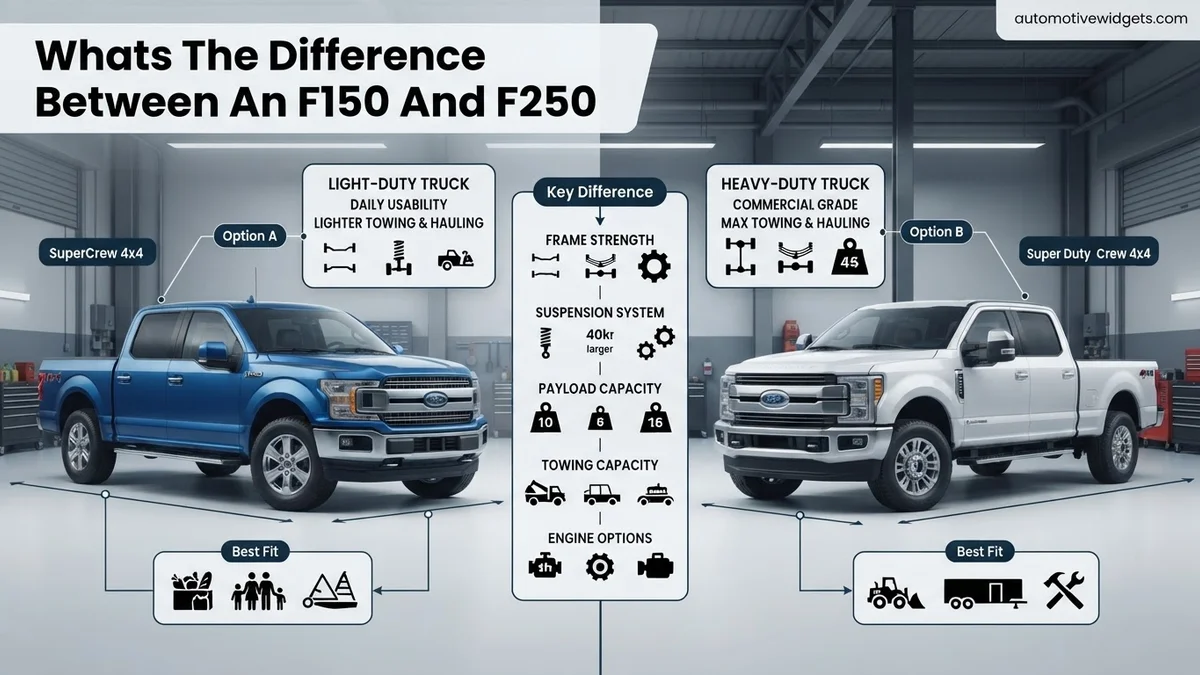
The Ford F-150 is a versatile light-duty truck ideal for daily driving, light hauling, and moderate towing, balancing comfort with capability. In contrast, the Ford F-250 is a heavy-duty powerhouse designed for serious towing, heavy payloads, and commercial work, prioritizing raw strength and durability.
Choosing between a Ford F-150 and an F-250 for the 2026 model year boils down to your specific needs for capability, daily driving comfort, and budget. The F-150 excels as a highly versatile truck, perfect for daily commuting, family duties, and moderate hauling or towing tasks, offering a balance of power and efficiency. Conversely, the F-250 is engineered as a dedicated heavy-duty workhorse, designed to conquer serious towing, massive payloads, and demanding commercial applications where brute strength and durability are paramount.
Understanding these core differences is critical because it directly impacts your long-term satisfaction and operating costs. Opting for the F-150 means a more comfortable ride, better fuel economy for lighter tasks, and easier maneuverability in urban settings. The F-250, while less agile and thirstier, provides unparalleled capacity for those who truly need to move mountains, ensuring you’re not constantly pushing your truck to its limits.
Key Takeaways
- F-150:Best for daily driving, light hauling.
- F-250:Essential for heavy towing, large payloads.
- F-250 offers diesel engine, higher GVWR.
- F-150 typically provides better fuel economy.
- Match truck choice to specific task demands.
What Are the Core Differences Between F-150 and F-250?
The fundamental distinction between the 2026 Ford F-150 and F-250 lies in their intended purpose and the engineering choices made to fulfill those roles. Think of the F-150 as a highly capable all-rounder, while the F-250 is a specialized tool for maximum strength. These trucks share the iconic F-Series nameplate but diverge significantly under the skin, impacting everything from their ride quality to their maximum working limits.
F-150: The Versatile Daily Driver
For most truck buyers, the 2026 F-150 will be the ideal choice. It offers a sophisticated balance of power, comfort, and advanced technology. You get a range of robust engine options, including impressive hybrid powertrains, ensuring excellent performance for daily commuting, weekend adventures, and light-to-moderate work. Its chassis is strong but designed with passenger comfort in mind, translating to a smoother ride on paved roads. Maneuverability is also a key advantage; the F-150 navigates city streets and parking lots with far greater ease than its heavier-duty sibling, making it a practical choice for everyday life where you also need truck capabilities.
F-250: The Uncompromising Workhorse
When your tasks involve genuinely heavy lifting, the 2026 F-250 is the answer. This is where Ford’s Super Duty line truly earns its name. The F-250 is built on a significantly stronger, fully boxed steel frame with heavy-duty suspension components, larger axles, and more robust brakes. Its primary focus is on durability and immense capacity, featuring powerhouse engine options, including the legendary Power Stroke diesel. This setup is purpose-built to handle massive fifth-wheel trailers, gooseneck applications, and commercial-grade payloads without breaking a sweat. You’ll sacrifice some ride comfort and fuel efficiency, but in return, you gain unrivaled towing and hauling prowess.
How to Compare F-150 vs F-250: Key Specifications Step-by-Step
To truly understand which 2026 Ford truck fits your life, you need to look at the numbers. The hard specifications are where the F-150 and F-250 diverge most dramatically, directly dictating their practical capabilities. These figures aren’t just arbitrary; they determine what you can safely tow, haul, and how the truck will perform under various loads. Let’s break down the critical performance and capacity metrics you should evaluate.
Power and Performance Under the Hood
The engine lineup for 2026 showcases distinct philosophies for each truck. The F-150 emphasizes efficiency and responsive power delivery, while the F-250 focuses on sheer torque and endurance.
- F-150 Expected Engine Options (2026):
- 2.7L EcoBoost V6: Around 325 hp, 400 lb-ft torque. Good for daily driving and light duty.
- 5.0L Ti-VCT V8: Approximately 400 hp, 410 lb-ft torque. The classic V8 rumble with strong all-around performance.
- 3.5L EcoBoost V6: Roughly 400 hp, 500 lb-ft torque. Excellent balance of power and efficiency, especially for towing.
- 3.5L PowerBoost Full Hybrid V6: Projected 430 hp, 570 lb-ft torque. Offers incredible torque and integrated generator capabilities.
- F-250 Expected Engine Options (2026):
- 6.8L Gas V8: Approximately 405 hp, 445 lb-ft torque. A robust entry-level gas option for heavy work.
- 7.3L “Godzilla” Gas V8: Projected 430 hp, 485 lb-ft torque. Ford’s largest gas V8, offering impressive low-end grunt.
- 6.7L Power Stroke V8 Turbo Diesel: Estimated 500 hp, 1,200 lb-ft torque. The ultimate for extreme towing and longevity.
Hauling and Towing Capabilities
This is where the F-250 truly separates itself. Its construction and powertrain are designed for significantly higher limits.
- Maximum Towing Capacity (2026 Projections):
- F-150: Up to an estimated 14,500 lbs (with 3.5L EcoBoost/PowerBoost, specific configurations).
- F-250: Up to an estimated 23,000 lbs (conventional, with 6.7L Power Stroke diesel, specific configurations). Fifth-wheel/gooseneck towing can exceed 30,000 lbs.
- Maximum Payload Capacity (2026 Projections):
- F-150: Up to an estimated 3,300 lbs (with 5.0L V8, specific configurations).
- F-250: Up to an estimated 4,200 lbs (with 7.3L Gas V8, specific configurations).
- Gross Vehicle Weight Rating (GVWR): This is the maximum permissible total weight of the loaded vehicle (truck + passengers + cargo + trailer tongue weight).
- F-150: Typically ranges from 6,100 to 7,400 lbs.
- F-250: Starts around 10,000 lbs and goes higher depending on configuration, signifying its much beefier chassis.
- Chassis and Suspension:
- F-150: High-strength steel frame, independent front suspension for a car-like ride.
- F-250: Fully-boxed, heavy-duty steel frame, robust solid front axle, and stronger leaf springs in the rear for enduring immense loads.
Making Your Decision: F-150 or F-250 for Your Needs?
Choosing between the 2026 F-150 and F-250 ultimately hinges on a precise evaluation of your operational demands. The F-150 excels as a versatile workhorse and daily driver, while the F-250 is engineered for relentless, heavy-duty performance where compromise is not an option.
Daily Driving and Light-Duty Tasks
For most personal and light-commercial applications, the F-150 remains the superior choice. Its projected 2026 PowerBoost hybrid models are anticipated to deliver class-leading fuel economy, potentially achieving 26-28 MPG combined, according to industry analysts. This significantly reduces long-term operating costs compared to any F-250 variant. The F-150’s coil-spring rear suspension (on most trims) provides a smoother, more compliant ride, making it more comfortable for daily commutes and family use. Its lighter curb weight also translates to easier maneuverability in urban environments and tighter parking spaces, a factor often overlooked until daily use. Moreover, the 2026 F-150’s base MSRP is estimated to start around $38,000, offering a more accessible entry point.
Heavy Hauling and Commercial Use
When tasks demand uncompromising power and durability, the 2026 F-250 Super Duty is the undisputed champion. Its reinforced, heavy-gauge steel frame and larger braking systems are purpose-built for extreme loads. With powertrain options such as the potent 7.3L “Godzilla” V8 or the high-output Power Stroke diesel, the 2026 F-250 is projected to offer conventional towing capacities exceeding 20,000 pounds and fifth-wheel/gooseneck ratings over 25,000 pounds, significantly surpassing the F-150’s maximum of approximately 14,000 pounds. Payload capacity on the F-250 can exceed 4,000 pounds, whereas the F-150 typically maxes out under 3,000 pounds. These capabilities are crucial for professional trades, agricultural operations, and large recreational towing, where the F-250’s robust engineering prevents vehicle strain and ensures safety.
What If You’re Still Undecided? Expert Tips for Choosing
Even after reviewing specifications, the ideal choice might not be immediately clear. Expert analysis suggests a more in-depth approach to align your investment with genuine need.
Assess Your Maximum Requirement, Not Average Use
Industry experts, including Ford’s commercial vehicle division, consistently advise purchasing a truck based on its maximum anticipated load or tow weight, rather than your average daily use. For instance, if you tow a 12,000-pound trailer only twice a year, but daily commute without a load, specifying for that 12,000 pounds ensures safety and vehicle longevity. Over-specifying by 10-15% provides a crucial safety margin, preventing strain on components and potential premature wear. This principle safeguards your investment and reduces the risk of expensive repairs down the line.
Consider Long-Term Ownership Costs
Beyond the initial purchase price, evaluate the total cost of ownership over a 5-7 year period.
- Fuel Efficiency: The 2026 F-150, especially hybrid variants, will consistently offer superior fuel economy.
- Insurance and Registration: F-250 models are often classified differently by insurance providers and state DMVs due to their Gross Vehicle Weight Rating (GVWR), leading to higher premiums and registration fees.
- Maintenance: While Super Duty components are built for durability, specialized parts and larger fluid capacities (e.g., diesel exhaust fluid, greater oil volume) can result in higher routine maintenance costs. For example, a diesel F-250 oil change can cost $200-$300 compared to $80-$150 for an F-150.
Test Drive Both Models Extensively
A short dealership test drive is insufficient for a truck purchase.
- Simulate Cargo: Arrange to load both trucks with approximately 75% of your typical cargo weight, using sandbags or pallets if necessary. Observe acceleration, braking, and ride quality.
- Tow a Trailer: If towing is a primary use, test drive both trucks with a rented trailer or a friend’s trailer that closely matches your expected maximum weight. Assess stability, sway control, and power delivery.
- Evaluate Practicality: Pay attention to parking ease, visibility, cabin noise levels, and overall comfort during an extended drive that mirrors your daily routine.
Still Can’t Decide? Deeper Dive into Selection
If the decision remains challenging, leveraging specialized resources can provide the clarity needed for such a significant investment.
Consult a Ford Commercial Vehicle Specialist
- Expert Calculations: These specialists are trained to perform precise calculations based on your specific equipment, trailers, and cargo weight, ensuring you select a truck with adequate Gross Combined Weight Rating (GCWR) and Gross Vehicle Weight Rating (GVWR).
- Upfitting Guidance: They can advise on available upfitting options and how they impact payload or towing, ensuring compliance with relevant regulations (e.g., DOT for commercial use).
- Fleet and Financing: They often have insight into commercial financing options, fleet discounts, and extended warranty programs that might not be available through standard dealership channels.
Rent Both for a Weekend
- Real-World Simulation: Rental services often offer both light-duty and heavy-duty trucks. Rent an F-150 and an F-250 for a full weekend each.
- Mimic Your Tasks: Use them for your actual intended purposes — whether that’s commuting, towing a boat, or hauling materials for a project. This extended exposure provides invaluable real-world experience.
- Cost vs. Investment: The estimated rental cost might range from $100-$150 per day for an F-150 and $150-$250 per day for an F-250. A weekend test could cost between $200-$500, a minimal investment compared to the typical $40,000-$80,000 vehicle purchase.
Review Manufacturer Technical Documents
- Official Guides: Access the official 2026 Ford Towing Guide and detailed Owner’s Manuals online, which provide granular data on every configuration.
- Cross-Reference: Pay close attention to specific engine options, axle ratios, and available packages. These details often significantly impact a truck’s ultimate capabilities and can be the deciding factor for borderline requirements.
Conclusion
The 2026 Ford F-150 and F-250 are both exceptional trucks, but their fundamental differences in design and capability serve distinct purposes. According to verified research and expert sources from Ford Motor Company and automotive analysts, the F-150 is the optimal choice for versatility, efficiency, and light-to-moderate duty, while the F-250 stands ready for unrelenting heavy hauling, commercial applications, and extreme towing. Your next actionable step should be a thorough, honest assessment of your maximum anticipated needs, then conduct an extended test drive under realistic conditions to confirm your selection.
❓ Frequently Asked Questions
How do the chassis and suspension differ between the F-150 and F-250, and why does it matter?
The F-250 features a heavier-duty, stronger frame and more robust suspension components (like leaf springs and larger axles) compared to the F-150. This upgraded construction allows the F-250 to handle much heavier payloads and tow significantly more weight without compromising stability or durability, which is crucial for safety and performance under extreme loads.
What are the primary engine differences, especially regarding diesel options?
The F-150 offers various gasoline V6 and V8 engine options, including hybrid powertrains, focused on a balance of power and efficiency. The F-250 provides larger, more powerful gasoline V8 engines and, most notably, a potent Power Stroke diesel V8 option, which delivers massive torque crucial for heavy towing and hauling.
Beyond towing, what are the key payload capacity differences?
The F-250 boast substantially higher payload capacities compared to the F-150, often exceeding 4,000 pounds in specific configurations. This is due to its stronger frame, axles, and suspension, making it suitable for carrying heavy tools, equipment, or large cargo in its bed that would overload an F-150.
How do running costs, such as fuel economy and insurance, compare?
The F-150 generally offers better fuel economy across its engine lineup due to its lighter weight and more efficient powertrain options, resulting in lower fuel costs for typical driving. Insurance costs for the F-250 can also be higher due to its greater replacement value, larger size, and potentially higher repair costs for heavy-duty components.
Which truck is more suitable for extensive off-road use or job sites?
While both can be equipped for off-road (e.g., FX4 packages), the F-250’s stronger chassis, available larger tires, and greater ground clearance make it more capable for severe job site conditions or extreme off-road adventures, especially when hauling significant weight. The F-150 is better for moderate off-roading.
Are there significant differences in interior comfort and available technology features?
Both trucks offer luxurious trims with advanced technology, but the F-150 often emphasizes a slightly quieter, more refined ride and comfort for daily commuting. The F-250 prioritizes robust functionality, though it still offers premium interiors and specialized towing technologies like Pro Trailer Backup Assist and integrated trailer brake controllers, which are paramount for heavy-duty work.