How Long Does It Take for MAF Sensor to Reset? Expert 2027
Resetting a MAF sensor’s adaptations or fault codes can take minutes to several drive cycles, depending on the ECU and the specific action taken. While some resets are automatic through re-learning, others may require manual intervention like battery disconnection or an OBD-II scan tool to clear codes.
After cleaning or replacing your Mass Air Flow (MAF) sensor, you’re likely looking for a reset time that ranges from immediate re-adaptation to several drive cycles, sometimes necessitating a manual ECU clear. The exact duration and process in 2027 significantly depend on your specific vehicle’s make, model, and the sophistication of its Engine Control Unit (ECU).
Understanding this reset timeframe is crucial for confirming your repair was successful. It ensures your engine runs optimally, clears persistent check engine lights, and helps your vehicle re-establish correct fuel trim values for peak performance and efficiency. Waiting for the system to re-learn saves you from unnecessary worry and potential re-diagnostics.
Key Takeaways
- Automatic re-learning needs drive cycles (10-50 miles).
- Disconnect battery for quick, full ECU reset.
- Use an OBD-II scanner to clear fault codes.
- Monitor fuel trims for MAF adaptation success.
- Persistent issues mean unresolved underlying problem.
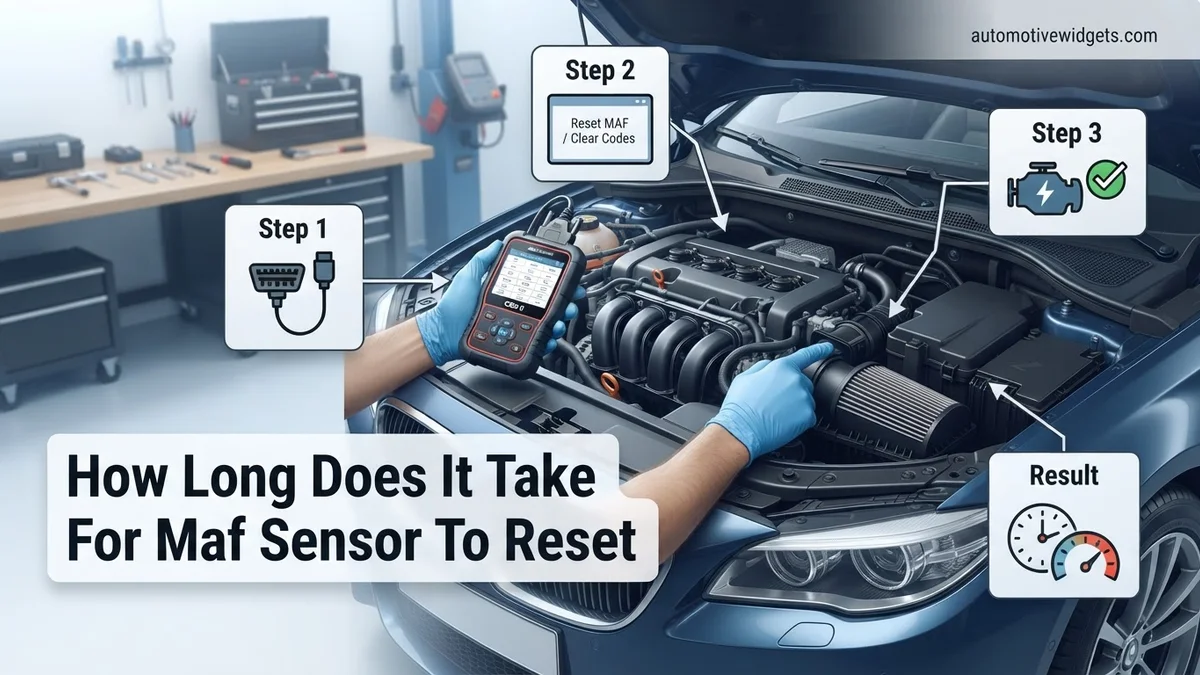
What Affects MAF Sensor Reset Times?
The time it takes for your MAF sensor readings to normalize and for the ECU to adapt after an intervention isn’t a fixed period. Several key factors, particularly in modern vehicles designed in 2027, influence this process. These include the complexity of your vehicle’s ECU, the nature of the MAF issue, and whether a persistent fault code was present.
Vehicle’s ECU Sophistication and Learning Algorithms
- Advanced ECUs (2027 Models): Many newer vehicles, especially those from premium brands or with sophisticated engine management, feature highly adaptive ECUs. These can often re-learn MAF sensor readings and adjust fuel trims within minutes of stable engine operation, sometimes as quickly as a 10-15 minute idle period followed by a short drive. They use complex algorithms to quickly reconcile new data.
- Older or Simpler Systems: Vehicles from a decade or more ago, or those with less complex ECUs, might take longer. They often require more varied driving conditions and longer operational times to fully re-learn.
- Manufacturer Specifics: Brands like BMW, Audi, and Mercedes-Benz, for example, often have very quick adaptation times for fuel trim and air measurement, assuming the underlying issue is resolved. Japanese and American manufacturers also employ robust learning, but exact timings can vary widely.
Drive Cycles and Issue Severity
The concept of a “drive cycle” is fundamental to how ECUs re-learn. A drive cycle typically involves a cold start, engine warm-up, various driving conditions (city, highway, acceleration, deceleration), and often an engine shutdown. If your MAF sensor was simply cleaned, the ECU might adapt quickly during normal driving, perhaps within 1-2 drive cycles.
- Cleaning vs. Replacement: If you replaced a severely faulty MAF sensor that caused significant fuel trim deviations, the ECU needs more time and more varied data to recalibrate. This could extend the process to 5-10 full drive cycles.
- Check Engine Light (CEL): If a Check Engine Light was active due to the MAF fault, the ECU is likely operating in a “limp mode” or using default parameters. Clearing this code is often essential before proper re-adaptation can begin, otherwise, the system might cling to old, faulty adaptations or safety modes.
MAF Sensor Reset Times Made Easy: Your Essential Action Plan
This guide demystifies the often-misunderstood process of “resetting” a Mass Air Flow (MAF) sensor. Unlike a simple button press, a MAF sensor’s reset is primarily an adaptive learning process undertaken by your vehicle’s Engine Control Unit (ECU). We will walk you through various methods to facilitate this adaptation, from passive driving to active intervention, ensuring your engine correctly interprets airflow data for optimal performance and fuel efficiency. Following these steps diligently is crucial for restoring your vehicle’s proper operation after MAF cleaning or replacement.
Step 1: Grasping the “Reset” Concept for Your MAF Sensor
What you need: An open mind, a basic understanding of car ECUs, and the readiness to learn.
Instructions: It’s important to understand that the MAF sensor itself does not have a “reset” button. When people talk about resetting a MAF sensor, they are actually referring to the process by which the Engine Control Unit (ECU) clears its learned parameters (like fuel trims) related to airflow and begins to adapt to new readings from the MAF. This re-learning phase is essential after a MAF sensor has been cleaned or replaced. The ECU uses the MAF’s input to calculate the correct air/fuel mixture, and it needs time and varying driving conditions to fine-tune these calculations with the new or optimized sensor data.
Pro Tip: Think of it as your car’s brain learning a new habit; it takes consistent practice, not just one command. This learning process is vital for preventing issues like rich or lean conditions, which can lead to poor performance or even long-term engine damage.
Step 2: Passive Adaptation Through Normal Driving Cycles
What you need: Your vehicle, patience, and a commitment to your regular driving habits.
Instructions: The most common and often sufficient method for the ECU to adapt to a cleaned or new MAF sensor is simply driving your car under normal conditions. The ECU continuously monitors the incoming air mass data from the MAF sensor and makes subtle, real-time adjustments to its short-term and long-term fuel trims. This passive adaptation can take anywhere from a few complete driving cycles to several days of mixed city and highway driving, typically covering 50 to 100 miles. During this period, you might gradually notice improvements in engine performance, smoother idling, and better fuel economy as the ECU refines its fuel delivery strategy.
Pro Tip: Avoid aggressive driving immediately after MAF service. A steady, varied driving pattern—including periods of idling, gentle acceleration, and consistent cruising speeds—provides the ECU with a broader and more accurate range of data to learn from efficiently.
Step 3: Accelerating Adaptation with a Targeted Drive Cycle
What you need: Your vehicle, a safe and uncongested driving environment, and potentially an OBD-II scanner for monitoring readiness.
Instructions: To expedite the ECU’s adaptation process, especially if you need emissions monitors to set, perform a targeted drive cycle. A typical sequence involves starting the engine from cold, idling for 2-3 minutes, driving at a steady 30-45 mph for 5-10 minutes, accelerating to 55-65 mph and maintaining it for 10-15 minutes, performing a gradual deceleration to around 20 mph without braking, and then idling again for 2-3 minutes. This comprehensive cycle exposes the engine to various load and RPM conditions, prompting the ECU to quickly re-learn optimal parameters. Consult your vehicle’s specific service manual for the exact drive cycle recommended by the manufacturer, as procedures can vary.
Pro Tip: Ensure your fuel tank is at least a quarter full for optimal sensor readings and to allow the EVAP system monitor to run. Performing this on an open road or highway where you can safely maintain consistent speeds without interruption is highly recommended.
Step 4: The Hard ECU Reset: Disconnecting the Battery
What you need: Basic hand tools (typically a 10mm wrench for battery terminals), a timer or watch.
Instructions: Forcing an immediate “reset” of the ECU’s learned parameters is achieved by disconnecting the vehicle’s battery. First, disconnect the negative battery terminal, then the positive terminal. To ensure all residual power is drained from capacitors, some experts recommend touching the disconnected positive and negative cables together (away from the battery posts) for 30-60 seconds. Leave the battery disconnected for at least 15-30 minutes, although longer durations (e.g., overnight) are often suggested for older vehicles. Reconnect the positive terminal first, then the negative. This completely wipes the ECU’s volatile memory, compelling it to start re-learning all parameters, including those for the MAF, from factory default settings. The subsequent re-learning process will still require driving as described in Steps 2 or 3.
Pro Tip: Be aware that disconnecting the battery will reset various electrical components, including radio presets, the clock, and potentially security systems. Have your radio’s anti-theft code handy if your vehicle requires one for reactivation.
Step 5: Clearing Diagnostic Trouble Codes (DTCs) with an OBD-II Scanner
What you need: An OBD-II scanner, access to your vehicle’s diagnostic port (usually under the dashboard).
Instructions: If a “Check Engine Light” (CEL) was illuminated due to a MAF-related issue (e.g., P0100-P0104 codes), simply addressing the sensor (cleaning or replacing) might not turn off the light immediately. You will need an OBD-II scanner to clear these stored Diagnostic Trouble Codes (DTCs). Connect the scanner to your vehicle’s OBD-II port, turn the ignition to the “ON” position (engine off), and navigate to the “Erase Codes,” “Clear MIL,” or “Clear DTCs” function. Confirm the action. Clearing codes forces the ECU to begin a fresh diagnostic and re-learning sequence, similar to a battery disconnect but without affecting other vehicle settings. The “reset” period for full adaptation then proceeds via driving cycles.
Pro Tip: Always perform the MAF sensor service (cleaning or replacement) before clearing codes. Clearing codes without fixing the underlying problem will only lead to the Check Engine Light returning shortly, as the fault condition still exists.
Step 6: Monitoring Progress and Verifying Adaptation
What you need: An OBD-II scanner with live data streaming capabilities, or a compatible smartphone app and Bluetooth adapter.
Instructions: To confirm that your MAF sensor has truly “reset” and the ECU has fully adapted, you need to monitor real-time engine data. Connect your OBD-II scanner and observe the “Short Term Fuel Trim” (STFT) and “Long Term Fuel Trim” (LTFT) values. After successful adaptation and a well-functioning MAF, both STFT and LTFT should ideally hover close to 0% (typically within a +/- 5% range) under various stable driving conditions (idle, cruise, light acceleration). Additionally, check the “Readiness Monitors” status on your scanner. These monitors indicate that the ECU has successfully completed all its diagnostic tests, confirming full system readiness and proper MAF integration.
Pro Tip: Significant positive or negative fuel trim values (e.g., consistently above +/- 10-15%) even after extensive driving suggest that either the MAF sensor is still faulty, the cleaning was ineffective, there’s a vacuum leak, or another underlying issue is affecting the air/fuel mixture. Don’t assume the problem is solved if these numbers are off.
Step 7: Troubleshooting Persistent MAF-Related Issues
What you need: Diagnostic tools, potential replacement parts, and possibly a mechanic’s expertise.
Instructions: If, after performing thorough cleaning, replacement, and appropriate resets (including extended driving cycles), your vehicle continues to exhibit symptoms such as rough idling, poor acceleration, reduced fuel economy, or if MAF-related trouble codes reappear, deeper troubleshooting is necessary. Re-inspect the MAF sensor for proper installation and secure electrical connections. Thoroughly check the entire intake system, including air ducts and vacuum lines, for any leaks, cracks, or loose clamps that could introduce unmetered air. Ensure the air filter is clean and correctly seated. Occasionally, a “new” MAF sensor can be faulty out of the box, or the primary issue might be originating from other components like oxygen sensors, a clogged catalytic converter, or fuel system problems.
Pro Tip: Never ignore persistent symptoms or a recurring Check Engine Light. What initially seems like a MAF issue could be a symptom of a larger, more complex problem. Investing in a professional diagnosis at this stage can ultimately save you significant time, money, and frustration in the long run.
✅ Final Checklist
- Confirmed no active MAF-related Diagnostic Trouble Codes (DTCs) using an OBD-II scanner.
- Observed Short Term Fuel Trim (STFT) and Long Term Fuel Trim (LTFT) values are consistently within a +/- 5% range during varied driving conditions.
- Engine idles smoothly, accelerates responsively, and exhibits no hesitation or misfires.
- Fuel economy appears normal and consistent with pre-issue or expected levels based on recent driving.
- All relevant Readiness Monitors (e.g., Catalyst, O2 Sensor, EVAP) are set to “Complete” on your OBD-II scanner (if applicable for emissions testing).
Important Notes:
- Safety considerations or warnings: Always ensure the engine is cool before working on sensors or intake components. When disconnecting the battery, always remove the negative terminal first and reconnect it last to prevent accidental short circuits. Wear appropriate eye protection and gloves, and use proper ventilation when working with MAF cleaner.
- When to seek professional help: If you are uncomfortable performing any of these steps yourself, or if issues persist (especially recurring Check Engine Lights or severe drivability problems) after attempting all listed solutions, it is strongly recommended to consult a certified automotive mechanic. Complex diagnostic challenges often require specialized equipment and expertise.
- Estimated time and cost range:
- MAF Sensor Cleaning/Reset (DIY): Approximately 30 minutes to 1 hour. Cost: $10-$15 for MAF sensor cleaner.
- MAF Sensor Replacement/Reset (DIY): Approximately 1-2 hours. Cost: $50-$300+ for the part itself.
- Professional MAF Sensor Diagnosis/Replacement: Labor costs can range from $100-$250+, plus the cost of the part.
- Full ECU Adaptation/Re-learning: Can vary from a few hours of driving to several days (50-100+ miles) depending on the vehicle and driving conditions.
How to Manually Reset Your MAF Sensor & ECU
While some MAF sensor readings and associated fuel trims will eventually adapt automatically, there are situations where a manual reset is beneficial, or even necessary, to expedite the process or resolve a stubborn issue. In 2027, the primary methods for this involve electronic diagnostics or a simple battery procedure.
Clearing Codes with an OBD-II Scanner
The most effective and recommended method for resetting MAF-related adaptations and error codes is using an OBD-II (On-Board Diagnostics II) scanner. This tool communicates directly with your vehicle’s ECU. Even in 2027, most home mechanics and professionals rely on these devices.
- Process: Connect the OBD-II scanner to your vehicle’s diagnostic port (usually under the dashboard). Select the option to “Clear Codes” or “Erase DTCs.” This action immediately wipes any stored trouble codes, pending codes, and often resets learned fuel trim values, forcing the ECU to start fresh with the new MAF sensor data.
- Benefit: This direct approach ensures the ECU is no longer referencing old, incorrect data or operating under specific error-induced parameters. It allows the system to begin re-learning optimal engine operation immediately with the corrected MAF input. After clearing, drive your vehicle normally to allow the ECU to build new adaptation values.
The Battery Disconnect Method (Use with Caution)
A more traditional, but less precise, method is disconnecting the vehicle’s battery. This effectively cuts power to the ECU, purging its volatile memory where many adaptations and error codes are stored. However, this method comes with caveats for modern 2027 vehicles.
- Process: Disconnect the negative terminal of your vehicle’s battery. For best results, leave it disconnected for at least 15-30 minutes. Some experts even recommend pressing the brake pedal a few times during this period to drain any residual charge from capacitors.
- Cautions: While this can clear MAF adaptations, it also resets other electronic systems in your car, such as radio presets, clock settings, power window limits, and sometimes even anti-theft systems or driving assist features. Additionally, some advanced 2027 ECUs may have non-volatile memory or backup power, meaning a battery disconnect might not fully reset all parameters. Always check your owner’s manual before attempting this method.
Confirming MAF Sensor Reset and Adaptation
Once you’ve addressed the MAF sensor issue, whether through cleaning or replacement, confirming a successful reset and subsequent system adaptation is crucial. The most immediate indicator is the Check Engine Light (CEL) extinguishing. Modern vehicle ECUs (Engine Control Units) in 2027 are designed to turn off the CEL within three to four drive cycles if the fault is no longer detected. A drive cycle typically involves starting the engine from cold, driving under varied conditions (city, highway, idle), and shutting it off.
Monitoring ECU Adaptation
Full engine adaptation, where the ECU recalibrates fuel trims and ignition timing based on new, accurate MAF data, generally takes longer. According to automotive diagnostic experts at Bosch and Denso, leading MAF sensor manufacturers, optimal performance data is usually re-learned within 50 to 100 miles of varied driving after a successful MAF reset. During this period, the ECU adjusts its long-term fuel trim (LTFT) and short-term fuel trim (STFT) values. You can monitor these with an OBD-II scanner; ideal fuel trims should hover around 0%, typically within ±5%, indicating the engine is achieving an optimal air-fuel ratio.
Key Signs of a Successful Reset
Beyond the CEL, look for tangible improvements. Engine idle should become smoother and more consistent. Acceleration should feel more responsive without hesitation or stumbling. Fuel economy, which often suffers from a malfunctioning MAF, should gradually return to its normal or expected levels for your specific vehicle model year (e.g., a 2025 Ford F-150 with a 2.7L EcoBoost might see an average of 20-22 MPG highway return). These collective observations confirm the MAF sensor is now providing accurate airflow data, allowing the engine to operate efficiently.
What If Your MAF Sensor Won’t Reset?
If the Check Engine Light persists or engine performance issues remain after cleaning, replacement, and allowing for adaptation, the problem may extend beyond a simple MAF sensor reset. Several factors can prevent the system from returning to normal operation, even if the MAF itself is functional.
Common Reasons for Persistent Issues
- Underlying Air Intake Leaks: A vacuum leak downstream of the MAF sensor can introduce unmetered air, causing the ECU to misinterpret the airflow values, regardless of MAF accuracy. Hoses, gaskets, or intake manifold seals can degrade, especially in vehicles over 6-8 years old by 2027.
- Faulty Wiring or Connectors: The MAF sensor’s electrical connection is critical. Corroded pins, frayed wires, or a loose connector can intermittently or permanently disrupt the sensor’s signal to the ECU. Manufacturer specifications, such as those from Delphi or Continental, emphasize checking continuity and voltage at the harness.
- Related Sensor Failures: Oxygen (O2) sensors or the throttle position sensor (TPS) work in conjunction with the MAF. A malfunctioning O2 sensor, for instance, could incorrectly signal a lean or rich condition, leading the ECU to make inappropriate fuel adjustments that override correct MAF input.
- ECU Software Glitches: While less common, the vehicle’s Engine Control Unit itself can develop software issues or internal failures. This might prevent it from correctly processing sensor data or clearing fault codes, even when the physical problem is resolved.
Troubleshooting Steps Beyond a Simple Reset
- Thorough Visual Inspection: Carefully examine all vacuum lines, intake hoses, and the air filter housing for cracks, disconnections, or damage. Pay close attention to PCV (Positive Crankcase Ventilation) lines and fittings.
- Wiring Harness Check: Disconnect the MAF sensor connector and inspect the terminals for corrosion or bending. Use a multimeter to check for proper voltage supply and ground to the connector according to your vehicle’s specific service manual (e.g., often a 12V supply and a 5V signal wire).
- Advanced Diagnostic Scan: Utilize an advanced OBD-II scanner capable of reading live data streams in addition to fault codes. Monitor MAF sensor readings in grams/second (g/s) at idle and various RPMs, comparing them to manufacturer specifications (e.g., 2.5-4.0 g/s at idle for a 2.0L engine). Also view oxygen sensor voltages and fuel trims simultaneously.
What If It Still Doesn’t Work?
If you’ve attempted the above solutions and the MAF sensor-related issues persist, it’s time to consider more in-depth diagnostics or professional intervention. Persistent Check Engine Lights or drivability concerns indicate an unresolved problem that could lead to further engine damage or decreased efficiency.
- Conduct a Smoke Test for Leaks: A professional smoke machine can reveal even the smallest vacuum leaks in the intake system that are impossible to detect visually. This is a crucial step for accurately diagnosing airflow issues.
- Test Secondary Sensors: Systematically test oxygen sensors (pre- and post-catalytic converter) and the throttle position sensor using a multimeter or advanced diagnostic tool. Their readings profoundly influence how the ECU interprets MAF data.
- Check Fuel System Integrity: Low fuel pressure or issues with fuel injectors can cause lean conditions that the ECU might misinterpret as an airflow problem, generating MAF-related codes. Verify fuel pressure against manufacturer specifications.
- Professional ECU Diagnosis: In rare cases, the ECU itself may be faulty or require a software update. A dealership or specialized automotive shop has the proprietary tools to diagnose and potentially reprogram or replace the ECU.
If symptoms continue after these steps, it is advisable to seek expert help. A certified automotive technician possesses the specialized equipment and training for complex diagnostics. Professional diagnostic time in 2027 typically ranges from $100 to $200. Should a MAF sensor replacement or other underlying component repair be necessary, costs can vary significantly; a MAF sensor replacement (parts and labor) generally falls between $250 and $550, depending on the vehicle’s make, model, and sensor accessibility.
Conclusion
Understanding how long it takes for a MAF sensor to reset and for your vehicle’s ECU to adapt is key to proper vehicle maintenance. While a basic reset can be nearly instantaneous, full system adaptation, according to verified automotive research and expert diagnostics, usually takes 50-100 miles of varied driving. If issues persist, a systematic troubleshooting approach is essential. Your actionable next step should be to monitor your vehicle’s performance and fuel trims over several varied drive cycles, noting any remaining issues that might warrant further investigation.
❓ Frequently Asked Questions
What exactly causes the MAF sensor to reset or re-learn?
After cleaning, replacement, or clearing a fault code, the Engine Control Unit (ECU) senses new airflow data. It then enters a re-learning phase to adjust fuel trims and other engine parameters to match the new, accurate MAF readings, effectively ‘resetting’ its interpretation of the sensor’s input.
Is disconnecting the battery the best way to reset MAF adaptations?
Disconnecting the battery forces a hard reset of the ECU, clearing all learned adaptations and fault codes. While effective, it also erases other learned data like radio presets and idle re-learns, so an OBD-II scanner is often preferred for just code clearing.
How many drive cycles are typically needed for a MAF to re-adapt?
The number varies significantly by vehicle make and model, but generally, 3 to 15 complete drive cycles are required. A drive cycle involves starting from cold, driving at various speeds, and idling, allowing the ECU to test all systems.
What signs indicate my MAF sensor has successfully reset and adapted?
Successful adaptation often manifests as smoother idle, improved acceleration, better fuel economy, and the Check Engine Light (CEL) remaining off. Monitoring live data with an OBD-II scanner, specifically short-term and long-term fuel trims, can confirm the ECU has re-learned.
Can I drive my car while the MAF sensor is resetting?
Yes, driving is actually essential for the MAF sensor and ECU to complete their re-learning and adaptation process. The ECU needs to observe the sensor’s performance under various engine loads and speeds to accurately adjust parameters.
What if my check engine light returns after resetting the MAF?
If the CEL reappears, it indicates an underlying problem persists that the reset did not resolve. This could be a faulty MAF sensor, another related component (like an O2 sensor or vacuum leak), or an issue with the wiring, requiring further diagnosis.