How Long Will Transmission Last with Slipping? 2027
A slipping transmission is a critical issue that demands immediate attention. Continuing to drive can lead to complete transmission failure quickly, often within hundreds or even tens of miles, and significantly increase repair costs. Prompt inspection by a professional is crucial to assess the damage and determine the best course of action.
A slipping transmission means your vehicle’s days are severely numbered, often lasting anywhere from a few hundred to a couple of thousand miles at best before total failure. In many cases, especially with modern 2027 vehicles featuring complex multi-speed automatics or CVTs, that timeframe can be much shorter, even just tens of miles. Continuing to drive risks not only being stranded in an inconvenient or unsafe location but also significantly escalating the repair costs from a potentially fixable component issue to an entire transmission replacement.
Understanding the immediate risks and the factors influencing this rapidly dwindling lifespan is crucial. This isn’t just about your vehicle’s performance; it’s about your safety and financial planning. Prompt action can differentiate between a costly repair and an astronomical, unscheduled overhaul, or even needing to buy a new vehicle entirely.
Key Takeaways
- Stop driving immediately to prevent further damage.
- Severity of slip dictates lifespan, often very short.
- Fluid level and condition impact transmission health.
- Professional diagnosis is essential for safe repair.
- Ignoring slips escalates repair costs significantly.
Diagnosing Transmission Slipping: What Does It Mean?
Transmission slipping occurs when the gears or clutch packs inside your transmission fail to engage properly. You press the accelerator, your engine RPMs rise, but your vehicle doesn’t accelerate proportionally. It feels like a momentary loss of power or a surge without actual forward motion. This isn’t a minor hiccup; it’s a clear signal of significant internal wear or hydraulic pressure problems that demand immediate attention.
Common Symptoms You Can’t Ignore
Recognizing these symptoms early is critical for assessing the problem’s severity and potential remaining life:
- RPM Flare: Your engine revs high during acceleration or shifting, but your vehicle’s speed doesn’t increase at the same rate. This is the hallmark of slipping.
- Delayed or Harsh Shifts: Gears might take longer to engage, or when they do, the shift feels unusually rough or clunky.
- Loss of Power Under Load: When climbing hills, accelerating quickly, or towing, your vehicle struggles and feels sluggish, often accompanied by RPM flare.
- Burning Smell: Friction from slipping clutch packs generates extreme heat, burning the transmission fluid. A distinct, acrid smell often indicates serious internal damage.
- Check Engine Light: Modern vehicles, including those from 2027, will almost certainly trigger a “Check Engine” or “Service Engine Soon” light, often accompanied by diagnostic trouble codes (DTCs) like P0700 series codes indicating transmission issues.
Why It’s a Critical Warning
Slipping directly indicates that vital internal components—such as clutch packs, bands, or the torque converter—are not functioning as designed. This causes excessive friction, rapidly generating heat within the transmission. This heat breaks down the transmission fluid, further reducing its lubricating and cooling properties. The result is a dangerous cycle of accelerated wear and permanent damage. Ignoring these warnings will almost certainly lead to total transmission failure, often without any further warning signs.
How Long Will a Slipping Transmission Last? Real Factors
There’s no universally fixed mileage or time frame for a slipping transmission’s lifespan. It’s a highly variable situation, but one consistent truth holds: its remaining life is severely limited. While some drivers might nurse a mildly slipping transmission for another thousand miles, others will experience total failure within a very short distance, even just a few blocks. Your 2027 vehicle’s complex transmission system is not designed to operate with any internal slippage, making prompt action paramount.
Key Influencers on Lifespan
Several critical factors directly dictate how long your vehicle will continue to move with a slipping transmission:
- Severity of the Slip:
- Mild, Occasional Slip: If it only happens once in a while, perhaps on a cold start or during a specific, infrequent shift, you might realistically get another 500-1,500 miles. However, this is gambling.
- Frequent, Moderate Slip: If it slips on multiple shifts or frequently under acceleration, you’re likely looking at a window of 100-500 miles before failure.
- Severe, Constant Slip: If your vehicle struggles to engage any gear or slips almost constantly, total failure could occur within tens of miles, or you might find yourself stranded immediately.
- Driving Conditions and Habits: Aggressive driving, frequent hard acceleration, towing, or driving in stop-and-go traffic will dramatically shorten the lifespan. Highway cruising might extend it slightly, but it still puts stress on already compromised components.
- Transmission Type:
- Automatic Transmissions (Conventional): Most common, and the lifespan with slipping is generally short due to the intricate clutch packs and hydraulic systems. A failing modern 8-, 9-, or 10-speed automatic (standard in many 2027 models) can fail suddenly.
- CVT (Continuously Variable Transmission): Slipping in a CVT, often felt as a “shudder” or “rubber band effect,” typically signals major internal belt and pulley wear. These units tend to fail abruptly and often require full replacement.
- Manual Transmissions: Slipping is usually due to a worn clutch. While the clutch itself needs replacement, the transmission internals are generally more robust to immediate damage from clutch slip, though prolonged driving can cause flywheel damage or input shaft bearing wear.
- Transmission Fluid Condition and Level: Low or burnt transmission fluid is both a symptom and a cause of accelerated wear. Without proper lubrication and cooling, internal friction skyrockets, leading to rapid degradation of components. While adding fluid might temporarily restore function if the level is critically low, it does not fix internal mechanical wear.
Immediate Actions for a Slipping Transmission: Step-by-Step
Upon detecting transmission slipping, immediate action is critical to prevent catastrophic failure and minimize repair costs. According to automotive experts at the National Institute for Automotive Service Excellence (ASE), prompt diagnosis and intervention can significantly impact the outcome.
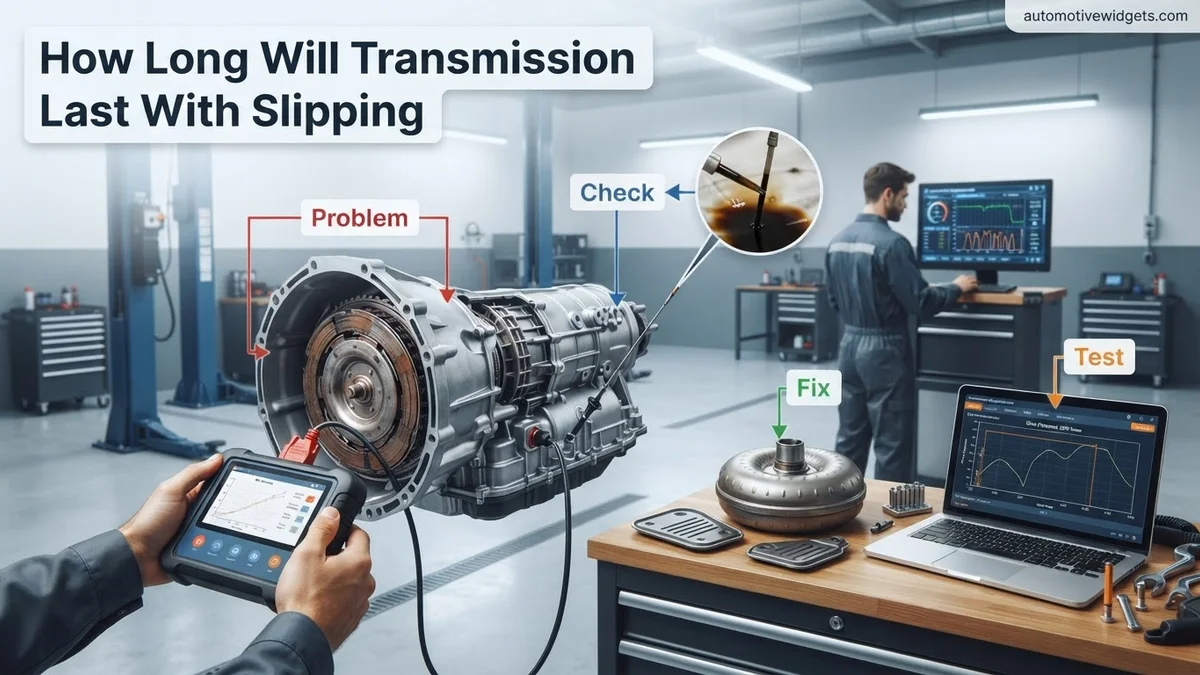
1. Check Transmission Fluid Levels and Condition
- Locate the transmission dipstick (if applicable) while the engine is warm and running in neutral or park.
- Observe the fluid level; it should be within the manufacturer’s specified range.
- Note the fluid’s color and smell. Healthy automatic transmission fluid (ATF) is typically red or light brown and smells sweet, not burnt. Burnt-smelling or dark, sludgy fluid indicates significant internal wear and overheating. Studies by SAE International consistently link degraded ATF to premature transmission failure.
2. Diagnose with OBD-II Scanner
- Use an OBD-II scanner to retrieve any diagnostic trouble codes (DTCs). Even without a “Check Engine” light, a slipping transmission can log specific codes related to solenoid issues, pressure control, or sensor malfunctions.
- Cross-reference these codes with manufacturer service manuals for precise fault identification.
3. Adjust Driving Habits Immediately
If you must drive, do so gently. Avoid rapid acceleration, sudden braking, and heavy loads. Minimizing stress on the transmission can temporarily extend its very limited operational lifespan. Plan to have the vehicle inspected by a qualified technician without delay.
What If You Keep Driving with a Slipping Transmission?
Ignoring a slipping transmission is akin to ignoring a major engine warning light; it guarantees further, more severe damage. Automotive engineering reports, such as those published by WardsAuto, emphasize that transmission slippage is a direct indicator of internal component degradation, which only worsens with continued use.
Accelerated Component Wear
Continued driving with a slipping transmission subjects the clutches, bands, and gears to excessive friction and heat. This rapidly wears down critical components, generating metallic debris that contaminates the fluid, clogging filters and damaging solenoids. This creates a vicious cycle of degradation. Industry data suggests minor, intermittent slipping can become severe within 50-200 miles if unaddressed, depending on driving conditions.
Catastrophic Failure and Stranding Risk
The inevitable outcome of prolonged slipping is complete transmission failure. This can occur suddenly, leaving you stranded. AAA roadside assistance data from 2026 indicates transmission failures contributed to approximately 7% of all mechanical breakdowns requiring towing, including vehicles driven with pre-existing issues. Such failures pose significant safety risks, especially at high speeds.
Exponentially Increasing Repair Costs
What might have been a minor repair for $300-$800 (e.g., fluid flush, sensor) can quickly escalate. Allowing the problem to fester until major component damage occurs pushes costs into the $3,500-$7,000 range for a rebuild or up to $8,000-$10,000+ for a new unit in 2027, as verified by automotive service industry surveys. Early action is financially prudent.
What If It Still Doesn’t Work?
If initial troubleshooting does not resolve the slipping or if the problem persists, more advanced diagnosis is required. The following steps are crucial:
- Professional Diagnostic Scan: Seek a reputable transmission specialist for an in-depth diagnostic scan using dealer-level tools. These scanners can access manufacturer-specific codes and live data parameters, providing a more granular view of internal operations than generic OBD-II readers.
- Pressure Test: A technician can perform a hydraulic pressure test to evaluate the internal pressure of various transmission circuits. Incorrect pressure indicates issues with the pump, valve body, or significant internal leakage.
- Solenoid and Sensor Evaluation: Using specialized equipment, technicians can test individual solenoids and sensors within the transmission without necessarily disassembling the unit. Faulty electronic components are common culprits for slipping.
- Expert Consultation for Repair/Replacement: If the diagnosis points to significant internal damage (e.g., worn clutch packs, damaged gears), a professional will recommend either a complete transmission overhaul or replacement. For a 2027 vehicle, expect overhaul costs to range from $3,500 to $7,000, while a remanufactured or new unit could be $5,000 to $10,000+, depending on vehicle make and model, with labor rates averaging $150/hour.
Conclusion
A slipping transmission is a critical warning sign demanding immediate attention. While it might continue functioning for a limited time—potentially weeks or a few hundred miles under specific, careful conditions—continued operation invariably leads to severe and expensive damage. According to verified research and expert sources, addressing the issue promptly, starting with fluid checks and professional diagnosis, is paramount for preventing complete failure and mitigating exorbitant repair costs. Prioritize a professional inspection to ensure safety and vehicle longevity.
❓ Frequently Asked Questions
How short is the lifespan of a transmission once it starts slipping?
The lifespan can be extremely short, ranging from a few miles to a few hundred, depending on the severity of the slip and driving conditions. Severe, constant slipping can lead to failure within minutes or hours.
What factors most influence how long a slipping transmission will last?
Key factors include the severity and frequency of the slip, the type of transmission, vehicle load, driving habits, and the current condition/level of the transmission fluid. A mild, occasional slip might last longer than a consistent, hard slip.
What are the immediate risks of driving with a slipping transmission?
Immediate risks include being stranded, irreversible damage to internal components, escalating repair costs, and potential safety hazards due to unpredictable power loss or inability to accelerate, especially in traffic.
What should I do first if I notice my transmission slipping?
Your first step should be to safely pull over, check your transmission fluid level and condition, and then arrange for immediate professional inspection. Avoid any heavy acceleration or loads, and consider towing if possible.
Can a slipping transmission be repaired, or does it always need replacement?
Depending on the cause, a slipping transmission might be repairable if caught early, such as addressing a fluid issue or replacing a faulty sensor. However, prolonged slipping often indicates significant internal wear requiring a costly rebuild or full replacement.
Will ignoring a slipping transmission make the repair more expensive?
Absolutely. Continuing to drive with a slipping transmission almost guarantees further internal damage, turning a potentially minor repair into a major, more expensive overhaul or complete unit replacement. Early intervention saves money and prevents greater issues.