Can You Drive In 4 Wheel Drive On The Highway Can You 2027
Driving a vehicle with part-time 4-wheel drive on dry paved highways is generally not recommended and can cause significant damage. This is due to ‘driveline bind,’ which occurs when the system cannot compensate for wheel speed differences on high-traction surfaces, leading to stress on the drivetrain components. Full-time 4WD and AWD systems, however, are designed for continuous highway use.
Can you safely drive your vehicle in 4-wheel drive mode on paved highways in 2027? The short answer is: it depends entirely on the type of 4WD system your vehicle has. For most traditional trucks and SUVs equipped with a part-time 4WD system, the answer is a definitive no, especially on dry, high-traction pavement. Doing so can cause significant, expensive damage to your vehicle’s drivetrain and compromise your safety.
Understanding the distinctions between different 4WD and All-Wheel Drive (AWD) systems is crucial for preventing costly repairs and ensuring your vehicle handles as intended. This isn’t just about preserving your investment; it’s about maintaining control and predictability on the road, particularly at highway speeds where mistakes can have serious consequences. Let’s break down why certain systems are highway-friendly and others are not.
Key Takeaways
- Part-time 4WD harms dry pavement driving.
- Driveline bind stresses drivetrain components.
- Full-time 4WD/AWD are safe for highways.
- Use part-time 4WD only on slippery surfaces.
- Improper 4WD use increases wear and risks.
What Causes Drivetrain Damage When Driving 4WD on Highways?
The Core Problem: Driveline Bind on Paved Surfaces
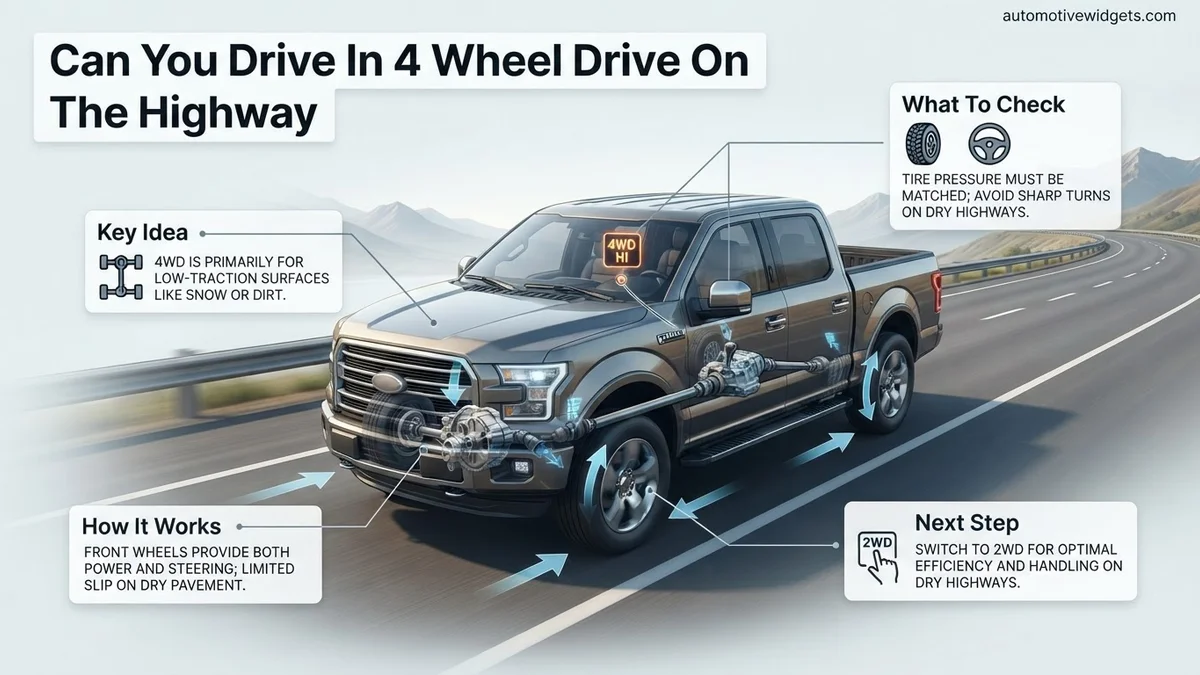
The primary reason you shouldn’t use part-time 4WD on dry pavement boils down to something called “driveline bind.” When your vehicle turns, each wheel travels a different distance. The outer wheels spin faster than the inner wheels. In a standard 2-wheel drive (2WD) vehicle or one with full-time 4WD or AWD, differentials allow these speed differences to occur smoothly. However, part-time 4WD systems lock the front and rear axles together. They lack a center differential, which is the component that allows the front and rear drivelines to rotate at different speeds.
- On loose surfaces like snow, dirt, or gravel, the tires can slip slightly, releasing this built-up tension.
- On dry, high-traction pavement, the tires cannot slip. This forces the entire drivetrain—from the transfer case to the axles—to absorb immense twisting forces.
- This constant struggle against itself is what we call driveline bind. It puts extraordinary stress on every component involved.
This stress accumulates rapidly, especially during turns, even subtle lane changes, and any time the front and rear wheels need to rotate at slightly different rates, which is almost constantly on a highway.
Consequences: From Stress to Serious Failure
Ignoring the risks of driveline bind on dry pavement can lead to a cascade of expensive problems for your vehicle. The components under the most strain are not cheap to replace in 2027.
- Transfer Case Damage: This is often the first component to suffer. Gears can strip, bearings can fail, and the entire unit can overheat or crack under prolonged stress.
- Differential and Axle Damage: The front and rear differentials, as well as the axle shafts themselves, are subjected to extreme torque. This can lead to gear wear, bearing failure, or even catastrophic breakage.
- Accelerated Tire Wear: Your tires will fight for traction, leading to uneven and rapid wear, especially noticeable on the shoulders of the tires. This directly impacts your budget for new tires.
- Reduced Fuel Efficiency: The drivetrain is constantly working against itself, creating drag and friction. This directly translates to more fuel consumed for less distance traveled.
- Compromised Steering and Handling: Driveline bind makes steering feel heavy, vague, or resistant. The vehicle may feel like it’s dragging, reducing your ability to steer precisely and react quickly, which is a significant safety hazard at highway speeds.
In the worst-case scenario, parts can suddenly seize or break while driving, leading to a loss of control or stranding you on the roadside.
How to Diagnose Your 4WD System Type & Its Highway Limitations
Understanding Part-Time 4WD Systems (No Center Differential)
Part-time 4WD systems are designed for maximum traction in low-grip situations, not for everyday road use. They are easily identifiable by their selector switch or lever, which typically offers distinct modes. You will commonly find these systems in older SUVs and many pickup trucks, even models produced in 2027.
- Selector Options: Look for options like “2H” (two-wheel drive high range), “4H” (four-wheel drive high range), and “4L” (four-wheel drive low range). Some might have a “4H Lock” or similar indicator.
- Usage Rule: These systems should ONLY be engaged when driving on slippery, low-traction surfaces such as heavy snow, ice, mud, sand, or gravel. On any paved surface where traction is good, you must be in 2H.
- Why Not Highway? As discussed, the lack of a center differential means the front and rear wheels are forced to rotate at the same speed. On dry pavement, this creates binding and damage, especially during turns.
If your vehicle has these specific settings and lacks an “Auto” 4WD or a “4A” (4-Auto) option that explicitly allows for paved road use, assume it is a part-time system and keep it in 2H on highways.
Full-Time 4WD and All-Wheel Drive (AWD): Highway Safe
Vehicles equipped with full-time 4WD or AWD systems are designed to operate safely on paved highways in their respective all-wheel drive modes. The key difference is the presence of a center differential (or an equivalent electronic system) that manages the speed differences between the front and rear axles.
- Full-Time 4WD: These systems often have a “4H” mode that can be used on all surfaces, including dry pavement, because they incorporate a center differential. They might also have a “4H Lock” for off-road use, which essentially mimics a part-time system by locking the center differential. Consult your owner’s manual carefully.
- All-Wheel Drive (AWD): Most modern crossovers, SUVs, and some sedans come with AWD. These systems are typically always engaged, or they automatically engage when slip is detected. They are specifically designed for continuous use on all road surfaces, including dry highways, optimizing traction without causing driveline bind.
- How They Work: The center differential (or an advanced clutch pack in AWD systems) allows for independent rotation of the front and rear drivelines, eliminating the binding issue that plagues part-time systems on high-traction surfaces.
If your vehicle advertises “AWD,” “Full-Time 4WD,” or has a “4A” (4-Auto) setting that permits highway use, you can drive it on the highway without concern for drivetrain damage. These systems are built for it, offering enhanced traction and stability in varying conditions.
How to Properly Use 4WD (and Avoid It) on Paved Roads
Understanding your vehicle’s specific 4WD system is paramount to prevent premature wear and costly repairs. Misuse, particularly on dry, paved surfaces, can severely impact drivetrain integrity and vehicle safety. The key distinction lies between part-time (selectable) 4WD and full-time 4WD or All-Wheel Drive (AWD) systems, as their operational parameters differ significantly.
Understanding Your Vehicle’s System
Most trucks and older SUVs feature part-time 4WD. This system locks the front and rear axles together, meaning all four wheels rotate at the same speed. On dry pavement, where tires need to rotate at slightly different speeds during turns, this causes severe driveline binding, known as “crow-hopping.” Modern vehicles, especially performance SUVs and crossovers from manufacturers like Subaru, Audi, and Volvo, typically employ full-time AWD. These systems incorporate a center differential or clutch pack that allows for differential speed between axles, making them safe for continuous use on all surfaces, including highways, in 2027.
Best Practices for 4WD Engagement
To ensure optimal performance and longevity:
- Consult Your Owner’s Manual: This is the definitive source for your vehicle’s specific 4WD capabilities and limitations. Manufacturers like Ford and Toyota explicitly detail conditions for 4WD engagement.
- Engage 4WD Only When Necessary: For part-time systems, activate 4WD only on slippery surfaces such as deep snow, mud, sand, or ice. Disengage immediately upon returning to dry pavement.
- Avoid High Speeds: If using part-time 4WD on minimally slippery roads (e.g., light snow), maintain speeds below 45 mph (72 km/h) to minimize stress on the drivetrain, as advised by numerous automotive engineering journals.
- Perform Monthly Engagement: For vehicles with part-time 4WD, engage the system for 10-15 miles (16-24 km) monthly, ideally on a loose surface, to lubricate components and prevent seals from drying out.
What If Your Vehicle Sustains Damage from Improper 4WD Use?
Driving a part-time 4WD system on dry pavement can lead to significant mechanical stress and damage. The rigid connection between axles on a part-time system creates binding that forces the drivetrain components to absorb rotational differences. This accumulation of stress can manifest in various ways, often resulting in expensive repairs and compromised safety.
Identifying Symptoms
Watch for these indicators of potential 4WD damage:
- “Crow-Hopping” or Jerking Sensations: Most noticeable during turns on dry pavement. This is the clearest sign of driveline binding and immediate stress.
- Unusual Noises: Grinding, clunking, or whining sounds originating from the transfer case, differentials, or universal joints often indicate worn or damaged gears and bearings.
- Vibrations: Excessive vibrations, especially at highway speeds, can signal universal joint damage, driveshaft issues, or differential problems.
- Difficulty Shifting 4WD: If the 4WD system struggles to engage or disengage, it suggests internal damage to the transfer case or actuator issues.
- Accelerated Tire Wear: Misalignment of tires due to driveline binding can lead to uneven and premature tire wear, potentially reducing tire life by 30-50% according to tire manufacturer analyses.
Immediate Actions
If you suspect damage:
- Disengage 4WD Immediately: If you are still in 4WD, switch back to 2WD mode.
- Reduce Speed and Drive Carefully: Avoid sharp turns and hard acceleration.
- Schedule Professional Inspection: Prompt diagnosis by a certified technician is crucial to prevent further component failure. Delaying repairs can escalate costs substantially.
Seeking Professional Rectification for 4WD Damage
If your vehicle exhibits symptoms of 4WD damage from improper highway use, professional intervention is critical. Attempting to ignore or self-diagnose complex drivetrain issues can lead to cascading failures and substantially higher repair costs, potentially exceeding the vehicle’s residual value in severe cases.
- Professional Diagnostic Service: A certified automotive technician will conduct a comprehensive inspection, utilizing specialized diagnostic tools to pinpoint the exact component failure. This typically involves lifting the vehicle, checking fluid levels, examining universal joints, driveshafts, differentials, and the transfer case. Diagnostic fees usually range from $150 to $300 in 2027.
- Transfer Case Repair/Replacement: Damage to the transfer case is common. Repairs, such as replacing internal gears or clutch packs, can cost between $1,000 and $3,500. A full transfer case replacement, often necessary for severe internal damage, can range from $2,500 to $6,000, depending on the vehicle model and parts availability.
- Differential Service/Rebuild: Damaged front or rear differentials can exhibit whining or grinding noises. A differential fluid change and inspection may be sufficient for minor wear, costing $150-$400. However, if internal gears or bearings are compromised, a rebuild can cost $1,200-$2,800 per differential.
- Driveshaft and U-Joint Replacement: Vibrations often indicate issues with driveshafts or universal joints. Replacing universal joints costs $200-$500 per axle, while a full driveshaft replacement can range from $600 to $1,500.
Always seek professional help from a reputable mechanic specializing in 4×4 or drivetrain systems to ensure proper repair and restoration of your vehicle’s capabilities.
Conclusion
Driving a part-time 4WD vehicle on the highway can lead to severe drivetrain damage and safety risks, while full-time AWD systems are designed for continuous use. According to verified automotive engineering research and manufacturer guidelines, understanding your vehicle’s specific system and adhering to proper engagement protocols is essential. Your immediate next step should be to consult your vehicle’s owner’s manual to confirm its 4WD type and recommended usage.
❓ Frequently Asked Questions
Why is driving with part-time 4WD on dry pavement so bad for my vehicle?
Part-time 4WD systems lock the front and rear driveshafts together, preventing any speed differentiation between the axles. On dry, high-traction pavement, this forces the wheels to slip or the drivetrain to bind, leading to excessive stress, premature wear on components like the transfer case and differentials, and potential catastrophic failure.
How can I tell if my vehicle has part-time 4WD, full-time 4WD, or AWD?
Check your owner’s manual for specific details on your vehicle’s system. Typically, part-time 4WD will have selectable modes like ‘2H,’ ‘4H,’ and ‘4L,’ often explicitly warning against dry pavement use. Full-time 4WD or AWD systems usually have a ‘4A’ (Auto) or ‘AWD’ setting, indicating they can be used continuously on all surfaces.
What specific components are at risk if I drive in part-time 4WD on the highway?
The primary components at risk are the transfer case, differentials (front and rear), universal joints, and axles. The immense pressure from driveline bind can cause gears to strip, shafts to twist, or seals to break, leading to costly repairs and rendering your vehicle immobile.
Are there any situations where using 4WD on the highway is acceptable?
Yes, if your vehicle has a full-time 4WD or an AWD system, it is designed for continuous highway use, as it includes a center differential to manage speed differences. For part-time 4WD, it is only acceptable on extremely low-traction highway surfaces like thick snow, ice, or deep mud, where wheel slippage can relieve the drivetrain bind.
Does driving in 4WD on the highway affect fuel economy or handling?
Yes, engaging 4WD (especially part-time) significantly increases drivetrain drag and friction, which reduces fuel efficiency. Additionally, on dry pavement, the driveline bind can negatively impact steering and handling, making the vehicle feel sluggish, causing it to ‘crab walk’ or skip in turns, and potentially creating a safety hazard.
What should I do if I accidentally drove in part-time 4WD on a dry highway?
Immediately shift out of 4WD (back to 2H) as soon as it’s safe to do so. Listen for any unusual noises (clunking, grinding) or feel for vibrations. If you notice any unusual symptoms or smells, have your vehicle inspected by a qualified mechanic to check for potential damage to the transfer case or differentials.