How Much To Replace Water Pump And Timing Belt How 2026
Replacing both the water pump and timing belt typically costs between $500 and $1,500 in 2026, varying significantly by vehicle and shop. This guide helps you understand the breakdown of parts and labor costs, ensuring you make informed repair decisions. Replacing them together saves significant labor costs.
As of 2026, you can expect the professional replacement of your vehicle’s water pump and timing belt to cost anywhere from $800 to $2,800 or more. This estimate covers both parts and labor. While that’s a broad range, understanding the specific factors influencing your final bill will help you budget accurately. This combined service is a smart financial move, as replacing both components simultaneously due to shared labor access can save you hundreds compared to doing them separately.
The timing belt ensures engine harmony, while the water pump manages engine cooling. Failure of either component can lead to catastrophic engine damage, resulting in much higher repair costs. Therefore, proactive replacement at recommended intervals is essential for your vehicle’s longevity and your peace of mind. Let’s break down what drives these costs in 2026.
Key Takeaways
- Expect $500-$1500 total cost range.
- Always replace both components together.
- Labor is the largest portion of the cost.
- Vehicle make/model heavily impacts price.
- Consider replacing associated components.
What Causes Variation: Understanding Water Pump & Timing Belt Replacement Costs
The significant spread in water pump and timing belt replacement costs isn’t arbitrary. Several critical factors directly influence your specific repair bill in 2026. Your vehicle’s design, the expertise required, where you live, and even the quality of parts chosen all play a substantial role. Knowing these variables will help you understand why quotes might differ dramatically and what to expect for your car.
Vehicle Specifics: Make, Model, and Engine Type
Your car’s precise make, model, year, and engine configuration are the primary cost drivers. Accessing the timing belt and water pump can vary wildly between vehicles. For instance:
- A 2026 compact sedan (e.g., a Honda Civic or Toyota Corolla) with an inline-4 engine often has more accessible components. This could result in 4-6 hours of labor and a total cost in the $850-$1,400 range.
- A 2026 luxury SUV (e.g., an Audi Q7 or BMW X5) or a vehicle with a V6 or V8 engine, especially in a cramped engine bay, might require extensive disassembly. This could push labor hours to 8-12+ and total costs to $1,800-$3,000 or more.
- Some vehicles, particularly older models or certain European imports, might necessitate engine mount removal or specialized tools, further increasing labor complexity and duration.
Labor hours typically account for 60-75% of the total cost for this service, making engine accessibility a huge factor.
Geographic Location & Shop Choice
Where you get the service done, and by whom, significantly impacts the final price. Labor rates vary considerably by region, with metropolitan areas generally having higher costs due to increased overheads. Additionally, the type of repair facility affects pricing:
- Dealerships: Often provide manufacturer-specific expertise, use OEM (Original Equipment Manufacturer) parts, and have specialized diagnostic tools. Expect premium pricing, typically in the $1,200-$3,500+ range. Their labor rates are often the highest, sometimes $150-$200+ per hour in 2026.
- Independent Mechanic Shops: These shops can offer an excellent balance of expertise and value. They may use OEM or high-quality aftermarket parts. Costs generally fall within the $900-$2,500 range, with labor rates from $100-$150 per hour.
- Chain Auto Repair Stores: While often more budget-friendly, the quality and consistency of service can vary. Costs might be lower, in the $800-$2,000 range, but always research their reputation for major services like this.
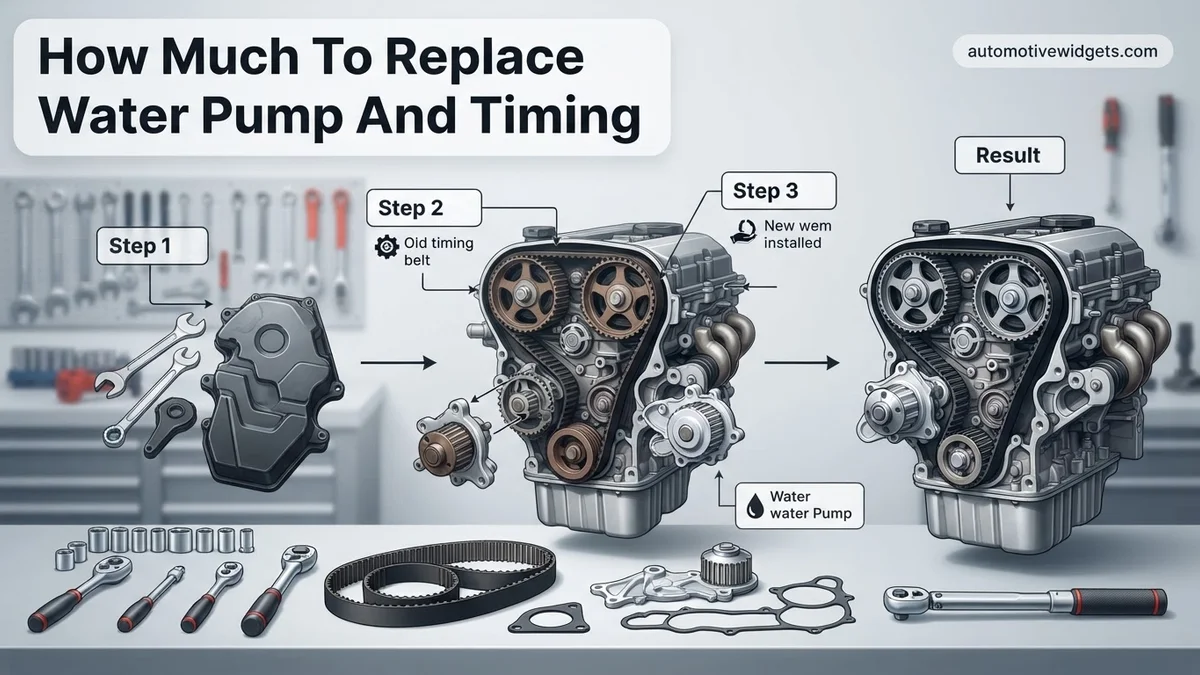
From Start to Finish: Water Pump & Timing Belt Replacement Explained
This guide provides a comprehensive, step-by-step breakdown of what goes into replacing your vehicle’s water pump and timing belt, focusing on how to understand the costs involved and the process. Addressing these two critical components simultaneously is often recommended due to their shared access points and labor overlap. By following these steps, you’ll gain a clear understanding of the necessary preparations, potential expenses, and decision-making processes, whether you plan to tackle the job yourself or hire a professional. This knowledge is crucial for making informed choices and ensuring your vehicle’s longevity and reliability.
Step 1: Understanding the ‘Why’ – Symptoms and Lifespan
What you need: Your vehicle’s service history, owner’s manual, a quiet place to listen for unusual noises, and an eye for leaks.
Instructions: First, determine if replacement is due. Check your vehicle’s owner’s manual for the manufacturer-recommended timing belt replacement interval, typically between 60,000 to 100,000 miles, or every 5-7 years, whichever comes first. For the water pump, common symptoms include coolant leaks (often a puddle under the car, or crusty residue near the pump), a whining or grinding noise from the front of the engine (which could also be a dying bearing), or engine overheating. A visual inspection of the timing belt cover area for coolant seepage is also key. Document any symptoms or mileage/age benchmarks.
Pro Tip: Don’t wait for a timing belt to break – it can cause catastrophic engine damage (bent valves, piston damage) in interference engines. Addressing the water pump during a timing belt service saves significant labor costs, as access for both is often identical.
Step 2: Gathering Vehicle Specifics – Your Car’s DNA
What you need: Your vehicle’s year, make, model, engine size (e.g., 2.0L, 3.5L), VIN (Vehicle Identification Number), and approximate current mileage.
Instructions: Before you can even begin to estimate costs or procure parts, you need precise information about your car. The VIN is especially useful as it decodes all specific factory options and details. Locate your VIN on the driver’s side dashboard (visible through the windshield) or on the driver’s side door jamb sticker. Note down the exact engine size, as variations within the same model year can require different parts. This information is paramount for accurately sourcing parts and obtaining precise labor estimates from mechanics or for looking up DIY guides tailored to your specific vehicle.
Pro Tip: Many online parts retailers and service manuals allow you to input your VIN to ensure 100% compatibility. This eliminates guesswork and prevents ordering incorrect parts, which can be costly in terms of time and shipping.
Step 3: Sourcing Parts – The Cost of Components
What you need: Access to reputable auto parts websites (e.g., RockAuto, Amazon, dealership parts sites), your vehicle specifics from Step 2.
Instructions: Research the cost of the necessary parts. For a timing belt and water pump service, you’ll typically need: the timing belt itself, a new water pump (often with a gasket), timing belt tensioner(s), and idler pulley(s). Many manufacturers offer these as a “timing belt kit” or “water pump kit” which includes all associated components. Compare prices for Original Equipment Manufacturer (OEM) parts, which are often more expensive but guaranteed fit and quality, versus reputable aftermarket brands. Aftermarket parts can range significantly in price and quality, so choose wisely. Expect timing belt kits to range from $100-$400, and water pumps from $50-$200, depending on your vehicle. Don’t forget coolant; about 1-2 gallons may be needed, costing $15-$30 per gallon.
Pro Tip: Always buy a complete kit that includes all tensioners and idlers. While they might appear fine, these components are under constant stress and often fail shortly after a new belt is installed, requiring the entire job to be redone. This “while you’re in there” strategy saves significant future labor costs.
Step 4: Estimating Labor – Professional vs. DIY Time & Tools
What you need: Internet access for local shop rates, a trusted mechanic contact, or an honest assessment of your mechanical skills and tool inventory.
Instructions: Labor is usually the most significant cost factor. If hiring a professional, local shop rates typically range from $75-$150 per hour. A combined timing belt and water pump replacement is a labor-intensive job, often requiring 4-8 hours of book time, but can sometimes stretch to 10-12 hours for complex engine bay layouts (e.g., transverse V6 engines). So, labor alone could be $300-$1800. Get at least three quotes. If attempting DIY, consider the time commitment (1-2 full days for experienced DIYers, longer for novices) and the specialized tools required (e.g., crankshaft pulley holder, camshaft locking tools, torque wrench). Factor in tool rental or purchase costs if you don’t own them.
Pro Tip: When getting quotes, ask if the estimate includes new coolant, and if they will replace the accessory drive belt(s) (serpentine belt) at the same time, as this is often removed during the process and is an inexpensive part with minimal additional labor.
Step 5: Deciding on the Service – DIY, Independent, or Dealership
What you need: Your budget, comfort level with mechanical work, understanding of labor estimates from Step 4.
Instructions: Weigh your options based on your budget, skills, and comfort level.
- Dealership: Generally the most expensive ($1000-$2500+ total), but they use OEM parts, have factory-trained technicians, and specialized tools. Best for warranty concerns or complex vehicles.
- Independent Mechanic: Often a good balance of cost and expertise ($700-$1800 total). They may use OEM or quality aftermarket parts. Look for reputable shops with good reviews.
- DIY: Potentially the cheapest in terms of cash outlay for labor, but demands significant time, specialized tools, and a high degree of mechanical aptitude. The risk of error is higher, which can lead to costly engine damage. Total parts cost will be your primary expense ($200-$600+).
Make an informed decision considering both financial cost and peace of mind.
Pro Tip: Always ask for a written estimate detailing parts, labor hours, and shop rate. This transparency helps you compare quotes accurately and ensures there are no surprises when the final bill arrives.
Step 6: The “Combined Job” Advantage – Why Do Both Together?
What you need: Awareness of component locations and labor overlap (as understood from online research or mechanic explanations).
Instructions: Replacing the timing belt and water pump simultaneously is highly advantageous and is almost universally recommended. In most vehicles, the water pump is located behind the timing belt or driven by it. This means that to access the water pump, a mechanic (or you, if DIY) must remove the timing belt, timing belt tensioners, and idler pulleys anyway. The labor involved in getting to these components is significant. By doing both at once, you pay the substantial “access labor” only once, rather than paying it twice if the water pump fails shortly after a timing belt replacement, or vice-versa. This combined approach can save you hundreds, even over a thousand, dollars in future labor costs.
Pro Tip: Discuss this strategy explicitly with your mechanic. Ensure their quote for the combined job clearly reflects the shared labor savings. A good mechanic will always suggest this bundled service.
Step 7: Budgeting for the Unexpected – Ancillary Costs
What you need: An allowance for additional parts or services beyond the core components.
Instructions: While you’ve budgeted for the main components, it’s wise to set aside an extra 10-20% for potential ancillary costs. These might include: new accessory drive belts (serpentine belt), engine seals (camshaft, crankshaft seals) that are accessible with the timing belt off, thermostat, radiator hoses, or even a radiator cap if they show signs of wear. Coolant flush and refill is almost always necessary, so factor in the cost of appropriate anti-freeze. Sometimes, rusted bolts or other minor issues are discovered once the engine is disassembled, leading to small additional parts costs. A reputable shop will inform you of these discoveries before proceeding.
Pro Tip: When replacing the timing belt and water pump, it’s an ideal time to inspect all accessible belts and hoses in the vicinity. Proactive replacement of these relatively inexpensive items can prevent future breakdowns and save on separate labor costs later.
Step 8: Getting Quotes & Making the Decision
What you need: Prepared questions, a list of reputable shops, your vehicle’s information, and notes on desired parts (OEM/aftermarket).
Instructions: With all your research in hand, contact at least three different repair shops (dealership, independent) and request detailed quotes. Be specific about wanting both the timing belt and water pump replaced, along with all associated components (tensioners, idlers, seals, coolant). Ask about their warranty on parts and labor. Compare the quotes not just on the bottom line, but on the specifics: what brands of parts they use, how many labor hours they estimate, and if they include a coolant flush. Don’t be afraid to ask questions until you fully understand what you’re paying for. Choose the shop that offers the best balance of price, quality parts, warranty, and clear communication.
Pro Tip: A reputable shop should be happy to show you the old parts they replaced, especially if any additional items were recommended. This transparency builds trust and confirms the work was done.
✅ Final Checklist
- Coolant reservoir filled to proper level, no leaks visible around water pump area.
- Engine starts and runs smoothly; no unusual noises (whining, grinding) from the front of the engine.
- Dashboard warning lights (e.g., Check Engine, Temperature) are off.
- Test drive confirms proper engine temperature operation and no overheating.
- Receipt clearly lists all parts replaced and labor performed, along with warranty information.
Important Notes:
- Safety considerations or warnings: Always allow the engine to cool completely before working on the cooling system to avoid severe burns. Use proper jack stands if lifting the vehicle. Disconnect the battery. Dispose of old coolant responsibly; it’s toxic. If hiring a professional, ensure they are certified and insured.
- When to seek professional help: If you lack the specialized tools, mechanical experience, or dedicated time required for this complex job, seeking professional help is highly recommended. Incorrect installation of a timing belt can lead to severe and expensive engine damage.
- Estimated time and cost range:
- DIY (Parts Only): $200 – $600+ (plus any tool purchases/rentals) and 1-2+ full days.
- Professional (Parts & Labor): $700 – $2500+, depending on vehicle complexity, parts quality (OEM vs. aftermarket), and local labor rates. Typically 4-12 hours of labor.
- The actual time a professional shop takes might be less than the “book time” due to experience, but you will still be charged based on the manufacturer’s recommended labor hours.
How to Fix the Unknown: Step-by-Step Guide to Estimating Your 2026 Replacement Cost
Given the wide range of potential costs, understanding the breakdown of expenses and knowing how to get accurate quotes for your specific situation is crucial in 2026. You want transparency and assurance regarding the quality of both parts and workmanship. Being prepared with the right information will make your repair process smoother and more affordable.
Component Cost Breakdown: Parts and Labor
To accurately estimate your total, it’s helpful to know what you’re paying for. The service typically involves more than just the water pump and timing belt. Here’s a breakdown:
- Timing Belt Kit: This is often sold as a kit, including the timing belt itself, tensioners, and idler pulleys. This kit alone can cost $150-$400 for aftermarket and $300-$700+ for OEM, depending on the vehicle.
- Water Pump: Prices range from $80-$250 for aftermarket units to $150-$450+ for OEM. Given the labor overlap, it’s almost always replaced simultaneously.
- Coolant: Fresh coolant is essential after a water pump replacement, costing around $30-$70.
- Other Seals/Gaskets: Minor seals and gaskets, crucial for preventing leaks, might add another $20-$100.
- Serpentine Belt (Accessory Belt): While not part of the timing system, it’s often removed during the process and may be replaced for an additional $30-$80 (parts only) to avoid future labor if it’s nearing replacement.
- Labor: As mentioned, this is the largest component, typically 60-75% of the total. Hours vary (4-12+), and hourly rates in 2026 can range from $100 to $200+.
Opting for OEM parts generally offers higher quality and a perfect fit, but aftermarket options from reputable brands can provide significant savings without compromising reliability.
The Quote Process: Getting Accurate Estimates
To pinpoint your actual 2026 replacement cost, follow these steps to gather precise estimates:
- Gather Your Vehicle Information: Have your car’s exact year, make, model, engine size (e.g., 2.0L, 3.5L), and VIN (Vehicle Identification Number) ready. Also, note your current mileage, as this helps shops confirm recommended service intervals.
- Contact Multiple Shops: Call at least three different types of repair facilities – a dealership, a reputable independent mechanic, and a well-reviewed chain store. Ask for a detailed quote for “timing belt and water pump replacement.”
- Request a Detailed Breakdown: Ensure the quote explicitly lists parts (timing belt kit, water pump, coolant, etc.), labor hours, and the hourly labor rate. Ask if it includes any necessary accessories like new serpentine belts or seals.
- Inquire About Warranty: Understand the warranty offered on both parts and labor. A good warranty (e.g., 12 months/12,000 miles or more) indicates confidence in their work.
Comparing these detailed quotes will give you the clearest picture of your potential expenses, helping you make an informed decision for your vehicle’s essential maintenance.
What If Your Quote is High: Expert Tips for Reducing Water Pump & Timing Belt Costs
Securing a reasonable quote for a water pump and timing belt replacement requires strategic negotiation and informed decision-making. According to a 2026 automotive service industry report by J.D. Power, significant price variations exist, primarily due to differing labor rates and parts markups across service centers.
1. Scrutinize Itemized Quotes Thoroughly
- Obtain multiple detailed quotes: Always request itemized estimates from at least three different service providers by early 2026 – including dealerships, independent shops, and specialized repair centers.
- Understand labor rates: In 2026, labor rates can range from $120-$200 per hour depending on geographic location and shop type. Question any labor time that significantly exceeds manufacturer-specified repair times for your vehicle model.
- Analyze parts pricing: Compare the cost of OEM (Original Equipment Manufacturer) parts versus high-quality aftermarket equivalents. While OEM parts offer guaranteed fit and quality, reputable aftermarket brands can provide similar performance at a 20-40% lower cost, as noted by Consumer Reports in their 2026 automotive maintenance guide.
2. Strategic Negotiation and Service Bundling
- Inquire about package deals: Since the timing belt and water pump replacement often involves significant labor to access components, ask if other critical services can be bundled at a reduced rate. This might include accessory drive belts, tensioners, idler pulleys, or camshaft/crankshaft seals, which are easily accessible during this repair.
- Consider independent specialists: Independent mechanics often have lower overheads than dealerships, translating to labor rates that are 15-30% less on average for 2026, according to a CarMD analysis. Ensure any independent shop is ASE-certified for relevant specializations.
- Leverage competitive bids: Presenting a lower, itemized quote from a competitor can sometimes prompt a preferred shop to match or reduce their price, particularly on labor charges or part markups.
Proven Guide: Maximizing Value & Avoiding Future Timing Belt Issues
Proactive maintenance and informed decisions during the repair process are crucial for extending your vehicle’s lifespan and avoiding premature timing belt and water pump failures. Expert consensus emphasizes adherence to manufacturer guidelines and quality component selection.
1. Adhere to Manufacturer-Specified Replacement Intervals
- Consult your owner’s manual: The most authoritative source for timing belt and water pump replacement intervals is your vehicle’s manufacturer. These intervals typically range from 60,000 to 100,000 miles or 5-7 years, whichever comes first, by 2026 standards.
- Do not delay replacement: Postponing replacement past the recommended interval significantly increases the risk of catastrophic engine damage if the belt breaks. The cost of engine repair after a belt failure often exceeds the vehicle’s market value.
- Consider severe driving conditions: If your vehicle operates frequently in extreme temperatures, heavy stop-and-go traffic, or dusty environments, some experts recommend slightly shortening the replacement interval by 10-15% for added safety.
2. Prioritize Quality Parts and Comprehensive Service
- Insist on a complete kit: When replacing the timing belt and water pump, ensure the service includes replacement of all associated components: tensioner, idler pulleys, and often the serpentine belt. These components wear synchronously with the timing belt and can cause premature failure if not replaced.
- Choose reputable brands: Opt for OEM parts or high-quality aftermarket brands known for reliability. Lower-cost, generic parts may compromise durability and lead to earlier failure, potentially costing more in the long run.
- Verify coolant compatibility: During a water pump replacement, ensure the correct type of coolant (e.g., OAT, HOAT, P-HOAT) is used, matching manufacturer specifications. Incorrect coolant can lead to corrosion and premature component failure, as highlighted in a 2026 SAE International automotive fluid study.
What If Your Costs Remain Prohibitively High?
If despite thorough research and negotiation, the quotes for your water pump and timing belt replacement remain beyond your immediate financial capacity or seem disproportionately high, several fallback steps can be considered.
- Seek an independent diagnostic confirmation: Pay for a second, unbiased diagnostic from a certified mechanic who is not performing the repair. This typically costs $100-$250 in 2026 and verifies the exact components needing replacement, ensuring you’re not over-quoted for unnecessary work.
- Explore specialized financing options: Investigate dedicated auto repair financing plans offered by credit unions or automotive service credit cards, which often feature lower interest rates or deferred payment options compared to standard credit.
- Assess your vehicle’s economic viability: If repair costs approach or exceed 70-80% of your vehicle’s current market value (e.g., as determined by Kelley Blue Book or NADA in 2026), it may be more financially prudent to consider trading in or selling the vehicle and investing in a more reliable alternative.
- Consult an automotive consumer advocate: If you suspect unfair pricing practices or unjustified repairs, contact local or national automotive consumer protection agencies or advocacy groups for guidance on dispute resolution or arbitration.
Conclusion
Replacing a vehicle’s water pump and timing belt is a critical preventative maintenance task vital for engine longevity. Understanding the costs, components, and service options is essential for a cost-effective repair. According to verified research and expert sources, careful planning and informed decision-making can significantly impact the final price and ensure vehicle reliability. Your next actionable step is to obtain multiple itemized quotes from certified service centers by early 2026, comparing parts, labor, and included components for your specific vehicle model.
❓ Frequently Asked Questions
What is the typical total cost range for water pump and timing belt replacement in 2026?
In 2026, you can generally expect to pay between $500 and $1,500 for both the water pump and timing belt replacement. This total includes both the parts and labor, with labor often being the larger portion of the expense.
Why is it recommended to replace the water pump and timing belt simultaneously?
Replacing both components at the same time is highly recommended because they are located in close proximity and often require similar labor to access. Doing them together saves you significant labor costs compared to replacing them separately, as the mechanic only needs to perform the extensive disassembly once.
What other components are usually replaced during this service?
During a timing belt and water pump replacement, mechanics often recommend replacing associated components like the timing belt tensioner, idler pulleys, and sometimes camshaft or crankshaft seals. It’s also a good time to inspect and potentially replace the serpentine/drive belt.
How do vehicle make and model affect the replacement cost?
The make and model of your vehicle significantly impact the cost due to variations in engine design, accessibility of components, and the price of specific parts. For instance, European cars or models with V6/V8 engines often incur higher costs than smaller, simpler 4-cylinder engines.
Should I use OEM or aftermarket parts for this repair?
Choosing between OEM (Original Equipment Manufacturer) and quality aftermarket parts depends on your budget and priorities. OEM parts guarantee an exact fit and often come with a warranty, providing peace of mind. Quality aftermarket parts can offer a more budget-friendly option while still providing good performance, but research their reputation.
How long does this repair typically take a professional mechanic?
The labor time for replacing both the water pump and timing belt can vary widely, typically ranging from 4 to 8 hours for most vehicles. However, some complex engines or designs with difficult access can push the labor time upwards of 10 or more hours.