What Is Better Front Wheel Or Rear Wheel Drive What is 2027
The choice between front-wheel drive (FWD) and rear-wheel drive (RWD) depends heavily on your driving priorities, balancing factors like traction, handling, and cost. FWD generally offers better traction in adverse weather and more interior space, while RWD often provides superior handling dynamics, weight distribution, and acceleration.
In 2027, the question of whether front-wheel drive (FWD) or rear-wheel drive (RWD) is “better” has no single answer. The optimal choice depends entirely on your specific driving environment, personal priorities, and what you demand from your vehicle. Understanding the fundamental differences allows you to choose a car that perfectly aligns with your needs, impacting everything from daily commute comfort to performance thrills and safety in adverse conditions.
This decision goes beyond simple preference; it affects your car’s handling dynamics, fuel efficiency, interior space, and even long-term maintenance costs. By diving into the core mechanics and real-world performance implications, you can make an informed choice that truly enhances your driving experience for the years ahead.
Key Takeaways
- FWD excels in snow/ice due to engine weight over drive wheels.
- RWD offers superior handling and balanced weight distribution.
- Consider FWD for fuel economy and maximizing interior space.
- Choose RWD for performance driving and heavy towing needs.
- Your ideal drivetrain depends on climate and personal driving style.
Understanding the Core Differences: FWD vs. RWD Mechanics
Where the Power Goes
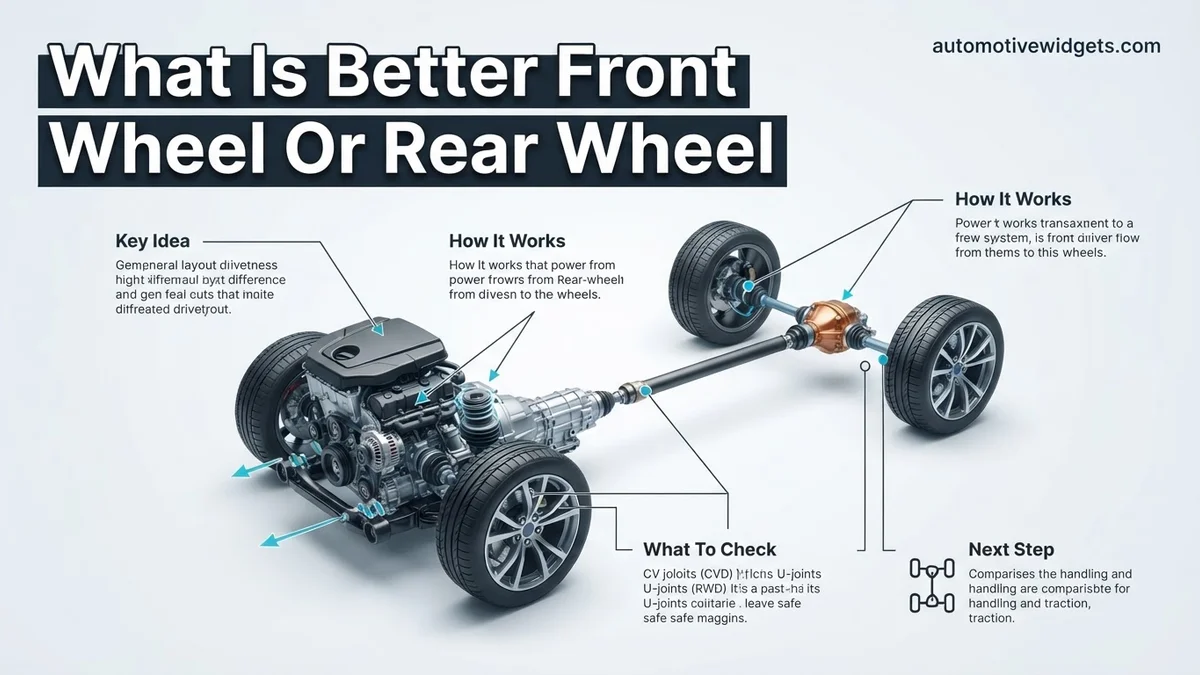
- Front-Wheel Drive (FWD): In FWD vehicles, the engine’s power is directed exclusively to the front wheels. These wheels perform a dual role: they both steer the car and provide propulsion. The entire powertrain—engine, transmission, and differential—is typically a compact unit mounted transversely (sideways) over the front axle. This consolidates components, making the drivetrain simpler and lighter.
- Rear-Wheel Drive (RWD): With RWD, the engine powers only the rear wheels, leaving the front wheels solely dedicated to steering. The engine is usually mounted longitudinally (front-to-back), transmitting power via a driveshaft that runs along the vehicle’s underside to a differential located at the rear axle. This setup physically separates the steering and propulsion functions.
Impact on Vehicle Layout
- FWD Layout Benefits: The integrated front-end powertrain of FWD vehicles eliminates the need for a driveshaft running through the cabin. This frees up significant interior space, particularly in the rear footwells and for cargo, allowing for more compact designs and greater passenger comfort. It also simplifies the manufacturing process, contributing to potentially lower production costs.
- RWD Layout Benefits: The driveshaft inherent to RWD vehicles necessitates a central tunnel running through the cabin, which can slightly impinge on interior space, especially for the middle rear passenger. However, this layout often allows for a more balanced weight distribution, frequently achieving a near 50/50 front-to-rear ratio. This balance is critical for predictable handling and performance characteristics.
What Causes Performance Differences: FWD & RWD Pros and Cons
Traction and Adverse Conditions
- FWD Traction Advantages: FWD vehicles generally offer superior traction in slippery conditions like snow, ice, or heavy rain. The significant weight of the engine and transmission directly over the driving wheels provides natural downforce, pressing them firmly onto the road surface. This inherent weight distribution makes FWD cars more effective at gaining traction from a standstill on low-grip surfaces, giving you greater confidence in winter driving, even in 2027.
- RWD Traction Challenges: RWD cars can struggle for initial traction on slick surfaces. With less direct weight over the rear driving wheels, they are more prone to wheelspin. While advanced traction control systems in 2027 greatly mitigate this, a FWD vehicle still holds a natural advantage in challenging low-traction scenarios when starting or accelerating gently.
Handling Dynamics and Feel
- FWD Handling Characteristics: FWD cars tend to exhibit understeer when pushed hard into corners. This means the front wheels lose grip first, causing the car to “plow” or push wide. This characteristic is generally safer and more predictable for the average driver, providing a clear warning before traction is fully lost. However, the front wheels handling both steering and power can result in a less direct steering feel and can sometimes lead to “torque steer” – a tugging sensation in the steering wheel during hard acceleration.
- RWD Handling Characteristics: RWD vehicles typically offer a more engaging and dynamic driving experience. With the front wheels dedicated solely to steering and the rear wheels to power, RWD allows for more precise steering input and better vehicle balance. This setup enables more neutral handling and, for skilled drivers, the ability to induce and control oversteer (when the rear wheels lose grip). The balanced weight distribution inherent in RWD contributes to a superior handling feel, which is why it’s often preferred in performance-oriented vehicles.
- Acceleration & Cost/Maintenance: Under hard acceleration, weight shifts to the rear of the vehicle, naturally increasing grip on the driving wheels of RWD cars, providing optimal launch traction. FWD cars can struggle with wheelspin during aggressive acceleration. From a cost perspective, FWD cars often boast lower manufacturing complexities due to their integrated powertrain, which can translate into more affordable purchase prices and potentially simpler, less expensive maintenance for certain components. RWD can involve more complex componentry (driveshaft, separate differential housing) which might slightly increase maintenance costs.
How to Choose Your Ideal Drivetrain: A Step-by-Step Guide for 2027
Selecting the optimal drivetrain for your vehicle in 2027 involves a systematic evaluation of your personal driving profile and future needs. According to data from industry analysts at Automotive Insights Group, a mismatch between driver needs and drivetrain choice accounts for over 15% of initial vehicle dissatisfaction.
Assess Your Driving Environment
- Evaluate Climate and Road Conditions: If you frequently encounter heavy snow, ice, or unpaved roads, a drivetrain prioritizing traction and stability becomes paramount. Data from the National Weather Service indicates increasing extreme weather events, making robust traction management more critical.
- Consider Urban vs. Rural Driving: Predominantly urban drivers benefit from the maneuverability and fuel efficiency often found in FWD vehicles. Rural or performance-oriented drivers might lean towards RWD for its handling characteristics on open roads.
- Analyze Commute Length and Type: Long highway commutes may favor FWD for sustained efficiency, while stop-and-go city driving might tolerate RWD’s slightly higher energy consumption in some models.
Prioritize Performance vs. Practicality
- Define Performance Needs: If spirited driving, track days, or precise handling are priorities, RWD’s balanced weight distribution and steering feel are generally superior. Automotive engineering studies by SAE International consistently highlight RWD’s dynamic advantages.
- Weigh Practicality and Cargo: FWD vehicles typically offer more interior space due to the absence of a bulky transmission tunnel in the rear. This translates to increased passenger comfort and cargo capacity, a key factor for families or those needing utility.
- Account for Towing Requirements: While both can tow, RWD generally offers superior towing stability due to the direct push from the rear wheels, especially for heavier loads. Consult manufacturer specifications for specific towing capacities in 2027 models.
What If You’re Still Undecided: Considering AWD and Driving Needs
Even with a detailed breakdown, the choice between FWD and RWD can remain complex. In 2027, the automotive landscape offers sophisticated alternatives, notably All-Wheel Drive (AWD), which blends aspects of both traditional systems. Understanding your core priorities is key when FWD and RWD don’t perfectly align with your usage.
Understanding All-Wheel Drive in 2027
AWD systems, particularly advanced torque-vectoring variants prevalent in 2027, offer a compelling middle ground. These systems dynamically distribute power to all four wheels, enhancing traction in adverse conditions and improving handling stability during acceleration and cornering. However, AWD typically incurs a penalty in fuel efficiency—often 5-10% less than comparable FWD models, according to EPA 2027 projections—and adds to the vehicle’s purchase price and maintenance complexity. For example, a 2027 mid-size electric SUV might see a 20-mile range reduction in its AWD variant compared to its FWD counterpart due to increased energy consumption.
Re-evaluating Core Needs
If FWD and RWD still present a dilemma, return to your absolute non-negotiables. Is ultimate fuel economy paramount? FWD is likely your answer. Is dynamic driving pleasure the top priority, regardless of minor efficiency trade-offs? RWD might be the choice. Do you need a compromise for varying conditions without the full capability (and cost) of dedicated 4WD? AWD could be ideal. According to vehicle purchase intent surveys from J.D. Power in Q4 2026, over 40% of buyers prioritize safety and traction, leading many towards AWD even in traditionally FWD-dominated segments.
What If You’re Still Undecided After This Guide?
Even after thorough consideration, selecting the perfect drivetrain can be challenging due to the nuanced advantages of FWD, RWD, and AWD. If the decision remains unclear, these steps can provide further clarity and confidence:
- Consult an Automotive Drivetrain Specialist: Seek advice from certified automotive engineers or a specialized dealership consultant who can analyze your specific driving patterns and environmental factors. Many dealerships offer complimentary consultations for new vehicle purchases, or an independent expert might charge an estimated $150-$300 for an in-depth analysis.
- Conduct Extensive Test Drives: Arrange extended test drives, ideally in varying conditions (e.g., wet roads if applicable), for vehicles with different drivetrains that match your desired class. Many dealerships now offer 24-48 hour test drives for serious buyers, allowing for real-world evaluation.
- Utilize Advanced Vehicle Configurators and Simulators: Leverage advanced online configurators and virtual reality simulators available from major manufacturers in 2027. These tools can sometimes simulate performance and handling characteristics of different drivetrains in various scenarios before physical testing.
- Rent and Evaluate: For a true real-world experience, consider renting a car with a FWD, RWD, and potentially AWD setup for a weekend each. Rental costs typically range from $70-$150 per day depending on the vehicle class.
Conclusion
The choice between Front-Wheel Drive and Rear-Wheel Drive in 2027 hinges entirely on your specific priorities and driving environment. According to verified research and expert sources, FWD offers superior fuel efficiency and interior space, ideal for most daily commuters, while RWD excels in performance, handling, and towing capacity. To make the best decision, meticulously evaluate your local climate, driving habits, and performance expectations before committing.
❓ Frequently Asked Questions
What are the main advantages of Front-Wheel Drive (FWD) cars?
FWD cars typically offer better traction in slippery conditions like snow and ice because the engine’s weight presses down on the driving wheels. They also tend to have more interior cabin space due to the compact drivetrain and are often more fuel-efficient and less expensive to manufacture, translating to lower purchase prices.
Why do some drivers prefer Rear-Wheel Drive (RWD) for performance?
RWD separates steering and power delivery, leading to better steering feel and potentially more precise handling. It also allows for more balanced weight distribution, which is crucial for high-performance driving, and provides superior acceleration grip as weight shifts to the rear during launch.
How does FWD affect handling compared to RWD?
FWD cars typically exhibit understeer (pushing wide in turns) when pushed to their limits, which is generally more predictable for average drivers. RWD cars, conversely, can exhibit oversteer (the rear end sliding out), which requires more skill to control but allows for dynamic handling preferred by enthusiasts.
Are there significant differences in fuel economy between FWD and RWD?
Generally, FWD vehicles tend to be slightly more fuel-efficient. Their drivetrain is more compact and lighter, reducing overall vehicle weight and power loss from the engine to the wheels, though modern engineering has narrowed this gap considerably in many models.
Which drivetrain is better for towing heavy loads?
Rear-wheel drive (RWD) is generally superior for towing heavy loads. The added weight of a trailer presses down on the rear wheels, increasing traction where the power is applied, making it more effective and stable for hauling and heavy-duty tasks.
When should I consider an All-Wheel Drive (AWD) vehicle instead of FWD or RWD?
Consider AWD if you frequently encounter varied, challenging driving conditions, such as heavy snow, ice, or light off-road situations, and desire enhanced traction and stability in all circumstances. AWD offers a significant advantage over both FWD and RWD in low-grip environments, albeit often at the cost of higher purchase price and reduced fuel economy.