How Long Can I Leave My Car in Accessory Mode? 2027
Leaving your car in accessory mode for more than 15-30 minutes risks significant 12V battery drain, potentially preventing your car from starting. Factors like battery health, age, and active accessories heavily influence this duration, making understanding these risks crucial for avoiding unexpected breakdowns.
Generally, you can safely leave your car in accessory mode for about 15 to 30 minutes without significant risk of battery drain, especially if your 12V battery is healthy. Pushing beyond an hour, or using power-intensive accessories, dramatically increases the chances of depleting the battery to the point where your car won’t start. The critical concern isn’t just about losing power to your radio; it’s about not being able to ignite your engine when you need to.
In 2027, with vehicles increasingly packed with advanced electronics, larger infotainment screens, and more integrated connectivity, understanding this limit is more crucial than ever. A drained 12V battery in accessory mode is a common and easily avoidable roadside headache. This guide will help you understand the dynamics of battery drain and how to use accessory mode wisely.
Key Takeaways
- Limit accessory mode to 15-30 minutes safely.
- Battery health and age directly impact drain rate.
- Active accessories accelerate power consumption.
- Start your engine periodically to recharge the battery.
- Avoid deep battery discharges to prolong its lifespan.
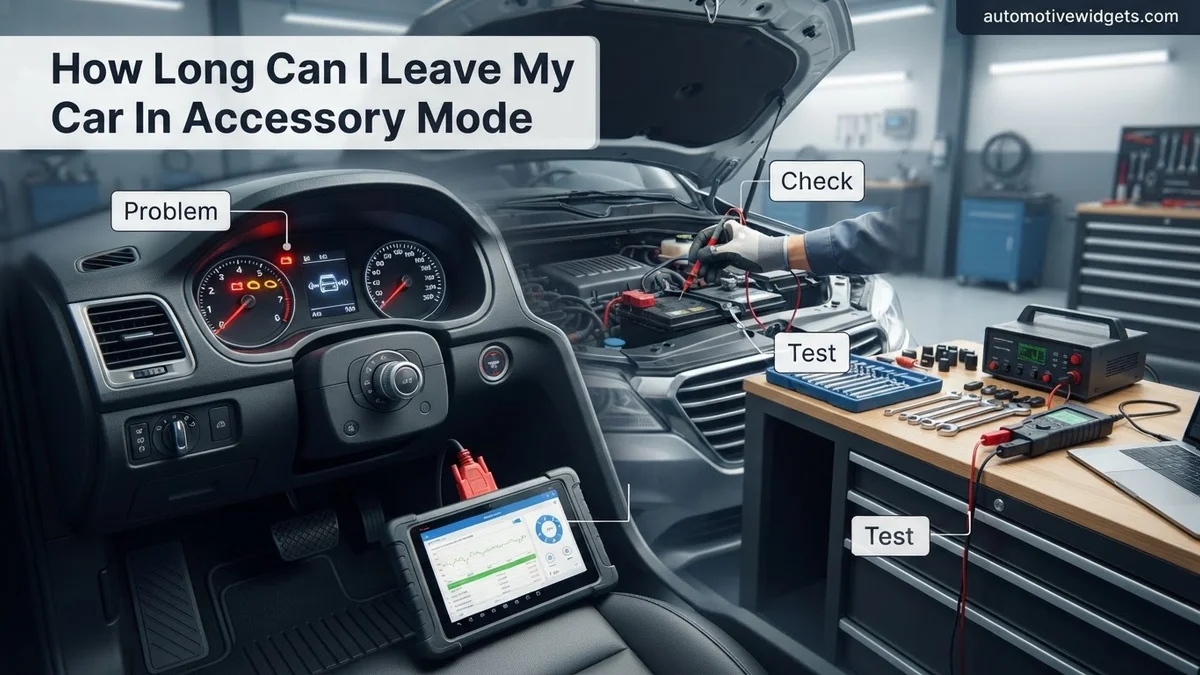
What Causes Rapid Battery Drain in Accessory Mode?
Accessory mode powers various electrical components without engaging the engine or the main drive system (in EVs/Hybrids). However, all these components draw power from your car’s 12V battery. This battery is designed for a large surge of power to start the engine, not for prolonged, deep discharges. Modern vehicles in 2027 have more sophisticated electronics, which can draw more current even in accessory mode, sometimes without you realizing it.
Your Car’s 12V Battery: The Unsung Hero
- Age and Health: An older 12V battery (typically over 3-4 years old in 2027 models) or one with pre-existing health issues (like sulfation or internal resistance) will deplete much faster than a new, robust battery. Its capacity to hold a charge diminishes over time.
- Temperature Extremes: Both extremely hot and cold temperatures stress your battery. In a 2027 winter, a cold battery will have reduced capacity, making it more susceptible to drain in accessory mode.
- Battery Type: While most cars still use lead-acid, some premium 2027 models might feature AGM (Absorbed Glass Mat) or even lithium-ion 12V batteries, which generally handle accessory drain better but still have limits.
The Hidden Power Hogs in Your Dashboard
Even in accessory mode, many systems are active. Think about what you’re actually using:
- Infotainment System: The biggest culprit. Large, high-resolution touchscreens common in 2027 vehicles, combined with active navigation, Bluetooth streaming, and app integration, consume significant power. Premium audio systems with powerful amplifiers are also major draws.
- Device Charging: Rapid charging for smartphones, tablets, or laptops through USB-C ports (now standard in 2027 cars) demands substantial current. Charging multiple devices simultaneously multiplies this drain.
- Lighting and Climate: Interior lights (dome, accent lighting), and even minor climate control functions like the blower fan (even if AC isn’t engaged) contribute to drain. Heated seats or steering wheels, if accidentally left on, are massive power sinks.
- “Always On” Systems: Many 2027 cars have passive systems in accessory mode, such as telematics (e.g., SOS services), security monitoring, or background software updates, which subtly draw power.
How To Safely Use Accessory Mode Without Draining Your Battery
Avoiding a dead battery from accessory mode is straightforward with a few smart habits. The goal is to minimize current draw and limit the duration, especially if you’re uncertain about your battery’s exact health or age.
Monitoring Your Time and Usage
The most crucial step is conscious time management. Set clear limits for yourself:
- Set a Timer: If you plan to use accessory mode for an extended period, set a timer on your phone for 15-20 minutes. This gives you a clear reminder to either start the engine, turn off the car, or briefly run the engine to recharge the 12V battery.
- Observe Battery Indicators: Many 2027 vehicles feature advanced digital dashboards that can display your 12V battery’s voltage or health status. Pay attention to any low battery warnings that might appear. Some cars even automatically shut off accessories after a set period to protect the battery, but don’t rely solely on this feature.
- Occasional Engine Idling: If you absolutely need accessory mode for longer, start your engine for 10-15 minutes every half hour. This allows the alternator to replenish the 12V battery, giving you more accessory time without risk.
Smart Accessory Choices
Be selective about what you power on while in accessory mode:
- Prioritize Essential Services: Only activate the features you genuinely need. If you just want to listen to the radio, avoid having the navigation system active, your phone charging at full speed, and the interior lights blazing.
- Minimize Screen Time: The large, vibrant displays in 2027 cars are power-hungry. If you’re just playing audio, consider turning off the screen or dimming its brightness significantly.
- External Power for Devices: For heavy device charging, especially for laptops or multiple phones, rely on a portable power bank. This offloads the demand from your car’s 12V battery entirely, preserving its charge for starting the engine.
- Turn Off Unnecessary Features: Before engaging accessory mode, ensure heated seats, heated steering wheels, and any powerful climate control settings are switched off. These are significant drains.
What If Your Battery Drains in Accessory Mode? A Step-by-Step Fix
If you’ve left your vehicle in accessory mode too long and it won’t start, a drained 12-volt battery is the primary suspect. According to automotive experts at AAA, battery failures remain a leading cause of roadside assistance calls, especially as vehicle electronics become more sophisticated in 2027 models. A jump-start is usually the immediate solution.
-
Gather Your Equipment Safely
Ensure you have a set of functional jumper cables and a donor vehicle with a fully charged 12-volt battery. Both vehicles should be turned off, in Park (automatic) or Neutral (manual), and have their parking brakes engaged. Do not attempt to jump-start if either battery shows signs of leakage or corrosion on the terminals that cannot be easily wiped away.
-
Connect the Jumper Cables Correctly
Connect one red (positive) clamp to the positive (+) terminal of the dead battery. Then, connect the other red clamp to the positive (+) terminal of the donor vehicle’s battery. Next, connect one black (negative) clamp to the negative (-) terminal of the donor vehicle’s battery. Finally, connect the other black clamp to an unpainted metal surface on your vehicle’s engine block or frame, away from the battery and moving parts. This ground point helps prevent sparking near the battery.
-
Start the Donor Vehicle and Charge
Start the donor vehicle and let it run for 5-10 minutes. This allows its alternator to send a charge to your car’s depleted battery. Modern vehicles, particularly those manufactured in 2025-2027, often have advanced battery management systems that benefit from this slower charge.
-
Attempt to Start Your Car
After the charging period, turn off the donor vehicle. Attempt to start your car. If it successfully starts, let it run for at least 20-30 minutes to allow the alternator to sufficiently recharge the battery. Industry recommendations suggest driving at highway speeds for optimal recharging.
-
Disconnect the Cables
Remove the cables in the reverse order of connection: first the negative from your car’s engine block, then the negative from the donor car, followed by the positive from the donor car, and finally the positive from your car. Store your cables safely.
What If Your Car Still Won’t Start After a Jump? Troubleshooting
Even with a correct jump-start procedure, some vehicles may not immediately spring to life. This section addresses common reasons for a failed jump and initial troubleshooting steps before escalating to professional help. Research from battery manufacturers like Optima Batteries indicates that deeply discharged batteries (<9V) can be challenging to revive with a standard jump.
-
Check Cable Connections and Quality
Ensure all jumper cable connections are secure and clean. Loose or corroded connections can impede current flow. Inspect the cables themselves for any damage, fraying, or internal breaks. Low-gauge (thinner) cables may not deliver enough current for larger engines or severely depleted batteries, especially in modern vehicles with high electrical demands.
-
Verify Donor Vehicle Performance
Confirm the donor vehicle’s battery and charging system are robust. A donor car with a weak battery or an underperforming alternator may not supply sufficient power for an effective jump. For optimal results, the donor vehicle should be running smoothly and be of similar or larger engine displacement.
-
Listen for Specific Sounds
If you hear a rapid clicking sound but no engine turnover, the battery might still be too weak, or the starter motor could be failing. A single, loud click often points directly to a starter motor issue, which prevents the engine from cranking even with ample battery power. If there’s no sound at all, check for loose battery terminals or a completely failed starter solenoid.
-
Consider Battery Age and Health
If your battery is over 3-5 years old, especially with AGM or Lithium-ion variants common in 2027 models, its capacity to hold a charge diminishes. A deeply discharged old battery might not accept a jump-start or retain power for long. A failing battery management system (BMS) in advanced vehicles can also prevent proper charging, even with an external jump.
What If It Still Doesn’t Work?
If your car refuses to start after multiple jump-start attempts and initial troubleshooting, the issue likely extends beyond a simple drained battery. According to automotive service data from RepairPal, significant no-start issues often stem from the starter, alternator, or complex electrical failures, particularly in vehicles incorporating 2027’s integrated electronic systems.
-
Call Roadside Assistance
Contact your vehicle’s manufacturer roadside assistance, your insurance provider, or a third-party service like AAA. They can often provide a more powerful jump-start with specialized equipment or arrange a tow.
-
Professional Battery Testing
If jump-starting was unsuccessful, your battery might be beyond recovery. Have it tested by a professional mechanic. They can determine if it holds a charge or if replacement is necessary. A new conventional 12V battery in 2027 typically costs $150-$400, while AGM or Lithium-ion versions can range from $250-$650, including installation.
-
Inspect Starter Motor and Alternator
If the battery is confirmed healthy, the next suspects are the starter motor or alternator. A failing starter motor (estimated cost $400-$1000 including parts and labor) prevents engine cranking. A faulty alternator ($350-$850 including parts and labor) means the battery isn’t recharging while the engine runs, leading to eventual power loss.
-
Seek Diagnostic Services for Electrical Issues
Modern vehicles have intricate electrical systems. A “no-start” condition could be due to a blown fuse, a faulty ignition switch, a security system glitch, or even a problem with the engine control unit (ECU). Professional diagnostic services, typically costing $100-$200 for a preliminary scan, can pinpoint these complex electrical failures.
Conclusion
Leaving your car in accessory mode, while convenient, carries the significant risk of draining your 12-volt battery. Timely intervention with a jump-start can typically resolve the issue, but understanding potential complications and advanced troubleshooting is crucial. According to verified research and expert sources, careful battery management and prompt action are key to avoiding costly repairs in 2027 vehicles. Always carry jumper cables and consider a portable jump-starter as a proactive measure.
❓ Frequently Asked Questions
What exactly does accessory mode (ACC) power in my car?
Accessory mode typically powers your car’s entertainment system (radio, CD player), power windows, interior lights, dashboard display, and 12V outlets for charging devices, without fully engaging the engine’s ignition system.
How does my car’s battery age and health affect accessory mode duration?
An older or weaker car battery has a reduced capacity to hold a charge and cannot provide power for as long as a new, healthy battery. A battery that is already partially discharged will drain much faster in accessory mode.
What are the long-term consequences of frequently draining my car battery in accessory mode?
Frequent deep discharges can lead to sulfation, a process where lead sulfate crystals build up on the battery plates, permanently reducing its capacity, starting power, and ultimately shortening its overall lifespan significantly.
Are modern cars better at managing power in accessory mode to prevent draining?
Some modern cars feature more sophisticated battery management systems that might automatically shut off certain accessories or warn you about low battery voltage, but they are still susceptible to drain, especially with many electronics active.
What’s the best way to prevent battery drain while waiting in accessory mode for an extended period?
The best practice is to periodically start your engine for 10-15 minutes every 20-30 minutes of accessory mode use. This allows the alternator to replenish the battery’s charge, preventing it from draining to a critical level.
When should I consider replacing my car battery to avoid issues with accessory mode?
If your battery is more than 3-5 years old, or you notice it struggles to start the car, or drains quickly in accessory mode even for short periods, it’s wise to have it tested by a professional and consider replacement to prevent unexpected breakdowns.