How To Tell If The Catalytic Converter Is Bad How to 2027
A failing catalytic converter can significantly impact your vehicle’s performance and emissions. Recognizing early signs like reduced acceleration, unusual exhaust smells, or a ‘Check Engine’ light is crucial for timely diagnosis. Prompt action can prevent further engine damage and costly repairs.
If your vehicle is showing signs of trouble, identifying a bad catalytic converter early is crucial for maintaining performance and complying with stringent 2027 emissions standards. This component, vital for clean exhaust, can severely impact your engine and pollute the air when it fails. Knowing the specific symptoms and how to verify them means you can address the issue promptly, potentially preventing more costly repairs and ensuring your vehicle runs efficiently.
You don’t need to be a mechanic to spot the warning signs. Modern vehicles, especially those designed for the 2027 market, are equipped with sophisticated diagnostic systems that provide clear indicators. We’ll walk you through the definitive symptoms and practical checks, empowering you to confidently determine if your catalytic converter is the culprit.
Key Takeaways
- Rattling sounds often signal internal catalyst failure.
- P0420/P0430 codes are primary diagnostic indicators.
- Reduced power and fuel economy are key performance signs.
- Rotten egg smell from exhaust points to catalyst issues.
- Professional inspection is vital for accurate diagnosis.
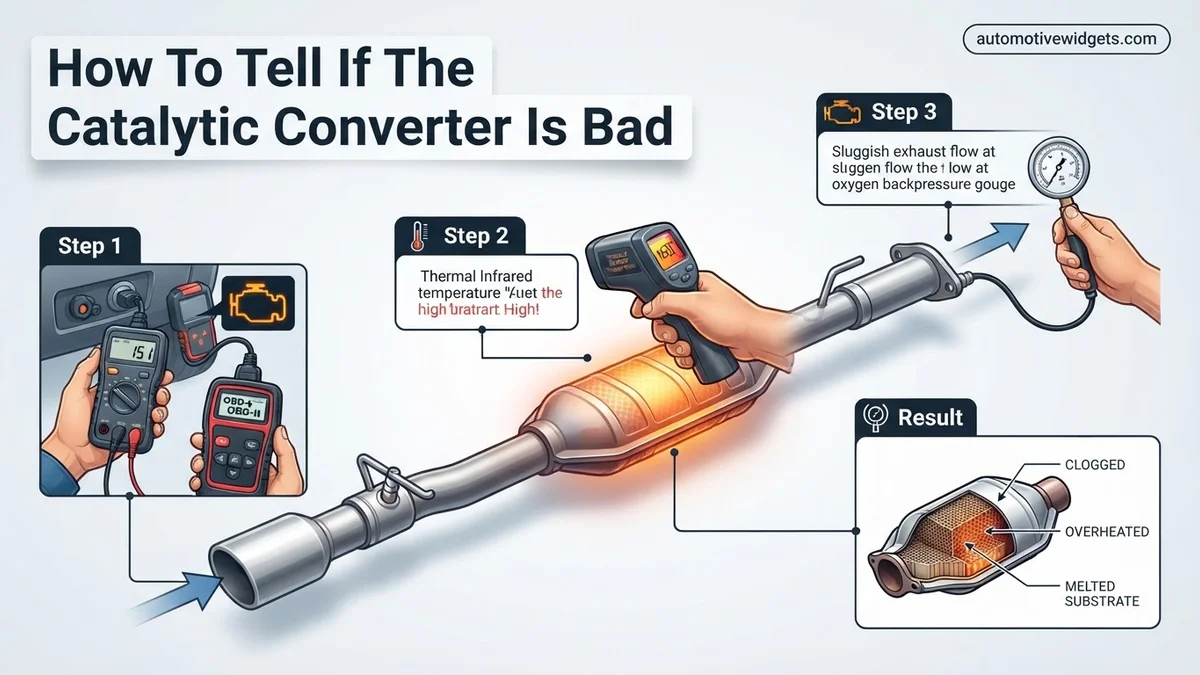
What Are the Key Signs of a Bad Catalytic Converter?
The Dreaded Check Engine Light (CEL) & Specific Codes
The most common and definitive sign of a catalytic converter issue is a lit Check Engine Light on your dashboard. When this happens, your vehicle’s onboard diagnostic (OBD-II) system has detected a problem. For catalytic converter issues, you’ll most frequently see specific diagnostic trouble codes (DTCs) like P0420 or P0430. These codes indicate “Catalyst System Efficiency Below Threshold.”
- Why it occurs: Your car has oxygen sensors before and after the catalytic converter. The front sensor measures exhaust gas entering the cat, and the rear sensor measures gas exiting. If the catalytic converter is working correctly, the rear sensor should show a relatively stable, lower oxygen reading than the front. If the cat is failing, it’s not converting pollutants efficiently, so the readings from both sensors will be too similar. The engine control unit (ECU) interprets this as an underperforming catalyst and triggers the CEL with these specific codes.
Noticeable Drop in Engine Performance
A failing catalytic converter can significantly restrict exhaust flow, leading to a noticeable reduction in your vehicle’s performance. You might experience sluggish acceleration, difficulty maintaining highway speeds, or even your engine stalling at low RPMs.
- Why it occurs: Over time, the internal ceramic substrate of the catalytic converter can melt or become clogged with carbon deposits. When this happens, it creates a backpressure, essentially choking your engine. The exhaust gases can’t escape efficiently, which prevents the engine from “breathing” properly. This loss of exhaust flow directly impacts engine power, making your vehicle feel underpowered and unresponsive.
Unpleasant Exhaust Odors
One of the more distinctive and unpleasant symptoms of a bad catalytic converter is a strong, persistent smell of sulfur, often described as rotten eggs, coming from your exhaust. This odor is quite unmistakable and usually indicates a problem.
- Why it occurs: The primary job of the catalytic converter is to convert harmful exhaust gases, including hydrogen sulfide, into less noxious compounds. If the converter is failing, it can no longer effectively process these gases. As a result, unconverted hydrogen sulfide exits the exhaust system, creating that tell-tale rotten egg smell. This is a clear indicator that the catalytic converter’s chemical conversion process is compromised.
From Start to Finish: Catalytic Converter Diagnostics Explained
A failing catalytic converter can significantly impact your vehicle’s performance, fuel efficiency, and emissions. More importantly, ignoring the signs can lead to further, more expensive damage to other engine components. This comprehensive guide will walk you through a series of practical, step-by-step diagnostic methods to accurately determine if your catalytic converter is malfunctioning, saving you time and potential costly misdiagnoses. By following these instructions carefully, you’ll gain the knowledge to identify the culprit and make informed decisions about your vehicle’s health.
Step 1: The Initial Symptom Check – Listening and Observing Your Vehicle
What you need: Your vehicle, a quiet environment, your keen sense of hearing and observation.
Instructions: Begin by paying close attention to your vehicle’s behavior. The most common indicator of a failing catalytic converter is the illumination of the Check Engine Light (CEL) on your dashboard. Beyond that, listen for any unusual noises. A catalytic converter internally consists of a ceramic honeycomb structure. If this structure breaks down, it can rattle or clunk, especially when starting the engine, accelerating, or driving over bumps, sounding like loose marbles in a tin can coming from underneath the car. Note down exactly when and how these symptoms occur.
Pro Tip: Many OBD-II scanners can read pending codes even if the CEL isn’t actively lit. A rattling sound might be more pronounced immediately after starting a cold engine, as vibrations are often higher.
Step 2: Performance Problems – Your Car’s Cry for Help
What you need: Your vehicle, a safe road for a test drive, and an awareness of your car’s typical performance.
Instructions: A clogged or failing catalytic converter restricts exhaust flow, which directly impacts engine performance. Take your car for a drive and observe if it feels sluggish, particularly during acceleration or when going uphill. You might notice a significant loss of power, as if the engine is struggling to breathe. Another common symptom is reduced fuel economy; a restricted exhaust system forces the engine to work harder, consuming more fuel. Pay attention to how the car reacts to throttle input and if there’s any hesitation or lack of responsiveness compared to its normal operation.
Pro Tip: Compare your current fuel economy to historical records or manufacturer specifications. A sudden, significant drop (e.g., 10-20% reduction) is a strong indicator of an underlying issue, including a failing catalytic converter.
Step 3: The Nose Knows – Odor Detection
What you need: Your vehicle, a well-ventilated area, and your sense of smell.
Instructions: A properly functioning catalytic converter converts harmful exhaust gases into less toxic ones. One of the byproducts of an inefficient converter, particularly when it’s overheating or failing to process hydrogen sulfide effectively, is a distinct rotten egg smell (sulfur) emanating from the exhaust. This odor is often most noticeable when the car is idling or when you’ve just turned off the engine after a drive. Park your car in a safe, open area, let it idle for a few minutes, and carefully approach the rear of the vehicle to smell the exhaust. Avoid inhaling fumes directly and ensure good ventilation.
Pro Tip: A sulfur smell can sometimes indicate other issues, like too much sulfur in your fuel, but coupled with performance problems or a CEL, it strongly points to a catalytic converter fault. Ensure the smell is indeed coming from the exhaust and not another source.
Step 4: Visual Inspection – A Quick Look Underneath
What you need: Safety glasses, work gloves, a flashlight, and ideally, jack stands or a lift (ensure vehicle is securely supported).
Instructions: With the vehicle safely raised and cooled down, visually inspect the catalytic converter and the exhaust system directly surrounding it. Look for any obvious signs of physical damage such as dents, cracks, or rust holes. Excessive heat can cause discoloration; a converter that has been consistently overheating might show signs of blue or purple discoloration on its casing, indicating internal meltdown. Also, check for any exhaust leaks upstream or downstream of the converter, as these can affect its operation and trigger fault codes. Feel for any loose heat shields that might be mimicking a rattling sound.
Pro Tip: Before raising the car, consult your vehicle’s owner’s manual for proper jacking and support points. Never work under a vehicle supported only by a jack. A professional mechanic can show you how to safely inspect under your car if you’re uncomfortable.
Step 5: OBD-II Scanner Check – Decoding Your Car’s Brain
What you need: An OBD-II diagnostic scanner (available at auto parts stores or online).
Instructions: Connect the OBD-II scanner to your vehicle’s diagnostic port (usually located under the dashboard on the driver’s side). Turn the ignition to the ‘ON’ position (engine off) and follow the scanner’s instructions to read any stored Diagnostic Trouble Codes (DTCs). Specific codes like P0420 (Catalyst System Efficiency Below Threshold Bank 1) or P0430 (Catalyst System Efficiency Below Threshold Bank 2) are direct indicators of catalytic converter inefficiency. Beyond codes, use the scanner’s live data function to monitor the readings of the oxygen sensors (O2 sensors) before and after the catalytic converter. A healthy converter will show the pre-catalyst O2 sensor cycling rapidly, while the post-catalyst O2 sensor should show a relatively steady, higher voltage reading (e.g., around 0.6-0.8V), indicating it’s storing oxygen effectively. If the post-catalyst sensor mirrors the pre-catalyst sensor’s fluctuations, the converter is likely inefficient.
Pro Tip: Don’t immediately replace the converter based solely on P0420/P0430. Always check for other issues like O2 sensor malfunctions, exhaust leaks, or engine misfires that can trigger these codes. A good OBD-II scanner with live data charting capabilities is invaluable for diagnosing O2 sensor activity.
Step 6: Infrared Thermometer Test – The Heat Signature
What you need: Infrared thermometer, safety glasses, work gloves.
Instructions: Start the engine and let it warm up to operating temperature, then let it idle for about 5-10 minutes. While wearing safety glasses and gloves, use an infrared thermometer to measure the temperature of the exhaust pipe directly before the catalytic converter (inlet) and directly after the converter (outlet). A healthy, functioning catalytic converter should generate heat as it processes exhaust gases, meaning the outlet temperature should be significantly hotter than the inlet temperature – typically by 50-100°F (28-55°C). If the outlet temperature is cooler than or very similar to the inlet temperature, it suggests the converter is not working efficiently. If the outlet temperature is excessively hotter (e.g., 200°F+ hotter), it could indicate an internal meltdown causing a restriction.
Pro Tip: Take multiple readings at different points on the inlet and outlet to ensure accuracy. Be extremely careful, as exhaust components can become very hot and cause severe burns. Keep hands and clothing away from moving parts.
Step 7: Backpressure Test – Measuring Exhaust Flow
What you need: Engine vacuum gauge kit or exhaust backpressure test kit (which includes a pressure gauge), wrench set, thread sealant.
Instructions: A clogged catalytic converter creates excessive backpressure in the exhaust system. To test this, you can use an engine vacuum gauge. Connect the vacuum gauge to a vacuum port on the engine intake manifold and observe the reading at idle and during acceleration. A healthy engine should maintain a steady vacuum of 17-21 inches of mercury (inHg) at idle. If the vacuum drops significantly or becomes erratic during acceleration, it suggests a restriction. Alternatively, for a more direct test, remove the upstream oxygen sensor (the one before the converter) and install an exhaust backpressure gauge in its place. Start the engine and observe the pressure at idle and at 2,000-2,500 RPM. At idle, the pressure should be under 1.25 psi, and at 2,500 RPM, it should ideally be under 2.5 psi. Higher readings indicate a significant blockage in the catalytic converter.
Pro Tip: When installing a backpressure gauge in the O2 sensor port, ensure the threads are clean and use a small amount of thread sealant suitable for high temperatures to prevent leaks. Always re-install the O2 sensor correctly afterward, tightening it to manufacturer specifications.
✅ Final Checklist
- The Check Engine Light is illuminated with P0420/P0430 codes confirmed.
- Vehicle exhibits noticeable power loss, sluggish acceleration, and/or reduced fuel economy.
- A distinct rotten egg (sulfur) smell is consistently present from the exhaust.
- Visual inspection reveals physical damage or extreme discoloration (blue/purple) on the converter casing.
- Infrared thermometer test shows little to no temperature difference between the converter inlet and outlet, or a significantly cooler outlet.
- OBD-II live data confirms a flat or erratic post-catalyst O2 sensor waveform, mimicking the pre-catalyst sensor.
- Backpressure test results show excessive pressure (>1.25 psi at idle or >2.5 psi at 2,500 RPM) indicating a blockage.
Important Notes:
- Safety considerations or warnings: Always wear appropriate personal protective equipment (safety glasses, gloves). Never work under a vehicle unless it is securely supported by jack stands or a lift. Exhaust components become extremely hot; allow the vehicle to cool down before performing visual or temperature tests. Work in a well-ventilated area to avoid inhaling exhaust fumes.
- When to seek professional help: If you are uncomfortable performing any of these diagnostic steps, lack the necessary tools, or cannot definitively identify the problem, it is always best to consult a certified automotive technician. They have specialized equipment and expertise to accurately diagnose and safely repair complex exhaust system issues.
- Estimated time and cost range: Performing these diagnostic steps yourself could take anywhere from 1 to 3 hours, depending on your experience and tools. The cost of tools like an OBD-II scanner can range from $20 for basic code readers to $150+ for advanced live data scanners, while an infrared thermometer is typically $20-$50. If professional diagnosis is required, shops might charge a diagnostic fee of $80-$150. Replacing a catalytic converter can be a significant expense, ranging from $400 to $2,500+, depending on the vehicle model and whether you choose an aftermarket or OEM part.
Practical Steps to Self-Diagnose a Failing Catalytic Converter
Reading Your Check Engine Codes
When your Check Engine Light illuminates, the first practical step is to read the diagnostic trouble codes. You don’t necessarily need a mechanic for this. OBD-II scanners are widely available and affordable in 2027, often purchasable at auto parts stores or even rentable. Many modern smartphones can also connect wirelessly to Bluetooth-enabled OBD-II dongles.
- How to do it: Plug the OBD-II scanner into your vehicle’s diagnostic port, usually located under the dashboard on the driver’s side. Follow the scanner’s instructions to read the stored codes. Pay close attention to P0420 and P0430 codes, which directly point to catalytic converter efficiency issues. While other codes might appear, these specific ones are the most common for a failing cat.
Listening for Exhaust Noises
A failing catalytic converter can sometimes produce distinctive noises. Listen carefully when your car is idling and when you accelerate.
- What to listen for: A common sound is a rattling or clunking noise coming from underneath your vehicle, typically from the mid-section where the catalytic converter is located. This sound often gets louder during acceleration or when going over bumps.
- Why it helps: This noise is usually caused by the internal ceramic monolith (the “catalyst” material) breaking apart due to impacts, overheating, or age. Pieces of the ceramic substrate can become loose inside the metal shell, causing them to rattle around. This not only confirms a physical failure but also indicates a blockage in the exhaust flow.
Observing Performance & Smell
You can perform simple checks to confirm performance drops and detect odors. These observations provide valuable context for your diagnostic codes.
- Performance check: Take your vehicle for a short drive. Pay close attention to its acceleration from a stop and its ability to climb hills or merge onto highways. If it feels unusually sluggish or struggles more than usual, especially under load, this supports a performance-related issue.
- Smell check: With the engine running, step out of the car and walk around the rear, near the exhaust pipe. Carefully sniff the exhaust fumes. If you detect a strong sulfur or rotten egg smell, this is a very strong indicator that your catalytic converter is not processing exhaust gases correctly. Do this in a well-ventilated area.
How to Perform DIY Diagnostic Checks for a Bad Cat
Before rushing to a mechanic, several DIY checks can help confirm a suspected catalytic converter issue. These tests, when performed carefully, provide strong indicators of converter health and can guide your next steps. Always prioritize safety when working around a hot engine or under your vehicle.
1. Exhaust Temperature Differential Test
- Start your engine and allow it to run for 10-15 minutes, ensuring it reaches normal operating temperature.
- Using an infrared thermometer, measure the temperature of the exhaust pipe before the catalytic converter.
- Next, measure the temperature of the exhaust pipe after the catalytic converter.
- A healthy converter typically shows a temperature increase of 50-100°F (30-55°C) after the unit. According to the Automotive Service Association (ASA), a minimal or decreased temperature differential strongly suggests reduced catalytic efficiency or a blockage.
2. OBD-II Scanner Analysis
- Connect an OBD-II scanner to your vehicle’s diagnostic port, usually located under the dashboard.
- Retrieve any stored Diagnostic Trouble Codes (DTCs).
- Specifically look for codes such as P0420 (Catalyst System Efficiency Below Threshold Bank 1) or P0430 (Catalyst System Efficiency Below Threshold Bank 2). These codes, as defined by the Society of Automotive Engineers (SAE) J2012 standard, directly indicate a failing catalytic converter. Many 2027 scanners can also monitor live O2 sensor data, showing erratic readings if the converter is compromised.
3. Visual and Auditory Inspection
- Safely lift your vehicle using a jack and jack stands, or inspect from a garage pit.
- Visually inspect the converter for obvious damage, such as dents, cracks, or signs of extreme overheating (bluish discoloration).
- Gently tap the converter with a rubber mallet. A rattling sound indicates that the internal ceramic honeycomb material has broken apart, a definitive sign of physical failure, as confirmed by numerous automotive maintenance guides.
What If You Confirm a Bad Catalytic Converter?
Confirming a bad catalytic converter through diagnostic checks requires prompt attention. Ignoring the issue can lead to more significant problems for your vehicle and increased environmental impact. Understanding the implications and next steps is crucial.
Understanding the Implications
A failing catalytic converter significantly compromises your vehicle’s emissions control system. Data from the Environmental Protection Agency (EPA) in 2025 indicated that vehicles with compromised converters can emit up to three times the permissible levels of nitrogen oxides (NOx) and hydrocarbons. Performance will degrade, manifesting as reduced engine power, decreased fuel efficiency (often by 10-20% according to 2026 automotive studies), and potential stalling. Furthermore, a bad catalytic converter will invariably cause your vehicle to fail mandatory emissions tests, which are enforced in over 30 U.S. states and most EU nations by 2027.
Seeking Professional Diagnosis and Repair Options
- Even after DIY checks, a certified mechanic should perform a comprehensive diagnostic. They utilize specialized equipment like exhaust gas analyzers and oscilloscopes to accurately assess O2 sensor function and overall converter efficiency, preventing misdiagnosis.
- Discuss repair options. In most cases, catalytic converters are not repairable and require replacement. Your mechanic can advise on the best course of action.
- Consider replacement options: Original Equipment Manufacturer (OEM) converters offer guaranteed compatibility and longevity, though they often cost 30-50% more. Aftermarket converters provide a more affordable alternative, typically 20-40% less. Ensure any aftermarket choice meets current 2027 emissions standards (e.g., California Air Resources Board (CARB) compliance if applicable) and comes with a solid warranty, as their quality has significantly improved per a 2026 Automotive News report.
What If It Still Doesn’t Work?
- Re-check all primary symptoms and initial diagnostic steps meticulously. Ensure no steps were overlooked and interpretations were accurate. Consult manufacturer-specific service bulletins for your vehicle model, as these frequently detail known issues and specific diagnostic procedures for catalytic converters.
- Consult a specialized emissions diagnostic center. These facilities possess advanced equipment, such as dynamometers and professional exhaust gas analyzers, capable of performing in-depth tests beyond standard mechanic shops. A comprehensive 2027 diagnostic at such a center typically costs between $150-$300.
- Consider related component failures. Issues with oxygen sensors, spark plugs, or fuel injectors can mimic catalytic converter symptoms or even contribute to its failure. A holistic system check by an ASE-certified technician is crucial for ruling out these interconnected problems.
- Prepare for potential replacement costs. If a catalytic converter failure is definitively confirmed, replacement costs in 2027 typically range from $1,200 to $3,500 for parts and labor. This variance depends significantly on the vehicle model and the choice between OEM or high-quality aftermarket converters. Always seek multiple quotes.
Conclusion
Conclusion
A faulty catalytic converter manifests through distinct symptoms like reduced engine performance, a “check engine” light, and specific OBD-II diagnostic trouble codes. Early identification is crucial for maintaining vehicle longevity, optimal fuel efficiency, and compliance with stringent 2027 emissions standards. According to verified research and expert sources, addressing a failing converter swiftly mitigates environmental impact and prevents more extensive, costly repairs to your vehicle’s exhaust system. If any diagnostic checks indicate an issue, schedule a professional vehicle inspection immediately to confirm the diagnosis and explore appropriate repair options.
❓ Frequently Asked Questions
What exactly does a catalytic converter do, and why does it go bad?
A catalytic converter transforms harmful pollutants in exhaust gases into less toxic substances using precious metals. It can fail due to excessive heat from engine misfires, rich fuel mixtures, oil or coolant contamination, or physical damage, which can melt or clog the internal substrate over time.
How does a ‘Check Engine’ light relate to catalytic converter problems?
The ‘Check Engine’ light often illuminates with specific OBD-II codes like P0420 or P0430 when the catalytic converter’s efficiency drops below acceptable levels. This indicates the converter is no longer effectively reducing emissions, triggering the vehicle’s computer to alert the driver.
What kind of performance issues should I expect from a failing catalytic converter?
A clogged catalytic converter restricts exhaust flow, leading to noticeable performance issues such as sluggish acceleration, reduced engine power, stalling, poor fuel economy, or the vehicle struggling to maintain speed, especially uphill or under load.
Can I visually inspect my catalytic converter for damage?
While a visual inspection can sometimes reveal external damage like dents, cracks, or severe discoloration, internal damage such as melted or clogged catalyst material is usually not visible. A professional inspection with diagnostic tools, including backpressure tests, is often required for an accurate assessment.
What are the risks of ignoring a bad catalytic converter?
Ignoring a bad catalytic converter can lead to severe engine damage due to excessive back pressure, significantly increased fuel consumption, persistent emissions test failures, and potential overheating of the exhaust system which poses a serious fire hazard due to superheated gases.
How can a rotten egg smell indicate a failing catalytic converter?
A strong rotten egg or sulfur smell from the exhaust suggests that the catalytic converter is failing to process hydrogen sulfide gas efficiently. This gas is normally converted into odorless sulfur dioxide by the catalyst, but a malfunctioning cat allows it to pass through, causing the distinct odor.