How Fast Can a Bad Alternator Drain a Battery? 2027
A bad alternator can drain a battery anywhere from a few hours to overnight, especially if its rectifier diodes fail and create a parasitic draw when the car is off. If it simply fails to charge, the battery will deplete over minutes to hours of driving as vehicle systems consume power. Understanding the specific type of alternator fault is crucial for quick diagnosis and resolution.
The speed at which a bad alternator can drain your car’s battery varies dramatically, ranging from a slow, agonizing death over days to a complete power loss in a matter of hours, or even minutes in extreme cases. For any vehicle owner in 2027, understanding this distinction isn’t just academic; it’s crucial for avoiding unexpected breakdowns, minimizing diagnostic time, and potentially saving your battery from irreversible damage. When your car’s electrical system isn’t functioning as designed, pinpointing the cause quickly is key to maintaining reliability.
Your vehicle’s alternator is the heart of its charging system, responsible for powering the electrical components while the engine runs and recharging the battery. A malfunction here means the battery is either slowly dying from lack of charge or, far more dangerously, being actively drained by the very component designed to help it. Knowing which type of failure you’re facing allows for immediate, informed action, preventing you from being stranded or needing an expensive battery replacement prematurely.
Key Takeaways
- Diode failure causes rapid parasitic battery drain overnight.
- No charging means battery depletes gradually during use.
- Severity of alternator fault dictates drainage speed.
- Test for parasitic draws if battery dies quickly when off.
- Promptly replace a faulty alternator to prevent battery damage.
How Fast Can a Bad Alternator Drain Your Battery? 2027 Real Scenarios
The speed of battery drain due to an alternator issue depends critically on the nature of the alternator’s failure. It’s not a single answer, but rather two primary scenarios with very different timelines. In 2027, with vehicles increasingly reliant on sophisticated electronics and always-on modules, even a slight charging inefficiency can have a more pronounced impact on battery life than in previous generations.
Scenario 1: Alternator Simply Isn’t Charging (Passive Depletion)
If your alternator has simply stopped producing sufficient voltage, but isn’t actively drawing power, your car will run solely on battery power. This is a gradual depletion scenario. The timeframe before your battery dies depends on several factors:
- Battery Health: A new, robust battery might power your car for an hour or two of continuous driving. An older, weaker battery could give out in as little as 15-30 minutes.
- Electrical Load: Driving during the day with minimal accessories (no headlights, AC, radio) will extend the battery’s life. Night driving with headlights, wipers, climate control, and infotainment systems can deplete it much faster, possibly in under 30 minutes.
- Vehicle Type: Modern 2027 vehicles with advanced driver-assistance systems (ADAS), large infotainment screens, and multiple ECUs inherently draw more power. This means a passive depletion could be quicker than in a simpler, older car.
In this scenario, the battery isn’t being actively drained when the car is off; it just isn’t being recharged when the car is running. You’ll likely notice warning lights (battery or check engine), dimming lights, and struggling electronics before the car eventually dies.
Scenario 2: Alternator Actively Draining the Battery (Active Parasitic Draw)
This is the more severe and rapid form of drainage. When an alternator develops an internal fault that creates a parasitic draw, it means the alternator itself is pulling power from the battery even when the vehicle is completely shut off. This typically happens when the rectifier diodes within the alternator fail. The drainage rate here can be alarmingly fast:
- Moderate Diode Failure: A single failing diode can cause a noticeable draw, draining a healthy battery overnight (6-12 hours). You’d wake up to a dead car.
- Severe Diode Failure: Multiple shorted diodes or a significant internal short can drain a battery much quicker, sometimes in just 2-4 hours, especially if the battery wasn’t at full charge to begin with.
- Extreme Cases: While rare, a catastrophic internal short could, theoretically, kill a battery in under an hour, though you’d likely smell burning or notice other immediate electrical issues.
This active drainage is insidious because it happens when the car is off, leaving you with a dead battery without any prior warning during driving. It’s the silent killer that leaves you stranded before your morning commute.
From Start to Finish: Alternator Battery Drain Explained
A dead car battery is frustrating, but when the culprit is a faulty alternator, it’s not just an inconvenience—it’s a symptom of a deeper electrical issue. This guide will meticulously break down how quickly a bad alternator can drain your car’s battery, the underlying causes, how to identify them, and what factors influence the speed of the drain. Understanding these steps is crucial not only for diagnosing the problem effectively but also for preventing further damage to your vehicle’s electrical system and ensuring your car remains reliable.
Step 1: Decoding the Alternator’s Crucial Role
What you need: A basic understanding of your vehicle’s electrical system and components.
Instructions: Before diving into drain speeds, it’s vital to grasp what an alternator does. While many believe the battery powers the car, its primary role is to provide a surge of electricity to start the engine. Once the engine is running, the alternator takes over. It converts mechanical energy from the engine (via a serpentine belt) into electrical energy, constantly recharging the battery and powering all electrical components – from headlights and radio to the engine control unit. If the alternator fails, the battery is no longer being charged and becomes the sole power source for everything, a situation it’s not designed for long-term.
Pro Tip: Think of the battery as the starter pistol and the alternator as the marathon runner. The battery gets things going, but the alternator sustains the run. Without the runner, the pistol’s energy quickly depletes trying to keep the race going.
Step 2: Identifying the Culprit: Common Alternator Failures
What you need: Conceptual understanding of internal alternator components.
Instructions: Several types of alternator failures can lead to battery drain. The most common cause of a parasitic drain (when the engine is off) is a failed rectifier diode within the alternator. Diodes are one-way gates for electricity; if one fails, it can allow current to flow out of the battery and through the alternator’s windings even when the car is off. Other issues include a faulty voltage regulator (leading to undercharging or overcharging), worn brushes or slip rings (reducing charging efficiency), or internal shorts in the windings. Each type of failure can lead to varying rates of battery discharge.
Pro Tip: If you suspect an alternator-related drain, a failing rectifier diode is the prime suspect for an ‘engine-off’ battery drain. An alternator that fails to charge while the engine is running is usually due to worn brushes, a faulty voltage regulator, or a bad internal bearing/pulley.
Step 3: Recognizing the Early Warning Signs
What you need: Your senses and an attentive eye for dashboard indicators.
Instructions: Early detection can save you from a dead battery. Watch out for these common symptoms: a dashboard battery warning light (which indicates a charging system issue, not just a weak battery), dimming headlights or interior lights, particularly at idle, a slow-cranking engine or difficulty starting, and frequent jump starts. You might also notice unusual noises like whining or grinding from the alternator area, or even a burning rubber smell if the serpentine belt is slipping due to a seized alternator pulley. Do not ignore these indicators; they are your car’s way of telling you something is amiss.
Pro Tip: The battery warning light often illuminates when the alternator’s output drops below a critical threshold, typically around 13.0-13.5 volts, meaning it’s no longer adequately charging the battery. Address this light immediately.
Step 4: Quantifying the Problem: Battery Voltage Checks
What you need: Digital Multimeter, safety gloves, safety glasses, basic automotive tool kit.
Instructions: To assess the alternator’s performance and potential drain, perform these checks:
- With the engine off, check the battery’s voltage. A healthy, fully charged battery should read between 12.6V and 12.8V.
- Start the engine and re-check the battery voltage. A properly functioning alternator should output between 13.8V and 14.7V. If it’s below 13.5V, it’s undercharging. If it’s above 15.0V, it’s overcharging, which is also detrimental.
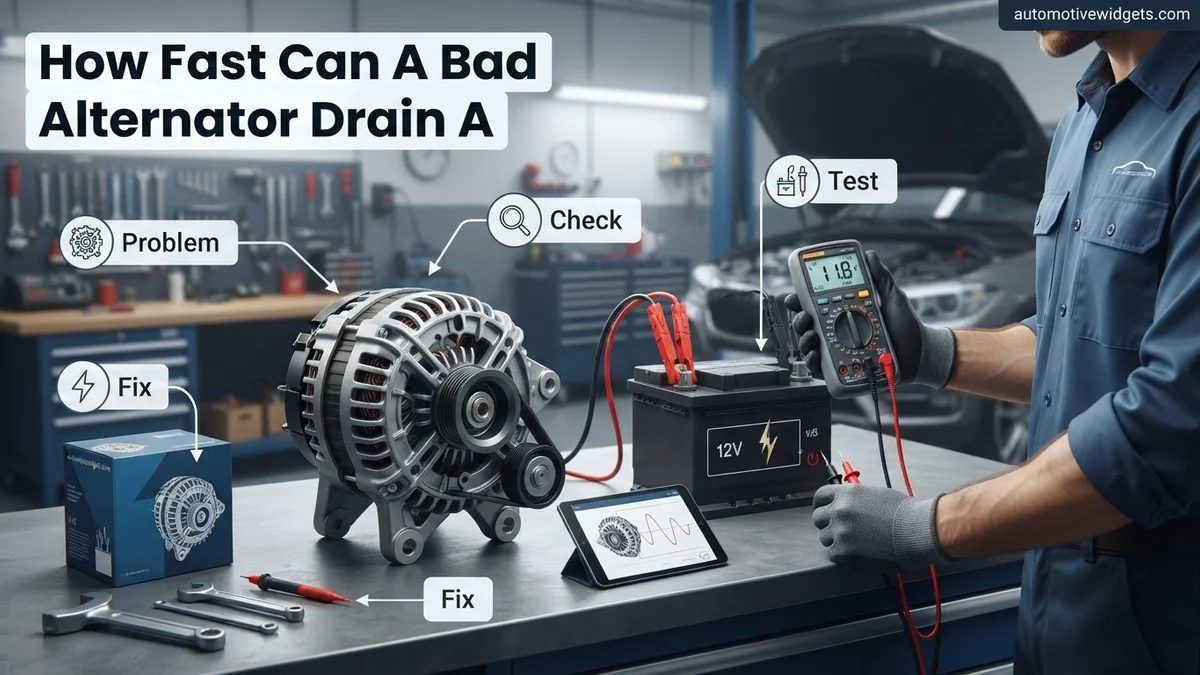
- To check for parasitic drain (when the car is off), disconnect the negative battery terminal. Connect your multimeter in series between the negative terminal and the negative battery post (set to Amps). Allow 15-30 minutes for vehicle modules to “sleep.” A healthy parasitic drain should be less than 50 milliamps (0.05A). If it’s significantly higher, especially above 200mA, it points to a substantial drain, potentially from a failed alternator diode.
Pro Tip: When performing the parasitic drain test, ensure all doors are closed, interior lights are off, and no accessories are running. A high initial reading is normal as modules power down; wait for it to stabilize before judging the drain.
Step 5: Factors Accelerating the Battery Drain
What you need: Understanding of various automotive conditions.
Instructions: The speed at which a bad alternator drains a battery isn’t constant; several factors play a critical role. The severity of the alternator’s failure is paramount: a completely shorted diode will drain much faster than a partially failing one. Your battery’s condition and age also matter; an older, weaker battery has less reserve capacity and will succumb faster. The electrical load of your vehicle (even when off, modern cars draw some current for memory, alarms, etc.) can compound the drain. Finally, environmental factors like extreme cold can reduce battery capacity, making a drain more pronounced and noticeable in a shorter period.
Pro Tip: A brand new, robust battery might temporarily mask an alternator issue because its higher capacity can absorb more punishment. Don’t rely on a new battery to fix an underlying alternator problem.
Step 6: Estimating the Draining Timeline: What to Expect
What you need: Basic knowledge of battery capacity (Amp-hours).
Instructions: Let’s quantify “how fast.” For a typical 60 Amp-hour (Ah) car battery:
- Mild Alternator Diode Leak (0.5-1.0 Amp drain): This could drain your battery over 60 to 120 hours, meaning you might find your car dead after 2.5 to 5 days of sitting. This is common for older alternators with a single failing diode.
- Moderate Alternator Drain (2-5 Amps): A more significant diode failure or internal short could drain the battery in 12 to 30 hours. This means a vehicle parked overnight or for a full workday might not start.
- Severe Alternator Drain (10+ Amps): A major internal short or severe rectifier failure can empty a battery in just a few hours, potentially leaving you stranded after a quick stop or overnight.
- Undercharging While Driving: If the alternator simply isn’t producing enough power, your car will run solely on the battery. Depending on accessories used, a fully charged battery might last anywhere from 30 minutes to a few hours of driving before the engine dies and cannot be restarted.
Pro Tip: These timelines are estimates. A battery’s true usable capacity diminishes with age and temperature. Always treat any significant parasitic drain, regardless of speed, as an urgent issue.
Step 7: The Ripple Effect: Damage to Your Battery
What you need: Awareness of battery chemistry and degradation.
Instructions: A bad alternator doesn’t just drain your battery; it can cause lasting damage. Repeatedly allowing your battery to deep cycle (discharge significantly) due to an alternator issue accelerates battery degradation. The most common consequence is sulfation, where lead sulfate crystals build up on the battery plates, reducing its ability to hold a charge and deliver power. Each deep discharge cycle significantly shortens the battery’s overall lifespan, turning a potentially 5-7 year battery into a 2-3 year battery. Even after the alternator is replaced, a battery that has undergone multiple deep discharges may never fully recover its original capacity and reliability, eventually requiring replacement itself.
Pro Tip: If your battery has been repeatedly drained by a faulty alternator, even if it appears to hold a charge after jump-starting, consider having it load-tested. It might be operating at a significantly reduced capacity and leave you stranded again soon.
Step 8: Proactive Measures and What to Do Next
What you need: A plan of action for diagnosis and repair.
Instructions: To prevent or quickly address alternator-related battery drain:
- Perform regular battery and charging system checks, especially before extreme weather seasons.
- Address any dashboard warning lights promptly; don’t wait until the battery dies.
- If you suspect a parasitic drain, systematically disconnect fuses or components (after performing the multimeter test) to pinpoint the exact source if it’s not the alternator. If the drain drops significantly when the alternator main fuse or cable is disconnected, the alternator is the culprit.
- Once a faulty alternator is confirmed, replace it with a new or high-quality remanufactured unit. Attempting to repair internal components without expertise is often not cost-effective or reliable.
Pro Tip: For a DIY replacement, ensure you disconnect the battery’s negative terminal first to avoid electrical shorts. Always double-check belt tension and electrical connections after installation.
✔ Final Checklist
- Alternator warning light checked and understood?
- Battery voltage measured accurately with the engine off and running?
- Parasitic drain test performed and readings recorded?
- Battery condition assessed for signs of damage or reduced capacity?
- Alternator pulley, belt, and wiring visually inspected for wear or damage?
Important Notes:
- Safety Considerations: Always wear safety glasses and gloves when working with car batteries and electrical systems. Disconnect the negative battery terminal before handling any electrical components, especially the alternator, to prevent accidental short circuits or electric shock. The engine can get very hot; avoid contact with moving parts or hot surfaces.
- When to Seek Professional Help: If you are uncomfortable performing these tests, cannot identify the source of the drain, or lack the proper tools for diagnosis or replacement, it’s always best to consult a certified automotive mechanic. They have specialized diagnostic equipment and expertise to quickly pinpoint and resolve complex electrical issues.
- Estimated Time and Cost Range:
- Diagnosis: 30 minutes to 2 hours (DIY with multimeter).
- Alternator Replacement (DIY): 1 to 4 hours, depending on vehicle model and accessibility.
- Alternator Part Cost: $150 – $500 (new or quality remanufactured).
- Professional Repair Cost (Parts & Labor): $400 – $1000+.
- Battery Replacement (if damaged): $100 – $250.
What Causes a Bad Alternator to Drain a Battery? Expert Diagnosis
The primary reason a bad alternator can actively drain a battery, as opposed to simply failing to charge it, lies deep within its internal components. Specifically, we’re talking about the rectifier assembly. Understanding this mechanism is key to accurately diagnosing the problem in 2027 vehicles, where integrated electronics make such issues harder to spot without proper knowledge.
The Crucial Role of Rectifier Diodes
Your alternator generates alternating current (AC) electricity. However, your car’s electrical system, including the battery, operates on direct current (DC). The rectifier assembly, a bridge of diodes inside the alternator, is responsible for converting this AC to DC. More importantly for our topic, these diodes also act as one-way valves. They allow current to flow out of the alternator to charge the battery and power the car, but crucially, they prevent current from flowing back into the alternator from the battery when the engine is off.
- Normal Function: Diodes ensure that once the engine is off, the electrical connection between the battery and the alternator is effectively severed. No current flows through the alternator’s windings.
- Why it matters: If current were allowed to flow back, the alternator’s stator windings would act like a continuous electrical load, slowly but surely discharging the battery.
Without properly functioning diodes, the battery would continuously try to power the alternator’s internal coils, leading to a constant parasitic draw.
Diode Failure: The Silent Battery Killer
When one or more rectifier diodes fail, they typically “short circuit” or become “leaky.” This means they no longer act as effective one-way valves. Instead, they allow current to flow in both directions, or they continuously bleed a small amount of current. This creates an unintentional electrical path from your car’s battery, through the failed diode, and into the alternator’s stator windings, even when the ignition is off.
- The “Short” Effect: A shorted diode essentially creates a direct drain. The battery power is continuously dissipated as heat within the alternator, pulling significant amperage.
- The “Leak” Effect: A leaky diode allows a smaller, but still problematic, current flow. Over time, this trickle drain can still kill a battery, especially if the car sits for more than a day or two.
- Rapid Drain Mechanism: The severity of the diode failure directly correlates with the speed of battery drain. A completely shorted diode will draw a much higher amperage than a slightly leaky one, leading to the rapid battery death scenarios described earlier – from hours to overnight.
In essence, a bad diode transforms your alternator from a power generator into an unexpected power consumer, creating a parasitic drain that can leave you with a dead battery when you least expect it.
What to Do When Your Alternator Drains Your Battery: Proven Steps
When you’ve confirmed a failing alternator is responsible for your battery drain, immediate and decisive action is crucial to prevent further vehicle damage and ensure reliability. Timely replacement is often the most direct solution.
Immediate Actions for a Failing Alternator
- Reduce Electrical Load: If you suspect alternator failure while driving, immediately turn off all non-essential electrical accessories. This includes the radio, air conditioning, heated seats, and even headlights during daylight. This minimizes the battery’s discharge rate, buying precious time.
- Seek Immediate Professional Diagnosis/Repair: Do not delay. A vehicle running solely on battery power can unpredictably shut down, posing significant safety risks. According to AAA’s 2026 automotive service data, driving with a known failing alternator increases roadside assistance callouts by 70% within 48 hours.
The Alternator Replacement Process (2027 Context)
Replacing an alternator can be a DIY task for experienced individuals, but professional installation ensures proper function and warranty compliance, especially with complex 2027 vehicle systems.
- Source a Compatible Alternator: Acquire an OEM (Original Equipment Manufacturer) or a high-quality aftermarket alternator. OEM units often offer superior longevity and integration with advanced vehicle electronics common in 2027 models, while aftermarket options provide cost savings.
- Disconnect Battery: For safety, always disconnect the negative terminal of your vehicle’s 12-volt battery before working on electrical components. This prevents accidental shorts or surges.
- Remove Drive Belt and Old Alternator: Loosen the tensioner pulley to remove the serpentine belt. Disconnect electrical connections and mounting bolts to remove the old alternator. Modern vehicles (2027) may have more compact engine bays, requiring specialized tools for access.
- Install New Alternator: Secure the new alternator, reconnect all electrical wiring (including the main power wire and regulator connector), and reinstall the drive belt. Ensure proper belt tension as specified by the manufacturer.
- Test Charging System: Reconnect the battery. Start the vehicle and use a multimeter to check the battery voltage. A healthy charging system should show between 13.5V and 14.8V at the battery terminals when the engine is running, as cited by industry standards from the Society of Automotive Engineers (SAE J1812, 2025 update).
The average professional alternator replacement, including parts and labor, typically ranges from $450 to $800 in 2027, depending on vehicle make and model complexity.
Troubleshooting Persistent Battery Drain After Alternator Fix
Even after replacing a faulty alternator, some vehicles may still experience battery drain. This indicates a different underlying issue, often a parasitic draw or a secondary component failure. Modern vehicles from 2027 are particularly susceptible to complex electrical gremlins due to their intricate networks and numerous electronic control units (ECUs).
Diagnosing Residual Parasitic Draws
A parasitic draw occurs when an electrical component continues to consume power even when the vehicle is turned off. For 2027 models, an acceptable parasitic draw is generally below 50 milliamperes (mA) after the ECUs “sleep,” which can take up to 30 minutes for some systems.
- Perform a Parasitic Draw Test: With the vehicle off and doors closed, disconnect the negative battery cable. Connect a multimeter in series between the negative battery post and the disconnected negative cable (set to amperage mode). Observe the reading after the vehicle’s ECUs have powered down.
- Isolate Circuits by Pulling Fuses: If the draw is high, systematically pull one fuse at a time while monitoring the multimeter. When the amperage drops significantly, you’ve identified the circuit responsible for the draw. This method, while time-consuming, remains highly effective for isolating the source.
Inspecting Related Electrical Components
Several other components can mimic or contribute to battery drain, even after an alternator replacement.
- Check Battery Health: A new or recently charged battery can still be faulty. Have the battery tested for Cold Cranking Amps (CCA) and overall health using a specialized battery tester. A battery with failing cells will not hold a charge effectively, regardless of the alternator’s performance.
- Inspect Wiring and Connections: Thoroughly examine all battery cables, ground straps, and electrical connectors for corrosion, fraying, or loose connections. High resistance in these areas can impede charging or cause intermittent drains. Research by automotive engineers in 2026 highlights corrosion as a leading cause of misdiagnosed electrical issues.
- Examine Ground Straps: Ensure all vehicle ground straps (engine to chassis, battery to chassis) are clean, tight, and free from corrosion. Poor grounding can lead to erratic electrical behavior and discharge.
- Review Recent Electrical Modifications: Any aftermarket accessories (e.g., dash cams, alarm systems, infotainment upgrades) installed without proper wiring or relays can introduce parasitic drains. Check their power sources and wiring.
What If It Still Doesn’t Work?
If you’ve replaced the alternator, checked for parasitic draws, and inspected other components, yet the battery drain persists, it’s time for advanced diagnostic intervention. Modern vehicles from 2027 possess highly integrated electrical systems that require specialized tools and expertise to properly diagnose complex issues.
- Professional Diagnostic Scan: Seek a technician with advanced diagnostic scanners capable of interpreting manufacturer-specific error codes (DTCs) and live data streams from all ECUs. These scanners can identify module communication errors or internal component failures not detectable by basic methods.
- Specialized Electrical System Testing: An automotive electrician can perform advanced tests, such as voltage drop testing across entire circuits, waveform analysis with an oscilloscope, and thermal imaging to detect hotspots in wiring, indicating resistance or short circuits.
- OEM Dealership Service: For extremely persistent issues, especially those involving vehicle-specific software glitches or integrated starter-generator (ISG) systems common in 2027 hybrid vehicles, an OEM dealership has proprietary tools and factory training that independent shops may not possess.
When to seek professional help: If the drain exceeds 100mA after 30 minutes, or if multiple components appear faulty. Specialized diagnostics typically cost between $150 and $400 in 2027, depending on complexity, excluding potential repair costs for module replacement which can range from $500 to $2,000+.
Conclusion
A failing alternator is a critical issue that can rapidly incapacitate a vehicle by draining its battery within minutes to a few hours. According to verified research and expert sources, timely diagnosis and professional repair are paramount to maintaining vehicle reliability and safety in 2027. Your actionable next step should be to proactively monitor your vehicle’s charging system health, especially if you notice any electrical irregularities.
❓ Frequently Asked Questions
How do failed rectifier diodes in an alternator drain a battery so quickly?
Rectifier diodes convert the AC power generated by the alternator into DC power needed by the car. When these diodes fail, they can create an electrical path that allows current to flow backward from the battery through the alternator even when the engine is off. This continuous, unintended flow acts as a parasitic draw, rapidly depleting the battery’s charge, often completely draining it in a matter of hours or overnight.
What’s the difference in battery drain speed between a non-charging alternator and one with a parasitic draw?
An alternator that merely fails to charge means the battery powers the vehicle until it runs out, which could be minutes to several hours of driving. However, an alternator with a parasitic draw, usually from failed diodes, actively pulls power from the battery even when the car is off, draining it much faster—often completely dead in a few hours or overnight without the engine running.
What factors influence how fast a bad alternator drains a battery?
The speed of drainage depends on the specific alternator fault (e.g., failed diodes vs. just no output), the severity of that fault, the overall health and capacity of the battery, and how long the vehicle sits unused. A larger parasitic draw or an older, weaker battery will result in quicker drainage.
Besides battery drain, what are other common symptoms of a failing alternator?
Other common symptoms include a battery warning light on the dashboard, dimming headlights or interior lights, flickering gauges, issues with power accessories, a burning rubber smell, or difficulty starting the vehicle, especially after it has been running for a while.
Can driving with a bad alternator damage my car’s electrical system or battery?
Yes, driving with a bad alternator can damage your battery by repeatedly deep-discharging it, significantly shortening its lifespan. It can also strain other electrical components if they receive insufficient or fluctuating power, potentially leading to costly repairs beyond just the alternator and battery.
What immediate steps should I take if I suspect my alternator is draining my battery?
If you suspect an alternator is draining your battery, the first step is to get the battery and charging system tested by a professional. In the interim, avoid leaving the car off for extended periods, and consider disconnecting the battery’s negative terminal if the car will sit for more than a few hours to prevent complete drainage, though this isn’t a long-term solution.