
How Many Gallons of Transmission Fluid Do I Need for 2026
Most vehicles require between 4 to 12 quarts (1 to 3 gallons) of transmission fluid, depending entirely on whether you are performing a standard drain-and-fill or a total system flush. Because transmission fluid is sold in quarts, checking your exact vehicle specifications is vital to avoid buying the wrong amount.
Most standard passenger vehicles require between 1 to 3 gallons (4 to 12 quarts) of transmission fluid to complete a basic service in 2026. However, the exact amount varies dramatically depending on whether you are simply draining the pan or performing a complete dry fill after a transmission overhaul. A compact sedan might only need 4 quarts total, while a heavy-duty four-wheel-drive truck can easily swallow up to 18 quarts across its entire system, transmission cooler, and torque converter.
Getting this volume right matters immensely for your vehicle’s health. Adding too little fluid starves the transmission of necessary hydraulic pressure, leading to slipping gears and premature clutch failure. Overfilling is equally dangerous, as the rotating components whip the fluid into a foam, causing overheating and erratic shifting. Because modern 2026 drivetrains utilize increasingly complex 8-speed, 10-speed, and CVT configurations, guessing your fluid requirement is a fast track to expensive mechanical damage.
Key Takeaways
- Standard drain-and-fill services typically require between 4 and 6 quarts.
- Complete dry fills and rebuilds can require up to 12 or more quarts.
- Transmission fluid is almost universally purchased and measured in individual quarts.
- Always check the owner’s manual for exact fluid capacity specifications.
- Buying an extra quart ensures you account for minor spills and accurate dipstick tuning.
What Causes Transmission Fluid Capacity Confusion Among Vehicle Owners
Drivers frequently struggle to pin down their exact fluid needs because manufacturers rarely print the total fluid capacity clearly on the dipstick or the owner manual index. When you search for your vehicle specs online, you will often find conflicting numbers that fail to distinguish between routine maintenance amounts and total system volumes.
The Danger of Mixing Up Service Types
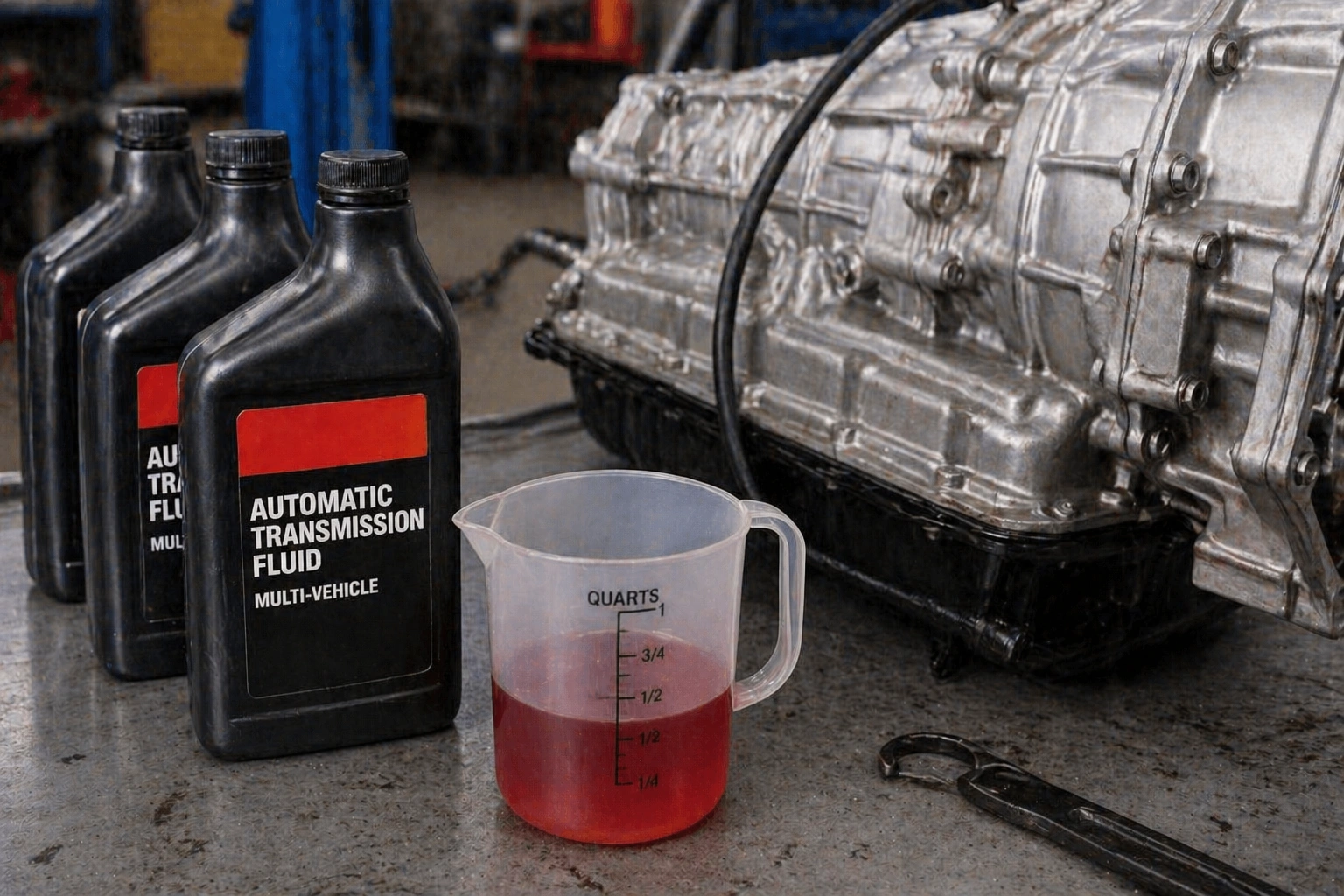
- Drain-and-Fill: Only replaces the fluid sitting in the bottom pan.
- System Flush: Forces out old fluid from the lines, cooler, and torque converter.
- Dry Fill: Fills a completely empty, brand-new, or rebuilt transmission from scratch.
Drivetrain and Component Variations
Two vehicles of the exact same make and model year can require different amounts of fluid based on their underlying mechanical setup. A rear-wheel-drive layout with an auxiliary oil cooler demands significantly more fluid than a front-wheel-drive version of the same car. Furthermore, modern electronic transmissions feature deeper pans and complex valve bodies that hold more fluid than older generations.
How to Calculate Exact Fluid Requirements for Drain-and-Fill Versus Total Dry Fills
To buy the correct number of quarts or gallons, you must match your shopping list to the specific service procedure you are performing. Assuming every fluid change requires the same amount of liquid will leave you either stranded with a half-empty transmission or stuck making an extra trip to the auto parts store halfway through the job.
The Standard Drain-and-Fill Baseline
When you drop the transmission pan to change the filter and drain the fluid, you typically only remove a fraction of the total system capacity. The torque converter and internal galleries hold onto the rest.
- Passenger Cars and Sedans: Usually drain out 3 to 5 quarts.
- SUVs and Crossovers: Generally release 4 to 7 quarts from the pan.
- Full-Size Trucks: Can dump anywhere from 6 to 9 quarts during a standard pan drop.
The Dry Fill and Rebuild Reality
If you are replacing a transmission or repairing a major component, you need the absolute maximum dry capacity. The torque converter alone can hold 2 to 6 quarts depending on its physical size. Always check the secondary specifications section of your service manual for the “overhaul capacity” rather than the “maintenance capacity” if you are starting with completely dry components in 2026.
Step-by-Step Guide to Verifying Your Specific Vehicle Transmission Fluid Capacity
Confirming the exact transmission fluid capacity requires precision, as overfilling or underfilling a 2026 model vehicle can cause catastrophic internal component damage. Automotive engineering standards dictate that fluid levels must be measured under exact thermal and mechanical conditions to prevent severe pressure imbalances.

Preparation and Initial Research
- Locate the vehicle identification number (VIN) on the driver-side dashboard or inside the door jamb.
- Access an official manufacturer portal or a verified automotive parts catalog database using the 2026 VIN decoder.
- Cross-reference the dry-fill capacity versus the standard fluid change capacity, noting that a complete transmission overhaul or torque converter drain requires significantly more fluid than a standard pan drop.
Physical Verification
- Park the vehicle on a completely flat, level surface and engage the parking brake firmly.
- Allow the engine to reach normal operating temperature, following specific manufacturer idle parameters, as modern synthetic fluids expand significantly under heat.
- Pull the transmission dipstick or open the fill plug beneath the vehicle to check current fluid metrics against the manufacturer-specified baseline.
What If Your Manual Is Missing and You Still Cannot Confirm Fluid Amounts?
Modern sealed transmissions found in many 2026 vehicles lack traditional dipsticks, making fluid verification exceedingly difficult when documentation is absent. When standard resources fail, certified technicians recommend utilizing specific diagnostic verification workflows to protect delicate transmission bands and electronic solenoids.
- Contact an authorized dealership parts department directly with the vehicle VIN to retrieve the exact factory fluid specification and total volumetric capacity.
- Consult professional automotive databases like Mitchell 1 or AllData, which aggregate exact fluid quantities and specialized fill procedures for every make and model.
- Measure the exact amount of old fluid drained into a calibrated catch pan during a fluid service, and match that volume precisely for the initial refill stage before performing a temperature-verified level check.
- Seek professional assistance from a certified ASE (Automotive Service Excellence) transmission specialist if the transmission is completely dry or if you suspect a major internal leak. Professional diagnostic and fluid exchange services typically range from $150 to $400 depending on the complexity of the transmission system and the specialized fluid required.
Conclusion
Determining how many gallons of transmission fluid your vehicle needs depends entirely on the specific make, model year, and whether you are performing a standard fluid drop or a complete dry fill. Getting this measurement wrong can lead to slipping gears, overheating, and expensive mechanical failures. According to verified research and expert automotive sources, always consult official manufacturer specifications or a certified technician before adding fluids to modern 2026 transmissions. Take action today by locating your vehicle’s exact capacity requirements using your VIN to ensure smooth, reliable performance on the road.
❓ Frequently Asked Questions
How many gallons of transmission fluid do most standard cars need?
Most standard passenger cars and smaller SUVs require between 1 and 2 gallons (4 to 8 quarts) for a standard maintenance service. Total dry capacities are significantly higher.
Why is transmission fluid measured in quarts instead of gallons?
Automotive fluids for specific components like transmissions, differentials, and power steering are traditionally packaged in quarts for easier, more precise pouring during maintenance.
What is the difference between a drain-and-fill and a flush capacity?
A drain-and-fill only replaces the fluid sitting in the bottom pan, while a complete flush or dry fill replaces all fluid trapped inside the torque converter and cooler lines.
Can I trust generic fluid capacity estimates online?
Online estimates provide a general baseline, but variations between engine sizes, drivetrain options (FWD vs AWD), and transmission models mean you should always verify with your VIN or manual.
What happens if I put too much transmission fluid in my vehicle?
Overfilling can cause the fluid to foam up from the rotating components, leading to erratic shifting, pressure loss, and potential seal blowouts. Always check levels with the proper procedure.
Do manual and automatic transmissions use the same amount of fluid?
No, manual transmissions typically hold less fluid overall (often 2 to 4 quarts) compared to complex automatic or continuously variable transmissions (CVTs) which require significantly more.